
"AI Bottleneck Trade" Ignites Upstream Sector—Who’s Raking in the Profits?

Individual US Stocks | AMD and Micron Technology surge sharply in a single day—warrants are most prone to the scenario of 'correct on the underlying stock, but wrong on the terms'
Among the 12 US stocks with Hong Kong-listed warrants this time, AMD and Micron Technology stood out the most: AMD surged 8.11% in a single day, while Micron jumped even higher by 12.17%. Apple, NVIDIA, Broadcom, and Tesla also posted gains; Google, Microsoft, Amazon, Meta, and Palantir declined.
However, the key difference between individual stock warrants and index products is that market choices are highly concentrated. Most individual stocks have only one call or one put warrant available—not allowing investors to freely select terms from over a dozen products—but instead requiring them to first assess:
Whether the only available warrant terms truly align with their trading direction and time horizon.
Individual Stock Product Overview

AMD$Advanced Micro Devices (AMD.US)$ : Underlying stock breaks out, but the sole available call warrant isn’t cheap
AMD closed at USD 544.43, surging 8.11% in a single day, reclaiming the Bollinger Bands middle band at USD 530.97, with RSI rebounding to approximately 59. Immediate resistance lies at the recent high of USD 584.73, with support around USD 520–500.
Technical momentum has indeed strengthened, but there is only one AMD call warrant available in the market:
– Strike price: USD 700
– Expiry: End of December 2026
– Effective leverage: Approximately 3.3x
– Delta: Approximately 41%
– Implied Volatility: Approximately 82.8%
– Premium: Approximately 46.4%
The contradiction in these terms is very clear: the expiry is not particularly short, and the delta isn’t extremely low, yet the strike price is about 29% above the current spot price. Combined with implied volatility exceeding 80%, this results in a premium close to 46%.
Therefore, this product is not a straightforward tool for capturing a short-term move in AMD from USD 544 to USD 560. Even if the underlying stock continues to rise, the warrant’s upside may still be constrained by high volatility costs and relatively low gearing.
For those already bullish on AMD, this product is better suited for scenarios where a significant upward move in the underlying stock is anticipated. If you're merely speculating on a one- or two-day continuation of the rebound, it may not deliver the explosive performance you imagine—especially since a pullback in implied volatility from elevated levels following a sharp rally in the underlying could offset some of the gains from the stock’s upward movement.
For AMD, the most critical issue right now isn't direction—it's that the market only offers this single warrant structure, leaving investors without alternative choices that are closer to the money or with lower volatility.
Micron Technology $Micron Technology (MU.US)$ : Share price rose 12%, but the warrant's implied volatility has already exceeded 100%.
Micron Technology closed at $970.82, up 12.17% in a single day, rebounding sharply from its recent low around $800. However, the current price remains below the Bollinger Band midline at $997.90. In the near term, watch whether it can firmly reclaim the $1,000 level; above that lies the resistance zone between $1,100 and $1,200.
Micron Technology’s warrant terms are the group requiring the most caution this time.
Differences between two call warrants
One has a strike price of $700, already in-the-money, with a delta of approximately 78%; the other has a strike price of $1,800, clearly out-of-the-money, with a delta of about 25%. Both have implied volatilities near or above 100%.
Although both products express bullish sentiment on Micron Technology, their actual uses are entirely different:

The call warrant with a $700 strike price, while offering lower leverage, has a higher delta and thus tracks the underlying stock more stably. For investors who expect Micron’s rebound to continue but prefer a product that doesn’t deviate significantly from the stock’s movement, this warrant structure is clearly more practical.
The issue with the $1,800 strike price warrant is straightforward: its strike is over 80% above the current share price, with a premium exceeding 100%. Although its nominal price may appear lower, this does not mean it’s cheap. Even if the stock rises from $970 to $1,100, it would still be far from the strike price, meaning time decay and volatility changes will dominate the warrant’s price.
The put warrant on Micron has a strike price of $400, with a delta of only about 6% and an implied volatility approaching 113%. With such terms, even if the underlying stock pulls back, the warrant’s price response may be underwhelming unless there’s a very sharp and substantial decline.
Therefore, Micron Technology is not 'the best candidate for buying call warrants simply because it has risen the most'; on the contrary, the higher the underlying stock's volatility, the more expensive the warrant’s implied volatility typically becomes.Among this set of Micron Technology warrants, the in-the-money calls clearly have better terms compared to deep out-of-the-money calls and puts.
Apple $Apple (AAPL.US)$ : With the underlying stock near its recent high, the call warrants are actually the more favorable group.
Apple closed at $327.74, with a recent high of $334.99. The stock remains in a clear uptrend. Its current price is above the Bollinger Bands middle band of $308.48, and the RSI is around 65—indicating strong short-term momentum but approaching overbought territory.
Apple call warrant with a strike price of $300:
– Already in-the-money
– Effective leverage is approximately 6.2x
– Delta approximately 71.7%
– Implied volatility approximately 38.3%
– Premium approximately 3.8%
– Expiry in early October 2026
Compared to AMD and Micron Technology, Apple’s call warrant has a significantly healthier structure. Its strike price is below the current share price, delta exceeds 70%, and its premium is less than 4%, meaning the product more directly reflects movements in the underlying stock.
Its main risk isn’t that the terms are too far out-of-the-money, but rather that Apple’s share price has already risen close to its recent high. If the underlying stock trades sideways around $335, the warrant price will still be eroded by approximately 0.5% per day due to time decay. Therefore, it’s better suited for investors expecting Apple to break above $335 in the short term, rather than those waiting for a breakout over an extended period.
Apple’s put warrant is entirely different: with a strike price of $248—about 24% below the current share price—its delta is only around 6%, and it suffers daily time decay of over 4%. If one merely expects Apple to pull back from $328 to $315, this put warrant may lack sufficient sensitivity.
In other words, the Apple market currently offers both call and put warrants, but their terms are asymmetric.The call warrant holds practical deployment value, whereas the put warrant requires a substantial decline in the underlying stock to perform effectively.
NVIDIA $NVIDIA (NVDA.US)$ Bullish warrants require a breakout, while bearish warrants offer two strike price distances to choose from
NVIDIA closed at $207.29, rebounding to trade above the Bollinger Bands’ middle band at $201.69, with an RSI of approximately 55. Near-term resistance lies between $213 and $215, with the prior high range above that; initial support levels are at $200 and $190.
The only available call warrant has a strike price of $275, which is about 33% above the current share price:
– Effective gearing of approximately 6x
– Delta of approximately 25%
– Implied volatility approximately 49%
– Premium approximately 38.6%
– Expiry at the end of December 2026
This product has a reasonably long time to expiry, but both its strike price and premium are relatively high. If NVIDIA only rises from $207 to $215, the warrant price will react, but may not fully realize its nominal 6x leverage. For the product’s sensitivity to improve noticeably, the underlying stock needs to first break above its recent trading range.
On the bearish side, there are two put warrants with strike prices around $168 and $130, respectively. The $168-strike product has a delta of approximately 21%, making it more suitable for capturing moderate pullbacks; the $130-strike product has a delta below 8%, requiring a deeper decline in NVIDIA’s share price to show a noticeable response.
Therefore, when bearish on NVIDIA, one should not merely compare which product has a lower price.The $168-strike product exhibits significantly higher underlying stock sensitivity than the $130-strike product.
Tesla$Tesla (TSLA.US)$ The rebound has not reversed the downtrend; call warrants require the stock price to first reclaim the $400 level
Tesla closed at $378.93, up 2.53% for the day, yet still below the Bollinger Bands’ midline of $395; the RSI is around 38, indicating a short-term bounce from oversold territory, but the overall trend has not yet fully strengthened.
The only call warrant has a strike price of $490:
– Approximately 29% above the current price
– Effective leverage of approximately 8.4x
– Delta of approximately 17%
– Implied volatility of approximately 54%
– Premium of approximately 33.3%
– Daily time decay of approximately 2.9%
An 8.4x leverage may look attractive, but a delta of 17% indicates the product remains out-of-the-money. For short-term Tesla positioning, it’s more important to monitor whether the underlying stock can first reclaim the $395–$400 range than to focus solely on leverage.
If Tesla merely oscillates within the $370–$390 range, the time decay on the call warrant will be quite significant; only a renewed breakout above $400 would gradually enhance the product's sensitivity.
Two Tesla put warrants have strike prices around $330 and $340, both with effective leverage of approximately 3.5x, deltas of roughly 28%–31%, and December expiries. Although this pair offers lower leverage, they are closer to the current stock price compared to the call warrants and are thus better suited for those expecting Tesla to break below recent lows.
How should one select individual stock-linked products?
This time, the stock-specific warrant market has a very clear characteristic:There are few products available, yet their terms vary significantly.
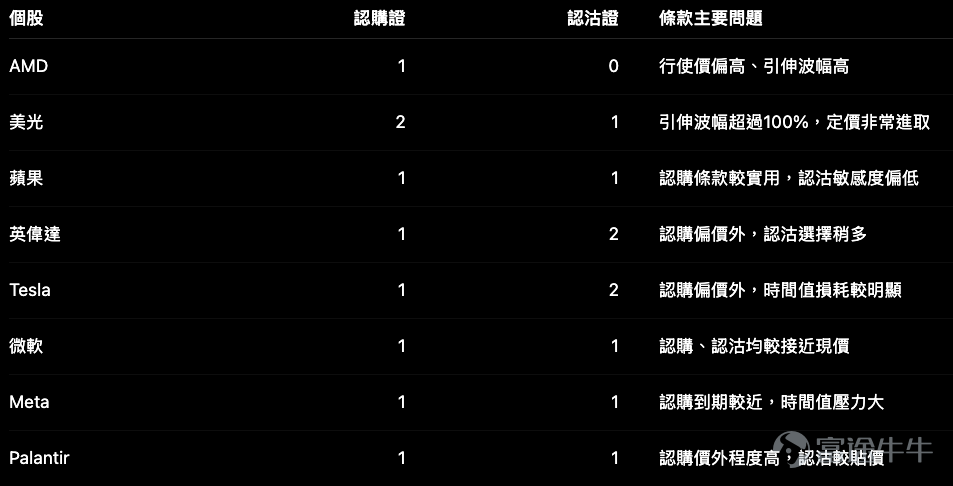
We will categorize several focus stocks as follows:

A common misconception regarding US-listed equity warrants traded in Hong Kong is assuming that if the underlying stock surges sharply in a single day, call warrants must deliver higher returns. However, a sharp rise in the underlying stock often means implied volatility has already been pushed higher; if the warrant is also deeply out-of-the-money, returns may still fall short of expectations—even if the directional view is correct.
The most typical examples this time are AMD and Micron Technology: their underlying stocks showed the most attractive price action, yet their warrant terms were not the easiest to work with. In contrast, Apple’s stock rose only 0.35% in a single day, but its call warrants offered a more favorable combination of moneyness, delta, and premium—making them among the most well-structured products in the entire batch.
Therefore, selecting US equity warrants isn’t just about asking which underlying stock is strongest—it’s about asking whether the available warrants can truly and effectively capture that move.
Risk Disclaimer: The above content only represents the author's view. It does not represent any position or investment advice of Futu. Futu makes no representation or warranty.Read more
Comments
to post a comment