
Apple and Amazon reported starkly contrasting earnings— which one are you bullish on?

US Equity Indices | The Nasdaq shows a stronger rebound, but choosing bull certificates shouldn't focus solely on the highest leverage
On July 21, all three major US equity indices rose in tandem: the Dow Jones closed at 52,224 points, up 0.74%; the S&P 500 closed at 7,509 points, up 0.89%; and the Nasdaq-100 posted the strongest gain, closing at 29,155 points, up 1.93%.
We believe everyone has their own outlook on the market ahead. This time, we won’t spend too much space forecasting index movements; instead, we’ll focus on:When both warrants and bull/bear certificates are available in the market, how should investors evaluate the terms for these three indices?
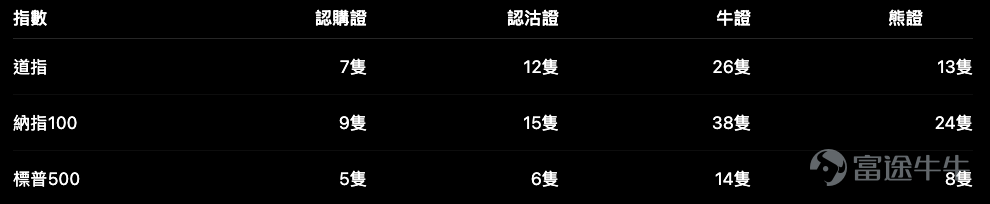
Product Availability Across the Three Indices

Among the three markets,the Nasdaq-100 offers the most comprehensive product selection, especially with 38 bull certificates available—ranging from high-leverage products close to the current price to defensive structures with knock-out levels more than 20% away.
The advantage of such a wide range of products isn't just about 'having more choices,' but rather enabling investors to match their positions more precisely to their intended holding period and risk tolerance.
Nasdaq-100 $NASDAQ 100 Index (.NDX.US)$ : The index rebounded, but the 29,400 level remains the first resistance.
The Nasdaq-100 rebounded near the 28,400 level and rose back to 29,155 points. However, the current price remains below the middle Bollinger Band at approximately 29,386 points. The short-term RSI is around 49, indicating a move from relatively weak back to neutral territory—still not yet showing clear signs of renewed strength.
For those already bullish on a short-term Nasdaq rebound, bull certificates currently available in the market can generally be grouped into three categories:

Currently, the closest-to-the-money Nasdaq bull certificates have a knock-in buffer of about 3.96% and offer maximum leverage of approximately 21.1x. While this sensitivity appears attractive on the surface, recent single-day swings of several hundred points in the Nasdaq are not uncommon; based on a spot level of 29,155, a 4% buffer translates to only around 1,160 points.
In other words, if the index tests its recent lows again, the risk of early termination for these at-the-money bull certificates would rise sharply.
We tend to prefera knock-in buffer of roughly 7%–10%as a more balanced short-term option: although the leverage is lower than that of the tightest-strike products, it still offers around 10x and provides better resilience against sudden weakness in futures during Hong Kong trading hours. Notably, Hong Kong-listed products trade before the U.S. cash market opens, so a sharp intraday drop in index futures could already be enough to trigger an early termination.
For those bearish on the Nasdaq, the nearest call knock-in levels of bear warrants are actually not as close as those of bull warrants, with initial distances starting around 6.3% and maximum leverage of approximately 18x. For investors who believe the resistance zone between 29,400 and 30,000 points remains valid, these terms offer a certain degree of sensitivity. However, note that knock-in prices for bear warrants are generally set at or above 31,200 points—only if the index genuinely breaks upward will knock-in risk significantly increase.
Watch out for Nasdaq derivative warrants: put warrants carry higher volatility costs.
Nasdaq call warrants have implied volatilities of roughly 24%–35% and effective leverage of about 8.7x–13.8x; put warrants show implied volatilities of approximately 28%–45%, reflecting notably higher overall pricing.
This means that even if your bearish view is correct, if the decline is insufficient or occurs later than expected, put warrants may not fully deliver the anticipated return. If you're purely targeting a sharp short-term drop, bear warrant terms are more direct; however, if you're concerned about sudden rebounds and wish to avoid mandatory knock-in risk, consider using put warrants for greater position tolerance.
Dow Jones Industrial Average $Dow Jones Industrial Average (.DJI.US)$ : The trend remains intact, but pressure is beginning to form near the 52,300 level.
After rebounding from 45,057 points, the Dow has maintained its uptrend, recently reaching a high of 53,289 points. Currently trading at 52,224 points—slightly below the Bollinger Band midline of 52,345—and with the RSI retreating to around 46, short-term momentum appears to be cooling off, though the broader uptrend remains unbroken.
There are currently 26 outstanding bull warrants on the Dow, with the nearest knock-out distance at approximately 4.26% and maximum leverage of 18x; the next tier has a knock-out distance of around 6% and leverage of about 13x.
If you're merely betting on the index reclaiming the 52,500–53,000 range, bull warrants with knock-out levels near 4% will indeed react more quickly. However, the index is now consolidating at relatively high levels rather than just starting to rise from a low base. Using near-the-money bull warrants in this situation presents a key issue:
The potential upside is beginning to narrow, yet knock-out risk hasn’t decreased accordingly.
Therefore, if you remain bullish on the Dow but expect only gradual upside, it may not be necessary to chase 18x leverage. Products with knock-out distances of roughly 6%–8% and leverage of about 10x–13x better align with the current consolidation phase.
The nearest call knock-out level for Dow Jones bear warrants is approximately 3.4% away, with leverage as high as 32.6x. This group is highly sensitive to any index pullback but can also easily enter the knock-out zone if the Dow rebounds by several hundred points in a single day. If your view is merely that the 53,000 level presents resistance—rather than expecting a sharp decline—bear warrants with more distant knock-out levels would be far more reasonable.
Dow Jones put warrants may not be a cheap bearish instrument
The implied volatility of Dow Jones put warrants ranges from roughly 24% to 34%, significantly higher than the 15%–18% seen in call warrants; daily time decay can exceed 6%.
Therefore, Dow Jones put warrants are better suited for short-term trades where you have a clear view on the timing of a market decline. If the index merely consolidates sideways around the 52,000 level—even if it eventually moves lower—the erosion from time decay and declining implied volatility could still eat into returns.
S&P 500 $S&P 500 Index (.SPX.US)$ : Exhibits the most stable price action, yet product terms require caution against being excessively near-the-money
The S&P 500 closed at 7,509, still above the Bollinger Bands midline at 7,478, with an RSI of around 52—making it the technically most stable among the three indices. The recent high of 7,621 serves as the key near-term resistance, with initial support seen between 7,400 and 7,340.
There are 14 S&P 500 bull warrants available, with the nearest knock-out distance around 4.1% and leverage of approximately 17x; more distant products can have knock-out levels over 20% away.
Given that the S&P 500 typically exhibits smaller daily swings than the Nasdaq, a 4%–6% knock-out distance may appear relatively safe. However, with the index currently not far from its all-time high, the actual upside potential beyond 7,620 may only be about 1%–2%. In this scenario, using a 17x leveraged bull warrant to chase gains may offer a less attractive risk-reward profile compared to mid-distance products.
For a bullish but gradual upward outlook, consider bull warrants with knock-out distances of roughly 6%–10% and leverage of about 8x–14x. Only if you anticipate an imminent breakout above recent highs would near-the-money products better capture their sensitivity.
The nearest knock-out distance for S&P 500 bear warrants is only about 2.5%, with maximum leverage reaching 33.7x—making this the most aggressive group among the three indices. Such products are not suitable for simply 'calling a top,' as the index needs to rise by less than 200 points to approach the knock-out zone.
How do the three indices align with different products?
We interpret the current terms as follows:
– Bullish on a Nasdaq rebound: Medium-distance callable bull certificates (CBBCs) offer better balance; at-the-money CBBCs are suitable only for very short-term trades.
– Bullish on the Dow continuing its upward trend: Avoid chasing the highest leverage only; a 6%–8% knock-out buffer is better able to withstand consolidation at elevated levels.
– Bullish on a gradual rise in the S&P: Medium-leverage products are better suited than at-the-money CBBCs given the currently limited breakout potential.
– Bearish on all three major indices: Bear certificates suit clear short-term downside views; put warrants lack a knock-out mechanism but incur higher implied volatility and time decay costs.
Getting the direction of the index right is only the first step. Especially when trading U.S. equity index products during Hong Kong market hours,distance to breakeven, implied volatility, and holding period are often more important than maximum leverage.
Risk Disclaimer: The above content only represents the author's view. It does not represent any position or investment advice of Futu. Futu makes no representation or warranty.Read more

Comments
to post a comment
1