
Eternal Fragments of Money: Third-Party Payments Lack First Principles
Author: Zuo Ye Web3
The wind howls as the storm approaches—Stripe is once again attempting to acquire PayPal. The tides have turned; last time, it was three decades ago when Peter Thiel’s PayPal merged with Elon Musk’s original X.com.
I don't understand—why is everyone talking about PayPal's slowing growth as if this FinTech sector spells doom for us. Twenty years ago, Peter Thiel launched his first venture from payments, and the PayPal Mafia was born. Wherever Elon Musk went, he was met with enthusiastic public support—it truly felt like the perfect moment in history, a vibrant era of boundless opportunity that still lingers vividly in our minds. Could it really be that, just two decades later, payments have become our graveyard?
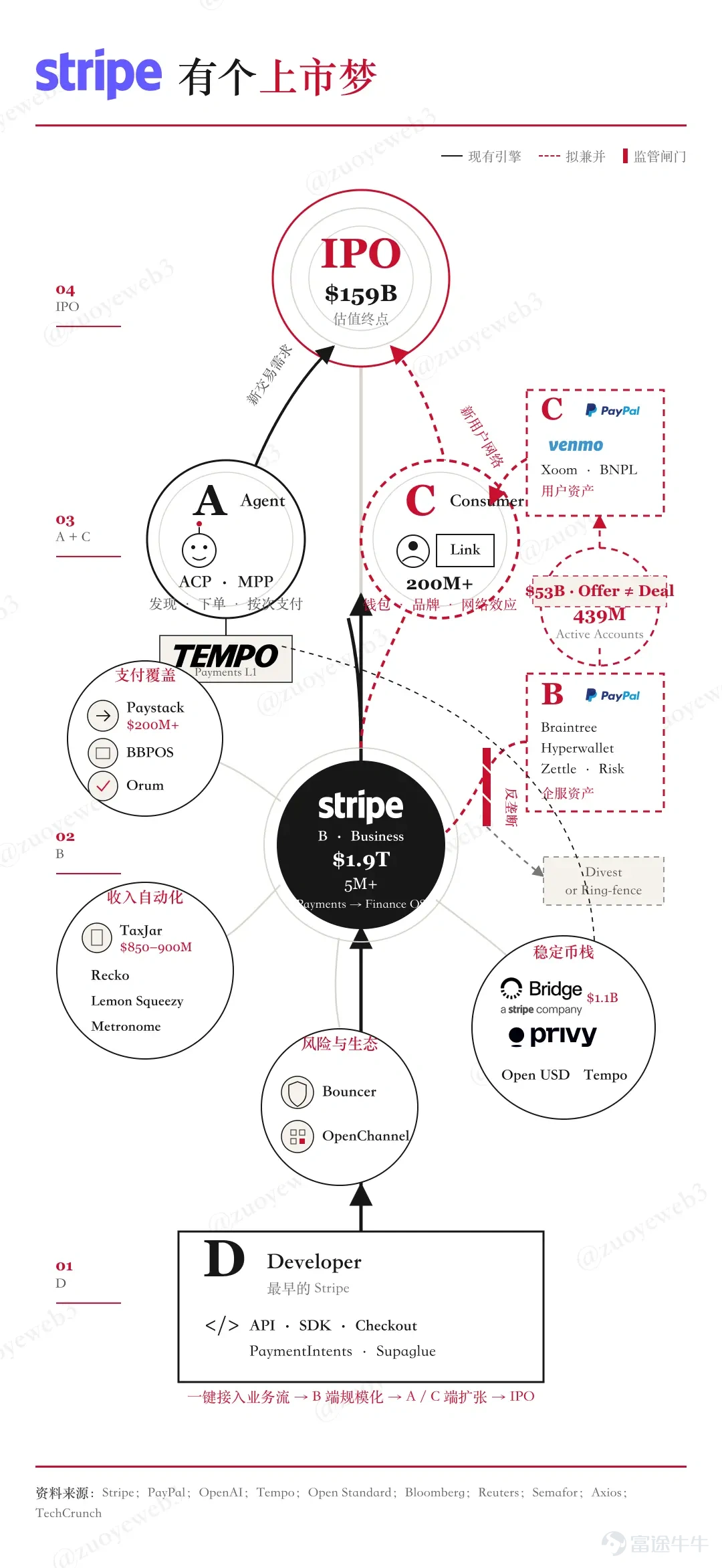
All of Stripe’s efforts have been directed toward an elusive IPO dream. During the pandemic, amid massive monetary stimulus, Stripe first reached a $100 billion valuation.
but failed to follow through promptly with an IPO like Coinbase and others, causing its valuation to plummet repeatedly. Mistaking historical tailwinds for personal achievement, Stripe has now embarked on a path of acquisitions after deep reflection.
Stripe started with a developer-friendly model—its one-click API integration proved irresistible to developers. This approach is unique in the payments industry: rather than fixating on fees or use cases, Stripe targeted the actual people building the products behind the scenes.
Stripe hopes to repeatedly leverage its past experience—entering the acquiring system from the B2B side, stablecoins from the consumer side, and even laying groundwork on the agent side with ACP/MPP protocols, aiming to reshape the entire payments industry.

Caption: Stripe’s rocky road to IPO
Image source: @zuoyeweb3
The payments industry has always been characterized by two traits that also hinder Stripe’s continued progress:
The payments industry is highly fragmentedThe landscape remains unchanged—companies can carve out a niche within a single country, a specific sector, or even just a few firms, allowing them to persist without being directly eliminated by external forces;
Payments are an appendage of banking, and both developers and B2B/B2C enterprises ultimately serve as external extensions of bank processes, with stablecoins eventually being brought into the banking fold.
In particular, its series of stablecoin-related acquisitions—from Bridge’s issuance infrastructure to Privy’s wallet entry point, and even Tempo and OpenUSD—seem unlikely to replicate Stripe’s past glory.
The current proposal to acquire PayPal is in fact a阶段性 outcome of Stripe’s failed attempt to use stablecoins to break into the consumer (C-end) market, now seeking to complement its own weaknesses with PayPal’s established C-end business.
PayPal’s problem isn’t that it’s failing to keep up with the times—neither Venmo nor PYUSD has reversed PayPal’s downward trajectory.
In other words, PayPal is simply too old; the company’s structural dysfunction has reached a point where launching new businesses alone cannot bring it back from the brink.
Stripe, which started slightly later, still hopes to add more narrative possibilities for itself before its IPO.
If Stripe wrapped backend infrastructure to dominate the developer market, then the stablecoin market—wrapped around frontend issuance networks—has likely already concluded its story. Tempo and OpenUSD may pressure Circle's stock price, but they won’t budge Tether at all.
If Stripe’s ceiling is merely Coinbase or Circle, then its IPO is destined for a post-listing slump. Compared with Adyen’s market cap and Airwallex’s valuation, Stripe’s stablecoin narrative combined with its Agent narrative does hold some merit.
Stablecoins are not yet part of today’s mainstream payment systems—but they represent a visible trend.
Agents still need to find an entry point into the existing financial system.
On the surface of recent news, Agents are already aggressively buying computing power and tokens using stablecoins—but beyond concerns about artificial volume inflation, Agents have yet to enter actual Web3 businesses, let alone more conservative institutions like corporations or banking systems.

Image caption: Agents are currently primarily used for inflating transaction volumes.
Image source: @BarkerMoneyX
With endpoints spanning the future (A-end), business (B-end), consumer (C-end), and origins (D-end), Stripe’s valuation will likely struggle to exceed the reasonable fintech ceiling of $50 billion; the $100 billion figure embeds far too much speculative optimism.
If it can’t briefly leap into the future,then scaling up its operations and ecosystem is the only lever Stripe can realistically pull., you can think of Stripe as a kind of options product.
Agents will use the OUSD stablecoin, operating on Tempo; Stripe should reach Visa's scale;
Agents will use stablecoins, but if OUSD fails and Tempo captures part of the market, Stripe should command a $100 billion valuation plus Tempo’s public blockchain valuation;
The agent economy may struggle to materialize, and agentic payments could be overshadowed by newer concepts, but at the very least, Stripe would still retain its core business.
While the investment loss is certainly a misstep, missing out would lead to lifelong regret. Starting from the dilemma Stripe poses to the primary market, it’s worth further reflection on how the entire payments industry might evolve.
The agent-driven future is visibly within reach—provided one survives long enough to see it.
Standing at mid-2026 marks a delicate inflection point—the final window for passage of the Clarity Act—and stablecoin yields could be decisively settled once and for all.
Meanwhile, the long-term outlook for the agent economy currently centers on models replacing white-collar and blue-collar workers, as well as emerging hardware domains such as new wearable devices and AIOS-powered smartphones.
The transformation of payments by agents has not yet triggered widespread societal attention, giving reasonable grounds to view this as a latent opportunity for stablecoins—a beta opportunity delivered by the era itself.

Image caption: The perpetually moving payments industry
Image source: @zuoyeweb3
However, the operational model historically built by the payments industry around 'licenses plus localization' may face ongoing disruption from clearing networks.
Stablecoins still require on-ramps such as fiat deposits at the front end, and off-ramps like on-chain transfers and settlement into spendable funds—this is precisely where banks derive their regulatory confidence.
The FinTech wave catalyzed by the internet over the past 30 years ultimately strengthened banks’ control over payments, unlike sectors such as publishing, retail, entertainment, and dining, which were directly transformed—or even rendered obsolete.
Amid technological waves, banks have grown increasingly transparent yet continue to retain terminal touchpoints through cash and physical branches. In a sense, the fragmentation of the payments industry stems from banks’ institutional and geographic segmentation; licensing regimes and sovereign boundaries merely reflect this reality.
Yet Stripe and Circle hint at another possibility for payments: acquiring customers via stablecoins at the front end and generating profits through clearing at the back end.
Stripe and Circle are actually quite similar—they represent the emerging convergence of FinTech and crypto, both building public blockchains (Tempo vs. Arc), stablecoins (OUSD vs. USDC), and clearing networks.
The reason this isn’t about sharing revenue from stablecoin issuance is that Circle has already begun subsidizing Hyperliquid channel partners, while OUSD directly shares revenue with collaborators—both sides are already locked in a race to the bottom, which cannot be sustainable long-term.
But clearing systems, for the first time, enable their respective public blockchains to generate returns from payment and stablecoin network effects purely through capital efficiency—without needing to artificially subsidize partners.
Clearing systems aren’t inherently complex; traditional fiat clearing relies on a cumbersome stack of card networks, SWIFT, central banks, and commercial banks—an architecture long burdened beyond capacity.
Emerging stablecoin-focused blockchains, unburdened by legacy systems, can prioritize improving settlement efficiency. With Circle and Stripe having received conditional approval for OCC special-purpose bank charters, they will inevitably move into settlement after capturing a share of stablecoin revenue.
Settlement networks could partially decouple from the traditional commercial banking system, thereby retaining profits within their own ecosystems.
Stripe missed its IPO window during the pandemic and has since entered the trench warfare of third-party payments—a battle resembling the eternal attrition of Verdun, where scale alone can never eliminate local or industry-specific niche players.
We must adopt a new approach and tackle the banking industry with efficiency—from PayPal to Stripe, from stablecoins to agents, four generations of payment innovation now coexist. Will this one finally succeed?
Risk Disclaimer: The above content only represents the author's view. It does not represent any position or investment advice of Futu. Futu makes no representation or warranty.Read more

Comments
to post a comment
4
1