

Gold prices have climbed above $4,600; can the year-to-date gains continue to expand?

[Countdown: 1 Day | Interactive Giveaway] With 50% tariffs taking effect and Hormuz disruptions unfolding, how will the Nasdaq, gold, and rate expectations play out?
On July 20, the market received two pieces of news:On one hand, Trump signed three proclamations imposing a 50% tariff on certain Canadian goods, with the White House stating this move was in response to Canada’s “discriminatory treatment” of U.S. products such as automobiles, alcoholic beverages, and dairy; on the other hand, Reuters reported that Iran stated two tankers exploded and lost navigational capability in the Strait of Hormuz, while U.S. military operations against Iran entered their ninth consecutive day.Viewing these two developments together, markets are no longer pricing in just a single geopolitical risk, but rather simultaneous disruptions along both trade and energy channels affecting inflation expectations.
The Strait of Hormuz is critical not only because it is sensitive, but also because it is highly “difficult to substitute.”According to IEA data, this waterway handles approximately 20 million barrels per day of oil shipments—about one-quarter of global seaborne oil trade—with roughly 80% destined for Asia; meanwhile, the majority of LNG exports from Qatar and the UAE also pass through this chokepoint.When disruptions arise in aviation, insurance, or delivery expectations, markets tend to prioritize reassessing energy prices and the inflation trajectory over risk-off sentiment itself.
⚖️In the context ofasset pricingup, the first-order impact isinterest rate expectations.After Brent crude oil reclaimed the $90-per-barrel level, markets are again concerned whether the inflation path—which had just begun showing signs of easing—might be pushed higher once more by energy prices.Politico previously noted that the recurring tensions involving Iran and energy prices could themselves undermine market confidence in a sustained cooldown of inflation, prompting the Federal Reserve to adopt a more cautious stance on interest rates. In other words,the Strait of Hormuz affects not just crude oil, but also market expectations about whether the Fed can pivot more quickly.
🎢From the perspective of index composition,$Nasdaq Composite Index (.IXIC.US)$ The composition is more concentrated in high-valuation, long-duration growth assets that are more sensitive to changes in discount rates; $S&P 500 Index (.SPX.US)$ It includes more energy, financials, and certain defensive sectors. In an environment where oil prices, inflation, and interest rate expectations are simultaneously volatile, the market performance of these two indices is more likely to diverge.
✨The logic behind goldis more complex.Sometimes, markets habitually interpret 'escalation in the Middle East' directly as 'gold benefits,' but this time it may not be such a straightforward trade. The World Gold Council’s mid-year outlook released on July 1 for 2026 explicitly noted thatkey drivers for gold in the second half include geopolitical risks, interest rate expectations, and investor positioning.In terms of current market dynamics, the situation in the Strait of Hormuz, oil price movements, and Fed rate expectations are all simultaneously influencing gold pricing.
If we unpack this chain of causality, how should we interpret:
1. As tariffs and Hormuz-related disruptions intensify simultaneously, they first push up crude oil prices and risk premiums on shipping.
2. Once crude oil and trade variables are disrupted at the same time, markets start worrying again about inflation and the path of interest rates.
3. When interest rate expectations are revised upward, assets like the Nasdaq highly valued growth assets are typically more sensitive.
4. Gold, on the other hand, will only gain a clearer advantage over interest-rate headwinds once safe-haven demand becomes sufficiently strong.
Therefore, what the market will focus on next isn't just whether gold is rising, but whether three key indicators continue to move in sync:First, whether crude oil transitions from event-driven spikes to sustained high-level volatility; second, whether market expectations for the Fed’s rate path tilt hawkish again; and third, whether the Nasdaq or gold shows earlier signs of reflecting the direction of this round of risk repricing.
From this perspective,Gold may not always be the strongest performer at every moment, but it remains one of the key assets for observing the tug-of-war between safe-haven sentiment and real interest rates.. Instruments such as $Value Gold ETF (03081.HK)$ —a gold-focused product—will also serve as a relatively direct benchmark for tracking developments along this theme going forward.
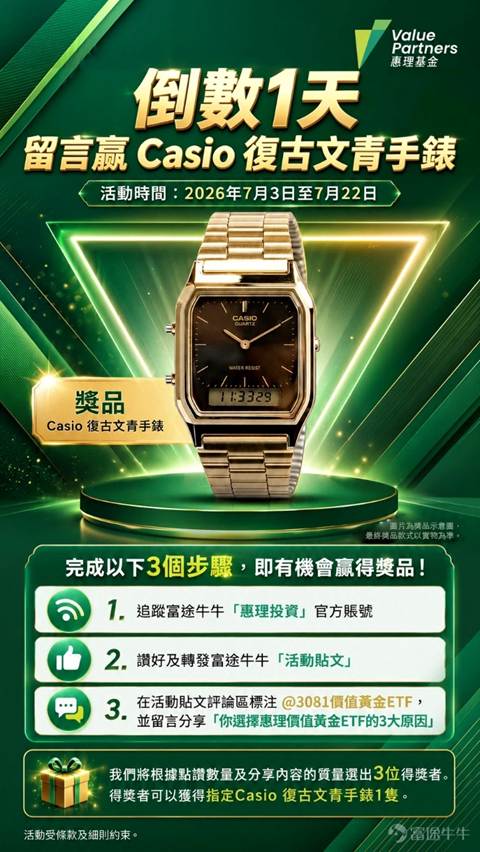
⭐ Interactive Giveaway | Countdown: 1 day
From today until July 22, 2026, follow, share, and comment on the promotional post for a chance to win an eye-catching Casio retro-chic watch! 🕶️
👇Click to go directly
🎁 Contest Giveaway | Comment with your top three reasons for choosing 3081 and stand a chance to win the viral Casio retro-chic watch! – BullBull Circle
Winners AnnouncementWill be announced on July 24, 2026. Terms and Conditions of the promotion:bit.ly/4gRH1Wo
Winners AnnouncementWill be announced on July 24, 2026. Terms and Conditions of the promotion:bit.ly/4gRH1Wo
Data source:July 20: White House announcement on imposing a 50% tariff on certain Canadian goods; July 20: Reuters report on U.S. imposition of a 50% tariff on certain Canadian goods; July 20: Reuters report that U.S. military strikes against Iran entered their ninth day, with Iran stating two oil tankers exploded and lost navigational capability in the Strait of Hormuz; February 2026: IEA data on oil shipment volumes through the Strait of Hormuz, flows to Asia, and LNG export figures; February 2026: IEA public documentation on the global significance of petroleum liquids consumption and transportation related to the Strait of Hormuz; July 14: Politico report on U.S. inflation, Fed Chair Volcker, and how the Iran situation impacts the interest rate path; July 20: Reuters report that Brent crude oil prices rebounded above USD 90.
Disclaimer
· The above content is provided for reference purposes only and does not constitute, nor should it be construed as, an offer, solicitation, or recommendation to buy or sell any securities, investment products, or funds. This content is intended solely for persons in jurisdictions where the distribution or provision of such content is lawful. By accessing this content, you represent and warrant that the applicable laws and regulations of your jurisdiction permit you to do so.
· Investment involves risk. Past performance is not indicative of future results. The price of fund units/shares may go up or down, and past fund performance does not guarantee future returns. Investors should refer to the relevant fund prospectus for details and risk factors. Investors may not recover the full amount of their initial investment. The value of investments and any income derived from them (if any) may be volatile and subject to significant fluctuations over short periods.
The data and information used in preparing the above content were obtained by Value Partners Fund Management (Hong Kong) Limited ("Value Partners") from sources believed to be reliable. However, no representation or warranty is made as to the accuracy or completeness of any third-party data. Any forecasts or other forward-looking statements regarding future events or performance of countries, markets, or companies are not necessarily indicative and may differ materially from actual events or outcomes. Value Partners shall not be liable for any losses incurred by any person acting upon the information contained herein.
No person may reproduce or use the above content, including but not limited to text, images, audio, and video, for any public or commercial purpose without the prior permission of Value Partners. Any modification or use of the above content may infringe upon copyrights and/or intellectual property rights held by Value Partners, where applicable.
· Issued by Value Partners Asset Management Hong Kong Limited and Saxo Asset Management Hong Kong Limited. This content has not been reviewed by the Securities and Futures Commission.
$Apple (AAPL.US)$$Tesla (TSLA.US)$$SK Hynix (000660.KR)$$SK hynix (SKHY.US)$$Samsung Electronics (005930.KR)$$Dell Technologies (DELL.US)$$MEITUAN-W (03690.HK)$$Micron Technology (MU.US)$$SpaceX (SPCX.US)$$SanDisk (SNDK.US)$$NVIDIA (NVDA.US)$$Intel (INTC.US)$Content Disclosure: Personal opinion
Risk Disclaimer: The above content only represents the author's view. It does not represent any position or investment advice of Futu. Futu makes no representation or warranty.Read more


Comment (1)
to post a comment
5
1