
AI computing demand is booming! Is Neocloud positioned to ride the wave?

Learn Investing from the Pros | From a Trial Stake to a 9.3% Holding: Why Is NVIDIA Continuing to Bet on NEBIUS?
A newly disclosed Schedule 13G filing has fully revealed the strategic hand NVIDIA is playing with NEBIUS, the rising star in AI cloud computing.
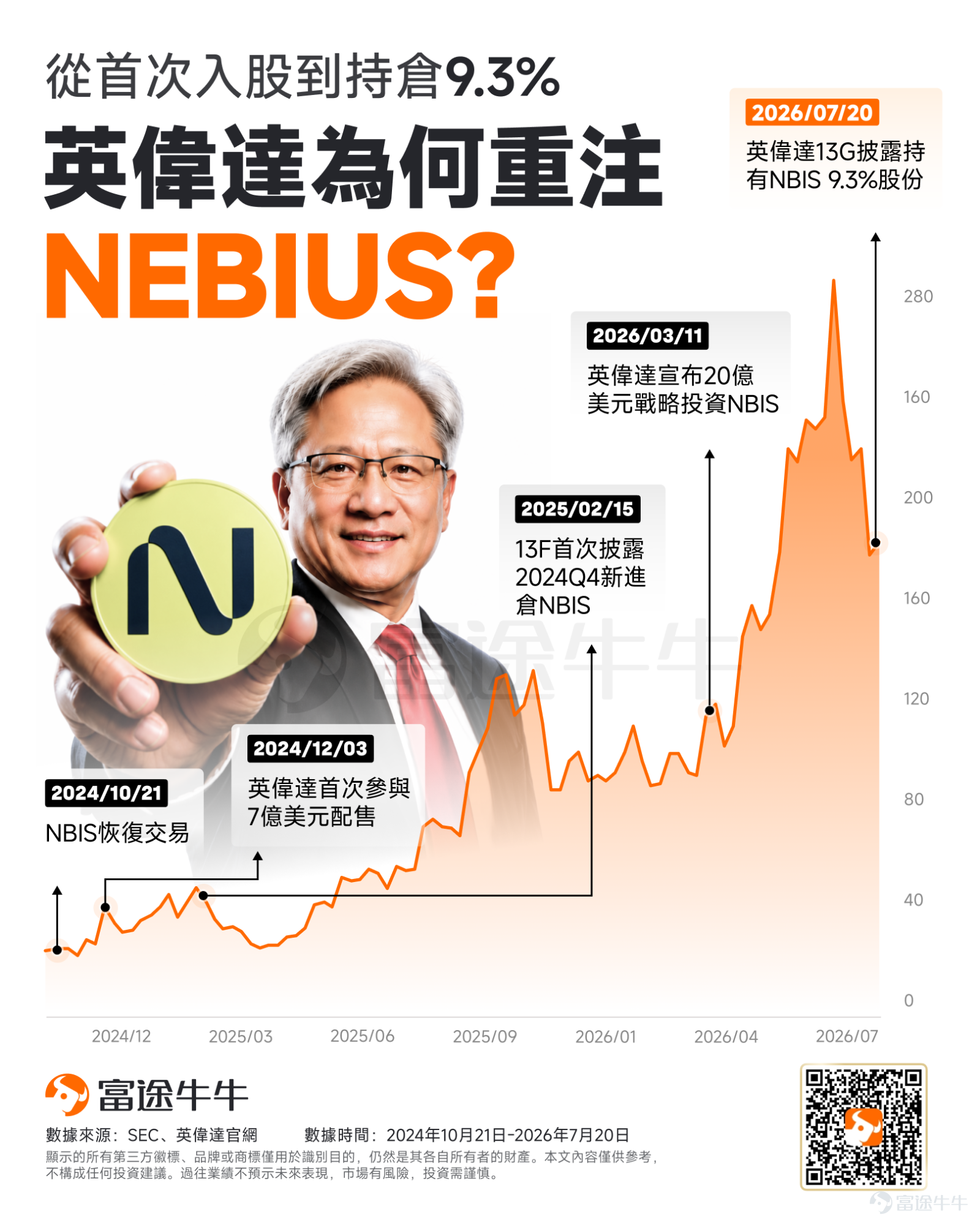
On July 20, 2026, $NVIDIA (NVDA.US)$ officially filed with the U.S. Securities and Exchange Commission (SEC), stating it now holds $NEBIUS (NBIS.US)$ approximately 22.3 million Class A ordinary shares, raising its stake to 9.3%.
Reviewing this alliance, NVIDIA’s accumulation of stakes followed a precise and highly patient 'three-stage approach':
2024 (Exploratory Phase): Established an initial strategic link through a modest equity investment.
2025 (Validation Phase): Monitor the implementation of its technology and rigorously evaluate its ability to expand its customer base, grow revenue, and deliver data centers in practice.
2026 (Heavy Investment Phase): After its business model is validated, significantly increase holdings, as both parties formally transition from operational synergy into a phase of deep joint infrastructure development.

This is by no means a purely financial investment; it is NVIDIA’s core strategic move to secure a foothold in the next-generation AI cloud infrastructure landscape.This article will thoroughly unpack three key rationales: Why does NVIDIA urgently need to support Neocloud? Why is it placing a major bet on NEBIUS? And what exactly enables NEBIUS to stand out among numerous cloud providers?
Why does NVIDIA need a 'new cloud'?
To understand why NVIDIA is investing in NEBIUS, one must first grasp the complex relationship between NVIDIA and cloud providers—one characterized by both collaboration and competition.
AWS, Microsoft Azure, and Google Cloud are among NVIDIA’s largest customers, yet they are simultaneously developing their own AI chips, such as Google TPUs, AWS Trainium, and Microsoft Maia. Traditional cloud giants aim to reduce their reliance on NVIDIA GPUs and capture more value within their own hardware and software ecosystems.
New cloud providers (Neoclouds) are different.
$CoreWeave (CRWV.US)$ 、 $NEBIUS (NBIS.US)$ CoreWeave, Lambda, and Nscale differentiate themselves by rapidly deploying NVIDIA’s latest-generation GPUs and building compute clusters around CUDA, InfiniBand, Spectrum-X, and NVIDIA AI Enterprise. The more successful these new cloud providers become, the greater the demand for NVIDIA GPUs and the broader the reach of the CUDA ecosystem. Therefore,Supporting new cloud providers delivers at least three layers of value for NVIDIA:
First, it creates a second sales channel beyond traditional hyperscalers, preventing a small number of large customers from gaining excessive bargaining power.
Second, it accelerates market adoption of the latest-generation GPUs. New cloud providers lack extensive legacy cloud product lines and don’t need to balance investments in custom silicon, so they typically make faster decisions and deploy Blackwell or Rubin GPUs more swiftly.
Third, it demonstrates that NVIDIA sells not just chips, but an integrated ‘AI factory’ platform encompassing GPUs, networking, racks, and software. If a new cloud provider can grow into a global cloud player entirely based on NVIDIA technology, it becomes the most compelling proof-of-concept imaginable.
Thus, NVIDIA’s investment in NEBIUS is fundamentally about cultivating a global compute infrastructure channel that fully embraces NVIDIA’s architecture while remaining independent from traditional cloud giants.
Why heavily bet on NEBIUS?
NVIDIA has also invested in it $CoreWeave (CRWV.US)$ 、 $IREN Ltd (IREN.US)$ , and maintains close collaboration with companies like Lambda and Nscale. What truly sets NEBIUS apart is that it’s not merely a compute infrastructure middleman that 'buys GPUs and rents them out.'
1. NEBIUS possesses rare full-stack engineering capabilities
In the joint announcement of their partnership, NVIDIA specifically highlighted NEBIUS’s “unique engineering depth spanning the entire AI technology stack.”
This statement is key to understanding this investment.
NEBIUS inherits Yandex’s seasoned technical team, built over years of developing search engines, cloud platforms, and large-scale distributed systems. It can independently design servers, racks, cooling systems, networking, storage, resource scheduling, and cloud software—then re-optimize all these components specifically for AI training and inference.
Many new cloud providers base their core competitiveness on fundraising ability, data center resources, and speed of acquiring GPUs; NEBIUS aims to go deeper—building everything from the layer above the chip all the way up to the cloud platform used by developers.
This means the same batch of GPUs could achieve higher utilization, more stable cluster performance, and lower per-unit inference costs on NEBIUS’s platform. For NVIDIA, the ideal partner isn’t necessarily the company with the most GPUs, but the one that can fully unleash the performance of its latest GPUs and keep customers deeply engaged within the CUDA ecosystem.
Second, it can serve both large clients and developers.
The new cloud computing industry tends to gravitate toward two extremes.
One model is to become a computing power contractor for major tech companies: signing multi-billion-dollar long-term contracts and financing data center clusters based on those contracts. This approach offers high revenue certainty but also high customer concentration, essentially positioning the company as a 'digital infrastructure wholesaler.'
The other model targets small and medium-sized developers by offering GPU rentals on an hourly basis. While this leads to a more diversified client base, demand is highly volatile, sales costs are high, and the business is prone to price competition.
NEBIUS aims to cover both ends of this spectrum:On one end, it secures long-term computing capacity commitments from large clients like Microsoft and Meta through dedicated clusters; on the other end, it attracts AI-native companies and developers via NEBIUS AI Cloud, AI Studio, managed Kubernetes, storage, and inference services.
This allows NEBIUS to move beyond merely selling 'GPU hours' and instead ascend into higher-value offerings such as model training, fine-tuning, inference, and agent development platforms—enhancing customer stickiness and per-customer revenue.
Third, it can serve as a joint testbed for NVIDIA’s new architectures.
By 2026, the partnership between the two parties will extend well beyond a typical supplier relationship. NEBIUS plans to deploy over 5 gigawatts of NVIDIA systems by the end of 2030 and participate in designing the architecture for next-generation AI factories. It is also among the first NVIDIA Cloud Partners slated to offer customers the Vera Rubin NVL72.
For NVIDIA, this collaboration can create a virtuous cycle:
NVIDIA provides NEBIUS with funding, product roadmaps, and engineering support; NEBIUS rapidly builds data centers optimized for next-generation chips; customers adopt Blackwell, Rubin, and their accompanying networking and software earlier; real-world workload experience feeds back into the design of next-generation systems.
Thus, the $2 billion is not just financial support—it’s as if NVIDIA has selected a scalable 'testbed' for its next-generation AI factories.
Fourth, NEBIUS combines a U.S. market presence with a European identity.
NEBIUS is headquartered in Amsterdam and is expanding its infrastructure in both the U.S. and Europe.
AI computing power is evolving from a purely commercial service into a strategic asset involving energy, data security, and digital sovereignty. U.S. customers require domestic compute capacity, while European governments and enterprises also seek to reduce their sole reliance on the big three U.S. cloud providers.
NEBIUS can participate in building hyperscale AI data centers in the U.S. while also holding a European cloud platform identity. This cross-regional positioning is not fully matched by CoreWeave and Lambda, which are primarily rooted in the U.S., and thus provides NVIDIA with a suitable vehicle to expand its influence over European AI infrastructure.
What truly differentiates NEBIUS from other new cloud providers?
$CoreWeave (CRWV.US)$ 、 $IREN Ltd (IREN.US)$ And, $NEBIUS (NBIS.US)$ All are categorized as 'new clouds' and maintain deep collaboration with NVIDIA. However, these three companies are not simply homogeneous GPU rental vendors—they each approach AI infrastructure from distinct angles: compute delivery, energy resources, and cloud technology, respectively.

$NEBIUS (NBIS.US)$ : Starting from a technology platform
NEBIUS’s starting point isn’t large customer contracts or power assets, but rather cloud computing and system engineering.
The company has inherited Yandex's engineering team, which accumulated years of experience building search engines, distributed systems, and cloud platforms. NEBIUS not only purchases NVIDIA GPUs but also designs its own servers, racks, storage, networking, and cloud software, offering managed Kubernetes, data processing, AI Studio, and inference services.
Therefore, NEBIUS aims to do more than just rent out GPUs—it seeks to manage the entire machine learning lifecycle, from data processing and model training to fine-tuning and inference deployment.
This is also why NVIDIA specifically highlighted NEBIUS’s 'unique engineering depth across the entire AI stack' in their 2026 partnership announcement. The collaboration spans AI factory architecture, next-generation GPU systems, and production software, with NEBIUS planning to deploy over 5 gigawatts of NVIDIA systems by the end of 2030. NVIDIA–NEBIUS Partnership Announcement
Compared to CoreWeave and IREN, NEBIUS currently does not have a scale advantage. Its real attempt to build a moat lies in improving GPU utilization, optimizing cluster performance, and capturing software value beyond GPU rental fees through its cloud platform and inference services.
In other words, NEBIUS aims to move beyond 'selling computing power' toward 'selling a platform.'
CoreWeave: Starting from Customer Orders
$CoreWeave (CRWV.US)$ It is the largest and most commercially mature among the three companies.
Its core model involves first securing long-term computing capacity contracts from major customers like Microsoft, OpenAI, and Meta, then using those contracts—along with GPUs and data center assets—to secure financing, rapidly procure NVIDIA chips, and build computing clusters.
In 2025, CoreWeave generated $5.131 billion in revenue, but its total debt reached $21.6 billion by year-end. Its revenue primarily comes from long-term committed contracts, with a few large customers playing a dominant role in its business.
Thus, CoreWeave’s greatest strength is not a proprietary technology, but its ability to rapidly execute the cycle of 'large customer orders → external financing → GPU procurement → cluster delivery.'
It resembles more of a hyperscale AI computing power wholesaler: focused on GPU count, speed of cluster deployment, and size of large contracts.
The advantage of this model is rapid revenue growth and high order visibility; the risks include substantial capital expenditures and debt levels, along with heavy reliance on a few hyperscale clients. Should client demand, financing conditions, or GPU residual values shift, financial leverage could amplify operational volatility.
IREN: Starting from Power and Data Centers
$IREN Ltd (IREN.US)$ Its starting point differs from that of NEBIUS.
IREN initially focused primarily on Bitcoin mining, thereby accumulating core assets including low-cost power, land, grid interconnection rights, self-built data centers, and energy infrastructure. As AI demand grew, IREN began converting some of its mining facilities into GPU data centers and gradually repositioned itself from a Bitcoin miner to an AI cloud infrastructure provider.
As of March 31, 2026, IREN owned seven data center projects that had already secured grid interconnection agreements or related rights, with a combined power capacity of approximately 4.51 gigawatts, and held around 150,000 GPUs already installed or on order.
IREN also signed a GPU services contract worth approximately $9.7 billion with Microsoft, and in May 2026 announced a $3.4 billion AI cloud contract with NVIDIA, along with a strategic partnership covering 5 gigawatts of projects. NVIDIA received the right to purchase up to $2.1 billion worth of IREN stock, subject to vesting as GPU infrastructure is actually deployed.
Additionally, IREN announced on Monday that it has signed new multi-year cloud computing contracts with multiple AI developers, with a total contract value of $2.8 billion.The company simultaneously raised its full-year guidance, increasing its target for annualized AI cloud service operating revenue from the previous $3.7 billion to over $4 billion, of which 85% is already backed by signed contracts.
IREN’s scarcest resources can be summed up in three words: power, land, and facilities.
In AI data center construction, securing GPUs isn't necessarily the most difficult part. Obtaining large-scale, stable power supply, completing grid interconnection, acquiring land, and delivering facilities on schedule are becoming bigger bottlenecks. IREN holds a clear advantage here thanks to its existing mining infrastructure.
However, Bitcoin mining facilities cannot be directly equated with AI data centers. AI clusters also require high-speed networking, low-latency interconnects, liquid cooling systems, higher reliability standards, and sophisticated cloud platforms and cluster orchestration software.
IREN’s core challenge is whether it can truly evolve from an infrastructure company with power and data halls into an AI cloud company equipped with software and operational capabilities.
Therefore, NVIDIA isn’t simply choosing 'one out of three' among CoreWeave, IREN, and NEBIUS; rather, it is simultaneously strengthening three critical components of AI infrastructure:
CoreWeave helps NVIDIA rapidly scale GPU sales and expand coverage among large customers;
IREN helps NVIDIA secure multiple gigawatts of future power capacity and data center space;
NEBIUS helps NVIDIA integrate chips, networking, and software into a complete AI cloud platform.
This also shows that NVIDIA’s investment rationale for each of the three companies differs.
The investment in CoreWeavefocuses on scale and delivery;Support IREN,the focus is on power and future capacity;double down on NEBIUS,the emphasis here is on full-stack engineering capabilities and co-building next-generation AI factories.
What is NVIDIA really betting on?
On the surface, NVIDIA is betting on NEBIUS’s revenue growth and data center expansion; at a deeper level, it’s betting on a new division of labor in cloud computing.
In this arrangement: NVIDIA provides chips, networking, system architecture, and foundational software; NEBIUS builds and operates AI factories, packaging complex hardware into cloud services; model companies and enterprise customers can access hyperscale AI compute without relying on the traditional big three cloud providers.
NEBIUS is thus not just a customer of NVIDIA, but also an amplifier of NVIDIA’s platform strategy.By March 2026, when NVIDIA decided to invest $2 billion, NEBIUS was no longer just a story backed by Yandex’s technical heritage—it had begun proving its business model through revenue, customer contracts, and infrastructure delivery.
Therefore, looking back at the entire journey, NVIDIA’s investment logic wasn’t about 'finding an undervalued stock,' but rather first validating the team with modest capital, then verifying execution through supply partnerships, and finally locking in a key ecosystem partner with $2 billion after NEBIUS secured major clients and demonstrated scalable capabilities.
Conclusion
NVIDIA’s potential ownership of approximately 9.3% of NEBIUS does not mean NEBIUS is a sure bet.
New cloud remains an extremely capital-intensive business. Power supply, land availability, GPU procurement, financing costs, and construction timelines—any issue in these areas could impact returns. NEBIUS also faces challenges including customer concentration, massive capital expenditures, equity dilution, and the execution risk of transitioning from a technical team to a global infrastructure operator.
But NVIDIA’s continued investment signals at least one thing: in its view, NEBIUS is not just another GPU rental company.
It possesses the technical depth of traditional cloud engineering teams, the rapid expansion pace of new cloud companies, a geographic footprint spanning both the U.S. and Europe, and a willingness to build its data centers, hardware, and software entirely on NVIDIA’s architecture.
If CoreWeave represents the first generation of new cloud—scaling GPU capacity rapidly through capital and contracts—then NEBIUS aims to become the second generation: not just owning compute power, but also possessing a full AI cloud technology stack.
NVIDIA’s bet on NEBIUS is precisely on this possibility.
Risk Disclaimer: The above content only represents the author's view. It does not represent any position or investment advice of Futu. Futu makes no representation or warranty.Read more


Comments (12)
to post a comment
51
193