
The high prosperity in optical communications persists, with the two leading Hong Kong-listed player

Rumors swirl that NVIDIA has secretly acquired 'dark fiber'—what’s the strategic play behind this move, and which companies stand to benefit?
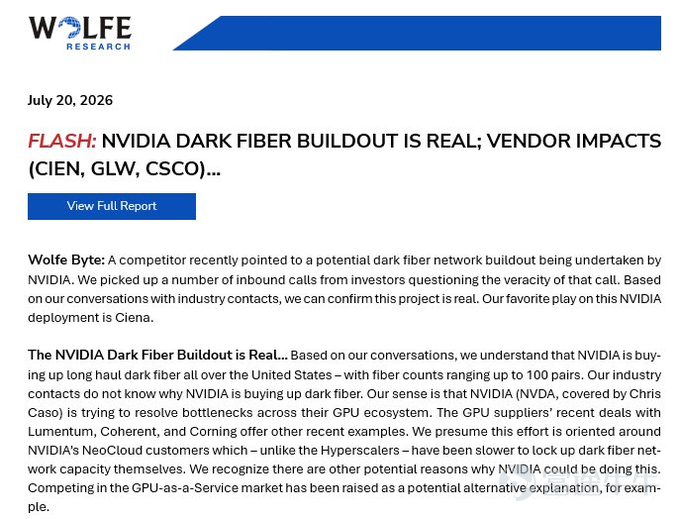
On July 20, 2026, a report from Wolfe Research drew market attention.
The report stated that $NVIDIA (NVDA.US)$ is secretly advancing a nationwide project unrelated to chips but potentially more strategically defensive than any GPU:acquiring dark fiber—already laid but never activated—across the U.S. to build its own carrier-grade telecom network infrastructure.Previously, Needham estimated that NVIDIA’s planned communications network could involve investments of $5–10 billion over the next three years.

Wolfe Research characterized this move as NVIDIA’s “ultimate insurance strategy against the rise of ASICs.” As major customers increasingly develop their own chips, eroding GPU market share, NVIDIA is attempting to shift the competitive battleground from “whose chip computes faster” to “who can deliver computing power to customers fastest”—by controlling the physical transport layer and building a second moat beyond hardware.
Although NVIDIA has not yet fully confirmed this plan,the specific scale of network investment, routing, and supplier allocations remain under industry investigation—but this is far from an isolated rumor. NVIDIA has recently launched Spectrum-XGS for inter-data-center connectivity and explicitly discussed deploying dark fiber, DWDM, and ZR4 coherent optical modules in its official documentation. In May 2026, it also signed a long-term agreement with Corning to significantly expand U.S. fiber and optical connectivity capacity.
These actions collectively signal a major strategic shift:NVIDIA is evolving from a GPU supplier into the chief architect of AI infrastructure. It aims not only to define chips and servers, but also to shape how data flows between data centers. Dark fiber is the key asset that links NVIDIA’s geographically dispersed AI data centers across the U.S. into a single 'virtual supercomputer.'
1. What is 'Dark Fiber'?
Dark fiber is not a special type of optical fiber.
It refers to fiber-optic cables that have already been laid but are not yet equipped with transmission hardware and carry no light signals. The fiber itself remains 'dark' until the user installs optical transceivers, DWDM equipment, amplifiers, switches, and routers at both ends, thereby 'lighting it up.'
Companies typically acquire dark fiber through three methods: (1) digging trenches and laying their own fiber cables; (2) leasing one or more fiber pairs long-term from a telecom carrier; or (3) obtaining an IRU (Indefeasible Right of Use), which grants exclusive usage rights for ten, twenty, or even more years in a single upfront agreement.
Its key difference from conventional leased lines lies in who controls the underlying network. When leasing traditional bandwidth services, customers purchase transmission capacity—such as 100G, 400G, or 800G—but the carrier largely dictates how the route is designed and when equipment is upgraded.
With dark fiber, the customer controls the entire fiber strand. They can decide how many wavelengths to deploy, how much bandwidth each wavelength carries, which vendor’s optical transmission equipment to use, and precisely when to upgrade from 400G to 800G or even 1.6T.
For typical enterprises with relatively stable data demands, this model is overly complex and heavy-handed.However, for NVIDIA—which plans to continuously build GPU clusters comprising hundreds of thousands, even millions of GPUs—the control afforded by dark fiber is extremely valuable.
2. Why is NVIDIA directly engaging in backbone optical networking?
1. A single data center is reaching its expansion limits: AI clusters are constrained by power, land availability, regulatory approvals, and grid interconnection capacity, making it impractical to concentrate millions of GPUs within a single campus. Future AI factories will be distributed across multiple data centers, interconnected via a 'scale-across' architecture to form a logical computing system.
2. Network transmission determines GPU utilization: Large model training requires GPUs to continuously exchange massive parameters and gradients. Insufficient bandwidth or high latency causes expensive GPUs to sit idle waiting for data. When clusters span multiple campuses, the bottleneck shifts from internal switches to metropolitan and long-haul optical networks. Even modest investments in networking that slightly improve GPU utilization can yield significant economic benefits.
3. Addressing weaknesses of new cloud providers (Neoclouds): Emerging cloud providers like CoreWeave and Lambda cannot rapidly replicate AWS or Microsoft’s global backbone networks. If NVIDIA integrates dark fiber with Spectrum-X and BlueField DPUs, it effectively builds a standardized 'computing highway' for these customers.
4. Lower long-term cost per unit of bandwidth: Traditional dedicated lines charge based on bandwidth, so costs rise with traffic volume. With ownership of dark fiber, NVIDIA can increase capacity by upgrading coherent optical equipment and activating the C+L bands. Given the explosive growth of AI traffic, this approach delivers lower cost per unit of bandwidth and avoids dependency on telecom operators’ upgrade timelines.
5. Building a more comprehensive ecosystem moat: NVIDIA already controls technologies such as GPUs, NVLink, InfiniBand, and CPO. By further securing dark fiber resources, it will no longer sell just hardware, but an integrated 'full-stack AI capacity' solution encompassing compute, networking, software, and transmission.
III. Why 'now,' of all times?
NVIDIA's bet on dark fiber aligns clearly with its optical networking initiatives over the past two years.
First came Spectrum-X and Spectrum-XGS,extending NVIDIA’s network boundary from within data centers to across data centers.
Next is CPO, or co-packaged optics.NVIDIA places optical engines near switch chips to reduce losses from high-speed electrical signals on circuit boards. NVIDIA states that its Spectrum-X Photonics can significantly lower power consumption per port and improve reliability, aiming to support million-GPU systems spanning multiple AI factories.
Then comes securing upstream capacity.In March 2026, NVIDIA announced $2 billion investments in both Lumentum and Coherent, along with multi-year purchase commitments and capacity rights; in May, it entered a long-term collaboration with Corning, which plans to expand its U.S. optical connectivity capacity tenfold and increase fiber production by more than 50%.
Therefore, what truly matters about the dark fiber initiative isn’t whether NVIDIA happened to lease a few specific lines, but rather that it has filled a missing piece in its optical networking puzzle:Corning provides the 'roads'; vendors like Coherent supply lasers and optical components; Ciena, Nokia, and Cisco deliver long-haul optical transmission capabilities; NVIDIA controls GPUs, switches, DPUs, and software; and dark fiber connects the distributed AI factories.
IV. Which companies benefit the most?
NVIDIA’s dark fiber network initiative will simultaneously drive demand across four categories: fiber optic cables and connectors, transmission equipment to light up the fiber, lasers and photonic components, and existing fiber infrastructure. The rationale for how different companies benefit varies: some have already signed partnerships with NVIDIA, others possess the requisite technical capabilities but have not yet secured confirmed orders, and a few simply stand to gain from the appreciation of fiber asset values.
First tier: Direct beneficiaries with high certainty
1. Ciena: The purest play on 'lighting up dark fiber'
Owning dark fiber does not equate to having a functional network. To carry dozens or even hundreds of high-speed wavelengths over a single fiber pair requires coherent DSPs, transponders, DWDM, ROADM, optical amplifiers, and monitoring and network control systems.This is exactly$Ciena (CIEN.US)$Core business.
Ciena’s WaveLogic 6 Extreme supports 1.6 Tb/s per wavelength, and its product portfolio spans metro, regional, and long-haul data center interconnects. The company has also introduced AI Scale-across solutions including C+L band line systems, 800G/1.6T coherent modules, and the Waveserver platform. Ciena’s AI optical networking solutions, Ciena OFC 2026 product data
If NVIDIA procures large volumes of 'bare fiber cores,' then aside from the physical fiber itself, one of the largest incremental expenditures will likely be the optical transmission equipment needed to light up those cores.
Therefore, among publicly listed companies, Ciena may be one of the highest-leverage plays on NVIDIA’s dark fiber initiative.
Its risks are also evident: high customer concentration, volatile project-based revenue recognition, and the fact that being mentioned by Wolfe Research does not equate to NVIDIA having publicly confirmed a firm order of significant scale.
2. Corning: The Clearest 'Shovel Seller'
$Corning (GLW.US)$ Its exposure to the AI-driven optical infrastructure theme is the most direct. It not only produces traditional telecom fiber but also offers high-density cables, connectors, wiring solutions, and optical connectivity solutions for data centers. AI data centers require significantly higher fiber core density than traditional data centers, and large-scale dark fiber networks also necessitate substantial volumes of long-haul fiber optic cables.
More importantly, Corning’s relationship with NVIDIA is no longer market speculation—it is a publicly disclosed, multi-year commercial and technical partnership.
Its benefits can be categorized into three layers: high-density optical interconnects within data centers; interconnects between campus and metro data centers; and long-haul dark fiber deployment plus inventory replenishment.
Corning may not be the stock with the highest earnings elasticity, but it is one of the companies in this supply chain with the strongest evidence of benefit and the broadest coverage across application scenarios.
The risk lies in the historically strong cyclicality of the fiber optic industry.The telecom bubble around 2000 led to severe fiber overcapacity. Whether this round of capacity expansion ultimately translates into sustained profits depends on the actual utilization of AI networks—not just on signed contracts and capital expenditures.
3. Lumentum: A Key Beneficiary of External Laser Sources for CPO
$Lumentum (LITE.US)$ Its core products include high-power continuous-wave lasers, EMLs, and indium phosphide-based photonic components, making it a critical upstream supplier for high-speed optical modules, silicon photonics, and CPO systems.
In March 2026, NVIDIA announced a $2 billion investment in Lumentum, along with multi-billion-dollar purchase commitments and rights to future production capacity. The two companies will also jointly advance U.S.-based manufacturing and R&D in advanced optical technologies.
Lumentum does not directly produce long-haul fiber optics, but NVIDIA needs to connect multiple AI factories, which requires massive amounts of high-speed optical transceivers, external laser sources, and CPO (co-packaged optics) equipment. Therefore, Lumentum is a high-certainty beneficiary of 'NVIDIA’s optical transition.'
It should be noted that LITE’s relationship with dark fiber projects is less direct than Ciena’s. Its revenue elasticity stems more from the ramp-up of CPO and high-speed optical interconnects rather than fiber cable deployment itself.
4. Coherent: Beneficiary in Lasers and Optical Components
$Coherent (COHR.US)$ Provides lasers, optical communication components, optical materials, and high-speed optical transceivers. NVIDIA has also signed a multi-year collaboration agreement with Coherent, including billions of dollars in purchase commitments and capacity rights.
Compared to Lumentum, Coherent offers a broader product portfolio, enabling it to participate simultaneously in lasers, pluggable optical transceivers, and certain advanced optical components. However, its business is more diversified, so AI-related optical communication orders may have a less concentrated impact on overall performance than for LITE.
Thus, Coherent is also a relatively high-certainty beneficiary, but its core investment thesis hinges on the broader expansion of the AI optical interconnect market, not just long-haul dark fiber.
Second Tier: Strong Technical Capabilities, But Market Share Still Uncertain
1. Nokia: A Strong Competitor in Long-Haul Optical Transmission
$Nokia Oyj (NOK.US)$ Offers a complete 1830-series optical transport platform, PSE coherent optical technology, C+L band systems, and solutions tailored for both metro and long-haul DCI (Data Center Interconnect).
The AI era demands more than just additional fiber—it requires: higher per-wavelength data rates; longer unrepeatered transmission distances; higher spectral efficiency; lower power consumption per bit; and more compact line amplifiers and ROADM equipment.
Nokia's product portfolio aligns closely with these requirements. Its latest solutions are explicitly targeted at distributed GPU clusters and interconnecting AI data centers across regions.
However, compared to Corning, it is unclear whether Nokia has secured an actual share in NVIDIA's projects; and unlike Ciena, Nokia’s business also includes significant segments such as mobile networks, so the impact of a single dark fiber project on its overall performance may be less pronounced.
2. Cisco: Benefits from routed optical networking but also faces competition from NVIDIA
$Cisco (CSCO.US)$ Through Acacia, Cisco possesses coherent optical modules and DSP capabilities, while also selling its 8000-series routers, NCS optical transport equipment, and Silicon One networking chips.
Once dark fiber is lit, data still needs to enter the routing and switching layer. Cisco’s strength lies in its ability to integrate routing, coherent optical modules, and network management, thereby reducing reliance on standalone optical transport equipment layers.
Cisco has disclosed that its 800G-ZR solution has already been adopted by hyperscale customers, and demand for its optical products from AI-focused clients is accelerating.
However, Cisco is not purely a beneficiary.NVIDIA is expanding its share in the data center Ethernet market through Spectrum-X, creating direct competition with Cisco in switches and networking chips.
Therefore, a more accurate statement would be:Dark fiber deployment benefits Cisco’s Acacia coherent optics and routed optical networking businesses, but NVIDIA’s expanding networking platform could squeeze market share for Cisco’s other products.
Third Tier: Operators with Fiber Assets
1. Lumen: Revaluation of its existing long-haul fiber network in the U.S.
If NVIDIA chooses not to dig trenches and lay all new fiber itself, but instead acquires existing fiber strands through IRUs (Indefeasible Rights of Use) or long-term leases, operators owning U.S. long-haul fiber assets would benefit.
$Lumen Technologies (LUMN.US)$ It owns extensive metro and long-haul fiber networks covering major U.S. cities and data centers. Potential revenue opportunities include leasing unused fiber strands, signing long-term IRUs, offering wavelength and hosted optical networking services, providing 'last-mile' connectivity to data centers, and improving utilization of existing network assets.
Since most of the fiber is already deployed, adding new long-term customers can enhance asset utilization and generate high marginal returns. Thus, demand for dark fiber could prompt the market to reassess the value of Lumen’s network assets.
However, Lumen still faces high debt levels, declining legacy businesses, and capital expenditure pressures. Even if it secures AI-related network contracts, this may not quickly resolve the company’s broader financial challenges.
Summary
Notably, building a cross-regional dark fiber network entails significant operational challenges. Deploying optical transmission equipment, managing network operations, and delivering 'last-mile' data center connectivity are all areas where NVIDIA currently lacks experience. Completing the physical network is only the first step; efficient ongoing operations and successful commercialization are the true tests, carrying substantial execution risk.
Risk Disclaimer: The above content only represents the author's view. It does not represent any position or investment advice of Futu. Futu makes no representation or warranty.Read more


Comments (11)
to post a comment
102
374