
Hong Kong stocks are rebounding—what sectors deserve attention?

After rebounding more than 26% from the lows: Has Alibaba’s valuation recovery run its course? Four indicators to assess further upside
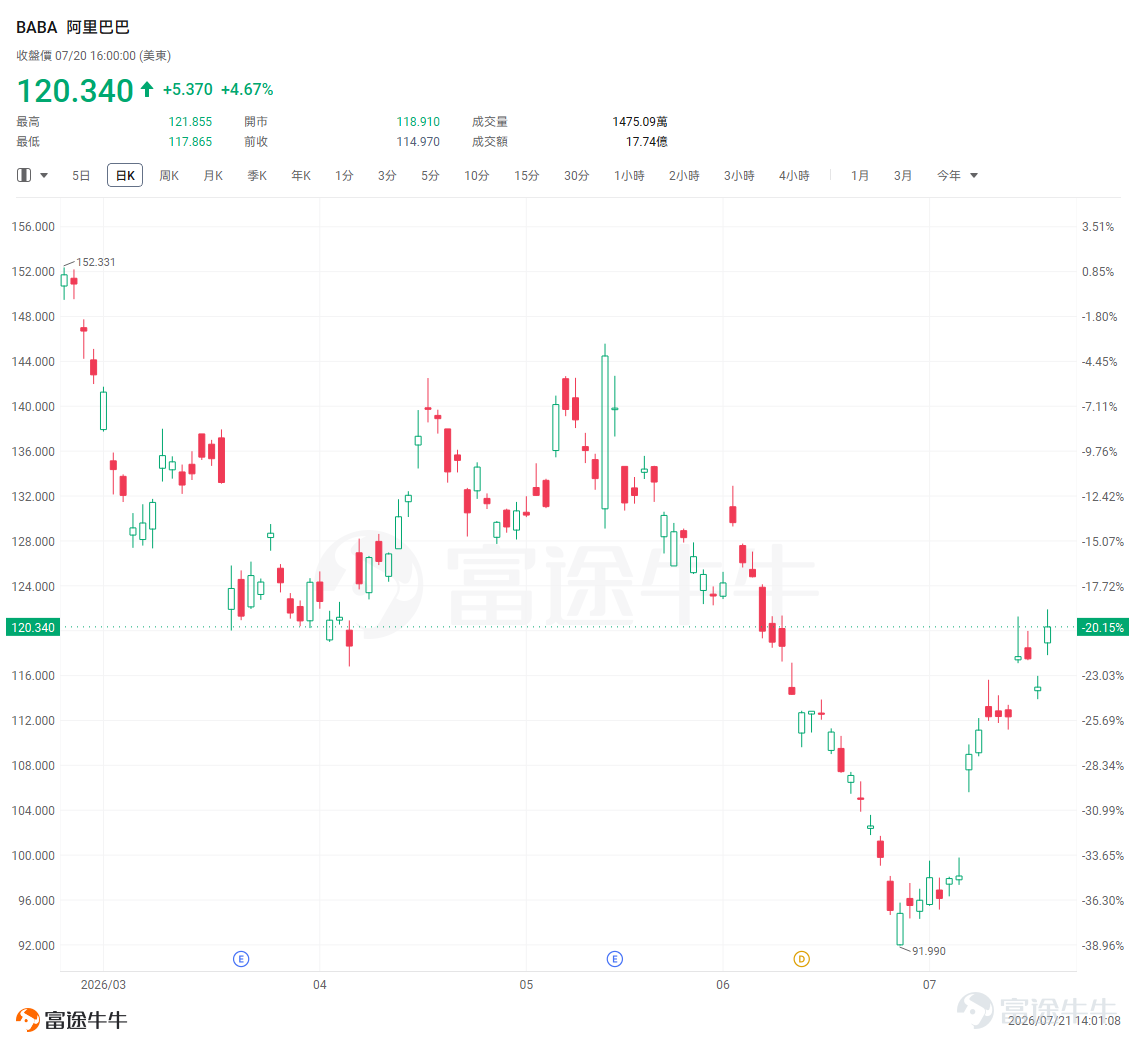
From the June 26 intraday low of approximately $94.81, $Alibaba (BABA.US)$ Alibaba’s U.S.-listed shares closed at $120.34 on July 20, marking a cumulative rebound of about 26.9%. The current share price remains significantly below its 52-week high, suggesting this rally is still more aligned with valuation recovery rather than being fully driven by earnings growth.
What is driving this rebound? What impact will holdings in Kimi and ChangXin Memory Technologies have? Will continued investment in instant retail continue to weigh on the group's profits and free cash flow? Can Alibaba Cloud sustain its accelerated growth?

I. Why has Alibaba rebounded more than 26% from its recent lows?
1. Deep prior corrections placed valuation and sentiment into a recovery window
Alibaba had previously been weighed down by intensified domestic e-commerce competition, investments in instant retail, U.S. policy risks, and capital expenditure pressures on its cloud business, causing its share price to approach a one-year low. The initial phase of the rally clearly exhibited characteristics of a bounce-back from oversold levels and short-covering.
2. Renewed enthusiasm around AI narratives has been the key incremental driver recently
Following the launch of Kimi K3, it quickly attracted a large user base, prompting Moonshot AI (the developer) to temporarily suspend new subscriptions due to demand exceeding initial projections and its computing clusters nearing capacity limits. This reignited market attention on the competitiveness of Chinese large language models and the potential benefits for platform companies like Alibaba and Tencent. Alibaba’s share price notably outperformed the Hang Seng Tech Index on the back of these developments.
3. Capital rotation: funds shifting from AI hardware to undervalued internet giants
In mid-July, global semiconductor and AI hardware stocks underwent a significant correction, prompting heavily positioned investors to reduce their chip exposure and seek assets that also carry an AI theme but trade at lower valuations and with lighter positioning. The recent rebound in Hong Kong-listed internet stocks has largely stemmed from capital reallocating out of AI hardware and into internet companies. The earlier decline in the Hang Seng Tech Index itself also reflected strong fund rotation dynamics, beyond just $Alibaba (BABA.US)$$BABA-W (09988.HK)$ in addition to $MEITUAN-W (03690.HK)$ 、 $TENCENT (00700.HK)$ 、 $JD.com (JD.US)$$JD-SW (09618.HK)$ 、 $PDD Holdings (PDD.US)$ 、 $XIAOMI-W (01810.HK)$ Various China-concept stocks rebounded to varying degrees, with the catalyst spreading from individual stocks to the entire internet sector.

2. Kimi and CXMT (ChangXin Memory Technologies) holdings provide additional asset value
Alibaba’s approximately 5% stake in CXMT, along with its investments related to Kimi, could both hold significant value.
First layer: Equity value revaluation.
Alibaba is a major shareholder in Moonshot AI (disclosed in 2024 as holding approximately 36% of Moonshot AI; this stake may have been diluted following recent financing rounds). As Kimi’s model gains influence, its fundraising valuation rises, and a potential Hong Kong listing progresses,Alibaba’s equity stake could generate book-value appreciation.
Alibaba holdsan approximately 5% stake in CXMT (ChangXin Memory Technologies), which could significantly appreciate upon an IPO.On July 16, ChangXin Technology (688825.SH) launched its IPO subscription on the STAR Market, marking the largest IPO in the history of the STAR Market. At the offering price of RMB 8.66 per share, Alibaba’s stake is valued at approximately RMB 25.9 billion, compared to its cumulative investment cost of around RMB 7.6 billion, implying a potential pre-tax unrealized gain of roughly RMB 18.3 billion.
This embedded value could enhance market perception of Alibaba’s AI-related asset reserves, although it may not directly contribute to operating cash flow in the short term.
Second layer: Alibaba Cloud secures external computing demand
Kimi K3 currently faces a clear computing power bottleneck, with user request volumes approaching the capacity limit of its existing cluster. Alibaba Cloud previously disclosed that Moonshot AI had completed large-model data preprocessing and elastic scaling.If Moonshot AI further utilizes Alibaba Cloud's computing resources, it would generate additional incremental revenue for Alibaba Cloud's business.
A risk to note isthe latter still requires verification through contracts and actual cloud revenue data.Kimi's new computing demand will not automatically flow entirely to Alibaba Cloud. Moonshot AI may opt for self-built clusters, multi-cloud deployment, or other vendors; the ultimate contribution scale must be assessed in conjunction with contracts, capital expenditures, and cloud revenue data.
After rallying more than 26%, can Alibaba continue to rise?
The current 26% rally already reflects partial oversold recovery and AI-related catalysts. The next phase requires earnings confirmation, particularly regarding cloud revenue, AI monetization, and returns on capital expenditure.
Four indicators to watch for future share price movement
1. Will continued investment in instant retail further drag down group profits and free cash flow?
Previously, the market was concerned that competition from Taobao Flash Deals, food delivery, and quick commerce would lead Alibaba to sustain significant long-term losses, eroding its e-commerce profitability.After discussions with the company, Bernstein believes that Alibaba’s overall operational tone for the June quarter was broadly in line with expectations, but the pace of loss reduction in quick commerce was notably faster than both the firm’s and the market’s prior forecasts.
This suggests Alibaba may not need to continuously increase subsidies as much as the market had feared, reducing near-term downside risks to earnings.
However, Bernstein still believes that e-commerce, food delivery, and quick commerce are gradually merging into a single market, where competition is intense and users and orders can easily migrate across platforms. While narrowing losses are a positive signal, competitive pressures have not disappeared.
2. Can Alibaba Cloud sustain its accelerating growth? Organizational restructuring supports Alibaba’s valuation narrative.
Alibaba Cloud remains in a phase where 'revenue growth is confirmed first, and long-term investment returns are validated later.' Official operating data already shows a consistent acceleration trend, with Alibaba Cloud’s revenue growth rising from 26% in the June 2025 quarter to 36% in the December 2025 quarter, and further reaching 38% in the March 2026 quarter.
Recent business adjustments, though somewhat complex, are generally favorable for the stock price.These adjustments may not immediately affect the group’s cash flow, but they improve visibility into Alibaba Cloud and AI chip businesses, making it easier for the market to assign standalone valuations to these assets.
Mainly includes:
– Integrating Pingtouge’s related businesses into Alibaba’s China e-commerce and cloud business structure helps boost revenue and profits in segments that investors prioritize;
– Selling chips to external emerging cloud computing customers, who then lease Alibaba Cloud’s computing power, could reduce the reported intensity of Alibaba Cloud’s capital expenditures.
External sales of chips could also create a new revenue stream, laying the groundwork for Pingtouge’s potential independent fundraising or IPO in the future.
45% is already close to the market's revised expectations,Bernstein believes Alibaba Cloud’s revenue growth rate will rise from 38% in the March quarter to the 'mid-40%' range, indicating a still-strong growth trend. Citi has raised its forecast for Alibaba Cloud’s revenue growth in the June quarter to 45%, implying revenue of approximately RMB 48.4 billion. UBS Group has also revised its estimate upward from around 40% to roughly 45%.
Higher computing power pricing, external customer demand, and adjustments in business reporting scope could all support growth in the June quarter. Alibaba Cloud previously announced that starting April 18, it would adjust prices for certain computing, GPU, storage, and software products, with some increases ranging from 25% to 34%. Since this price adjustment covers most of the June quarter, revenue will benefit from both volume and pricing support.
However, the price hikes also reflect rising hardware costs for GPUs, memory, and storage. Therefore, accelerated revenue growth does not necessarily imply a corresponding improvement in margins. What investors should watch more closely in the earnings report is the adjusted EBITDA and margin for the cloud business.
3. The Cloud Computing Conference (Apsara Conference) could serve as a trading catalyst in the coming months.
Historically,Alibaba’s stock price saw strong gains ahead of both the 2024 and 2025 Apsara Conferences.With Alibaba Cloud’s growth rebounding and continued progress in AI models and chip businesses, the 2026 Apsara Conference could again act as a sentiment catalyst.
However, many investors are already aware of this pattern, so the market move could start early, and the catalyst may be partially priced in before the conference actually takes place.
4. Model performance, API pricing, and developer usage volume of the official Qwen3.8-Max release
On the product front, Alibaba teased a new large AI language model—Qwen3.8 Max—on its social media channels on Sunday.With approximately 2.4 trillion parameters, it has already launched on Alibaba’s AI platform, and the company plans to release model weights later. The model remains focused on code generation, complex reasoning, and agent tasks—scenarios that typically involve longer inference chains and higher token consumption.Alibaba described its new model as one of the current "most powerful", comparable to other leading frontier AI models,second only to Anthropic's Fable 5.。
The actual capabilities of the preview version still require validation through independent evaluations, API usage volume, and enterprise customer adoption. Model parameter count alone does not directly translate into revenue; what truly impacts the stock price are customer numbers, token consumption, and cloud business margins.
Bernstein believes the core thesis is not that 'Tongyi will quickly become China's strongest consumer AI gateway,' which clearly differs from valuation boosts driven solely by new model launches. The focus remains on: Alibaba Cloud meeting AI compute demand; enterprise clients and developers utilizing the models and cloud services; and asset value generated from Pingtouge chips and external AI investments.
IV. Options Strategy
This round of rebound in Hong Kong tech stocks is supported by fundamentals, but at this stage it is still primarily driven by valuation and sentiment recovery. As of July 21, Alibaba’s forward P/E ratio has recovered to around 21x.The earnings announcement on August 28 and the Cloud栖 Conference in September will serve as critical validation points,If the signals mentioned above receive positive confirmation, the market will continue to raise the valuation anchor for internet leaders. Conversely, following the recent rally, the stock could more easily enter a consolidation phase.

Currently, BABA.US has an implied volatility (IV) of 52.74%, an IV Rank as high as 79.22%, and an IV Percentile of 93.65%—a typical high-volatility environment where options are relatively expensive, statistically favoring options sellers.The short-term trend is upward, with price breaking above the 60-day moving average, short-term moving averages in bullish alignment, and a MACD golden cross; however, technical indicators show the rebound is now overbought.

1. Strategy One: Sell Cash-Secured Puts
Applicable outlook: Bullish on Alibaba's medium-term prospects and willing to acquire shares on a pullback.
Sell puts below the current stock price with expirations of 1–2 months. Suitable for investors who believe Alibaba Cloud is accelerating and AI-driven catalysts will persist, but expect near-term consolidation. If the stock stays above the strike price at expiration, you keep the premium; if it falls below, you acquire the shares at your predetermined strike price. Ensure sufficient cash is set aside to avoid margin pressure from uncovered (naked) put selling.
(The chart below illustrates the simulated profit/loss profile of this strategy at expiration. The displayed graphic is for demonstration purposes only and does not constitute investment advice or guarantees; market conditions change rapidly, and the prices shown do not reflect real-time data.)

2. Strategy Two: Covered Call—hold the underlying stock to enhance returns during consolidation periods.
Applicable outlook: Ideal for investors already holding positions who believe upside potential is limited in the short term following the recent rebound.
Operationally, hold Alibaba shares while simultaneously selling out-of-the-money calls at a strike price above the current market price. As long as the stock doesn’t rise above this strike, your shares won’t be called away, and you collect the premium—which lowers your cost basis and provides some downside cushion. However, if the stock rises above the strike price, your shares will be sold at that strike, forfeiting any additional gains beyond that level.
(The chart below illustrates the simulated profit/loss profile of this strategy at expiration. The displayed graphic is for demonstration purposes only and does not constitute investment advice or guarantees; market conditions change rapidly, and the prices shown do not reflect real-time data.)

Strategy 3: Bull Call Spread – bullish on further upside, but controlling the cost of chasing higher prices
Buy an at-the-money or slightly out-of-the-money call option while simultaneously selling a call option with a higher strike price. The maximum loss is limited to the net premium paid, and the maximum profit equals the difference between the two strike prices minus the net premium.
Alibaba has multiple catalysts supporting its upward momentum, including potential continued acceleration in Alibaba Cloud’s growth, improving losses in its quick commerce segment, and revaluation of assets such as Kimi and ChangXin Memory Technologies. However, Alibaba’s stock has already rebounded more than 26% from its recent low, with some optimistic expectations already priced in. Using a Bull Call Spread can reduce exposure to premium costs and potential losses from declining volatility, making it suitable for investors who remain bullish on further upside but wish to avoid the full time-value decay risk of a single long call position.
(The chart below illustrates the simulated profit/loss profile of this strategy at expiration. The displayed graphic is for demonstration purposes only and does not constitute investment advice or guarantees; market conditions change rapidly, and the prices shown do not reflect real-time data.)

Finally, Options Sir has a small giveaway for fellow investors—feel free to claim it!Options Starter Pack
*This promotion is exclusively available to invited Hong Kong users. Click to learn more.Detailed terms and conditions of the promotion >>
Market conditions are complex and ever-changing,Options strategiesToo many choices and unsure how to proceed? Let Futubull help you build a strategy in three simple stepsOptions strategies, making investing simple and efficient!

Options Risk Disclosure:An option is a contract that grants the holder the right—but not the obligation—to buy or sell an underlying asset at a predetermined price on or before a specified date. Option prices are influenced by multiple factors, including the current price of the underlying asset, the strike price, time to expiration, and implied volatility. Implied volatility reflects the market’s expectation of future price fluctuations over the life of the option; it is derived by reverse-engineering the Black-Scholes pricing model and is commonly viewed as an indicator of market sentiment. When investors anticipate higher volatility, they may be willing to pay more for options to hedge their risk, resulting in higher implied volatility. Traders and investors use implied volatility to assess the attractiveness of option prices, identify potential mispricings, and manage their risk exposure.
Disclaimer:This content does not constitute an offer, solicitation, recommendation, opinion, or any form of guarantee regarding any securities, financial products, or instruments. The risk of loss in trading options can be substantial. In certain circumstances, your losses may exceed the initial margin deposit. Even if you place contingent orders such as 'stop-loss' or 'limit' orders, there is no assurance that losses will be avoided, as market conditions may prevent execution of these orders. You may be required to deposit additional margin on short notice. If you fail to meet such margin calls within the stipulated time, your open positions may be liquidated. You remain fully liable for any resulting deficit in your account. Therefore, prior to trading options, you should thoroughly research and understand how options work and carefully consider whether such trading aligns with your financial situation and investment objectives. If you trade options, you should become familiar with the procedures for exercising options and handling expiration, as well as your rights and obligations upon exercise or expiration. Options trading involves significant risk and is not suitable for all investors. Investors should carefully read"Characteristics and Risks of Standardized Options"。
Risk Disclaimer: The above content only represents the author's view. It does not represent any position or investment advice of Futu. Futu makes no representation or warranty.Read more


Comments (14)
to post a comment
52
106