Welcome Zone | Claim your 100,000 anniversary reward and kickstart your investment journey!

ETF Showdown | Market Volatility Making Stock Picks Tough? Try 'Small Monthly Investments' for Low-Stress Ownership of Big-Tech Mini Shares
Hello, fellow investors! 👋
This past week, global stock markets experienced an “epic” bout of volatility. U.S. tech stocks and semiconductor sectors tumbled sharply, leaving investors anxious—but at the same time, Hong Kong stocks seem to be showing signs of recovery, making everyone feel both nervous and tempted!
Faced with such unpredictable market movements, many fellow investors are likely feeling lost:
“Why did the market drop? Is it due to weakening fundamentals, or has market sentiment peaked?”
“Will the decline continue, or could a rebound happen at any moment?”
“Is now actually a good time to enter the market? How can I get in with lower risk?”
Today, we’ll break down—in plain language—the real reasons behind this major market swing and share a beginner-friendly, lower-risk strategy to get you started!
💡 Before entering the market, clarify these two key questions:
1. If fundamentals are still solid, why did global tech stocks suddenly 'flash crash'?
What’s driving many people crazy lately is: 'Even though $Taiwan Semiconductor (TSM.US)$ 、$ASML Holding (ASML.US)$ just reported earnings that beat expectations and even raised its forward guidance, why did the stock price drop instead of rising—and trigger another sharp sell-off across the global semiconductor sector?'
In fact, this recent plunge can’t be explained at all by 'fundamentals.'
Let’s use a simple analogy:
Imagine a super popular bus called the 'Tech/AI Express.' Because it had been making so much money, everyone on the street rushed to get on—even borrowing money (using leverage) to squeeze aboard, until the bus was packed beyond capacity with no standing room left.
Suddenly, someone shouts: ‘Time to get off and cash in!’
As a result, even though the bus engine is still running perfectly fine and moving steadily (fundamentals and earnings beat expectations), the extreme overcrowding and high leverage caused panic—everyone stampeded to get off at once (deleveraging and profit-taking).
Morgan Stanley's quant team has used data to confirm:
In this cycle, the TMT tech momentum factor has already dropped more than 40% from its peak—marking the fastest and deepest sell-off in the history of the tech momentum factor. Note: in history! How brutal is this deleveraging process? Take the South Korean stock market as an example: recently, on average, 1 out of every 30 South Korean adults has experienced a forced liquidation (margin call)!
🔑 One-sentence summary: The tech sector isn’t broken—it’s just that the 'car was moving too fast and too crowded.'The market is now undergoing an intense 'passenger-unloading/deleveraging' process.
2. Hong Kong stocks are showing signs of recovery from their 'valuation trough'—is this a buying signal?
While US markets are deleveraging, Hong Kong stocks have shown notable resilience over the past two days!
As of the close on July 20, $Hang Seng Index (800000.HK)$ it rose by 2.36%, $Hang Seng TECH Index (800700.HK)$ Also rose by 2.79%! $Alibaba (BABA.US)$ 、 $TENCENT (00700.HK)$ 、 $MEITUAN-W (03690.HK)$ Technology and internet stocks (tech-internet stocks) became the main drivers of gains.
Why has the Hong Kong stock market recently rebounded against the broader market trend? This rebound is supported by strong 'internal factors' and catalyzed by powerful 'external factors':
[Internal Support: Extreme Valuation + Stabilizing Fundamentals]
– An extreme 'valuation trough': After years of deep corrections, the overall valuation of Hong Kong stocks remains at a historic low on a global scale, with price-to-earnings (PE) ratios offering exceptional value. With prices having fallen as far as they can go, Hong Kong equities have naturally become a safe haven for global risk-off capital.
– Fundamentals of industry leaders are stabilizing and improving: Major companies such as Tencent, Meituan, and Alibaba have recently been actively repurchasing shares and proactively combating 'involution.' Coupled with the gradual commercialization of AI, market expectations for earnings among tech-internet leaders are beginning to improve, moving away from unwarranted pessimism.
[External Catalysts: Policy and Capital Backstops + Renewed Momentum in AI Technology]
– 'National team' backing with real money + policy support: On Monday, China’s Securities Regulatory Commission held a symposium to earnestly solicit opinions on promoting stable and healthy market development, sending a strong signal of market stabilization. This was further reinforced by prior disclosures from China Reform Holdings Corporation and Chengtong Holding Group regarding substantial purchases of Chinese equities. The combination of a policy bottom and large-scale buying by the 'national team' has significantly boosted market confidence.
– Rapid iterations of large AI models reignite tech-sector enthusiasm: Recent rapid iterations of large AI models—such as Kimi K3, DeepSeek V4, and Alibaba’s Qwen3.8—have directly driven strong gains across cloud computing, SaaS, and data center-related stocks. However, fellow investors should note that individual stocks in the large-model space remain highly divergent (for example, $Z.AI (02513.HK)$ 、 $MINIMAX-W (00100.HK)$ the price movements of related stocks vary significantly),making it still very difficult to 'pick the winners.'
🔑 One-sentence summary: The confluence of multiple tailwinds—policy support, institutional buying, undervalued assets, and AI-driven catalysts—has indeed triggered a notable rally in Hong Kong stocks. But can the Hong Kong market truly transition from a short-term 'sentiment recovery' to a sustained 'trend reversal'? For retail investors, market divergence persists, which is precisely why many remain hesitant to go 'all-in.'
🤷♂️ Feeling tempted to jump in, but just as you’re about to act, your inner 'doubt monster' shows up again?
After hearing the above analysis, I believe many fellow investors feel just like me: on one hand, it seems like 'opportunities are everywhere' after the sharp sell-off, but on the other hand, your palms are already sweaty.
Precisely because U.S. stocks are currently undergoing 'violent deleveraging,' and while Hong Kong stocks enjoy policy support, individual names are diverging sharply—every time you're ready to place an order, that 'doubt monster' inside your head pops up again:
– Looking at Hong Kong stocks: “Hong Kong stocks are cheap, but I’ve been hurt too badly in the past. What if this time it’s just another ‘lukewarm, short-lived rally’? If I jump in now and buy near a short-term peak, won’t I just become another ‘bagholder’ again?” 💔
– Looking at US stocks: “Tech stocks have dropped so much—I really want to scoop up the bottom! But deleveraging in the US market doesn’t seem over yet. What if I jump in now and end up buying halfway down the cliff?” 😭
Picking stocks one by one requires analyzing financial reports and constantly worrying about sudden shifts in market sentiment—truly too high a decision-making cost for beginners with limited capital and no time to monitor the market!
Are we really doomed to be mere spectators, helplessly watching the ‘golden pits’ created by market volatility slip away?
Of course not! In fact, to capture the rebound opportunities from this wave of volatility, you absolutely don’t need to guess ‘which individual stock will bounce back fastest,’ nor do you need to take on the huge risk of ‘betting everything on a single stock.’
The answer is—use ETFs to bundle a ‘basket’ of quality assets and get onboard with relatively less pressure! 👇
🛡️ Ultimate Guide: How to get onboard with relatively less pressure using ETFs?
For beginners looking to safely enter a volatile market and reduce the chance of ‘picking the wrong stock or stepping on a landmine,’ the following two strategies can help:
Strategy 1: Choose ETFs based on your risk tolerance
– If you prefer stability and are wary of volatility ➡️ opt for [broad-market ETFs] or [high-dividend defensive ETFs]
- Hong Kong and U.S. broad-market ETFs (e.g., those tracking the Hang Seng Index or S&P 500) reflect the average performance of the overall market.When the market rebounds, you’ll steadily keep pace with the broader recovery, without worrying that your individual stocks underperform. During market downturns, because these ETFs hold a diversified basket of stocks, their losses tend to be smaller than those of individual stocks—unless there’s a broad-based market sell-off.
◦ Sample Hong Kong equity index ETFs: $TRACKER FUND OF HONG KONG (02800.HK)$ 、 $TRACKER FUND OF HONG KONG (82800.HK)$ 、 $CSOP Hang Seng TECH Index ETF (03033.HK)$
◦ Sample U.S. equity index ETFs: $Vanguard S&P 500 ETF (VOO.US)$ 、 $iShares Core S&P 500 ETF (IVV.US)$ 、 $SPDR S&P 500 ETF (SPY.US)$
◦ Data source: The above products are selected from the Futubull app > Market > ETFs > Hong Kong/U.S. > Index ETFs, representing the top 3 by assets under management as of July 20, 2026.
- High-dividend defensive ETFs focus on high-dividend sectors such as utilities. During volatile markets, even if share prices stagnate or decline, these ETFs can still deliver steady dividend income, offering relatively stronger downside resilience.
◦ High-dividend ETFs for reference: $Global X HSCEI Covered Call Active ETF (03416.HK)$ 、 $Global X Hang Seng TECH Covered Call Active ETF (03417.HK)$ 、 $Global X HSI Covered Call Active ETF (03419.HK)$
◦ Data source: The above products are selected from Futubull app > Market > ETFs > Hong Kong > High-Dividend ETFs, representing the top 3 ETFs by last fiscal year (LFY) dividend yield as of July 20, 2026.
– If you seek “high elasticity and want to bottom-fish in tech stocks” ➡️ choose [thematic/sector ETFs]
◦ If you're bullish on the long-term prospects of AI, semiconductors, or Hong Kong tech/internet stocks but aren’t sure which among Nvidia, Taiwan Semiconductor, Tencent, or Alibaba will rebound fastest, consider buying thematic/sector ETFs likeSemiconductor ETF、Hang Seng Tech ETF that bundle leading tech names into a single investment!
This way, you can capture the upside of an entire sector’s rebound without worrying about black-swan events affecting any single company. However, note that during downturns like the recent AI-tech selloff, purer thematic ETFs or leveraged ETFs tend to experience larger drawdowns—so always assess your own risk tolerance before using leverage.
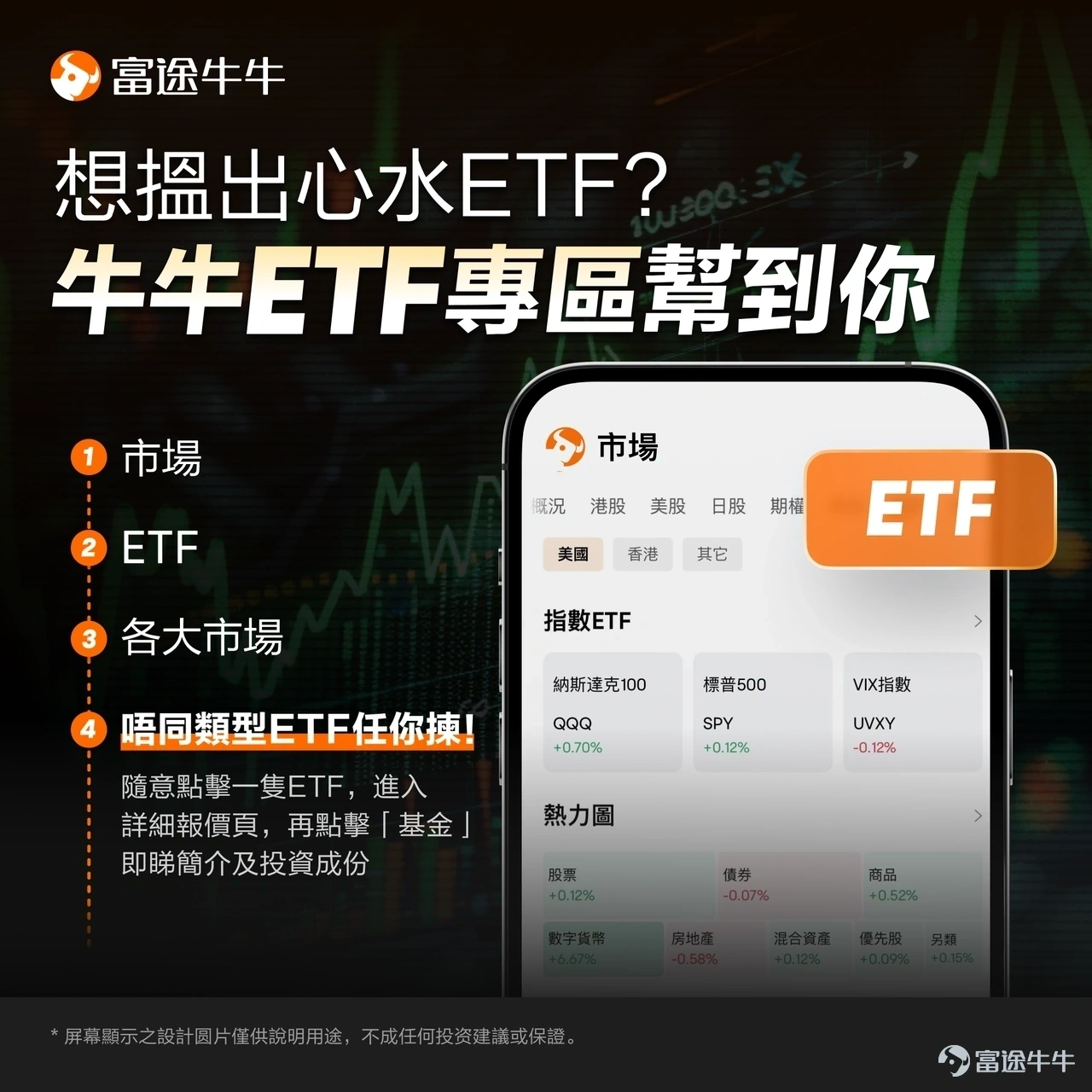
◦ How to find thematic ETFs: Futubull app > Market > ETFs > Thematic ETFs

Strategy 2: Test the waters with small capital using 'monthly contributions / dollar-cost averaging' to smooth out risk
After a sharp market decline, the worst thing you can do is go 'all-in.' If the market is still halfway through deleveraging, jumping in all at once could easily leave you trapped.
– Very low entry barrier: ETFs have very accessible entry costs—you can start with just a few hundred HKD or USD, making them ideal for testing the waters with small amounts.
– Dollar-cost averaging (DCA): In volatile market conditions, the best approach is 'small and steady.' You can set up fixed weekly or monthly investments—for example, $1,000.
◦ When the market falls, your $1,000 buys more ETF shares (automatically accumulating more at lower prices);
◦ When the market rises, your $1,000 buys fewer shares.
◦ Over time, your average purchase cost becomes very smooth—you don’t need to guess 'which day is the absolute bottom,' and you can comfortably participate in the market rebound while sleeping soundly!
🎯 Summary
A sharp market drop isn't scary—the real danger is panicking and not knowing what to do when it happens. Instead of agonizing every day over whether to buy Alibaba or Tencent, or worrying if US stocks will keep falling, why not click in now to our 【App – Markets – ETF Zone】。
From broad-based Hong Kong and US ETFs and popular semiconductor funds to defensive high-dividend ETFs, we’ve handpicked a selection of quality options for you. Based on your investment needs,first add the ETFs that interest you to your watchlist,track their daily price movements, build your intuition, and thenstart your first Hong Kong/US stock trade stress-free with a diversified basket of assets and small, regular monthly investments! 🚀
💬 Today’s topic:
Amid this major market volatility, are you planning to 'dollar-cost average into US tech stocks' or 'play it safe with high-dividend Hong Kong stocks'? Share your thoughts in the comments below! 👇
Risk Disclaimer: The above content only represents the author's view. It does not represent any position or investment advice of Futu. Futu makes no representation or warranty.Read more

Comment (1)
to post a comment
21
6