
Apple and Microsoft both raise prices! Is AI-driven inflation showing a 'backlash effect'?

US Equity Warrants Watch | Apple and Microsoft turn stronger, Tesla tests support level, Micron's toughest choice remains the warrant terms
Among these 11 US stocks, we will focus on Apple, Microsoft, Tesla, Micron, and Broadcom。
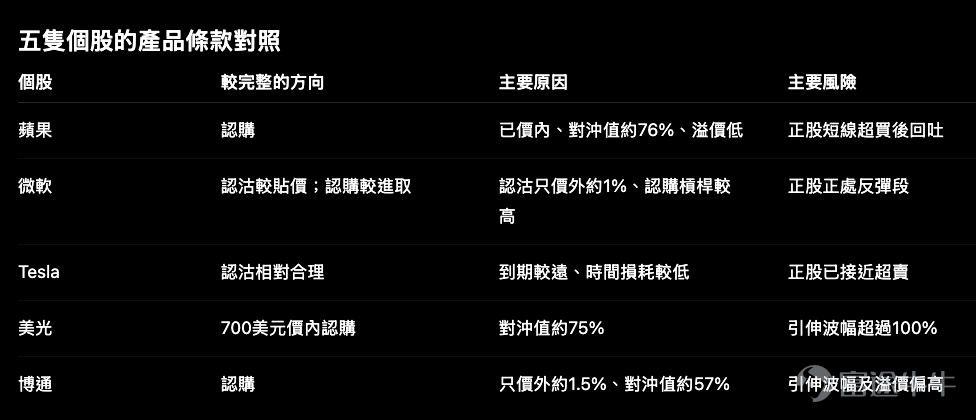
This isn't simply because their price movements have been particularly large, but because the price trends of these five stocks have formed several distinct combinations with the terms of existing warrants:
– Apple's underlying stock is strong, yet its call warrant terms remain relatively reasonable;
– Microsoft is rebounding, with both call and put warrants offering clear utility;
– Tesla is testing support levels, but its call warrants are deeply out-of-the-money;
– Micron has exhibited the highest volatility, with warrant terms also being the most extreme;
– Broadcom’s direction remains unclear, but its call warrants are relatively close to the money.
Currently, the uploaded US stock warrant products include only call and put warrants,with no stock-specific bull/bear certificates available., so the following focuses on analyzing warrants.
Apple $Apple (AAPL.US)$ : The underlying stock pulled back from a high level, but the call warrant remains one of the more intact ones among individual stocks.
Apple closed at USD 326.59, down 2.14%, retreating from a high of USD 334.99. The underlying stock remains in a clear uptrend, but its short-term RSI has retreated after rising into overbought territory; investors should manage their pace when chasing prices at this stage.
The current Apple call warrant has a strike price of 300 USD, approximately 10% in-the-money based on the product's reference price, expiring in October.
Key terms:
– Delta approximately 75.5%
– Effective leverage approximately 5.6x
– Implied volatility approximately 39.9%
– Premium approximately 3.4%
– Daily time decay of approximately 0.4%
Judging solely by its terms, this is a relatively well-structured call warrant among the current Apple equity-linked warrants. Rather than relying on deep out-of-the-money strikes to create high leverage, it achieves sensitivity through a higher delta.
For investors already bullish on Apple, the advantage of such a product is that if the underlying stock rebounds from $326 to challenge $335 again, the warrant is theoretically more likely to follow closely. Even a modest rise in the underlying doesn’t require first overcoming a distant strike price.
Conversely, Apple put warrants have a strike price of only $248—about 25.6% out-of-the-money—with a delta of roughly 5% and daily time decay exceeding 4%.
Even though these put warrants show an effective gearing of around 11x, it doesn’t mean the warrant will instantly gain 11% if the underlying drops 1%. The low delta implies limited responsiveness to initial declines in the underlying; unless Apple experiences a significant pullback, it’s common to see 'the underlying falls, but the put warrant rises only slightly.'
Apple’s current warrant structure clearly favors call warrants as more practical, while put warrants are excessively out-of-the-money.
Microsoft $Microsoft (MSFT.US)$ : Rebounding back toward the $400 level—both calls and puts have their respective uses
Microsoft closed at $402.29, up 2.15%. After rebounding from a low of $349.20, it has now broken above the middle Bollinger Band, with short-term RSI around 66.
The underlying stock’s short-term momentum is improving, but the $402–$407 range also approaches the upper Bollinger Band resistance zone. Thus, both bullish and bearish views are reasonable—the key lies in product selection.
Microsoft call warrant strike price is $450, about 13.9% out-of-the-money, expiring in October:
– Effective leverage of approximately 8.8x
– Delta of approximately 29.8%
– Implied volatility of approximately 43%
– Premium of approximately 17.3%
– Daily time decay of approximately 1.9%
This call warrant is more suitable for investors who expect Microsoft to continue a pronounced upward trend. If one only anticipates a rise from $402 to $407 or $410, the delta of around 30% may not provide strong tracking performance; moreover, a premium above 17% is not cheap.
Microsoft put warrants are entirely different. With a strike price of $390, they are only about 1.3% out-of-the-money and expire at the end of September:
– Delta of approximately 43%
– Effective leverage of approximately 6.3x
– Premium of approximately 8%
– Daily time decay of approximately 1.1%
For investors who believe Microsoft’s share price will rise to the upper Bollinger Band in the near term and then pull back, put warrants—though offering lower leverage than call warrants—actually have strike prices closer to the current share price. Their sensitivity will further increase if the underlying stock falls below around $390.
This illustrates perfectly: **higher leverage does not necessarily mean better terms.** Currently, Microsoft call warrants represent a more aggressive directional play, whereas put warrants offer a more at-the-money setup for a potential pullback.
Tesla$Tesla (TSLA.US)$ The stock price has approached the lower Bollinger Band; being bearish on the product is more reasonable than being bullish.
Tesla closed at $369.57, down 2.96%, approaching the lower Bollinger Band at $364.84, with a short-term RSI of approximately 26, entering oversold territory.
A technical rebound is likely from this level, but the overall trend remains weak. The stock has declined steadily from $498.83 and recent rebounds have failed to hold above $400.
Current Tesla call warrants have an exercise price of $490, which is about 28.3% out-of-the-money, expiring in early October:
– Delta approximately 19.4%
– Effective gearing approximately 8.2x
– Implied volatility approximately 53.4%
– Premium approximately 30.7%
– Daily time value decay approximately 2.6%
The biggest issue with this product is not whether Tesla will rebound, but whether the rebound will be large enough to drive an out-of-the-money call warrant that is nearly 30% out of the money.
Even if Tesla rebounds from $370 to $390—a gain of over 5%—it would still be far from the $490 strike price. The low delta, relatively high implied volatility, and premium exceeding 30% make the product unfriendly to small short-term rebounds.
There are two put warrants available, with strike prices of $340 and $330, respectively—approximately 11% and 13.6% out of the money—and expiring in late December:
– Delta approximately 26% to 29%
– Effective gearing approximately 3.5x to 3.6x
– Implied volatility around 56%
– Premium around 19% to 21%
– Daily time decay of approximately 0.6%
The put warrants offer relatively low leverage, but have a longer time to expiry and lower time decay, with higher delta compared to call warrants. If bearish on Tesla breaking below the $365 support level, the $340 strike series is closer to the underlying price than the $330 strike, offering better tracking.
However, the underlying stock is already in short-term oversold territory, so chasing put warrants now carries the risk of a technical rebound. This warrant series is more suitable for investors with a clear breakdown thesis, rather than those simply shorting due to a large intraday decline.
Micron $Micron Technology (MU.US)$ The underlying stock is highly volatile, and the warrant terms differ even more significantly.
Micron closed at $865.46, up 1.94%, but has pulled back significantly from its recent high of $1,254.81. The stock is now nearing the lower Bollinger Band at $790.78, with an RSI of approximately 33, indicating continued short-term consolidation in a weak position.
There are two call warrant series on Micron, but their terms are virtually worlds apart.
First type: $700 strike price, already about 19% in-the-money
– Delta approximately 75.5%
– Effective gearing around 2.4x
– Implied volatility approximately 100.8%
– Premium approximately 11.7%
– Daily time decay of approximately 0.4%
– Expires in early November
These products have relatively low leverage but high delta, offering more direct correlation with the underlying stock. For investors seeking to capture Micron’s rebound with smaller capital, the terms are relatively straightforward.
Category Two: $1,800 strike price, over 107% out-of-the-money
– Delta approximately 23.3%
– Effective leverage approximately 3.4x
– Implied volatility approximately 101.2%
– Premium approximately 114%
– Daily time decay approximately 1.4%
These products have strike prices more than double the current share price, with premiums exceeding 100%. Even if Micron’s underlying stock experiences a solid rebound, the warrants may not fully track it, as the market would need to absorb both the extreme out-of-the-money positioning and the very high premium.
More notably, the implied volatility of both call warrants exceeds 100%. Even if you opt for an in-the-money product with a $700 strike price, be mindful that a decline in implied volatility could offset part of the underlying stock’s gains.
Micron’s put warrant has a strike price of $400, approximately 54% out-of-the-money, with a delta below 7% and a premium of around 57%. Such products are also deeply out-of-the-money and thus less suitable for typical short-term bearish strategies.
Therefore, the real choice for Micron isn’t simply ‘buy calls or puts,’ but rather:
Can you accept implied volatility levels above 100%, given that the market currently offers only one in-the-money call warrant that reasonably tracks the underlying stock?
This is also the stock among all individual names this time requiring the most caution in product selection.
Broadcom $Broadcom (AVGO.US)$ The underlying stock is trading sideways; the call warrant is near-the-money, but implied volatility remains relatively high.
Broadcom closed at $378.16. Recently, the underlying stock has mostly consolidated between $360 and $400, with the Bollinger Bands’ midline around $380—no clear breakout direction yet.
Broadcom’s call warrant has a strike price of $380, just about 1.5% out-of-the-money, expiring in December:
– Delta approximately 57.3%
– Effective leverage of approximately 4x
– Implied volatility of approximately 58.5%
– Premium of approximately 16%
– Daily time decay of approximately 0.5%
The warrant’s moneyness and delta are both reasonable. If Broadcom rebounds above $400, this call warrant theoretically has the potential to follow suit.
However, a 16% premium and implied volatility close to 59% are not cheap. If the underlying stock continues trading sideways between $360 and $390, even with daily time decay of only about 0.5%, a decline in implied volatility could still pressure the warrant’s performance.
The put warrant has a strike price of $280, is about 25% out-of-the-money, has a delta of approximately 17%, and a premium close to 30%. By comparison, the terms of this bearish product are clearly weaker.
Thus, bullish products on Broadcom currently offer better structures, but investors should wait for a clearer breakout in the underlying stock to more easily offset the relatively high implied volatility and premium.
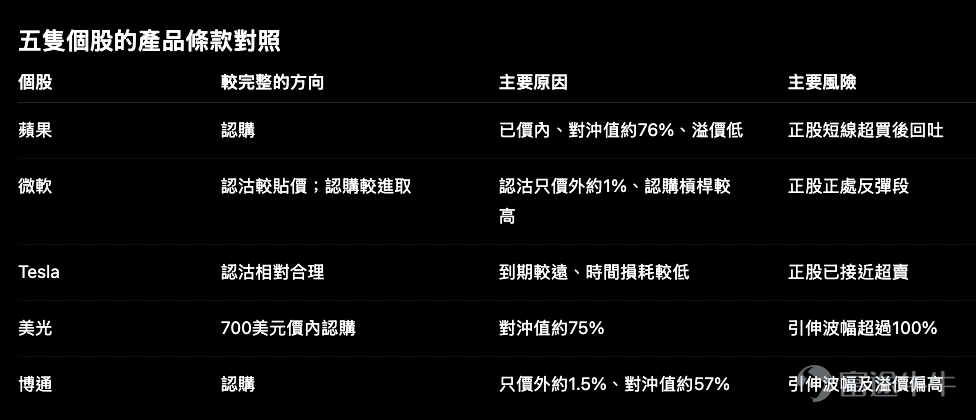
A key commonality across individual stocks in this market is the extremely limited selection of warrants—many stocks have only one call and one put available. In such cases, investors may not find ideal terms and shouldn’t feel compelled to accept a deeply out-of-the-money, high-premium, low-delta product just because they’re bullish on a particular stock.
Being right on the underlying stock’s direction is only the first step. What matters more in actual trading is whether the warrant can effectively track the move, how large a price change is needed before it becomes sensitive, and how much time decay and implied volatility risk you’ll need to endure during the holding period.
Risk Disclaimer: The above content only represents the author's view. It does not represent any position or investment advice of Futu. Futu makes no representation or warranty.Read more


Comments
to post a comment
3
1