
Technology Research Institute: CPI data is about to be released! What opportunities are there amid t

US Equity Index Derivatives Watch | All three major indices pulled back in unison, but the selection of bull/bear certificates and warrants is asymmetric
After a recent rally, the three major U.S. stock indices have started consolidating at higher levels in the short term.
The Dow closed at 51,839 points, down 0.59%; the Nasdaq 100 closed at 28,604 points, largely flat; the S&P 500 closed at 7,443 points, down 0.19%. Chart analysis shows all three indices have pulled back from recent highs, but to varying degrees: the Dow and S&P 500 remain relatively close to their medium-term uptrend ranges, while the Nasdaq has already retreated near the lower Bollinger Band, indicating relatively clear short-term downside pressure.
We believe everyone has their own views on the market’s next direction. Rather than rushing to predict which index will rebound first, we’ll focus instead on:Given your existing bullish or bearish outlook, which currently available callable bull/bear contracts (CBBCs) and warrants have terms best suited to your view?

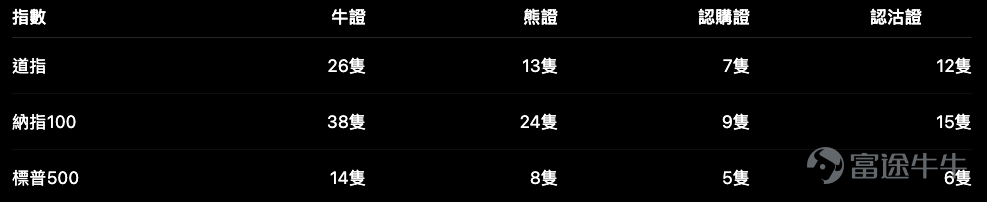
The Nasdaq offers the largest number of products, with the most comprehensive range of terms; the Dow follows next. Although fewer S&P 500 products are available, some of its call warrants actually trade closer to the underlying price than those on the Dow, so they’re not necessarily at a disadvantage.
Dow Jones Industrial Average $Dow Jones Industrial Average (.DJI.US)$ : Approaching short-term oversold territory; bull certificates should not solely chase the highest leverage
The Dow Jones Industrial Average fell from 53,289 pointsfrom its high down to 51,839 points. It has now broken below the Bollinger Bands middle band at 52,320 points but remains above the lower band around 51,512 points. The short-term RSI has dropped to approximately 28, technically approaching oversold levels.
For those bullish on a short-term Dow rebound, there are currently 26 bull certificates available, with call prices ranging from 50,000 points to 40,100 points, representing knock-in distances of roughly 4.1% to 23.1%。
The closest-to-the-money bull certificate with a call price of 50,000 points offers leverage of about 16.9x but has only a 4.1% buffer. Such products are most sensitive to intraday rebounds; however, the Dow remains in a pullback phase. If it breaks below the 51,500-point level again, it would be just about 1,500 points away from the call price, leaving limited downside protection.
If you remain bullish but are not purely day-trading, we would pay closer attention to:
– Knock-in level around 49,000 to 48,000 points
– Distance to knock-in around 6% to 8%
– Leverage around 10x to 13x
– Premium around 1.1% to 1.4%
This set won't be as sensitive as the bull certificates with a 50,000-point strike, but it has better resilience if the index tests lower levels again.
On the bearish side, the knock-in levels of Dow Jones bear certificates are concentrated around 54,000, 55,000, 56,000, and 57,000 points. Among these, the bear warrant with a call-back level at 54,000 points is approximately 3.6% away from the current index level, offering leverage of about 31x to 34x.
The issue is that the Dow Jones RSI has already fallen to a relatively low level. Choosing the bear warrant with the nearest call-back level may make it difficult to hold—even if your directional view is correct—because any technical rebound in the index could quickly erode the product’s price. Therefore, if you are moderately bearish but not chasing the immediate downside momentum, bear warrants with call-back levels at 55,000 or 56,000 points—approximately 5.5% to 7.4% away—offer a more reasonable risk profile.
Problem with Dow Jones warrants: Most are deeply out-of-the-money
There are only seven Dow Jones call warrants available, with strike prices ranging from 55,000 to 60,000 points—all approximately 5.5% to 15.1% out-of-the-money, with deltas of only about 17% to 25%.
In other words, even if the Dow Jones rebounds, deeply out-of-the-money products may not immediately track the underlying move closely. Among them, those with strike prices closer to the current level (55,000 to 55,275 points) offer effective leverage of roughly 23x to 28x, but their daily time decay exceeds 2%, with some approaching 3%.
The problem is even more pronounced for bearish put warrants: most are approximately 14% to 21% out-of-the-money, with many having deltas below 10%. If you only anticipate a modest pullback in the Dow Jones, these deeply out-of-the-money puts may lack sufficient sensitivity.
Therefore, for short-term directional plays on the Dow Jones at this stage, bull/bear warrants are generally more straightforward than derivative warrants (CBBCs vs. traditional warrants), which come with lower sensitivity and noticeable time decay.
Nasdaq-100 $NASDAQ 100 Index (.NDX.US)$ : Offers the widest product selection, but the risk profiles on the bull and bear sides are asymmetric
The Nasdaq has declined from its recent high of 30,762 points to 28,604 points, nearing the lower Bollinger Band at approximately 28,553 points, with a short-term RSI around 31. This is a level prone to technical rebounds, though it has not yet reclaimed the middle Bollinger Band at 29,446 points.
There are 38 Nasdaq bull certificates in total—the highest among the three major indices.
The two closest-to-the-money ones have call prices at 28,000 points, just about 2.1% away from the current index level, with leverage of approximately 23x to 26x. Such products are already in a highly aggressive zone: a typical daily move in the Nasdaq during regular U.S. trading hours could be enough to bring them close to their call price.
Therefore, bullish positioning on a Nasdaq rebound can be divided into three groups:

We are particularly focused on the middle group, which offers a relatively balanced trade-off between sensitivity and call risk. Although the 28,000-point bull certificate offers high leverage, the Nasdaq is currently near its lower Bollinger Band, meaning any pre-market or overnight volatility could rapidly narrow the distance to the call price.
On the bearish side, the nearest existing bear certificates have call prices as high as 31,000 points, roughly 8.4% above the current level, with leverage around 15x to 16x; the rest are even farther away, ranging from 10% to 19% above.
This means there are no near-the-money Nasdaq bear certificates available. The advantage is relatively low call risk, but the downside is that these products may not be very responsive to modest declines. If one only expects the Nasdaq to fall from 28,600 to around 28,000 points, bear certificates with call distances over 8% may not deliver gains as strong as anticipated.
Nasdaq call warrants: Near-the-money products are actually more analytically valuable
Although there are only nine Nasdaq call warrants, their terms fall into two extremes:
– Strike prices from 28,800 to 28,944 points: only about 0.7% to 1.2% out-of-the-money
– Strike prices from 32,000 to 35,800 points: approximately 12% to 25% out-of-the-money
The first group has delta values of roughly 49% to 51% and effective gearing of about 9.5x to 10.9x, clearly tracking the index more closely. The second group, while offering headline gearing of up to around 13x, has deltas as low as approximately 11%, meaning larger index movements are required to truly realize gains.
Therefore, for investors bullish on a Nasdaq rebound who wish to avoid the knockout risk of bull certificates, near-the-money call warrants expiring in September offer a more complete alternative. However, time decay erodes their value by about 1.2% to 1.3% per day—if the index continues to trade sideways, their price will still be eaten away by time decay.
On the put side, products with a strike price of 29,000 points are slightly in-the-money, with a delta of approximately 45% and effective gearing of about 6.1x; the closer-to-the-money puts with a 28,000-point strike are about 2.1% out-of-the-money and have a delta of around 38%.
While this group doesn’t offer high gearing, it is more practical than deeply out-of-the-money put warrants. For those bearish on the Nasdaq, the key consideration isn’t the deeply out-of-the-money products with 12x gearing, but whether one can find near-the-money terms with a delta close to 40%.
S&P 500 $S&P 500 Index (.SPX.US)$ : Fewer bull/bear certificate choices, but call warrant terms are more consistent
The S&P index pulled back from its high of 7,621 points to close at 7,443 points—slightly below the middle Bollinger Band at 7,476 points, yet still above the lower band at 7,338 points. RSI stands at around 36, weaker than neutral but not yet approaching clear oversold territory like the Dow or Nasdaq.
There are 14 S&P bull certificates in total, with the nearest knockout level at 7,200 points, approximately 3.5% away, with leverage of about 17.4x. The next knock-out level is at 7,000 points, roughly 6.1% away, where leverage drops to around 12x.
Since the index is currently only about 100 points above the lower support band, bullish CBBCs with a 7,200-point call price offer high sensitivity if you expect a short-term rebound, but the risk is also very direct. If your holding period exceeds a day or two, CBBCs with a 7,000-point knock-out level would be easier to manage.
The closest knock-out level for bear CBBCs is at 7,700 points, approximately 3.3% away, with leverage of about 33.8x; next is 7,800 points, roughly 4.6% away, with leverage between 25x and 27x.
Products on this side are highly aggressive. The index has not yet broken below the lower support band. If chasing bear CBBCs, the biggest risk is the index oscillating near 7,400 points—over a short timeframe but causing extreme price volatility in these products.
Notably, among S&P 500 Index call warrants, three have strike prices around 7,200 to 7,236 points, already 3% to 3.5% in-the-money, with delta around 64% to 65%, effective gearing of approximately 11x, and only about 2.6% premium.
Compared with deeply out-of-the-money products linked to the Dow Jones and Nasdaq indices, this group of call warrants actually has a more robust structure:
– Already in-the-money
– Delta exceeds 60%
– Premium of approximately 2.6%
– Daily time decay of about 0.7% to 0.8%
– No call warrant knock-out mechanism
Therefore, for investors bullish on the S&P Index who wish to avoid knock-out risk, these call warrants offer the most straightforward terms among the three indices.
How do we evaluate the three indices?
If we consider only product structure without forecasting market direction:
– Nasdaq: Offers the widest selection, with both at-the-money calls and puts relatively well-covered, but the 28,000-level bull warrants are too close to the knock-out barrier.
– S&P Index: Has the fewest products, but the in-the-money call warrants have more balanced terms.
– Dow Jones Industrial AverageThere is a sufficient selection of callable bull/bear certificates (CBBCs), while warrants are generally deep out-of-the-money and exhibit weaker tracking performance.
The market is currently consolidating at elevated levels. What truly matters now is not just whether you're bullish or bearish, but whether the product can keep pace with the expected magnitude of movement. Even if you correctly anticipate the direction, choosing a product with low delta, deep out-of-the-money strike, or a knockout barrier too close to the current price could still lead to results vastly different from your expectations.
Risk Disclaimer: The above content only represents the author's view. It does not represent any position or investment advice of Futu. Futu makes no representation or warranty.Read more

Comments
to post a comment
1