
Hong Kong stocks are rebounding—what sectors deserve attention?

Hang Seng Index Callable Bull/Bear Certificates (CBBC) Market Watch | The index has reclaimed the 25,000 level; next, we need to see if it can firmly hold between 25,155 and 25,211
Hang Seng Index $Hang Seng Index (800000.HK)$ closed at 25,143 points, rising by 580 points or 2.36%, rebounding steadily from the intraday low of 24,756 points and closing near the session high of 25,155 points. The strength of this rebound was solid, but the index has now reached a short-term zone dense with resistance levels. When selecting bull or bear certificates going forward, investors should not focus solely on today’s gain but pay closer attention to where the call price is set.
Currently, the representative CBBCs listed in the product overview have knock-in buffers primarily ranging from 4.8% to 5.4%. This range is not particularly tight, yet the leverage remains close to 19x, making these instruments more suitable for capturing confirmed short-term directional moves rather than blindly chasing prices ahead of resistance zones.
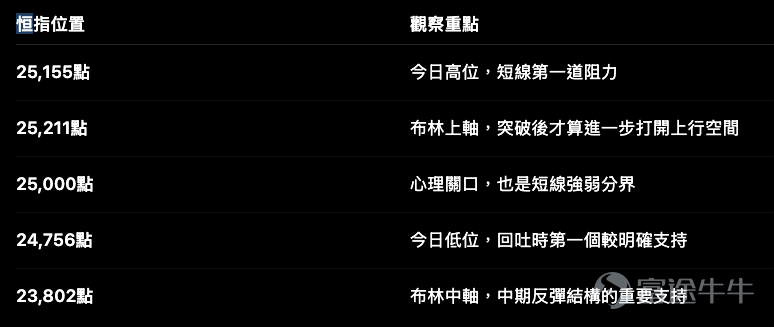
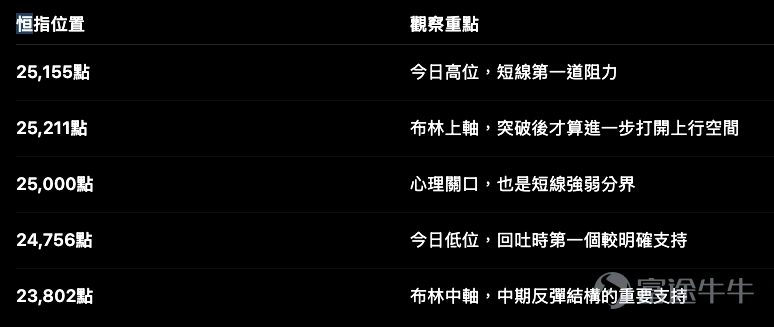
Key technical levels: 25,155 is the first hurdle; 25,211 is the more critical confirmation level
The Hang Seng Index reached a high of 25,155 pointstoday, closing at 25,143 points. The first resistance level to watch is naturally the intraday high of 25,155 points.
Moving higher, the upper Bollinger Band is around 25,211 points. In other words, although the Hang Seng Index has reclaimed the 25,000-point level, it has not yet fully broken through this short-term resistance zone.
Key levels to monitor for now include:
The short-term RSI indicator has risen to approximately 72.2, indicating clear rebound momentum but also entering an overbought territory. This doesn't necessarily mean the Hang Seng Index will immediately pull back; it simply suggests that entering bullish warrants at current levels requires stricter timing compared to when the index was still near 24,000 points.
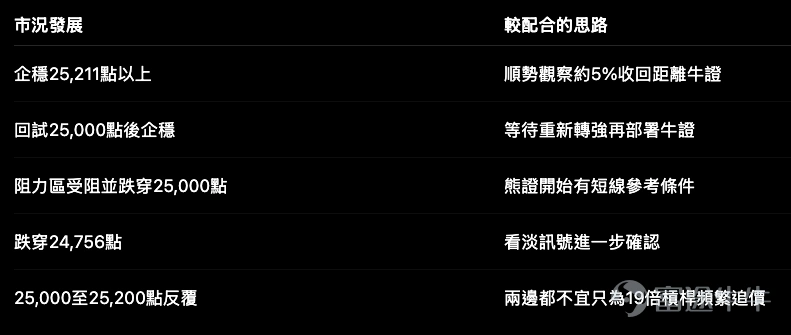
Therefore, we will treat the 25,155–25,211 point range as a confirmation zone:
– If the index stabilizes above this zone, deploying bullish warrants would be more favorable;
– If it fails to break through and falls back below 25,000 points, bearish warrants would start to present clearer short-term setups;
– If it merely trades sideways between 25,000 and 25,200 points, highly leveraged products on both sides could easily suffer from whipsaw volatility.
Bull warrant distribution: Call prices clustered around the 23,900 level
Two representative bull warrants listed in the product overview have very close call prices:

The call prices of these two products differ by only 30 points, and their leverage ratios and bid-ask spreads are also very similar. Based solely on terms, BNP Paribas 60039 has a slightly higher call price, resulting in a marginally shorter distance to call and slightly higher leverage; UBS Group 57410 offers approximately 30 extra points of buffer.
This 30-point difference isn’t substantial, but in a sharp Hang Seng Index (HSI) downturn, a lower call price still provides a bit more defensive cushion.
It’s worth noting that both bull warrants have call prices near the 23,900 level—over 800 points below today’s low of 24,756. These products aren’t the most aggressive, at-the-money bull warrants. Their advantage lies in avoiding premature calls due to normal intraday volatility; however, their drawback is that if the HSI rises only 100–200 points, their leveraged response may be less pronounced compared to closer-to-the-money products.
How should one allocate positions for a moderately bullish stance?
For investors bullish on the HSI breaking above 25,211, this pair of bull warrants—with call distances of approximately 5%—offers a more balanced choice.
We place greater emphasis on two scenarios:
Deployment following a breakout
If the HSI breaks above 25,211 and doesn’t immediately retreat after a brief spike, observe whether the bull warrant price tracks the index normally. At that point, using products with a call distance of roughly 4.8% to 4.9% is more reasonable than placing bets ahead of the resistance level.
Rebounds and stabilizes after testing the 25,000 level
If the Hang Seng Index first retraces to around 25,000 points and then moves upward again, the entry point is usually more comfortable than chasing near the day's high. However, if it breaks below 25,000 and continues falling, attention should shift to whether 24,756 can hold.
Between the two products, if greater emphasis is placed on downside buffer, UBS Group’s 57410 with a call price of 23,900 points may be preferred; if one is willing to accept a slightly closer call price in exchange for marginally higher leverage, BNP Paribas’ 60039 offers slightly more aggressive terms.
Bear warrant distribution: Call prices concentrated between 26,400 and 26,488 points
This represents a similar call distance of approximately 5% for bear warrants:

Merrill Lynch’s 58165 has a closer call price and slightly higher leverage; UBS Group’s 57776 has a call price 88 points higher, expanding the call distance to 5.35% and offering slightly more downside cushion.
The Hang Seng Index currently trades at 25,143 points, and both bear warrants have call prices above 26,400 points. Even if the index breaks above 25,211 points, it would still remain over 1,100 points away from the call price, meaning normal upside moves won’t immediately trigger a call.
However, this doesn’t mean it’s suitable right now to buy bear warrants solely because the RSI is elevated. The Hang Seng Index closed near today’s high, indicating short-term momentum remains intact. Deploying bear warrants requires clearer price signals—not just the fact that the market has risen significantly.
What should bearish positioning wait for?
The first scenario is if the Hang Seng Index repeatedly fails to break through the 25,155–25,211 range and subsequently falls back below 25,000 points. This would indicate resistance is taking effect, providing clearer short-term conditions for bear warrants.
The second scenario is the Hang Seng Index falling below today's low of 24,756 points. If it even breaches the starting point of today’s entire rebound, the correction could widen further.
Regarding product selection:
– For those seeking slightly higher leverage and a more aggressive position, consider Morgan Stanley CBBC 58165;
– For those preferring a wider buffer to the call price, UBS Group CBBC 57776 has a relatively distant call price of 26,488 points.
The leverage difference between the two is only 0.3x; what truly matters isn’t which product shows a higher number, but whether the investor is comfortable with a closer call price.
Both bull and bear warrants offer leverage of around 19x; at this point, the entry signal is more critical.
In this product overview, the terms of Hang Seng Index bull and bear warrants are fairly symmetrical:
– Bull warrant call price buffers are approximately 4.82% to 4.94%
– Bear warrant call price buffers are approximately 5.00% to 5.35%
– Leverage on both sides is approximately 19x
– This indicates the product’s bid-ask spread is roughly one tick.
Therefore, neither side currently offers significantly more favorable terms. The product itself provides similar offensive and defensive conditions; what ultimately determines the outcome is whether the Hang Seng Index can break above 25,211 points or fall back below 25,000 points.
We’ll simplify the current market situation as follows:
Using warrants as an alternative: How to choose if you want to avoid knock-out risk?
For those bullish on the Hang Seng Index but wishing to avoid the mandatory knock-out risk of bull certificates, please note the following in the product overview:
– UBS Group 25916: Strike price at 25,000 points, approximately 0.6% in-the-money, with an effective leverage of 9.7x;
– UBS Group 13632: Strike price at 25,800 points, approximately 2.6% out-of-the-money, with an effective leverage of 10.2x;
– Citi 14246: Strike price at 26,200 points, approximately 4.2% out-of-the-money, with an effective leverage of 8.9x.
If merely anticipating a continuation after breaking through 25,211 points, the closer-to-the-money UBS Group 25916 would be more direct than deeply out-of-the-money products; only consider strike prices at 25,800 or 26,200 points if expecting a further expansion in gains.
On the bearish side, UBS Group 13336 has a strike price of 24,200 points, about 3.8% out-of-the-money, with an effective leverage of 7.9x; HSBC 29787 has a strike price of 23,800 points, about 5.3% out-of-the-money, with an effective leverage of 9.9x. The former is closer to the money, while the latter offers higher leverage but demands a larger decline.
Summary: 25,000 points is not the endpoint—25,211 points is the key level to test this rebound.
The Hang Seng Index rose 580 points in a single day, significantly improving market sentiment, though the closing level landed precisely within the short-term resistance zone.
Currently, both bull and bear warrants have knock-out distances of around 5%, with leverage concentrated near 19x, indicating relatively balanced terms. For bullish positioning, the key is awaiting confirmation of a breakout above 25,211 points; for bearish positioning, first monitor whether 25,000 points and 24,756 points hold.
What should be most avoided here is chasing bullish warrants right before resistance just because the Hang Seng Index surged sharply, or immediately buying bearish warrants against the trend simply because RSI has moved into overbought territory. With leverage close to 19x, even normal intraday swings of several hundred points can significantly magnify losses or gains if the entry point isn't ideal.
We believe everyone has their own view on the Hang Seng Index's outlook. At this stage, would you place more emphasis on a breakout above 25,211 points, or are you concerned about losing the 25,000-point level again?
Risk Disclaimer: The above content only represents the author's view. It does not represent any position or investment advice of Futu. Futu makes no representation or warranty.Read more

Comments
to post a comment
4