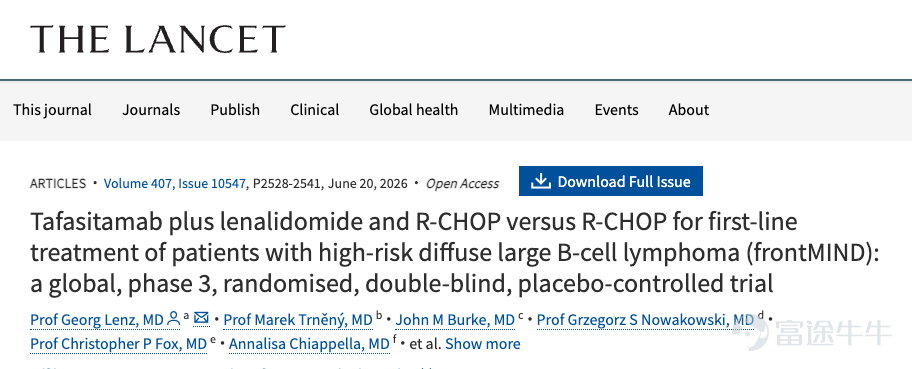

The Lancet publishes Phase III trial results of tafasitamab combination therapy for previously untreated DLBCL
The international top-tier medical journal The Lancet recently published results from the global Phase III frontMIND study evaluating tafasitamab combination therapy in patients with previously untreated diffuse large B-cell lymphoma (DLBCL). The results showed that, compared with the standard R-CHOP regimen, the tafasitamab plus lenalidomide and R-CHOP regimen (tafa-Len-R-CHOP) reduced the risk of disease progression or death by 25% and significantly improved progression-free survival. Post-hoc analysis in patients confirmed as having DLBCL following central pathology review demonstrated even more pronounced clinical benefit.
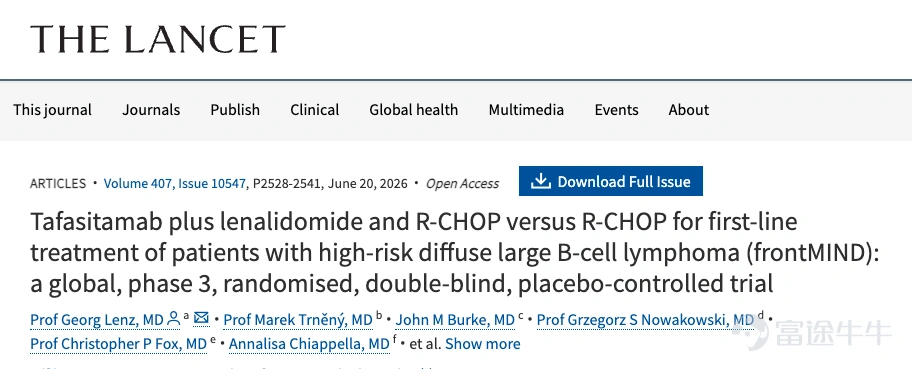
The frontMIND study is a randomized, double-blind, placebo-controlled international multicenter trial designed to identify a first-line treatment regimen with superior efficacy and safety compared to R-CHOP.
After a median follow-up of 35.2 months, the tafa-len-R-CHOP regimen reduced the risk of disease progression or death by 25% compared to R-CHOP (hazard ratio HR=0.75, P=0.0194), increasing the 2-year progression-free survival (PFS) rate by 8.2% and the 3-year PFS rate by 6.6%.
Across all pre-specified subgroups, the tafa-Len-R-CHOP regimen consistently demonstrated a trend toward improved progression-free survival, including across lymphoma subtypes confirmed by central laboratory testing and molecular subtypes based on cell-of-origin (COO)—namely activated B-cell-like (ABC) and germinal center B-cell-like (GCB).In patients with ABC subtype, the PFS benefit in the tafa-Len-R-CHOP arm was particularly pronounced (HR=0.59).
Following central pathology review, the 24-month PFS rates were 72.7% in the tafa-Len-R-CHOP group and 62.2% in the R-CHOP group, demonstrating superior efficacy.
Geographically, the tafa-Len-R-CHOP regimen showed a more pronounced efficacy advantage in Asian patients.
In terms of safety, the adverse event profile of the Tafa-Len-R-CHOP regimen was consistent with expectations; the addition of tafasotuzumab and lenalidomide did not affect the dosing or scheduling of the R-CHOP regimen.
At the recently concluded 2026 annual congress of the European Hematology Association (EHA), results from the frontMIND study were presented as a late-breaking oral presentation during the plenary session—the highest-level forum of the meeting.
Diffuse large B-cell lymphoma (DLBCL) is the most common lymphoma worldwide, accounting for 25%–45% of non-Hodgkin lymphomas. It is highly heterogeneous, and patients with intermediate-high or high-risk DLBCL or high-grade B-cell lymphoma (HGBL) have poor prognoses. R-CHOP remains the standard first-line curative regimen for DLBCL; however, approximately 40% of high-risk patients exhibit primary resistance or relapse after treatment, resulting in persistently low overall survival rates in this population. The tafa-Len-R-CHOP regimen has the potential to become a novel first-line treatment option for high-risk DLBCL and HGBL.
The Lancet is one of the world’s four leading general medical journals. According to the 2026 Journal Citation Reports (JCR) released by Clarivate, the journal’s latest impact factor is 109.0, ranking it first among general and internal medicine journals globally.
Risk Disclaimer: The above content only represents the author's view. It does not represent any position or investment advice of Futu. Futu makes no representation or warranty.Read more
Comments
to post a comment