
Who captures value in Web 2.5?
Article author: Bryan Daugherty
Article translated by: Block Unicorn
For most of financial history, moving money was the hard part—the challenge lay in getting funds from point A to point B, which often required routing through a series of banks, each taking a cut. Sometimes, this even involved cross-border transfers.
Over the past decade, cryptocurrencies andstablecoinshave promised to minimize these frictions through crypto applications and wallets. But if these funds can’t be used across the broader economy, then fast, low-cost transfers become meaningless. Dollars stranded in a crypto wallet are worth less than their real-world value. That’s why crypto is now increasingly serving as improved infrastructure for transferring existing traditional assets.
The convergence of old and new financial systems has given rise to a new intermediary layer, where value is being captured. In today’s article, I’ll explore who is capturing that value in this emerging layer.
For over a decade, the cryptocurrency industry has been trying to convince people to download wallets, bridge assets across different blockchains, and deposit funds into new applications. But people won’t abandon systems they’ve known and used for decades just to try something new. No merchant wants to accept payments via blockchain only to watch that money sit idle in their wallet while they figure out how to convert it back into a bank account they can use for everyday expenses. Transferring funds from a wallet to a bank account incurs fees and, in most cases, requires compliance checks.
The problem was never about cryptocurrency’s ability to transfer funds instantly; it was always about its architecture requiring people to give up systems they already use—such as bank accounts, credit cards, and payroll infrastructure—in favor of entirely new ones. On-ramps, off-ramps, and bridges are friction points that should be hidden, not features to boast about. People will always adopt new technologies that let them move their existing funds faster and more cheaply into the accounts they already have.
The ideal infrastructure positions cryptocurrency as an efficient, invisible enabler and underlying layer for traditional finance. We refer to this optimal state as 'Web 2.5.' While the term may sound awkward, the idea behind it is to combine the best of both worlds. We retain the strengths of traditional finance—regulation, licensing, verification, and the user interfaces and experiences people already trust and use—and integrate them with the low-cost, programmable, and always-on settlement capabilities offered by cryptocurrency. The two don’t need to replace each other. Banks remain banks, while cryptocurrency breathes new life into legacy financial infrastructure that has long been slow and outdated.
But if cryptocurrency becomes an invisible underlying layer while traditional finance remains the familiar surface, where does value accrue in this new Web 2.5 world?
Historically, the layer connecting two major financial systems has generated more value than most of the institutions it connects. Visa reported an operating profit of $24 billion last fiscal year (ending September 2025), earning less than one percent in fees per transaction on its network—yet still achieving an operating margin of 60%. The Depository Trust & Clearing Corporation (DTCC), which is currently building its own on-chain settlement system,DTCCprocessed $47 trillion worth of securities transactions in 2025 and earned $2.9 billion in profit.
Both sides are now building translation layers that allow banks to maintain their existing infrastructure while converting ISO 20022 instructions into on-chain settlement.
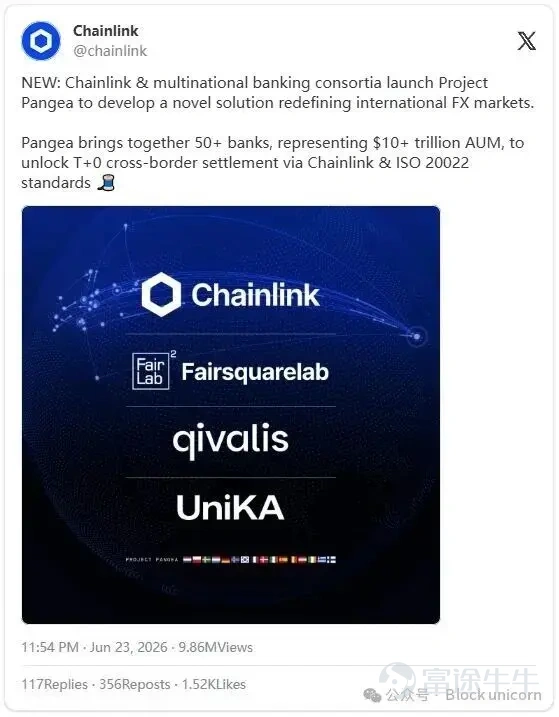
On June 23, Chainlink and a consortium of over 50 European and South Korean banks—collectively holding approximately $10 trillion in assets—announced the launch of Pangea project to test real-time settlement for foreign exchange transactions.

The goal is to transition foreign exchange settlement infrastructure from the traditional T+2 cycle to a real-time T+0 model.
Chainlink’s Compute Runtime Environment (CRE) acts as an orchestration layer, connecting blockchains with external payment systems without requiring manual routing or bridging. It converts each standard instruction into an on-chain atomic swap and returns the result to the banking system for processing.
Chainlink is a relatively new technology. Yet DTCC, a 50-year-old institution at the heart of the U.S. market that processed approximately $4.7 trillion in securities transactions last year, has chosen the same Chainlink runtime to support its collateral application chain.
On the traditional institutional side, SWIFT serves as an example. According to early predictions about cryptocurrency, SWIFT was precisely the kind of institution blockchain was supposed to replace. Many forecast that stablecoins would bypass this messaging monopoly. Eight years ago, this bank-oriented global messaging network stated that blockchain was “not yet ready for mainstream adoption.” Yet today, SWIFT is collaborating with more than 40 banks to build a blockchain-based shared ledger.
This is not a replacement for the SWIFT network but rather an orchestration layer built on top of it. The movement of funds on-chain was never the real threat. What concerns SWIFT is being excluded from the layer that determines how those funds flow on-chain. As long as it can participate and retain a voice in decision-making, it remains in the game—and so it is building that layer itself.
Even sovereign states are rushing into this space to capture value. The Bank for International Settlements (BIS) has convened seven central banks and over 40 private-sector institutions to jointly launch Project Agorá, aiming to test atomic settlement using tokenized central bank reserves.

But is the real value truly in bridging two financial giants and/or banking behemoths?
A translation layer that merely enables dialogue between two parties is likely to be more valuable than the participants themselves.
Visa and MasterCard were originally routing networks between banks and merchants. Even today, they hold no deposits, issue no cards, and assume no risk. Yet Visa’s market capitalization exceeds that of every bank globally except JPMorgan.

The value generated by operating a translation layer goes far beyond money. Those who control the flow of funds also hold the power to shut off that channel at will.
The SWIFT system was launched in 1973 as a simple method for banks to exchange standardized messages. Fifty years later, it wields significant power to impose sanctions on entire countries. Over the past decade, SWIFT has played a pivotal role in economic warfare—for instance, sanctioning Russia over its war in Ukraine. It has also enforced EU sanctions against Iranian banks to curb the country’s nuclear program, later easing those restrictions as progress was made on a nuclear deal.
Chainlink’s current pilot collaboration with Project Pangea on addressable liquidity pools for real-time foreign exchange settlement is highly significant.
Cross-border payments amount to between $150 trillion and $190 trillion annually and are projected to exceed $250 trillion by 2030. If Chainlink and its consortium of 50 partner banks capture even 1% of this market, its total addressable market (TAM) would surpass $1.5 trillion. Charging just 0.1% in fees, Chainlink could generate $1.5 billion in revenue by bridging traditional finance with on-chain settlement.
But there’s a caveat: both SWIFT and Visa became dominant standards in their respective domains, eventually forcing the entire ecosystem to adopt them. In each domain, there is only one winner—and that position solidifies over decades.
Today, four distinct models—protocol, market utility, bank cooperative, and central bank club—are all competing to become the single translation layer connecting the financial worlds of Web 2.0 and Web 3.0.
The economic mechanisms driving this layer of value have long existed. As payment rail technology has advanced, transaction processing itself has increasingly become commoditized. With the cost of moving money declining, the extractable value now concentrates primarily in two areas. The first is authorization—the power held by those who determine whether a transaction can proceed and under what conditions. The second is float income—the interest earned on funds while they sit idle awaiting transfer.
We previously wrote about how payments between AI agents operate (see here and here). Today, the same logic applies to interbank settlements.
This is precisely what makes the intermediary coordination layer worth fighting over. It creates a two-sided network effect: the more banks connect on one side, the more attractive the settlement provider becomes on the other—and vice versa. Each additional institution raises the cost for existing participants to exit. While competition exists among individual banks and blockchains, the entity managing the coordination layer can serve all banks and blockchains alike and collect fees from them.
Stripe employs the same strategy in the credit card payment space. Through a simple, developer-friendly API suite, it enables businesses of all sizes to easily accept and manage online payments—hiding the complexity of payment processors, acquirers, and payment networks behind the scenes. It then charges all users fees to eliminate transaction friction and keep that complexity hidden.
This is why the connectivity layer has become a prime acquisition target. Once someone builds this layer, others prefer to acquire it outright rather than rebuild from scratch. We saw this five years ago when Visa agreed to acquire Plaid for $5.3 billion. Although the deal ultimately collapsed due to an antitrust lawsuit filed by the Department of Justice, the intent was clear: Visa sought to acquire the market share of Plaid’s connectivity layer, which links thousands of fintech applications to bank accounts.
The world of Web 2.5 holds more promise than the fully decentralized, utopian vision of Web 3.0 because it doesn’t require capital to flee existing players in search of services offered by crypto. Instead, it treats crypto as a more efficient underlying infrastructure for moving money and assets within the existing ecosystem.
Although bank-side initiatives—including Pangea, DTCC’s AppChain, and Agorá—are still in pre-production, we are optimistic about the direction taken by players like Chainlink. For years, the crypto community has been locked in internal debates over how to build better crypto-native applications to lure users away from traditional payment rails. Developers have argued endlessly about which blockchain has the lowest gas fees or which token is best for storing value. Web 2.5 renders these debates obsolete by stripping away all jargon and hiding the infrastructure in the background.
The internet we use is essentially packets of information transmitted across a global network of computers. While that’s certainly interesting knowledge, it’s nothing to brag about if you just want to go online. No one cares whether the technology enabling these lightning-fast, low-cost transactions is cryptocurrency or something else entirely.
Blockchains are gradually becoming commoditized—an interchangeable, invisible, and low-margin component of transactions. Their value now lies in the business models built around the flow of money, granting participants influence over how and whether funds move.
Risk Disclaimer: The above content only represents the author's view. It does not represent any position or investment advice of Futu. Futu makes no representation or warranty.Read more

Comments
to post a comment
1