
From Papi Jiang to Jiang Sida’s 'Long Talk,' are celebrity interviews the new form of 'reality TV'?
Author | Akagi Binzi
Edited by Mia
"OMG, you scared me! Your taste doesn’t match mine at all—how could you possibly like something like this?..."
In early July, self-media creator Papi Jiang released a single titled 'Angry,' with lyrics written by her team and music composed and performed by AI. Paired with its quirky lyrics and catchy melody, clips of the song quickly went viral on social media platforms, garnering over 2.5 million likes on Douyin within just a few days of its release.
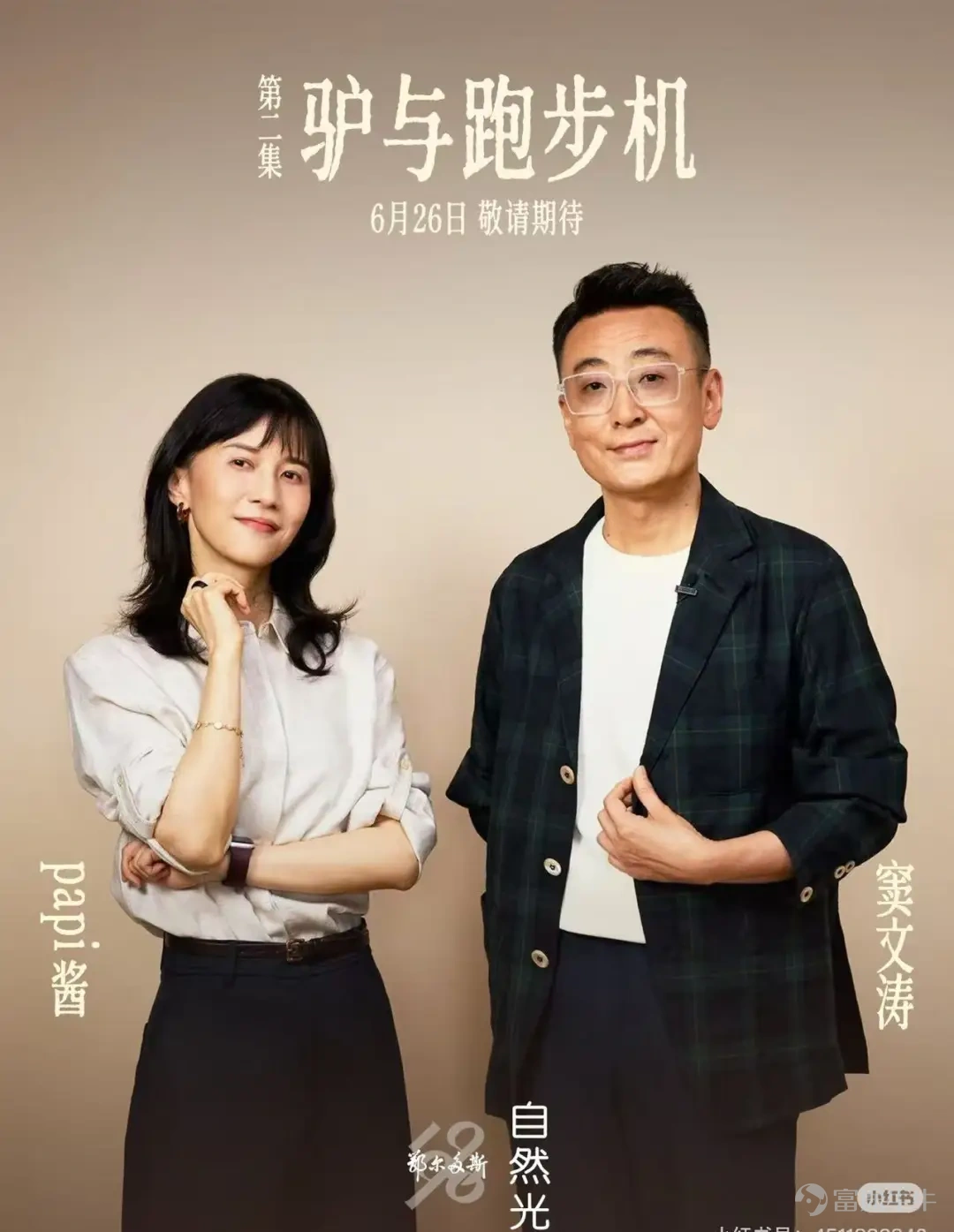
Interestingly, around the same time, in the 2.5-hour video podcast 'Natural Light,' Episode 2—titled 'Donkey and Treadmill'—the roles of interviewer and interviewee subtly shifted between Dou Wentao and Papi Jiang. Dou repeatedly revealed his own confusions and inner conflicts, while Papi Jiang listened, responded, and even pinpointed the core issues with striking clarity, leading viewers to describe her as offering him an impromptu 'psychological counseling session.'

In today’s internet landscape, saturated with content emphasizing 'authentic human presence,' audiences are simultaneously captivated by AI-generated songs and deeply drawn to real, unscripted conversations—rediscovering their appetite for dialogues that often stretch three or four hours long.
Over recent months, Lu Yu’s audio podcast 'Flowers in the Rock' surpassed two million subscribers on the Xiaoyuzhou platform, topping the charts across all categories; the episode of 'Chen Luyu · Slow Talk' featuring Jiang Sida exceeded five million plays; and Yi Lijing’s 'Beyond Words' reversed Zuo Xiaoqing’s public image through a nearly four-hour conversation.
The logic behind entertainment and cultural consumption is shifting,as audiences are no longer satisfied with watching polished 'perfect personas' and instead seek more 'complex' personalities, whether it’s through avidly dissecting every subtle facial expression of couples on dating reality shows or the rise of a new style of celebrity interviews—both fundamentally reflect a yearning for authentic, multifaceted human character.
Yet questions arise: Is this pursuit of 'authenticity' a reclaimed space for public figures to express themselves in an age of fragmented media, or is it another instance of the content industry repackaging 'sincerity' after precisely decoding audience psychology?
This kind of raw, courageously self-deconstructive conversation—akin to showing an unfinished 'bare-shell apartment'—may appear stripped-down and unadorned in form, yet its popularity is far from accidental.
In the past, audiences became familiar with public figures primarily through films, television shows, music, live performances, and interview programs—from 'Art of Life' and 'A Date with Luyu' to 'Super Visit.' Interviews once served as the standard channel for public figures to reveal 'another side beyond their work' to the general public.
After interview programs largely vanished from public view, exposure pathways for public figures shifted to promotional tours, variety reality shows, short videos, livestreams, and vlogs. Increasingly formulaic promotional tours have now been overtaken by content designed to grab attention—gaming interactions, viral dances, internet memes, and reluctant appearances—offering very limited space for audience questions or in-depth conversation, serving mainly as a way to 'warm up the crowd.'
Variety reality shows offer another form of exposure, but increased visibility does not necessarily lead to deeper understanding. Under algorithmic fragmentation, celebrities are reduced to countless 'labels' and 'clips.' Li Xiaoran, labeled as 'willful' on the travel-themed variety show 'Flowers All the Way,' was later 'rehabilitated' from that persona on the performance-based reality show 'Sisters Who Make Waves 2026.' Audiences only ever see fragmented, interpreted fragments—never a complete person.
Against this backdrop,A new generation of celebrity interviews is beginning to take on the role of a 'new kind of reality show'—with the primary goal, of course, being authenticity.
In the second episode of 'Natural Light,' titled 'Donkey and Treadmill,' Dou Wentao and Papi Jiang spent two and a half hours in conversation, during which their roles continuously shifted.
Dou Wentao was not merely an interviewer; he also openly shared his own doubts and inner conflicts. Papi Jiang was not just the sharp-witted short-video creator known for her comedic timing—she also emerged as a listener and responder. The extended dialogue dissolved preconceived identities, making pauses, hesitations, clarifications, and even occasional wordlessness compelling to viewers.
The two gradually moved from initial mutual wariness to becoming healer and healed. At the start, Dou Wentao still carried the habits of an old-school host, repeatedly addressing Papi Jiang as 'beauty,' prompting online comments like 'That’s so cringey.' Later in the conversation, when discussing family upbringing, Dou again fell into self-doubt: 'You see, it’s genetic—I’ve realized my father was exactly like this.'

Papi Jiang interrupted him directly: 'I think you should stop telling yourself that... Since you’re already aware this trait might have been learned from your father or unconsciously imitated, what you should focus on is how to break free—not keep saying, “Because of my family, I’m like this.”'
Similarly, Chen Luyu’s 'Slow Talk with Chen Luyu' and Yi Lijing’s 'Beyond Words with Yi Lijing' are also engaged in this de-glamorizing process. Interviewers no longer press aggressively for 'signature works' or 'celebrity gossip'; instead, they become vessels, holding space for their guests’ emotional struggles—and in doing so, generate many of the so-called 'golden quotes.'
Jiang Sida went through only one month of anxiety during the period when he couldn’t pay salaries and had to sell handbags—because 'after a month, I decided to start livestreaming,' and livestreaming became the answer to everything. Jiang said he no longer wants to hear too much advice: 'I’ve realized there’s an oversupply of wisdom in this world. Everyone loves spouting golden quotes and life lessons. What I want to hear more of are stories—because stories don’t come with moral lessons.'
A user commented under the video of Lu Yu’s conversation with Jiang Sida: 'I absolutely loved this episode. I appreciate how Jiang Sida avoids preaching grand principles or sharing success formulas. Instead, he genuinely shares his dark sides, imperfections, moments of downfall, quirks, immaturities, and things he just couldn’t ‘get over’—that’s what makes him a real, living person!' This comment received over 3,400 likes.

Jiang Sida also asked Lu Yu on behalf of viewers about her recent resurgence in popularity: 'Everyone loves you so much and recognizes your talent—do you feel you deserve this?' Lu Yu responded after thoughtful reflection: 'A small part of me feels, ‘Yes, I deserve this.’ If you’d asked me five or ten years ago, that part would have been much bigger.'
In the nearly four-hour-long conversation on 'Beyond Words,' Xiang Zuo—who has often been demonized and reduced to a symbol in public discourse—candidly told Yi Lijing that he 'doesn’t actually have any natural talent.' This deliberate act of demystification instead sparked empathy from viewers toward his imperfections.

It is precisely those micro-expressions, speech hesitations, and self-corrections caught under long takes—impossible to fake—that today’s audiences crave as proof of authentic humanity.
It is against this backdrop that the deeper value of celebrity interviews has been rediscovered:The 'complexity' stripped away from public figures by social media and fragmented information is restored through extended, in-depth conversations.
Why, at this particular moment, have celebrity interviews become a proven business model?
From the perspective of industry supply-side dynamics, this surge is no accident—celebrity interviews are fundamentally a cost-efficient solution.Bilibili, which entered the video podcast space last year, has already shown results this year. According to data disclosed in Bilibili’s internal 'Handbook': on May 13 this year, daily watch time for video podcasts on Bilibili surpassed 100 million minutes for the first time. By 2027, daily watch time is projected to reach 300 million minutes—a 300% year-over-year increase. Additionally, over half of Bilibili’s video podcast content exceeds 30 minutes in length, and submissions of 'ultra-long podcasts' over two hours have grown nearly ninefold. Douyin and Xiaohongshu have also launched respective support initiatives.
Platforms are collectively pivoting based on a simple cost rationale. Compared to flagship content that often requires investments of hundreds of millions, celebrity interviews—a lightweight format—only need two chairs, a recording studio, a few microphones, some lighting, and a soul eager to express itself, making them highly cost-effective. Moreover, high-quality in-depth interviews offer exceptional 'time compounding,' enjoying extremely long lifespans and generating steady long-tail traffic on platforms like Bilibili, Xiaohongshu, and Xiaoyuzhou.
Long-form interviews provide a counter-strategy: proactively demystifying oneself actually builds the safest public relations moat. After all, a candid, imperfect 'real person' is far harder to smear or subject to moral judgment. Rather than waiting for others to dissect you, it’s better to take a seat at the table yourself.

This is the industrial essence of the era of long-form expression: audiences no longer want 'fully furnished' content—they want 'unfinished shells.' Fully furnished presentations can be replicated, but every crack in an unfinished shell is unique. Whether it’s deep conversations in video podcasts or intimate relationship reckonings akin to 'Goodbye, My Love,' the tide of popular entertainment is flowing in the same direction: meticulously constructed celebrity personas ultimately cannot withstand audiences’ relentless, curiosity-driven deconstruction.
It could be said thatThe endgame of entertainment isn’t idol-making—it’s 'removing the makeup.'This 'developing' process fundamentally reflects audiences seizing more active 'deconstruction rights.' In shows like 'Goodbye, My Love' or 'Wife’s Romantic Travels,' what goes viral isn’t usually the polished, saccharine moments, but rather the guests’ unguarded exposure of personality flaws and defense mechanisms during exhaustion, conflict, or instinctive reactions. This mirrors the rise of long-form interviews: the public is trading away celebrity mystique for authenticity.
From platforms to brands to creators, every link in the industry chain is reevaluating the value of 'long duration.' This explains why celebrity interviews have become a proven business by 2026—perhaps marking the entertainment industry’s rediscovery of the commercial value of 'complete expression' after a decade of fragmentation. Yet whether this 'long-form expression' is merely a fleeting trend or a genuine revelation remains uncertain.
Risk Disclaimer: The above content only represents the author's view. It does not represent any position or investment advice of Futu. Futu makes no representation or warranty.Read more
Comments
to post a comment