
What's the Talk on US Stocks | A Quiet Week, but Are US Treasuries Poised for Turmoil?

Earnings Options Strategy | Google: Cloud business may accelerate, but the real trading threshold is higher; capital expenditure scale remains the key variable
$Alphabet-A (GOOGL.US)$$Alphabet-C (GOOG.US)$ will release earnings after U.S. market hours on July 22the options market implies an earnings-related volatility of roughly 5.6%–6%, corresponding to a near-term price range of approximately $326–$368.
This quarter's GAAP EPS is susceptible to fluctuations from changes in the valuation of equity investments.Bank of America expects that Alphabet's stake in Anthropic could generate a one-time book gain, leading to its GAAP EPS forecast of $8.38—significantly higher than the consensus estimate of $2.90.
However, such gains do not improve core operating cash flow. After earnings are released, investors should focus on operating profit, Cloud margins, and free cash flowto avoid being misled by superficial EPS growth.
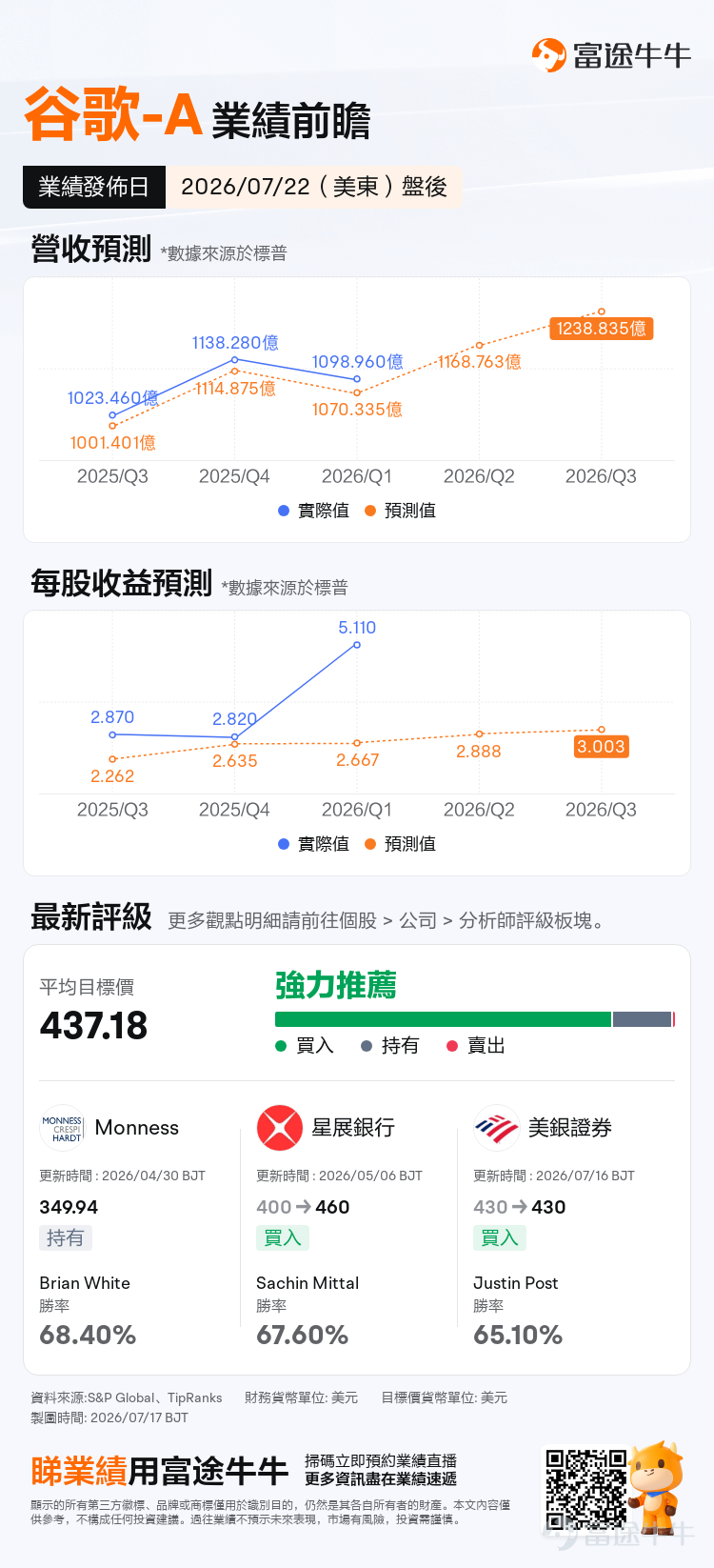
Institutions project Q2 2026 revenue of $116.876 billion, an increase of 21.21% year-over-year; EPS is expected to be $2.888, up 25.04% year-over-year. The above figures are based on US-GAAP accounting standards.

Google Cloud: Consensus expectation is 65%, but the real deal threshold is already approaching 70%
Based on the latest Q1 2026 data released, advertising revenue still accounts for approximately70% of total revenue, with Search dominating overwhelmingly. Google Cloud’s revenue share has risen to 18%, generating $6.6 billion in operating profit, with margins increasing from 17.8% a year ago to 32.9%.Whether the current valuation can be sustained increasingly hinges on how quickly Cloud delivers.

Consensus expectations for Google Cloud’s growth in Q2 stand at 65%, implying further acceleration from Q1’s 63%.Key supporting factors include: sustained strong enterprise AI demand; new data centers and computing capacity coming online; a large Cloud backlog; rapidly rising usage of Gemini models and TPUs; and long-term contracts from major clients such as Anthropic.
Among major banks’ forecasts, Bank of America expects70%, while Wells Fargo expects72%, both significantly above the publicly reported consensus expectation.This means that 65% is closer to the 'sell-side consensus expectation,' and the latest trading threshold may have already risen to around 70%.Even if Cloud slightly exceeds 65%, the stock price may not see a strong positive feedback.
Google Cloud’s backlog reached $46.2 billion at the end of Q1, nearly doubling quarter-over-quarter, and the company expects to recognize slightly more than half of this amount as revenue over the next 24 months.The market will watch whether the backlog continues to grow, whether the pace of revenue recognition accelerates, and whether the addition of new capacity eases constraints on compute supply.
Google Cloud’s operating profit margin in Q2 has already reached approximately33%. If revenue maintains high growth without a significant decline in margins, Cloud’s valuation narrative will gradually evolve from a 'high-growth cloud business' to a 'high-growth, high-margin AI infrastructure platform.'
Will capital expenditures be raised again? Will Google further open up its compute capacity?
As AI enters its second phase, investors are starting to ask who will use the newly built compute capacity, how high utilization rates will be, and whether it can generate sustainable revenue.This also means that during this earnings season, the impact of Capex on different assets will diverge significantly:
– For $SK hynix (SKHY.US)$ 、 $Micron Technology (MU.US)$ For semiconductor and AI hardware companies, the scale of capital expenditures (Capex) determines order volumes and the duration of the upcycle;
– For platform companies like Google, $Meta Platforms (META.US)$ Capex returns determine free cash flow and valuation;
– For $Amazon (AMZN.US)$ AWS, $Microsoft (MSFT.US)$ Azure, Google Cloud, and emerging cloud providers, the ability to monetize excess computing capacity will influence future competitive dynamics and cloud service pricing.
Alphabet has currently provided a 2026 capital expenditure guidance of $180–190 billion, nearly doubling from 2025 levels, and expects further significant growth in 2027.The vast majority of this spending will go toward technical infrastructure such as servers, data centers, and networking. BofA believes that, accounting for rising prices of storage, servers, and other components, 2026 Capex could be revised upward by approximately 5%, reaching $190–200 billion; its Q2 Capex forecast is approximately $50.1 billion.
Buy-side expectations may be even higher.According to JPMorgan, buy-side consensus estimates for Google’s actual 2027 capital expenditures may already have reached $325–350 billion (compared to the sell-side consensus market estimate of $250 billion).
An increase in capital expenditure guidance isn’t necessarily bearish by itself. The key lies in whether management can clarify how much additional computing capacity, revenue, and payback period the new investments correspond to. Without clear ROI justification, such increases are more likely to trigger valuation compression. Meta’s move to lease out computing capacity signals that the market is beginning to accept a new logic:AI infrastructure at hyperscale tech companies can shift from a cost center to a revenue-generating asset.
This logic is more grounded in reality for Google, as it already has an established Cloud customer base, TPU chips, and an enterprise AI platform—enabling it to offer AI services to consumers while also selling cloud computing, model APIs, and compute capacity to enterprises.
TPUs in particular: in-house developed chips help reduce Google's internal training and inference costs and also hold potential for external sales or leasing to customers.If Google were to disclose further details on TPU external revenue, profit margins, and order volumes, the market might assign a higher valuation to its Cloud business.This means Google’s TPUs are evolving from an internal cost-saving tool into infrastructure products that can be directly sold or leased externally.
What are your thoughts on the delay of Gemini 3.5 Pro?
Similarweb data shows that in June, Google’s global web traffic grew approximately 4% year-over-year, ChatGPT’s traffic was roughly flat year-over-year, and Gemini’s web traffic surged about 341% year-over-year.At the very least, this data indicates that Google Search continues to maintain a stable user base, and Gemini is experiencing rapid user growth.
Recently, Bloomberg reported that Google’s flagship AI model, Gemini 3.5 Pro, has been delayed by several months, with the core issue reportedly being that its code-writing capabilities have not met internal benchmarks. Google responded that the model is still undergoing testing with partners but did not provide a specific release date.
Gemini 3.5 Pro has not yet been commercialized at scale; this quarter, Google Cloud’s growth was primarily driven by existing enterprise AI demand, TPUs, older versions of Gemini, infrastructure services, and backlog orders.Therefore, the direct impact on Q2 revenue is limited, but the impact on post-earnings valuation and market sentiment is significant.
During the earnings call, management needs to address several questions:
– The new launch timeline for Gemini 3.5 Pro, and whether the delay stems from model capabilities, inference costs, or safety testing issues; If management continues to avoid providing a timeline, the market may easily interpret this as an indication that the issue remains unresolved.
– How its coding and AI agent capabilities compare with those of key competitors;
Two signals need to be monitored over the medium term. First, whether the final released Pro model can rank among the top tier in real-world coding and agent tasks—public benchmarks are no longer sufficient; developer usage and enterprise adoption matter more. Second, whether Google Cloud can sustain its high growth rate. As long as Cloud bookings, backlog revenue, and margins remain strong, a delay in a single model leans more toward a product timing issue; however, if the model delay coincides with a slowdown in Cloud growth, the market will begin questioning Google's overall AI strategy.
Upside and downside drivers for the stock price
Strictly speaking, Alphabet is not an outright underperformer this year. As of July 17, its share price was still up approximately 13% year-to-date, outpacing the S&P 500’s gain of about 9% over the same period. However, the stock has pulled back roughly 13% from its May high and currently trades at $346.77.The sense of 'underperformance' investors feel mainly comes from the retreat from recent highs and its clear lag behind semiconductor and AI infrastructure stocks.
The current share price of $348 has already priced in some concerns over capital expenditure.The forward P/E ratio is approximately 27x, and valuation has already contracted noticeably compared to May,but it remains above the five-year average of 22x, and has not yet entered a clearly deep value range.

GOOGL is currently trading at around $346.77,the options market implies an earnings-related volatility of roughly 5.6%–6%, corresponding to a near-term price range of approximately $326–$368.
The macro environment has further amplified this sensitivity.The S&P 500 remains near record highs, with Q2 aggregate earnings expected to grow by about 26% year-over-year, leaving limited room for error for large-cap tech companies. Meanwhile, the semiconductor sector has just undergone a correction of over 20%, and Middle East tensions, oil prices, and the upcoming Fed meeting at month-end could still disrupt risk appetite.

Currently, GOOGL’s options market exhibits characteristics of elevated implied volatility and heightened long-short divergence,An IV Percentile of 88.89% indicates that we are in a period of relatively high volatility over the past year; between July 16 and July 17, the put/call ratio surged sharply from 0.27 to 0.62–0.63, with put volume significantly increasing, coinciding with a drop in share price from $370.92 to $346.77 (a decline of approximately 6.5%), reflecting a surge in demand for downside protection. However, open interest data still shows call positions maintaining an advantage.
In terms of notable options activity, overall, the unusual options flow signals for Google leanbullish on a medium-term horizon, notably, a set of simultaneous trades occurred at 00:04 on July 18:
– Buy GOOGL 260918 380.00C × 3,500 contracts
– Sell GOOGL 260918 450.00C × 3,500 contracts
This is a classicBull Call Spread, with strikes at $380/$450, expiring in 60 days, and a maximum profit zone between $380–$450, reflecting large investors’ bullish outlook on a medium-term rebound but belief that upside is limited.

The bullish path for the stock price is relatively clear: Cloud growth exceeds 70%, margins remain above 30%; search revenue continues growing at around 17%, with disclosed data on AI search monetization; capital expenditures for 2026 stay below $200 billion; and management can clearly explain the orders, capacity, and returns tied to new investments in 2027. Quantifiable revenue from TPU external sales, Gemini subscriptions, and enterprise AI services would also drive the market to revalue Cloud higher.
Downside risks primarily stem from Cloud growth falling below 65%, search revenue (ex-FX) significantly slowing, or 2027 capital expenditures rising above $300 billion without corresponding upward revisions to revenue and profit guidance. Continued equity issuance, negative free cash flow, and regulatory constraints limiting AI-powered search ad formats could also weigh on valuation.
Given current earnings expectations, Cloud outlook appears strong and search ads remain resilient, yet stock price direction carries more uncertainty than the fundamentals themselves.The magnitude of capex increases, the commercialization path for AI compute, and progress on Gemini 3.5 Pro may determine the stock’s direction.Based on this view, defined-risk spread structures are more suitable.
1. Strategy 1: If moderately bullish, use a Bull Call Spread instead of buying naked calls
Appropriate scenario: You believe there’s a high probability of earnings beating expectations—Cloud growth nears or exceeds 70%, capital expenditure is reasonably justified, and more details are disclosed regarding TPU or monetization of computing power.
A Bull Call Spread involves buying a call option and simultaneously selling another call option with a higher strike price. This reduces the initial cost but also caps potential upside. The strike price of the long leg determines your 'entry point' for participating in upward moves, while the short leg’s strike should be set at what you consider a reasonable short-term target range. This structure covers most moderately bullish post-earnings scenarios and partially offsets the impact of elevated implied volatility by selling the higher-strike call.
(The chart below illustrates the simulated profit/loss profile of this strategy at expiration. The displayed graphic is for demonstration purposes only and does not constitute investment advice or guarantees; market conditions change rapidly, and the prices shown do not reflect real-time data.)

Strategy 2: If you already hold the underlying stock, use a Collar to hedge against tail-risk events
Appropriate scenario: You remain long-term bullish on Google but worry that risks such as a significant increase in capital expenditure or unclear progress on Gemini could trigger a sharp post-earnings pullback.
This strategy primarily guards against negative earnings outcomes. While holding the underlying stock, you buy a put to hedge against downside risk and sell a call to offset part of the put premium, thereby achieving low-cost protection. Choose the put’s strike based on the price level you want to protect as your floor, and select the call’s strike according to the upside level at which you’re willing to cap your gains. If the stock rises, the sold call may be exercised, limiting overall profit potential. If the stock falls, the long put will gain value, capping maximum losses.
(The chart below illustrates the simulated profit/loss profile of this strategy at expiration. The displayed graphic is for demonstration purposes only and does not constitute investment advice or guarantees; market conditions change rapidly, and the prices shown do not reflect real-time data.)

Finally, Options Sir has a small giveaway for fellow investors—feel free to claim it!Options Starter Pack
*This promotion is exclusively available to invited Hong Kong users. Click to learn more.Detailed terms and conditions of the promotion >>
Market conditions are complex and ever-changing,Options strategiesToo many choices and unsure how to proceed? Let Futubull help you build a strategy in three simple stepsOptions strategies, making investing simple and efficient!

Options Risk Disclosure:An option is a contract that grants the holder the right—but not the obligation—to buy or sell an underlying asset at a predetermined price on or before a specified date. Option prices are influenced by multiple factors, including the current price of the underlying asset, the strike price, time to expiration, and implied volatility. Implied volatility reflects the market’s expectation of future price fluctuations over the life of the option; it is derived by reverse-engineering the Black-Scholes pricing model and is commonly viewed as an indicator of market sentiment. When investors anticipate higher volatility, they may be willing to pay more for options to hedge their risk, resulting in higher implied volatility. Traders and investors use implied volatility to assess the attractiveness of option prices, identify potential mispricings, and manage their risk exposure.
Disclaimer:This content does not constitute an offer, solicitation, recommendation, opinion, or any form of guarantee regarding any securities, financial products, or instruments. The risk of loss in trading options can be substantial. In certain circumstances, your losses may exceed the initial margin deposit. Even if you place contingent orders such as 'stop-loss' or 'limit' orders, there is no assurance that losses will be avoided, as market conditions may prevent execution of these orders. You may be required to deposit additional margin on short notice. If you fail to meet such margin calls within the stipulated time, your open positions may be liquidated. You remain fully liable for any resulting deficit in your account. Therefore, prior to trading options, you should thoroughly research and understand how options work and carefully consider whether such trading aligns with your financial situation and investment objectives. If you trade options, you should become familiar with the procedures for exercising options and handling expiration, as well as your rights and obligations upon exercise or expiration. Options trading involves significant risk and is not suitable for all investors. Investors should carefully read"Characteristics and Risks of Standardized Options"。
Risk Disclaimer: The above content only represents the author's view. It does not represent any position or investment advice of Futu. Futu makes no representation or warranty.Read more


Comments (2)
to post a comment
20
76