Apple and Amazon reported starkly contrasting earnings— which one are you bullish on?

Kimi K3 sparks 'DeepSeek 2.0' anxiety: Will this model weaken GPU demand or trigger a new round of compute capacity expansion?
Following DeepSeek, China's large models are once again shaking up the global AI market.
On July 16, Moonshot AI officially launched Kimi K3, a model with a total parameter count of 2.8 trillion, built on a Mixture-of-Experts architecture, natively supporting multimodality, and featuring a 1-million-token context window—making it one of the largest open-weight large models by parameter scale to date.
More notably, Kimi K3 has already approached or even surpassed certain mainstream U.S. models in select programming, agent, and knowledge-work benchmarks. Although Moonshot AI acknowledges that K3’s overall capability still lags behind the strongest closed-source models,it has nonetheless demonstrated that the gap between Chinese open models and global state-of-the-art is rapidly narrowing.
Following the announcement, AI supply-chain companies such as NVIDIA, Broadcom, and Micron briefly came under pressure,as markets feared Kimi K3 could trigger another 'DeepSeek moment': if increasingly powerful and lower-cost large models continue to emerge, will tech giants still need to purchase so many GPUs?
However, based on K3’s architecture and actual deployment requirements, the answer may well be the opposite.
1. Where exactly does Kimi K3’s advantage lie?
Kimi K3’s real breakthrough isn’t just about larger parameters—it’s about striking a new balance among ultra-large-scale models, inference efficiency, and agent capabilities.
First, large models are still effective.
Kimi K3 has a total of 2.8 trillion parameters, several times that of Kimi K2. Unlike the recent market trend favoring 'smaller models with higher efficiency,' Moonshot AI chose to continue scaling up model size, indicating that the Scaling Law remains valid: under continuously improved architectures and training methods, increasing parameter scale can still deliver performance gains.
However, K3 doesn’t activate all parameters during each inference. It uses a Stable LatentMoE (Mixture of Experts) architecture, selecting only 16 out of 896 experts per inference—activating approximately 1.8% of the experts. This allows the model to retain vast knowledge capacity without computing all 2.8 trillion parameters for every token.
Second, linear attention reduces the cost of processing long contexts.
In traditional Transformers, attention computation scales rapidly with context length. When handling hundreds of thousands or even millions of tokens, the KV cache consumes substantial memory.
Kimi K3 introduces Kimi Delta Attention (KDA), which combines linear attention with traditional attention. In prior research on Kimi Linear, this architecture reduced KV cache usage by up to 75% in 1-million-token scenarios and increased decoding throughput to several times that of conventional architectures.
This means K3 is particularly well-suited for handling large codebases, hundreds of PDFs, long-running agent tasks, and complex research projects. Its strength isn’t answering a single question faster, but rather working continuously for hours or even tens of hours to complete an entire workflow with minimal human intervention.
Third, it features native multimodality and agent capabilities.
K3 can not only understand text but also simultaneously process images, videos, web pages, tables, and code. Moonshot AI has showcased use cases including automatically developing GPU compilers, creating games, designing chips, analyzing thousands of pages of research documents, and executing complex tasks in parallel through multiple sub-agents.
Therefore, K3 functions more like a 'digital employee' capable of invoking tools, observing outcomes, adjusting strategies, and continuously executing tasks—rather than a traditional chatbot.
Fourth, open model weights combined with lower pricing create competitive advantages.
The Kimi K3 API is priced at $3 per million input tokens and $15 per million output tokens—roughly half the cost of some leading U.S. models. Additionally, Moonshot AI plans to release the full model weights on July 27, enabling enterprises to self-host, fine-tune, and customize the model.
This gives K3 three competitive edges simultaneously: near-state-of-the-art capabilities, lower pricing, and the ability for private enterprise deployment.
II. Why is Wall Street paying such close attention to Kimi K3?
Wall Street’s intense focus on K3 appears on the surface to stem from concerns that Chinese AI might once again trigger a 'DeepSeek shock,' but at its core, it reflects a reevaluation of three valuation logics.
First, the moat protecting U.S. closed-source models may be narrowing.
Previously, the market broadly believed that U.S. labs like OpenAI and Anthropic held a clear lead in frontier models, allowing them to maintain high API prices and profit margins.
However, Chinese open models—from DeepSeek and GLM to Kimi K3—are steadily closing the gap with frontier-level performance. Morgan Stanley views K3 not as an overnight miracle but as the result of sustained accumulation in China’s large-model industry; Bernstein argues that K3 further demonstrates that top Chinese labs now have the capability to keep pace with the global technological frontier.
Once the performance gap between different models narrows, enterprises will be able to dynamically select models based on cost, speed, and task type.
This is not good news for model companies. Model capabilities may gradually become commoditized, making it increasingly difficult to achieve high profit margins solely by offering the 'best' model.
Second, value may shift from the model layer to the application layer.
The stronger the open models become, the lower the cost for application companies to use AI.
For example, companies in programming, financial research, customer service, advertising production, and enterprise automation no longer need to rely entirely on expensive closed models; instead, they can combine multiple open models to complete tasks. B. Riley believes that K3 intensifies price competition at the model layer but provides incremental upside for application-layer companies embedding AI capabilities.
In other words, future AI industry profits may no longer be concentrated solely in model companies but could gradually flow toward platforms that own users, data, workflows, and distribution channels.
Third, the market has started re-evaluating AI capital expenditures.
K3 employs linear attention, reducing KV Cache requirements, so the market’s immediate reaction was:
The VRAM and computational requirements per inference decrease, potentially weakening demand for NVIDIA, HBM, and networking equipment.
This is also a key reason behind the recent correction in semiconductor stocks. In the week K3 was released, the Philadelphia Semiconductor Index declined noticeably, as the market viewed it as another test—following DeepSeek—of the rationale behind AI capital spending.
However, this assessment only focuses on the reduction in KV Cache while overlooking K3's extremely large model weights and its requirement for expert parallelism.
Third, will linear attention truly weaken demand for NVIDIA and HBM?
What K3 reduces is only part of the attention computation per token—it does not mean the entire model becomes 'small and lightweight.'
According to SemiAnalysis estimates, even when using low-precision formats, K3’s model weights would still require over 1.5TB of HBM capacity. A single GPU cannot accommodate such a massive model, necessitating the distribution of its 896 experts across numerous GPUs.
When a token is routed to different experts, data must be continuously transferred between GPUs. This expert parallelism approach, known as WideEP, creates extremely high scale-up interconnect demands. SemiAnalysis believes that although KDA can significantly reduce KV Cache traffic at most, the network demands generated by model weights and expert routing could be even greater.
Moonshot AI has also explicitly stated that efficient inference with K3 requires deployment on a super node comprising at least 64 accelerators. In other words, K3 is not a low-cost model that runs on just a few graphics cards—it is a typical rack-scale AI system workload.
Under these circumstances, K3 could simultaneously drive demand for four categories of hardware:
First, GPUs and AI accelerators:
The model must be distributed across dozens or even more accelerators; the larger the parameter scale, the larger the compute domain required to host the model weights.
Second is HBM:
Model weights exceeding 1.5TB need to reside long-term in high-speed memory, and scaling up model size continues to directly drive higher HBM capacity demand.
Third is DDR5 and enterprise-grade SSDs:
When HBM is primarily used to store model weights, portions of the KV Cache and intermediate data must be offloaded to CPU memory and NVMe SSDs, forming a multi-tiered storage architecture where HBM, DDR5, and NAND work together.
Fourth is Scale-Up high-speed interconnects:
With 896 experts distributed across different GPUs, expert routing requires high-bandwidth, low-latency inter-chip communication. The more K3 relies on expert parallelism, the greater the demands on NVLink, NVSwitch, copper networking, and rack-level networking.
Therefore, K3 does not simply reduce compute requirements; rather, it changes how compute resources are consumed: KV Cache usage declines, but demands for model weights, expert parallelism, and rack-level interconnects increase.
IV. Which companies could benefit from Kimi K3?
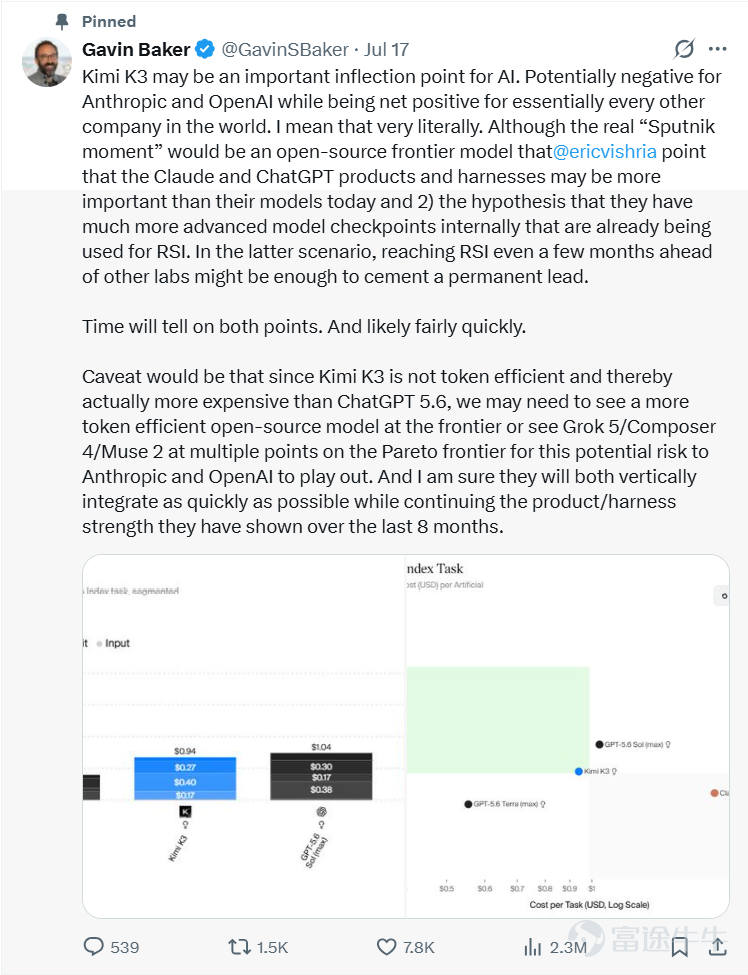
Gavin Baker, founder and CIO of the well-known U.S. tech investor and hedge fund Atreides Management, stated on X:Kimi K3 could be a significant inflection point for AI—potentially negative for Anthropic and OpenAI, but net positive for nearly every other company globally.

In fact, from a supply chain perspective, Kimi K3 has not weakened demand for AI infrastructure; on the contrary, it may drive upgrades in compute architecture.GPU vendors such as $NVIDIA (NVDA.US)$will still be the most direct beneficiaries.Although linear attention reduces some of the KV cache pressure, K3—with its 2.8 trillion parameters and 896 experts—still requires large-scale GPU clusters and high-speed interconnects, driving demand for rack-level AI systems such as GB200 and GB300.
In terms of memory, $SK hynix (SKHY.US)$、 $Samsung Electronics (005930.KR)$、 $Micron Technology (MU.US)$HBM suppliers such as ... will continue to benefit.One of the core bottlenecks for ultra-large models is model weight storage; K3’s massive parameter count requires substantial HBM support. Meanwhile, as AI agent workloads increase, DDR5 and enterprise-grade SSDs could also see new demand.
In the high-speed interconnect space, $NVIDIA (NVDA.US)$、 $Broadcom (AVGO.US)$、 $Marvell Technology (MRVL.US)$companies such as ... will likewise benefit.The Mixture-of-Experts architecture requires extensive data exchange among numerous GPUs, raising demands for Scale-Up interconnects and boosting demand for NVLink, switching chips, and high-speed networking solutions.
In addition,$Taiwan Semiconductor (TSM.US)$ 、 $ASE Technology (ASX.US)$ Advanced process and packaging companies may also benefit from the continued expansion of AI clusters.As model sizes grow, GPUs, HBM, advanced packaging, and high-speed interconnects will remain core bottlenecks in AI infrastructure.
Overall, Kimi K3 does not lead to a 'decline in compute demand,' but rather shifts compute demand from pure computation toward"computation + storage + interconnect"a system-level upgrade. The true beneficiaries remain core suppliers with capabilities in GPUs, HBM, advanced packaging, and high-speed interconnects.
V. Efficiency Gains: Why Might We Actually Need More Compute?
Understanding K3’s impact on AI hardware hinges on Jevons Paradox.
When the efficiency of using a resource improves and its cost declines, people typically don’t reduce usage; instead, they develop more applications, ultimately increasing total resource consumption.
K3 lowers the cost of long-context and complex agent tasks, making previously prohibitively expensive use cases commercially viable. For example, a company that previously used only a few million tokens per day could see its token usage increase by tens of times after adopting automated coding, automated research, automated customer service, and multi-agent workflows.
Demand surged rapidly after K3’s launch, exceeding Moonshot AI’s existing compute capacity.The company temporarily suspended new user subscriptions to prioritize existing users with computing power and stated it is accelerating capacity expansion. This is a real-world example of how 'models have become more efficient, yet total compute demand continues to rise.'

Conclusion: K3’s impact is not on GPUs, but on the high profit margins of model companies.
What Kimi K3 truly changes is not whether AI still needs computing power, but at what price the intelligence generated by that computing power will be sold.
For closed-source model companies like OpenAI and Anthropic, K3 means intensified competition, increased pricing pressure, and a potential reassessment of long-term profit margins at the model layer.
However, for the hardware supply chain, the signal conveyed by K3 is not pessimistic.
Linear attention reduces KV cache consumption but does not alter the trajectory of large models continuing to scale up. Requirements such as 2.8 trillion parameters, 896 experts, model weights exceeding 1.5TB, and deployment across more than 64 accelerators indicate that cutting-edge AI is evolving from competition at the single-chip level to system-level competition involving entire racks—integrating GPUs, HBM, DDR5, storage, and high-speed interconnects.
Therefore, K3 is more likely to trigger a reallocation across the AI value chain: model capabilities accelerate toward commoditization, application layers gain lower costs, and 'pick-and-shovel sellers'—those who control GPUs, memory, advanced packaging, and high-speed interconnects—remain the most certain beneficiaries of compute expansion.
⚠️It should be noted that as of July 20, the full model weights and technical report for K3 have not yet been officially released; current performance data still comes from Moonshot AI’s official benchmarks. Whether K3 can maintain the same performance, cost-efficiency, and stability in third-party deployment environments remains to be independently verified after model weights are opened on July 27.
Risk Disclaimer: The above content only represents the author's view. It does not represent any position or investment advice of Futu. Futu makes no representation or warranty.Read more


Comments (57)
to post a comment
111
347