Intel reports strong earnings—will its stock price regain upward momentum?

Earnings Options Strategy | After Setting a High Bar, Can Intel's Q2 Earnings Replicate Its Explosive Rally?
$Intel (INTC.US)$ Will release its Q2 2026 earnings after the U.S. market close on July 23.This earnings report has drawn significant market attention—not only because Intel's fundamental business dynamics and valuation logic are undergoing profound changes driven by the AI wave, but also because the semiconductor sector has recently experienced markedly increased volatility, leaving the market in urgent need of earnings season to validate whether the AI narrative can continue advancing.
Wall Street Expectations: A Growth Test Under High Benchmarks
Last quarter, Intel delivered results that significantly beat expectations, sparking a market rally with its stock surging in a single day and continuing to climb afterward. However, since hitting a record high at the end of June, it has followed the broader AI hardware pullback, leading bulls and bears into an intense tug-of-war ahead of the earnings release.
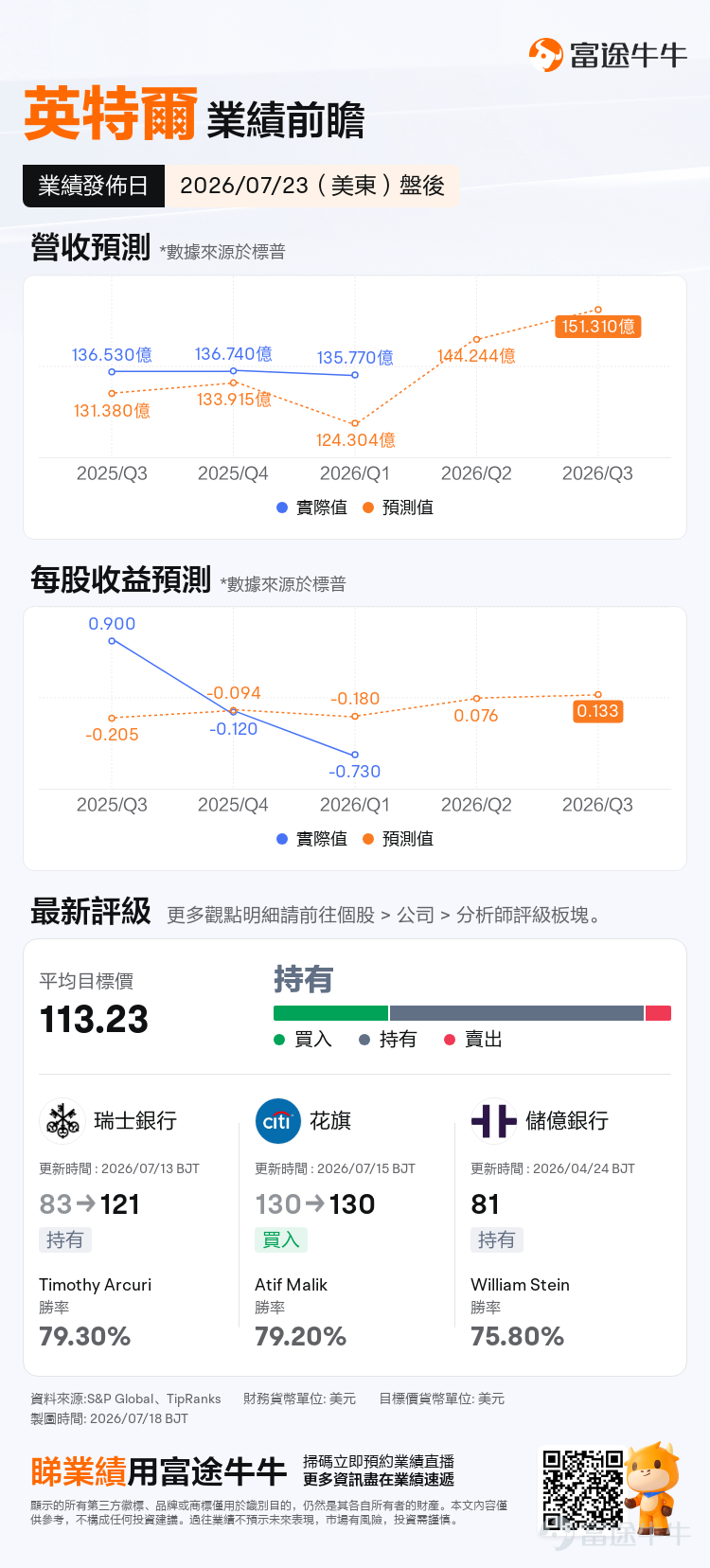
According to consensus estimates, Wall Street expects Intel’s Q2 revenue to reach $14.42 billion, an approximately 12% year-over-year increase, with earnings per share (EPS) forecast at $0.076. Recent moves by major banks such as UBS Group and Citi suggest most sell-side analysts view the stock as oversold in the short term but remain relatively cautious about the potential upside of any rebound.

At the end of April, Intel’s Q1 results briefly ignited market enthusiasm.Revenue of $13.577 billion significantly exceeded market expectations. Although EPS for the period remained negative (due to restructuring and capital expenditures), forward guidance continued to far surpass forecasts, driving the stock to jump more than 20% at the open. Wall Street attributed this breakout to a core thesis: in the Agentic AI era, CPU demand is undergoing structural revaluation, with the CPU-to-GPU ratio shifting from 1:8 during training to parity in inference and agent-driven scenarios.This historically strong earnings surprise has undoubtedly set an extremely high bar for the July 23 report.

Intel’s stock has pulled back more than 30% since peaking at the end of June, but viewed over a longer timeframe,Intel’s year-to-date gains remain impressive, with the stock still up more than 150% since the start of the year.
Key Focus Areas for This Earnings Report: CPUs, the 18A node, external collaborations, and the U.S. government’s strategic bets
(1) CPUs are the most critical variable to watch in this earnings report
Over the past six months, Intel has repeatedly raised prices for both consumer and server CPUs. Data center CPU prices have increased by several hundred to over a thousand dollars, with high-end Xeon series seeing price hikes of 3% to 12%. Consumer-grade models like the Core Ultra 200 series have also seen increases of $30 to $50.Since the beginning of the year, CPU prices have continued to rise—though not as dramatically as memory prices—still reflecting tight supply-demand dynamics.
The key driver is demand rather than costs: the deployment of AI inference and agent applications has triggered a surge in demand for high-end compute CPUs, compounded by ongoing tightness in ABF substrate and advanced node capacity on the supply side, creating a rare 'volume and price up together' scenario not seen in years. Multiple institutions believe CPU price increases are still in the early stages, and this supply-demand-driven trend could persist into Q3–Q4.During the earnings call, management’s commentary on CPU pricing trends for the second half, whether capacity can meet demand, and $Advanced Micro Devices (AMD.US)$、 $Arm Holdings (ARM.US)$changes in market share against competitors in the server CPU segment will be key determinants of market reaction.
(2) The 18A process node is critical to foundry operations
At the TMC conference, CEO Lip-Bu Tan provided an updated roadmap: 18A has entered volume production, supporting Panther Lake processors (with approximately 200 design wins), and yields are improving by about 7% per month—ahead of internal targets. For 14A, the target is to deliver PDK 0.9 to external customers by October, with risk production scheduled for 2028 and volume production in 2029. Organizationally, Intel has undergone drastic restructuring—management layers have been reduced from 12 to 5, and engineering leads now report directly to the CEO, replacing previous bureaucratic decision-making with 'light-speed' execution.
More notably, Trump recently publicly confirmed that $Apple (AAPL.US)$ has agreed to collaborate with Intel to design and manufacture chips in the U.S. Bernstein analysts noted thatInitial collaboration will focus on low-volume, low-risk entry-level PC chips, primarily serving as a proof of concept—but carrying immense symbolic significance: the world's most valuable tech company choosing Intel Foundry is the strongest endorsement yet for its 18A process node.The market will closely monitor the latest 18A yield data, Panther Lake customer adoption progress, signs of external client commitments for 14A, and the specific scale and timeline of Apple's collaboration.
(3) Strategic Support from the U.S. Government
Intel is reaping the greatest benefits from the CHIPS Act—the U.S. government has already converted part of its subsidies and funding from the Secure Enclave program into an equity investment, acquiring approximately 9.9% of Intel’s common stock, amounting to $8.9 billion.
Intel has invested over $100 billion in expanding its U.S.-based wafer fabs,making it the single largest beneficiary of the CHIPS Act. Its collaboration with $Tesla (TSLA.US)$ on the Terafab project further validates the strategic value of its foundry business. The U.S. government has transitioned from being a 'subsidy provider' to a 'strategic shareholder,' a relationship that provides a policy safety net and partially mitigates extreme downside risks. Investors should also watch for updates on government collaboration during earnings calls.
Options Strategies Amid High Volatility
According to Futubull data, the options market is pricing in apredicted volatility of ±15.21% for this Q2 earnings report.
Looking back at history, there are several patterns worth noting.
First, actual volatility has often significantly exceeded forecasts, especially in the most recent two quarters.— Q1 forecast ±12.05%, actual +23.60%; Q4 forecast ±10.09%, actual -17.03%. In both cases, the actual moves were nearly double the predicted ranges.
Second, IV crush is the norm. Regardless of direction, implied volatility (IV) typically drops sharply by 5% to 14% after earnings. Buyers of single-leg options may face significant time-value decay risk.
Third, directional uncertainty is extremely high.— The stock has alternated between gains and losses over the last two consecutive quarters, with each move exceeding 15% in magnitude. Betting purely on direction is little better than flipping a coin.

Ahead of this quarter’s earnings, Intel’s implied volatility has also reached historically elevated levels. In such a 'high IV' environment, buying outright directional options is extremely expensive; consider using spread-based strategies instead.

Strategy 1: Iron Condor — Bet on range-bound movement and sell elevated volatility.
If you believe the market’s expectation of a 15% move is overly aggressive and expect post-earnings realized volatility to stay within a narrower range (e.g., under 10%), with no clear directional bias,

(The design images displayed on the screen are for demonstration purposes only and do not constitute any investment advice or guarantee; market movements are frequent, and the illustrated option prices do not represent actual conditions)
this is a strategy with limited profit and limited risk. Take advantage of Intel’s currently expensive option premiums by selling a strangle to collect substantial time value.Buying further out-of-the-money options on both sides serves to cap potentially unlimited losses within a manageable range.
As long as the stock price doesn't break out of the protective range set on either side after earnings, the investor can profit by closing the position as implied volatility (IV) drops sharply and option values shrink. Given that Intel has already pulled back 30% from its highs, some negative sentiment has been priced in; if earnings neither surprise positively nor negatively and the stock remains range-bound, the trade can be profitable. However, if the stock experiences sharp spikes or plunges like in the previous two quarters, losses will occur—but these losses are capped.
Strategy 2: Bull Call Spread – Moderately bullish while controlling cost and IV risk
If you hold a moderately bullish outlook on Intel’s earnings—such as expecting benefits from CPU price hikes or positive developments related to the 18A process—and anticipate a modest rebound rather than a massive rally, while also wanting to reduce the high cost of buying a naked call option.
Consider buying one call option with a lower strike price and simultaneously selling one call option with a higher strike price (both on the same underlying asset and with the same expiration date).

(The design images displayed on the screen are for demonstration purposes only and do not constitute any investment advice or guarantee; market movements are frequent, and the illustrated option prices do not represent actual conditions)
In a high-IV environment, buying a call outright is extremely expensive and exposes you to IV crush risk. The bull call spread mitigates this by collecting premium from selling the higher-strike call, partially offsetting the cost of the long call and reducing net outlay. Maximum loss is limited to the net premium paid, while maximum profit equals the difference between the two strike prices minus the net cost. Compared to a naked long call, this strategy is less sensitive to changes in volatility and offers a better risk-reward profile even if the directional view is correct but the upside is limited.
Strategy 3: Covered Call – Hold the underlying stock and enhance returns
If you already hold Intel shares and believe earnings will bring mild positives but that the stock is unlikely to quickly recover the 30% decline since June, you may want to take advantage of the elevated IV to collect premium income.
For example, hold Intel shares (typically in multiples of 100 shares) and simultaneously sell an out-of-the-money call option (e.g., with a strike price 10%–15% above the current stock price).
Selling an out-of-the-money call in this scenario allows you to collect a richer-than-usual premium, effectively adding a 'cushion' to your stock position. If earnings disappoint, the premium received can partially offset losses on the underlying shares (though it won’t fully protect against a sharp drop). If earnings beat expectations but the stock price doesn’t rise above the strike price, you keep both the premium and benefit from any appreciation in the underlying stock.If the stock price surges well above the strike price, the underlying shares will be sold at the strike price to lock in profits, at the cost of forgoing any additional upside beyond that level.
Intel is currently undergoing the most critical transformation in its corporate history.On one hand, last quarter’s gap-up rally demonstrated the market’s eagerness for and recognition of its recovery; on the other hand, the more than 30% pullback since June has revealed investor concerns about the certainty of its future outlook.The Q2 earnings report on July 23 will be a crucial test of the credibility of this 'transformation of the century.'
In the options market’s 'pressure cooker' environment—characterized by expectations of high volatility—it is unwise to blindly buy single-directional options. Investors must incorporate several key variables and carefully assess the stock’s potential trading range to gain a probabilistic edge in this bullish-bearish tug-of-war.
Finally, we have a small treat for our fellow investors—please feel free to claim it.Options Beginner Pack
*This event is exclusively for invited HK users. Click to learn moreDetailed event terms >>
Market conditions are complex and volatile,Options StrategyOverwhelmed by too many choices? Futubull helps you set up your portfolio in three simple steps.Options Strategymaking investing simple and efficient!

Risk Disclaimer: The above content only represents the author's view. It does not represent any position or investment advice of Futu. Futu makes no representation or warranty.Read more


Comments
to post a comment
17
43