
Apple and Amazon reported starkly contrasting earnings— which one are you bullish on?

Down more than 60% from its peak, Zhipu AI falls below HK$1,000: Is this a bursting bubble or competitive pressure?
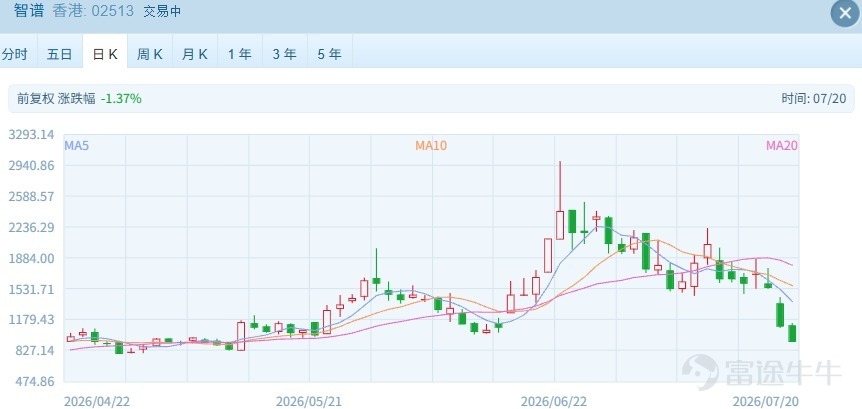
Today (July 20), Hong Kong-listed large-model leader Zhipu AI (HK02513) suffered another heavy blow. Following a 28% drop last Friday, the stock plunged over 16% intraday today, breaking below the HK$1,000 mark.
Since late June 2026, the Hong Kong AI large-model sector has undergone a sharp valuation reset, with leading stocks rapidly shedding their valuation bubbles. Zhipu AI—one of the two dominant players in Hong Kong’s large-model space—has been in continuous decline since hitting an all-time high of HK$2,980, retreating more than 66% from its peak in just one month and suffering significant market cap erosion. Meanwhile, the other leader, MiniMax (HK00100), has seen even steeper losses, nearly halving twice from its historical high and now hovering near its IPO price. The entire Hong Kong large-model sector is undergoing a deep correction.
Behind the sharp decline in share prices of the two leading large AI model companies, is this the bursting of a valuation bubble or the impact of brutal competitive pressures?
Compounded by widespread paper losses among July placement investors, pressure from expiring lock-up shares, and the launch of Moonshot AI’s Kimi K3 top-tier open-source model—which delivered a technological knockout blow—the investment thesis for Hong Kong-listed AI stocks has fundamentally shifted.
The current correction in Hong Kong-listed AI large-model stocks began on June 22, when Zhipu AI’s share price hit an all-time high of HK$2,980. At that time, the market held extremely high expectations for the commercialization prospects and technical advancement potential of domestic large models, driving valuations in the sector ever higher. However, since then, individual stock performance has continuously weakened, with the magnitude of the correction repeatedly exceeding market expectations, rapidly bringing sector valuations back to rational levels.

The short-term price decline has been especially severe. On July 17 (last Friday), Zhipu AI experienced its steepest single-day drop since listing, plunging 28.49% to close at HK$1,107, wiping out over HK$200 billion in market value in one day and decisively breaking through near-term support levels. The sell-off showed no signs of stopping: when Hong Kong markets opened on July 20, Zhipu AI continued its downward trend, falling as much as 16% intraday to a low of HK$920—officially breaching the psychologically significant HK$1,000 mark and hitting a new low in this correction cycle. As of midday close today, Zhipu AI traded at HK$979.50, down 11.52%, representing a cumulative 66% decline from its June 22 peak and erasing more than HK$800 billion in market value within a month, effectively clearing out the previously accumulated valuation bubble.

Peer stocks have fared even worse. The other member of Hong Kong’s ‘twin large-model leaders,’ MiniMax, has shown pronounced weakness. After reaching an all-time high of HK$1,330 earlier this year, the stock entered a prolonged downtrend and now trades below HK$200—down over 85% from its peak and just HK$30 above its IPO price of HK$165, teetering on the brink of breaking below issue price.
Beyond fading market sentiment and valuation normalization, the core fundamental factor dragging down Zhipu AI and MiniMax shares has been the supply-side pressure from expiring lock-up periods, which significantly expanded the free float and disrupted market supply-demand equilibrium. In early July 2026, the two Hong Kong-listed AI leaders simultaneously faced their first major post-IPO lock-up expiration, shattering market balance.
Zhipu AI’s first unlock occurred on July 8, releasing 25.6816 million shares—5.76% of total outstanding shares—held by 11 cornerstone investors, including Taikang Life Insurance, GF Fund Management, and Shanghai Gao Yi Asset Management. Prior to this unlock, the company’s freely tradable shares totaled only 11.74 million; this event dramatically increased tradable supply, exerting clear downward pressure on the share price in the short term. Although most cornerstone investors with state-backed backgrounds are focused on long-term strategic positioning and are unlikely to engage in large-scale immediate selling, market concerns about potential sell-offs persist. Moreover, a far larger unlock is scheduled for January 2027, when approximately 40% of original pre-IPO shares will become tradable, maintaining medium- to long-term selling pressure.
MiniMax faced an even more severe unlock shock. On July 9, it unlocked shares representing a staggering 48% of its total outstanding shares, causing its free float to surge from under 6% to nearly 50% overnight. With a flood of early-stage VC and strategic investor shares entering the market, expectations of concentrated profit-taking by financial investors intensified, triggering a 17.98% single-day plunge that pushed the company’s market cap below HK$100 billion.
Compounding the pain, Zhipu’s targeted share placement this month further amplified market losses and eroded investor confidence. On July 13, Zhipu completed a placement of 19.78 million new H-shares at HK$1,588 per share, with proceeds earmarked for technology R&D and commercial expansion. By July 20, the company’s share price had already fallen below HK$1,000, leaving institutional investors who participated in the placement facing unrealized losses exceeding 37%.
While lock-up expirations and share placements exert short-term pressure on the stock price, disruptive technological iterations by industry rivals strike at the core of Zhipu’s long-term valuation thesis. Recent high-profile developments from Moonshot AI (Kimi) have fundamentally altered the competitive landscape of the Hong Kong-listed large-model sector, emerging as the key bearish catalyst weighing on Zhipu’s valuation.
According to market reports, Moonshot AI plans to complete its Hong Kong IPO within the next six months. If successfully executed, this listing would significantly reshape the leadership map of AI large models in Hong Kong, pushing competition in the segment into a white-hot phase. Even more impactful, on July 17, Moonshot officially launched its next-generation open-source flagship model, Kimi K3.
Publicly available data shows that Kimi K3 boasts a total parameter count of 2.8 trillion, far surpassing comparable offerings in the industry. Functionally, Kimi K3 natively supports a one-million-token context window, enabling direct, full parsing of medium-sized codebases, lengthy industry documents, and massive volumes of meeting transcripts. It achieves a quantum leap in four core capabilities: complex logical reasoning, full-scenario code generation, long-text processing, and intelligent agent task execution. Additionally, it features native vision understanding capabilities, supporting multimodal closed-loop tasks such as visual reasoning and iterative code optimization.
Industry analysts note that the debut of Kimi K3 marks a new phase in domestic large-model competition, rapidly erasing—and even reversing—Zhipu’s prior technological edge. The impact of Kimi K3 extends beyond Chinese AI-related equities, even spilling over into U.S. markets. Last Friday, Synopsys, a U.S.-listed EDA (electronic design automation) giant, plunged more than 12% intraday and closed down over 7%, while Cadence Design Systems dropped more than 9%. JPMorgan described the K3 launch as a 'DeepSeek 2.0 moment,' underscoring its significant market implications.
Guolian Minsheng Securities recently noted that open-source AI has entered its 'DeepSeek 2.0 moment,' forecasting that domestic models will soon join the 3-trillion-parameter club. The firm recommends closely monitoring recent model updates from DeepSeek V4, Qwen, and MiniMax, as the investment narrative around domestically developed large models and domestic AI computing infrastructure continues to strengthen.
CITIC Securities pointed out that Zhipu previously raised HK$31.4 billion through its recent share placement. With these funds now secured, the company is expected to overcome its computational capacity constraints. Zhipu remains in a phase of intensive strategic investment, with R&D expenses projected at RMB 3.18 billion in 2025—far exceeding its revenue. The core bottleneck is not insufficient demand, but rather a shortage of computing power supply. This substantial capital raise will provide ample resources for building out AI infrastructure, potentially resolving capacity constraints related to API call volume and token consumption.
Secondly, a leap in model capabilities is accelerating the commercialization flywheel. Over the medium to long term, given the high growth potential of the large-model sector, Zhipu’s leadership position among domestic foundational models, and its dual A+H share listing providing a robust capital platform, the company’s long-term growth trajectory is clear, and a profitability inflection point appears achievable.
Most institutions believe that Zhipu's recent sharp decline results from a confluence of three factors: the bursting of a high-valuation bubble, pressure from share lock-up expirations, and setbacks in technological competition. The company previously enjoyed an exceptionally high valuation driven by enthusiasm for the AI sector, but its current unprofitable fundamentals are severely misaligned with its elevated market capitalization. This round of decline thus represents a rational valuation correction.
Some leading institutions point out that Zhipu’s core challenge now lies in 'weakening technological advantages and commercialization falling short of expectations.' Compared to Kimi’s rapid pace of technological iteration and open-source ecosystem development, Zhipu has recently slowed its product update cadence, lacks clear differentiation, and has yet to achieve scalable profitability—leaving its high valuation unsupported by fundamentals. However, other institutions argue that after a deep correction of over 60%, Zhipu’s valuation bubble has largely been cleared, and stock price risks have been sufficiently released.
Over the long term, according to the consensus among institutions, Zhipu’s future performance will hinge entirely on two key variables: first, whether it can accelerate technological iteration to catch up with industry leaders and rebuild core competitiveness; and second, whether it can speed up commercialization to achieve strong revenue growth and narrow losses. If the company can quickly address its technological shortcomings and successfully scale commercial applications, its stock could see a valuation recovery. Conversely, amid intense industry competition, the company may remain trapped in a prolonged valuation downtrend, and the Hong Kong-listed large-model sector will likely undergo further consolidation and market-driven selection.
Disclaimer: The content and data in this article are for reference only and do not constitute investment advice. Please verify information independently before use. Any actions taken based on this information are at your own risk.
Copyright Daily Economic News
Risk Disclaimer: The above content only represents the author's view. It does not represent any position or investment advice of Futu. Futu makes no representation or warranty.Read more
Comments
to post a comment
1