
Tesla plunged after its earnings report—what’s the outlook ahead?

[Comment to Win Prizes] Tesla, Intel, and Google all report earnings this week! Who will pass the AI test and lead the rally?
 This week, the U.S. earnings season continues to heat up! Tech stocks are about to face another round of critical tests:$Tesla (TSLA.US)$and$Alphabet-C (GOOG.US)$will be the first to release earnings,$Intel (INTC.US)$will also report after the market close on July 23,Stories around AI, electric vehicles, cloud computing, and the chip sector revival are about to be put to the test by the market.
The most critical theme of this earnings season remains:Can tech giants’ AI investments truly translate into earnings growth? Over the past year, market expectations for AI have kept rising, but investors are no longer satisfied with grand narratives like 'AI will transform the future.' Instead, they want to see tangible revenue, profits, and commercialization progress.
Divergence among tech stocks is becoming increasingly evident, as the market shifts from 'buy anything AI-related' to a more selective approach. Those who can demonstrate that their AI investments are generating returnswill likely continue to enjoy valuation premiums; conversely, those missing earnings expectations, offering weak guidance, or losing control over capital expenditures could face significant stock price volatility.![[Cheerlead]This week, the U.S. earnings season continues to heat up! Tech stocks are about to face another round of critical tests:$Tesla (TSLA.US)$and$Alphabet-C (GOOG.US)$will be the first to release earnings,$Intel (INTC.US)$will also report after the market close on July 23,Stories around AI, electric vehicles, cloud computing, and the chip sector revival are about to be put to the test by the market. The most critical theme of this earnings season remains:Can tech giants’ AI investments truly translate into earnings growth? Over the past year, market expectations for AI have kept rising, but investors are no longer satisfied with grand narratives like 'AI will transform the future.' Instead, they want to see tangible revenue, profits, and commercialization progress.[Thinking Face] [Scowl]Divergence among tech stocks is becoming increasingly evident, as the market shifts from 'buy anything AI-related' to a more selective approach. Those who can demonstrate that their AI investments are generating returnswill likely continue to enjoy valuation premiums; conversely, those missing earnings expectations, offering weak guidance, or losing control over capital expenditures could face significant stock price volatility. Currently,$Tesla (TSLA.US)$Tesla is still navigating between the 'valley of reality' and the 'vast ocean of future possibilities.' Near-term focus remains on vehicle deliveries, price wars, and gross margin pressures, but what the market truly cares about may no longer be just how many cars Tesla sells,but whether Musk can articulate a compelling vision during the earnings call for Robotaxi, FSD, autonomous driving, Optimus robots, and...](https://nnqimage.futunn.com/sns_client_feed/999982/20260717/web-1784268965051-oUVncdggS8.jpeg/big?area=2&is_public=true&imageMogr2/ignore-error/1/format/webp)
Currently,$Tesla (TSLA.US)$Tesla is still navigating between the 'valley of reality' and the 'vast ocean of future possibilities.' Near-term focus remains on vehicle deliveries, price wars, and gross margin pressures, but what the market truly cares about may no longer be just how many cars Tesla sells,but whether Musk can outline a clearer commercialization roadmap for Robotaxi, Full Self-Driving (FSD), autonomous driving, the Optimus robot, and the AI ecosystem during the earnings call.
$Alphabet-C (GOOG.US)$stands at the crossroads of AI-powered search and cloud computing. Can Google Cloud sustain its growth momentum? Will AI-driven search impact ad monetization? And can the Gemini ecosystem deliver new incremental value? Against the backdrop of intensifying competition in generative AI,Google needs to demonstrate to the market that it is not merely a defender in the AI wave, but still a tech giant with strong offensive capabilities.
and$Intel (INTC.US)$the earnings report reads more like a milestone check-in on a 'comeback story.' With competition heating up across AI chips, advanced process nodes, and foundry services, Intel must deliver more convincing data center performance, gross margin improvements, and forward-looking guidance.This will determine whether the market remains willing to believe in Intel’s narrative of returning to center stage in the semiconductor industry.
🔎 Key Highlights from the Big Three Earnings Reports
Tesla: Under pressure in auto segment—can the AI story reignite investor enthusiasm?
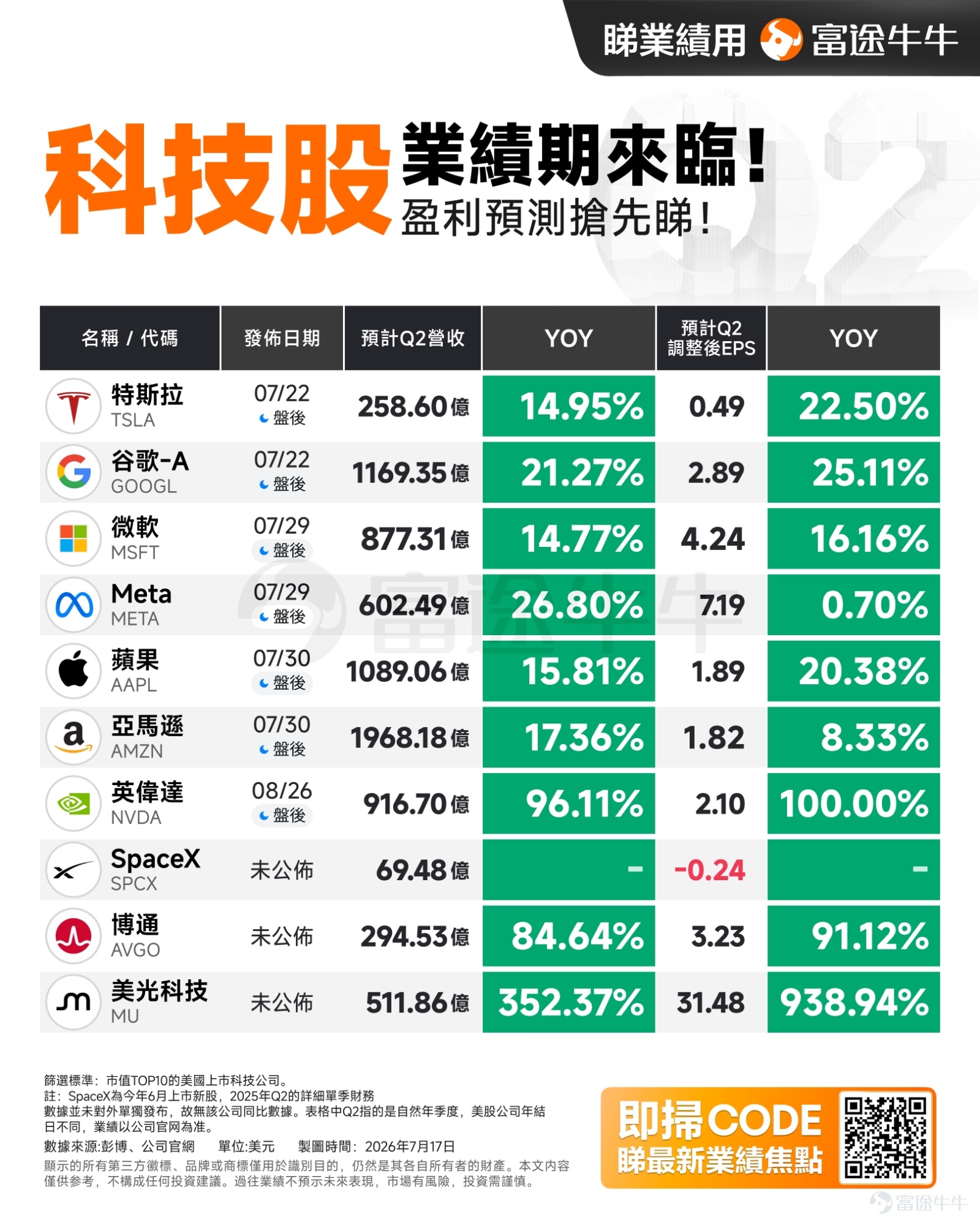
Bloomberg forecasts Tesla’s revenue for this quarter at $25.86 billion, up 14.95% year-over-year; adjusted EPS is expected to be $0.49, an increase of 22.5% year-over-year.
Tesla’s near-term fundamentals still face multiple challenges, with deliveries, price competition, automotive gross margins, and demand shifts remaining central market concerns. However, for investors, what may truly determine the stock’s upside potential is whether Elon Musk can deliver stronger signals during the earnings call regarding Robotaxi, Full Self-Driving (FSD), the Optimus robot, and AI-related businesses.If the company presents a sufficiently clear future roadmap, the market may remain willing to pay for the valuation premium associated with Tesla as a 'technology platform company.'
Google: Can AI-powered search and cloud businesses continue to drive growth?
Bloomberg forecasts Google’s revenue for this quarter at $116.935 billion, up 21.27% year-over-year; adjusted EPS is expected to be $2.89, an increase of 25.11% year-over-year.
Google’s key focus lies in AI’s dual impact on search advertising and cloud business. On one hand, AI-powered search could reshape user entry points and ad models; on the other, Google Cloud remains a critical metric by which the market assesses its AI commercialization capabilities.If cloud business maintains strong growth and progress continues smoothly within the Gemini ecosystem, Google stands to reaffirm its position as a core player in the AI race.
Intel: The chipmaker’s revival story enters its validation phase
Consensus market expectations indicate Intel’s revenue for this quarter is forecast at $14.413 billion, up 20.95% year-over-year.
Intel is at a critical juncture in its transformation. The market will closely monitor whether its data center business shows improvement, if PC demand rebounds, whether gross margins recover, and if its foundry strategy makes tangible progress.Amid intensifying competition in AI chips and advanced semiconductor processes, Intel could emerge as a 'dark horse' this earnings season if it delivers guidance that exceeds expectations.
So, among the three tech giants, whose earnings performance will satisfy the market?
🚗 Can Tesla offset pressure from its automotive business with its Robotaxi and AI narrative?
☁️ Can Google prove that its AI-powered search and cloud businesses remain key growth drivers?
💾 Can Intel deliver results that convince the market of its 'chip revival'?
This time, the market is looking beyond just the earnings numbers—it’s about whether these companies can provide investors with compelling reasons to keep believing in their future.Now, it’s time to showcase fellow investors’ insights!Come join the interactive event with rewards and earn points!👇👇Fellow investors, what are your views on how the companies reporting earnings this week will perform?
🏆 Activity 1: Bull Circle Insight Champion ✨
Tesla’s Robotaxi, Google’s AI search and cloud business, or Intel’s chip revival—which do you favor most?
Share your thoughts in the comments below:
✅ At least 30 characters ✅ Original viewpoint ✅ Complies with community guidelines
Meet the requirements and share in 30,000 points!
🏆 Activity 2: Options Strategy Exchange ✨
Individual stock implied volatility (IV) often spikes ahead of earnings reports—this is the ideal window to position options trades.How do you plan to trade? Share your options strategy in the comments below!Write at least 30 characters with sound reasoning to earn 66 points(Points stack on top of those from Activity 1)
🏆 Activity 3: Speak Your Mind | Win Futubull Merchandise ✨
We’re not just looking for directional calls—we want to hear your reasoning.
How to participate: Reply in the comment section of this post with at least 30 characters and your own unique insights
Sir Performance will review all comments,and reward the three fellow investors whose comments receive the most likes—each will additionally receive one Spade Futubull!
![[Cheerlead]This week, the U.S. earnings season continues to heat up! Tech stocks are about to face another round of critical tests:$Tesla (TSLA.US)$and$Alphabet-C (GOOG.US)$will be the first to release earnings,$Intel (INTC.US)$will also report after the market close on July 23,Stories around AI, electric vehicles, cloud computing, and the chip sector revival are about to be put to the test by the market. The most critical theme of this earnings season remains:Can tech giants’ AI investments truly translate into earnings growth? Over the past year, market expectations for AI have kept rising, but investors are no longer satisfied with grand narratives like 'AI will transform the future.' Instead, they want to see tangible revenue, profits, and commercialization progress.[Thinking Face] [Scowl]Divergence among tech stocks is becoming increasingly evident, as the market shifts from 'buy anything AI-related' to a more selective approach. Those who can demonstrate that their AI investments are generating returnswill likely continue to enjoy valuation premiums; conversely, those missing earnings expectations, offering weak guidance, or losing control over capital expenditures could face significant stock price volatility. Currently,$Tesla (TSLA.US)$Tesla is still navigating between the 'valley of reality' and the 'vast ocean of future possibilities.' Near-term focus remains on vehicle deliveries, price wars, and gross margin pressures, but what the market truly cares about may no longer be just how many cars Tesla sells,but whether Musk can articulate a compelling vision during the earnings call for Robotaxi, FSD, autonomous driving, Optimus robots, and...](https://nnqimage.futunn.com/sns_client_feed/999982/20260717/web-1784259711124-474FHis84a.png/big?area=2&is_public=true&imageMogr2/ignore-error/1/format/webp)
Note: All activities above will end at 00:00 Beijing Time on July 23; activity rewards are stackable; rewards will be distributed collectively after the conclusion of this earnings season.
Click to reserve:‘Earnings Express’: Futubull AI decodes key insights—build your options strategy in three steps!![[Cheerlead]This week, the U.S. earnings season continues to heat up! Tech stocks are about to face another round of critical tests:$Tesla (TSLA.US)$and$Alphabet-C (GOOG.US)$will be the first to release earnings,$Intel (INTC.US)$will also report after the market close on July 23,Stories around AI, electric vehicles, cloud computing, and the chip sector revival are about to be put to the test by the market. The most critical theme of this earnings season remains:Can tech giants’ AI investments truly translate into earnings growth? Over the past year, market expectations for AI have kept rising, but investors are no longer satisfied with grand narratives like 'AI will transform the future.' Instead, they want to see tangible revenue, profits, and commercialization progress.[Thinking Face] [Scowl]Divergence among tech stocks is becoming increasingly evident, as the market shifts from 'buy anything AI-related' to a more selective approach. Those who can demonstrate that their AI investments are generating returnswill likely continue to enjoy valuation premiums; conversely, those missing earnings expectations, offering weak guidance, or losing control over capital expenditures could face significant stock price volatility. Currently,$Tesla (TSLA.US)$Tesla is still navigating between the 'valley of reality' and the 'vast ocean of future possibilities.' Near-term focus remains on vehicle deliveries, price wars, and gross margin pressures, but what the market truly cares about may no longer be just how many cars Tesla sells,but whether Musk can articulate a compelling vision during the earnings call for Robotaxi, FSD, autonomous driving, Optimus robots, and...](https://nnqimage.futunn.com/sns_client_feed/999982/20260717/web-1784259810640-peK2f4w13y.webp/big?area=2&is_public=true&imageMogr2/ignore-error/1/format/webp) Futubull AI Instant Q&A to resolve doubts, AI-powered stock screening to identify breakout potential, and portfolio analysis to seize opportunities and avoid risks!
Futubull AI Instant Q&A to resolve doubts, AI-powered stock screening to identify breakout potential, and portfolio analysis to seize opportunities and avoid risks!![[Cheerlead]This week, the U.S. earnings season continues to heat up! Tech stocks are about to face another round of critical tests:$Tesla (TSLA.US)$and$Alphabet-C (GOOG.US)$will be the first to release earnings,$Intel (INTC.US)$will also report after the market close on July 23,Stories around AI, electric vehicles, cloud computing, and the chip sector revival are about to be put to the test by the market. The most critical theme of this earnings season remains:Can tech giants’ AI investments truly translate into earnings growth? Over the past year, market expectations for AI have kept rising, but investors are no longer satisfied with grand narratives like 'AI will transform the future.' Instead, they want to see tangible revenue, profits, and commercialization progress.[Thinking Face] [Scowl]Divergence among tech stocks is becoming increasingly evident, as the market shifts from 'buy anything AI-related' to a more selective approach. Those who can demonstrate that their AI investments are generating returnswill likely continue to enjoy valuation premiums; conversely, those missing earnings expectations, offering weak guidance, or losing control over capital expenditures could face significant stock price volatility. Currently,$Tesla (TSLA.US)$Tesla is still navigating between the 'valley of reality' and the 'vast ocean of future possibilities.' Near-term focus remains on vehicle deliveries, price wars, and gross margin pressures, but what the market truly cares about may no longer be just how many cars Tesla sells,but whether Musk can articulate a compelling vision during the earnings call for Robotaxi, FSD, autonomous driving, Optimus robots, and...](https://nnqimage.futunn.com/sns_client_feed/999982/20260717/web-1784259816047-e4KGA5cP23.webp/big?area=2&is_public=true&imageMogr2/ignore-error/1/format/webp)
Risk Disclaimer: The above content only represents the author's view. It does not represent any position or investment advice of Futu. Futu makes no representation or warranty.Read more


Comments (85)
to post a comment
29
11