
HK Stock Market Barometer | Super Earnings Week for HK Stocks!

Global Weekly Insights | US inflation cools more than expected; China’s economy shows signs of structural recovery
On the macroeconomic front
United States: Inflation cooled more than expected, confirming a downtrend, though sustainability remains uncertain; monetary policy pressure has eased marginally.
Last week, US inflation data weakened significantly, fully reversing earlier concerns about persistent high inflation and markedly improving market expectations for monetary policy. Both headline and core CPI in June undershot expectations on year-over-year and month-over-month bases. The CPI recorded its first negative month-over-month reading in years, primarily dragged down by falling energy prices and broad-based softening in core goods and services. Sticky components such as housing, lodging, auto insurance, and communication services also cooled, indicating a substantive easing of domestic underlying inflation pressures.Compounded by June’s PPI data, which also declined more than expected, inflationary pressures on the production side have continued to ease, further confirming the disinflation trend.Following the data release, markets priced in a 'dovish' monetary stance: Treasury yields and the dollar index fell, while precious metals and US equities rallied. Market expectations for further rate hikes cooled noticeably but have not vanished entirely. Overall, this round of inflation moderation has largely benefited from easing Middle East tensions, lower oil prices, and the lagged impact of high interest rates suppressing demand.However, uncertainties remain ahead—repeated geopolitical flare-ups could push energy prices higher again, potentially feeding through to services and reigniting inflation via second-round effects.Federal Reserve Chair Waller has consistently reaffirmed the Fed’s anti-inflation stance, emphasizing that a single month of cooling is insufficient to resolve high inflation. Future policy decisions will remain highly data-dependent, and the risk of additional rate hikes has not been fully eliminated. Monetary policy therefore remains tight and unlikely to pivot toward easing soon.
China: Mid-year economic data released, showing a pattern of structural recovery.
A full set of macroeconomic indicators for Q2 and June has been released domestically, revealing a continuation of moderate economic recovery with pronounced structural divergence. At the aggregate level, GDP grew 4.7% year-over-year in H1, with Q2 growth slowing to 4.3%, reflecting a deceleration in the pace of economic repair—primarily weighed down by weak domestic demand and pressured investment. The production side showed resilience, with industrial value-added accelerating notably in June.Manufacturing and power generation led the way, with high-tech manufacturing, advanced equipment, shipbuilding and aviation, and electronic equipment sectors—representing new growth drivers—maintaining strong momentum.Industrial recovery continues to be driven by industrial upgrading. External demand has become the key pillar of economic support: June exports and imports surged well beyond expectations, with exports surpassing the USD 40 billion mark for the first time. Exports of AI-related semiconductors, smart devices, new energy vehicles, and green energy products posted explosive growth, while machinery and equipment exports demonstrated rising competitiveness. Export composition continues to improve, with a clear emphasis on intelligence and sustainability ('smart and green'). Consumption exhibited notable structural divergence, with June retail sales growth turning positive after a prior decline.Essential consumption and upgraded spending on communications and digital devices remained robust, with the AI-driven smartphone replacement cycle boosting sales of communications equipment. However, big-ticket consumption linked to automobiles and real estate continued to weaken, reflecting subdued domestic demand recovery.Overall, China’s current economic landscape is characterized by 'stable production, strong exports, weak consumption, and underperformance in traditional sectors.' Insufficient effective demand remains the core challenge, and counter-cyclical policies aimed at stabilizing domestic demand, expanding consumption, and supporting investment are expected to remain active in the second half of the year.
In the equity market,
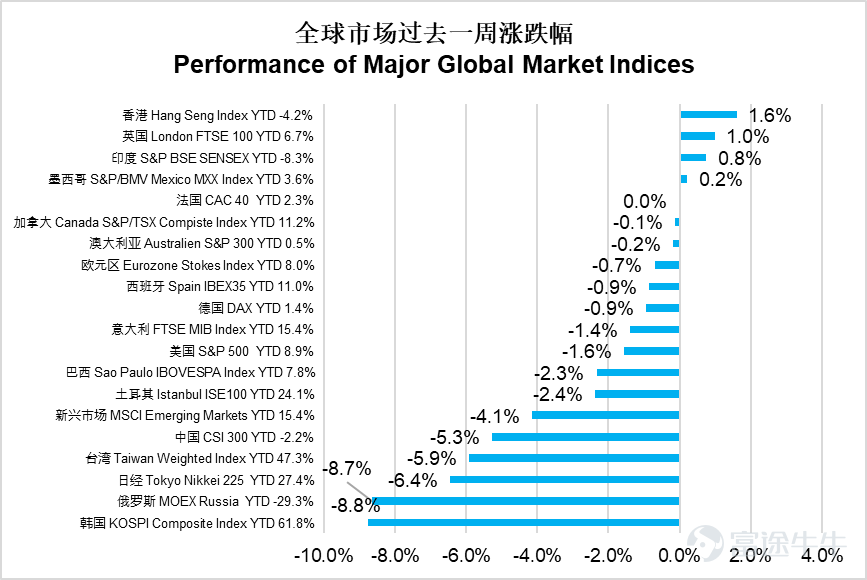
Global markets weakened significantly last week, with Asia-Pacific and emerging markets posting notable declines. European markets proved relatively resilient, with only a few—such as Hong Kong, the UK, and India—posting gains.The KOSPI plunged 8.8% and Russia’s MOEX fell 8.7%, leading global losses. The Nikkei 225, Taiwan Weighted Index, and CSI 300 all underwent deep corrections, dragging down the MSCI Emerging Markets Index. The S&P 500 retreated 1.6%, while major European markets saw modest pullbacks.Hong Kong’s Hang Seng Index rose 1.6%, standing out positively, while the UK and Indian markets posted modest gains.Markets broadly followed a pattern of Asia-Pacific leading the decline, Europe and the US showing relative resilience, and Hong Kong equities strengthening independently.

Data source: Wind
US stocks last week $S&P 500 Index (.SPX.US)$fell 1.6%, with defensive and energy sectors outperforming while technology and growth stocks broadly corrected.The energy sector surged 5.0%, leading gains, while real estate, consumer staples, and financials also posted逆势 gains; the information technology sector tumbled 3.8%, communication services weakened in tandem, and industrials, materials, and discretionary consumer sectors broadly declined.Market risk-off sentiment clearly intensified.

Source: Wind
The Hang Seng Index rose 1.6% last week, with pronounced sectoral divergence.Defensive value-oriented sectors such as consumer staples, real estate, and energy led the gains, while technology, industrials, and materials pulled back. Consumer staples surged 4.5%, with real estate and construction and energy posting the strongest gains; industrials tumbled 3.8%.The information technology sector, Hang Seng Tech Index, and healthcare sector all posted modest declines. The market overall exhibited a structural pattern in which defensive value sectors outperformed, while growth and cyclical sectors faced pressure.

Source: Wind
Bond Market
Global bond markets saw a modest rebound over the past week. The Global Aggregate Index rose 0.03%, the US Aggregate Index gained 0.13%, US investment-grade corporate bonds advanced 0.07%, and US high-yield corporate bonds rose 0.03%. The Emerging Markets USD Bond Aggregate Index declined 0.17%, while the China USD Credit Bond Index rose 0.07%.

On the rates front, US Treasury yields moved lower across the curve: the 2-year Treasury yield fell by 3 bps to 4.18%, and the 10-year Treasury yield dropped by 1 bp to 4.55%.

Market outlook
– Market confidence in the narrative of 'unlimited AI-driven demand expansion' has wavered, raising questions about whether deleveraging is nearing its end.
Better-than-expected inflation data this week failed to lift US tech stocks. The Philadelphia Semiconductor Index officially entered a technical bear market, and Taiwan Semiconductor’s strong earnings were interpreted by the market as 'buy the rumor, sell the news.'Given previously elevated valuation levels, modest earnings beats are no longer sufficient to support further share price appreciation.Next week, nearly 80 S&P 500 companies—including Alphabet, Tesla, and Intel—will release their Q2 earnings reports. Alphabet, as the first hyperscale cloud provider to report after the recent semiconductor selloff, will be closely watched: its guidance on AI-related capital expenditures will directly determine whether the current chip stock correction marks a short-term reset or the start of a broader trend reversal.
This round of selling reflects both fundamental and positioning-related drivers.On fundamentals, market concerns over slowing capital expenditure by AI cloud vendors, combined with the impact of new Chinese AI models on the chip competitive landscape, have shaken the previous consensus expectation of 'unlimited AI demand expansion.'In terms of positioning, hedge funds tracked by JPMorgan have been reducing their AI exposure and leveraged ETF positions for over a month. A sudden tightening by Korean regulators of rules on single-stock leveraged ETFs triggered a disorderly deleveraging in the memory sector. The key question now is whether 'deleveraging is nearing its end'—if no new forced liquidation pressures emerge over the next one to two weeks, selling pressure could naturally stabilize.If cloud computing vendors continue to raise their capital expenditure guidance in next week’s earnings reports, there will be room for market sentiment to recover.Meanwhile, Trump’s renewed threat to blockade Iran via the Strait of Hormuz pushed Brent crude prices up nearly 15% in a single week, adding fresh upward pressure to the inflation trajectory and reinforcing market uncertainty about the policy path ahead of the FOMC meeting at the end of July.
It is worth emphasizing that current U.S. equity market movements reflect a sector rotation dynamic.While AI/semiconductor stocks have undergone a sharp correction, non-AI sectors—particularly financials—have delivered exceptionally strong results. All five major U.S. banks reported second-quarter earnings that beat expectations, each achieving double-digit profit growth. This banking earnings surge has been jointly driven by a recovery in the capital markets cycle—record-breaking IPO volumes have propelled investment banking fees to their highest level since 2021, and trading revenues (especially equity trading) have surged significantly.Combined with robust deal pipelines supported by the AI funding boom, this reflects resilience in real economic activity and corporate financing demand, not signs of a recession.Therefore, the current pullback should be understood as a structural unwinding led by the most expensive and crowded AI hardware segment, rather than a systemic selloff across risk assets.
Key economic data and events this week
China will release its July Loan Prime Rate (LPR) data on Monday;
The U.S. will release its July S&P PMI data on Friday.
Disclaimer: The issuer of this report is E Fund Asset Management (Hong Kong) Co., Ltd. This report does not constitute an invitation or recommendation to invest in fund units. Fund unit subscriptions can only be made using application forms accompanied by the fund prospectus. Investment involves risks; fund prices may rise or fall, and past performance is not indicative of future results. Before investing, investors should carefully read the fund prospectus (including the 'Risk Factors' section) to understand the investment risks related to the fund. This report may only be distributed in certain jurisdictions. In any jurisdiction where distributing such information or making any invitation or recommendation is prohibited, or where distributing this report or making an invitation or recommendation to any person would be illegal, this report does not constitute such distribution or invitation or recommendation. This document has been exempted from prior review and approval by the Hong Kong Securities and Futures Commission, and has not been reviewed by the SFC. SFC approval does not imply promotion or endorsement of the plan, nor does it guarantee its commercial merits or performance, nor does it indicate suitability for all investors, or endorsement of suitability for any particular investor or category of investors. All rights reserved © 2026. E Fund Asset Management (Hong Kong) Co., Ltd.
Risk Disclaimer: The above content only represents the author's view. It does not represent any position or investment advice of Futu. Futu makes no representation or warranty.Read more
Comments
to post a comment
1