
Apple and Amazon reported starkly contrasting earnings— which one are you bullish on?

AI is a cash-burning game that no one wants to play—so why is Buffett doubling down on Alphabet?
Introduction
On July 15, 2026, Warren Buffett confirmed in a CNBC interview that Berkshire Hathaway (BRK.A, BRK.B)'s investment in $Alphabet-A (GOOGL.US)$ (GOOGL, GOOG) was initiated by him personally; the previous month, Berkshire participated in Alphabet’s private placement with a $10 billion investment. Alphabet is building an AI computing ecosystem spanning chips, data centers, models, cloud services, and consumer products, with capital expenditures projected to reach $180–190 billion in 2026. This massive spending aims to meet compute demands for model training, search inference, and enterprise AI services—and will significantly increase depreciation, financing needs, and fixed costs.
Why would an investor who has long favored high returns on capital expand his position just as Alphabet becomes rapidly more capital-intensive? The answer hinges on Google’s two-decade-old business foundation and whether its search, advertising, cloud computing, and subscription businesses can collectively absorb these new assets.
01 Buffett personally drove Berkshire's increased stake in Alphabet
Berkshire Hathaway initiated its position in Alphabet starting in the third quarter of 2025 and significantly increased its holdings in the first quarter of 2026. According to SEC filings, as of the end of March, Berkshire and its consolidated reporting entities held approximately 54.25 million shares of Alphabet Class A stock and 3.59 million shares of Class C stock, totaling about 57.84 million shares. In a CNBC interview, it was estimated that including the $10 billion private placement, Berkshire’s stake in Alphabet is now worth over $31 billion.
In June, Alphabet announced an approximately $80 billion equity financing plan, comprising a $30 billion underwritten offering, a $40 billion at-the-market (ATM) offering program, and a $10 billion private placement subscribed by Berkshire. Berkshire plans to allocate $5 billion each toward purchasing Alphabet Class A and Class C shares. The proceeds will be used to expand AI infrastructure and computing capacity, as well as to cover tax obligations related to employee equity awards and for general corporate purposes.
The consecutive purchases in the secondary market and the targeted private placement send a signal distinct from typical financial investments. Open-market buying can be flexibly adjusted based on valuation and market volatility, whereas a private placement means Berkshire is directly providing long-term capital to support Alphabet’s expansion. The scale and structure of this investment indicate that Buffett has accepted the possibility of lower near-term capital returns from Alphabet, while judging that the company’s long-term odds of prevailing in the AI race are strong enough to justify the risk.
02. Buffett’s three-tiered assessment expressed in his own words
In the interview, Buffett articulated three main judgments.First, he acknowledged that not investing in Google earlier was a mistake.When asked why Berkshire didn’t buy Google when it required less capital investment and the market favored the business model—but is now building a position as the company begins large-scale capital spending—Buffett responded directly: “I made a mistake.” This isn’t the first time he has admitted missing out on Google.
Second, he emphasized Alphabet’s track record of past operational performance.Buffett stated that Alphabet has a higher probability of becoming a winner than 90% or 95% of the companies promoted by Wall Street. The key word here is “record”—the company’s long-accumulated history of operations. He believes an excellent business must generate returns on capital consistently above risk-free rates over an extended period and ideally be able to reinvest additional capital at similarly high returns. The challenge with AI companies is that they require hundreds of billions of dollars in investment, yet investors currently struggle to assess how much cash return that capital will ultimately generate.
Third, he believes that major companies are rapidly burning cash because these AI firms no longer have the option to stop investing.Buffett remarked that hyperscale tech platforms are participating in a game they never wanted to join. The continued expansion of AI infrastructure investment isn't entirely driven by management’s confidence in sufficiently high returns; rather, no company can afford to voluntarily exit. As long as competitors might disrupt the existing market through better models, lower inference costs, or new product entry points, cutting back on investment could jeopardize core businesses such as search, cloud computing, productivity software, and advertising.
Taken together, these three layers of reasoning clarify Buffett’s investment logic. He does not deny the risk of overinvestment in AI-related capital expenditures, nor does he assume all AI companies will achieve high returns. Instead, his view is closer to this: since this is a high-cost race with no option to quit, the odds of winning will ultimately concentrate among the few companies that already possess strong cash flows, user access points, infrastructure, and commercialization capabilities—and Alphabet is one whose operating track record is relatively easy to verify.
03 Why Take a Heavy Position in Alphabet? Buffett Is Buying Alphabet’s Business Foundation
1. He is betting on its operating track record, judging that Alphabet has a higher probability than most competitors of converting AI into revenue and cash flow.
The generative AI industry often ranks companies based on their models’ inference, coding, multimodal, and context-handling capabilities, but these advantages can shift rapidly with the release of next-generation products.
Buffett acknowledges that he is neither skilled at assessing these rankings nor expects to become so. Berkshire doesn’t need to predict that Gemini will lead in every future generation; it only needs to judge that Alphabet has a higher probability than most competitors of turning AI into revenue and cash flow.
Alphabet differs significantly from many pure-play AI companies in that it doesn’t need to acquire users from scratch. Google controls key entry points including Search, Chrome, Android, YouTube, Gmail, Google Maps, Workspace, and Google Cloud. Alphabet has disclosed that Gemini is already integrated into 13 of its products with over 1 billion monthly active users, five of which exceed 3 billion users. AI Overviews now reach more than 2.5 billion monthly users, and AI Mode—launched roughly a year ago—has surpassed 1 billion monthly users. This means Alphabet can deploy its models directly into existing products. Every search query, video recommendation, ad impression, email interaction, and enterprise workflow can become an AI use case. By contrast, many standalone AI companies must first bear the costs of model training and inference, then purchase users via advertising, app stores, or partnerships, before finally testing whether subscriptions, APIs, or enterprise services can cover their compute expenses.
Alphabet also has multiple monetization avenues. Search generates revenue through advertising; Google Cloud sells compute capacity, models, data platforms, and security services; Gemini and Google One monetize via subscriptions; Workspace earns through enterprise seat fees; and YouTube benefits from advertising, subscriptions, and improved recommendation efficiency.
These revenue streams do not require the model API itself to maintain high margins. Even if foundational model capabilities converge and API pricing declines in the future, Alphabet can still capture AI-generated value through its traffic gateways, cloud services, enterprise software, and advertising ecosystem. Buffett is betting on a proven business system—not on any single technical metric maintaining permanent leadership.
2. He missed Google in the past because he misjudged its business model as a technology issue.
At Berkshire Hathaway's 2017 annual shareholder meeting, Buffett reflected on why he missed investing in Google. GEICO, Berkshire’s auto insurance subsidiary, had been an early advertising customer of Google. At that time, GEICO paid Google approximately $10 to $11 for each ad click—a figure that already revealed the economic value embedded in Google’s search advertising. Meanwhile, Google’s marginal delivery cost for each additional click was relatively low. Although continuous investment was required to maintain its search infrastructure, once Google’s index, ad systems, and traffic entry points achieved scale, serving one more commercial search query did not require proportional increases in labor, physical stores, or sales personnel. Ad revenue could grow with search volume and bidding intensity, without a corresponding rise in delivery costs.
Buffett had already observed the customer value of this business through GEICO, yet he still categorized Google as part of the unpredictable tech sector. He focused on the possibility that search technology might change rapidly and failed to fully appreciate that Google had already captured user intent, advertising budgets, and commercial distribution channels.
His key mistake in missing Google wasn’t failing to understand search technology, but rather not promptly recognizing search advertising as a business with measurable ROI, low marginal costs, and network effects.
Today, Alphabet’s products and technologies are far more complex than they were in 2017, but its core business foundation remains intact. Users still need to find information, compare products, watch videos, manage emails, and get work done; businesses still need to acquire customers, purchase computing resources, and improve employee productivity. AI has transformed product formats, but it hasn’t eliminated these fundamental needs.
For Buffett, this makes Alphabet newly 'understandable.' He doesn’t need to predict every technical detail—only answer a few key business questions: Are users continuing to use Google’s products? Are advertisers still achieving measurable returns? Are enterprise customers willing to pay for Cloud and AI services? And can Alphabet deliver these services at a cost lower than the incremental revenue they generate?
As long as the answers to these questions remain positive, Alphabet is not just an AI model developer, but also a commercial infrastructure connecting users, enterprise clients, advertising budgets, and computing resources.
04 Why Larger AI Capital Expenditures Could Actually Strengthen Alphabet’s Moat
Alphabet expects capital expenditures to reach $180–190 billion in 2026—roughly six times the $31 billion spent in 2022 and about double the amount projected for 2025. The company also anticipates that 2027 capital expenditures will be significantly higher than those in 2026.
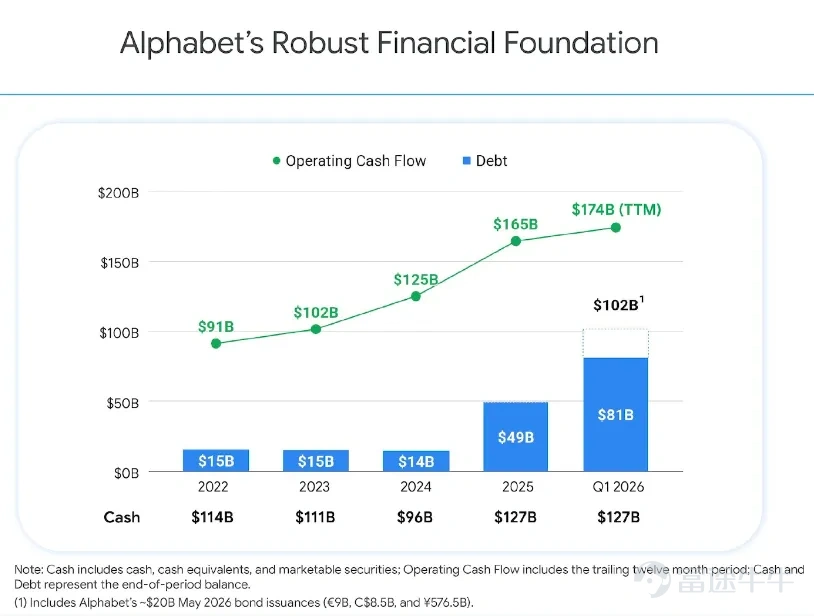
In the twelve months ending Q1 2026, Alphabet generated approximately $174 billion in operating cash flow, while its projected full-year capital expenditures for 2026 range from $180 to $190 billion. Capital spending may now exceed operating cash flow for the same period, prompting the company to simultaneously expand both debt and equity financing.
Chart: Alphabet's operating cash flow, cash, and debt changes

Source: Alphabet Investor Presentation, June 2026
However, higher capital expenditures could also lead to a second outcome: significantly raising the minimum threshold required to compete in AI.
Competition in foundational models is no longer just about algorithmic rivalry between research teams. Companies now need to simultaneously possess chips, data centers, power, networking, training data, model talent, cloud platforms, and product distribution channels. Even if a startup develops an excellent model, it may struggle to achieve a viable business loop due to high inference costs, insufficient stable computing capacity, or lack of sufficient users.
Alphabet’s advantage lies in its ability to share the same infrastructure across multiple businesses.Underlying TPUs, servers, fiber optics, and data centers can support Gemini training while also powering search inference, ad systems, YouTube recommendations, Workspace, developer APIs, and Google Cloud customers.
Alphabet has disclosed that its infrastructure includes approximately 10 million kilometers of terrestrial and submarine fiber, over 30 data centers, and more than 40 Cloud regions. The company offers its own custom-designed TPUs, Axion CPUs, and NVIDIA GPUs, aiming to create an integrated ecosystem spanning chips, data centers, models, development tools, and products.
Its custom-designed TPUs are a critical component of this architecture. TPU stands for Tensor Processing Unit—a specialized chip developed by Google for machine learning workloads. Alphabet has already launched its eighth-generation TPU 8t and TPU 8i, tailored respectively for large-scale training and inference needs. The company reported that Gemini service costs dropped by 78% in 2025, and with the launch of Gemini 3, core AI response costs fell by another 30%+. These figures demonstrate that Alphabet is simultaneously scaling total compute capacity while reducing per-unit inference costs.
This is precisely the condition under which high capital expenditures can create competitive barriers: the scale of investment is only the starting point; what truly matters is infrastructure utilization. If a single data center serves only one chatbot, the path to recouping capital investment is relatively narrow. But if it can simultaneously support search, advertising, cloud computing, video recommendations, productivity software, and external developers, fixed costs can be shared across multiple business lines.
Smaller AI companies may face the opposite situation: they need to purchase expensive computing power from external cloud providers, rely primarily on subscription or API-based revenue, and incur additional channel costs to acquire customers. If model pricing declines or user growth slows, infrastructure costs are difficult to scale down quickly.
Therefore, AI-related capital expenditures have a dual effect on Alphabet: they compress free cash flow in the short term but could, over the long term, turn scale of computing power, unit costs, and product distribution into harder-to-replicate competitive advantages.What Buffett is truly betting on is not that spending money itself creates an advantage, but rather thatAlphabet has a greater ability than most companies to increase the utilization rate of these assets.
05 Whether high capital expenditures are justified ultimately depends on validation through revenue, profits, and customer demand—and Alphabet is already showing positive signals.
Whether high capital expenditures are justified ultimately depends on validation through revenue, profits, and customer demand. Alphabet’s disclosed Q1 2026 data currently provides some positive signals.
In Q1, Alphabet reported revenue of nearly USD 110 billion, up 22% year-over-year; operating profit reached USD 40 billion, up 30% year-over-year. Revenue from Google Search and other services grew 19% year-over-year, while Google Cloud revenue surged 63% year-over-year. Cloud backlog nearly doubled sequentially to USD 462 billion, with slightly more than half expected to be recognized as revenue within the next 24 months.
Google Services revenue grew 16% year-over-year, with operating margin improving from 42% a year earlier to 45%. Google Cloud generated USD 20 billion in revenue in Q1, with operating profit of USD 7 billion and a margin that rose to 33%. Alphabet stated that enterprise AI solutions became, for the first time, the largest contributor to Cloud growth.
Figure: Google Services and Google Cloud Operating Performance, Q1 2026

Source: Alphabet Investor Presentation Materials, June 2026
These figures indicate thatAlphabet is not yet subsidizing AI initiatives—which have yet to generate meaningful demand—with cash flows from a legacy business in sustained decline.Search revenue continues to grow, Cloud is simultaneously achieving both revenue growth and margin expansion, and subscription businesses are also scaling. Alphabet now has 350 million paying subscribers, and YouTube’s combined ad and subscription revenue is projected to exceed $60 billion in 2025.
Validation of the search business is particularly critical.AI-generated answers may reduce traditional web clicks and increase computational costs per query. If users obtain information directly from AI responses, ad impression and click-through models will need to be redesigned.However, Alphabet has disclosed that AI Overviews and AI Mode are boosting user engagement, with search query volume reaching an all-time high last quarter and search revenue still growing by 19%.
This does not yet prove that the long-term business model for AI-powered search is stable. Search growth may be influenced simultaneously by ad pricing, query volume, and macro-level advertising demand, while capital expenditure and depreciation pressures will gradually materialize in coming quarters.Based on current data, AI product deployment has not yet undermined Google's most important source of cash flow.
Google Cloud offers another form of validation. Its $46.2 billion backlog indicates enterprise customers are signing longer-term contracts for cloud computing and AI services. Seventy-five percent of Cloud customers already use Google’s AI products, and the number of large contracts valued between $100 million and $1 billion signed in Q1 doubled year-over-year.
The validation Alphabet has provided so far can be summarized in three points: search shows no significant deterioration, Cloud is securing enterprise AI contracts, and subscriptions and ads are creating additional monetization pathways for AI. This evidence is sufficient to explain why Buffett believes Alphabet has better odds than many AI companies that have yet to establish a viable revenue model.
06 Summary: Why he chose Alphabet instead of broadly betting on all AI companies
First, Alphabet already has cash flow sufficient to support its AI investments.Many AI companies must first raise capital to build computing infrastructure and then rely on future revenue to cover costs. Alphabet generated approximately $174 billion in operating cash flow over the past twelve months and held $127 billion in cash and marketable securities as of the end of Q1 2026. Although its planned capital expenditures of $180–190 billion will still require debt and equity financing, the company does not need to assume that capital markets will remain continuously open for its survival.
Second, Alphabet already has a vast user base.Search, Chrome, Android, YouTube, Gmail, and Workspace allow Alphabet to deploy AI directly to users worldwide. Independent AI companies typically must build their brand from scratch or rely on browsers, operating systems, app stores, and search advertising for customer acquisition. By embedding Gemini into its existing products, Alphabet can reduce distribution costs for new offerings and gain access to larger-scale usage data.
Third, Alphabet has multiple monetization channels.AI can be monetized through search advertising, Cloud computing capacity, enterprise software, consumer subscriptions, and developer APIs. Even if one monetization path underperforms expectations, other businesses may still absorb part of the infrastructure costs. This diversified revenue structure reduces Alphabet’s reliance on subscription fees or API pricing for a single model.
Fourth, Alphabet controls both the models and the underlying infrastructure.The company owns both Google DeepMind and the Gemini models, as well as TPUs, data centers, global networking capabilities, and the Cloud platform. While this full-stack approach doesn’t guarantee superiority in every component, it enables Alphabet to jointly optimize costs across chips, models, and products. For example, its custom-designed TPUs can be tailored to internal workloads, while Search and Cloud provide sufficiently large-scale usage to justify such integration.
Fifth, Alphabet has already demonstrated its ability to translate technical capabilities into commercial revenue.This is also the point most consistent with Buffett's typical way of thinking. Search advertising, YouTube, and Google Cloud have all evolved from technological products into major sources of revenue. Buffett doesn’t need to believe everything management says about their AI vision; he only needs to assess whether the company has a track record of repeatedly commercializing new products.
Berkshire didn’t choose the most 'pure-play' AI company, but rather one that can still generate revenue through advertising, cloud computing, subscriptions, and distribution channels—even if foundational model profits decline.
This approach aligns with how Buffett previously understood Apple. He didn’t necessarily view the company solely as a technology hardware manufacturer, but instead focused on user relationships, brand strength, ecosystem dynamics, and recurring consumer spending. Alphabet’s business model differs from Apple’s, yet both companies benefit from massive user touchpoints and sustainable monetization pathways.
07 An Additional Layer of Reflection: Where Are the Potential Risks in Buffett’s Judgment?
The investment thesis for Alphabet holds true only if it clears several key hurdles.
First, search could be transformed by AI.Google’s largest current profit driver remains search advertising. Generative AI can directly answer user queries, reducing the need to click through to external websites. Ad placements, click-through rates, and the presentation of commercial search results could all change. Alphabet must demonstrate that the increased query volume from AI-powered search, more complex commercial intent, and higher ad conversion rates can offset reduced clicks and rising inference costs.
Second, capital expenditures, depreciation, and financing costs could persistently outpace AI revenue growth.Capital expenditures of $180–190 billion imply significant new investments in servers, chips, data centers, and power infrastructure, with related depreciation expenses flowing into the income statement over the coming years. Alphabet is also expanding its debt and issuing common stock and mandatory convertible preferred shares, which simultaneously increase interest expenses and pose potential equity dilution risks. If equipment utilization falls short of expectations—or if next-generation chips render existing infrastructure obsolete sooner than anticipated—revenue growth may not translate proportionally into free cash flow per share.
Third, in-house chip development could also introduce strategic pathway risks.TPUs can help Alphabet reduce costs, but in-house chip development requires sustained investment in R&D, software ecosystems, and supply chain resources. If industry workloads shift, or if external general-purpose chips maintain a clear advantage in performance and ecosystem support, Alphabet will still need to procure multiple computing platforms simultaneously. While a full-stack architecture enables synergy, it also increases the complexity of technology investment and resource allocation.
Fourth, Cloud backlog does not equate to realized profit.The $462 billion backlog provides visibility into future revenue, but orders must go through compute infrastructure build-out, customer deployment, and revenue recognition. Large AI contracts may involve significant hardware investments and pricing concessions, meaning revenue growth does not necessarily translate into proportional free cash flow growth.
Fifth, Alphabet’s product synergies could also face regulatory constraints.Synergies across search, browsers, mobile operating systems, ad technology, and account systems form a critical foundation for Alphabet to lower distribution costs. If regulators restrict default entry points, data sharing, or ad business integration, Alphabet’s ability to leverage its existing products to promote AI could weaken.
Buffett is betting on Alphabet’s relative odds of winning the AI shakeout, not on the certainty that its $190 billion capital expenditure will yield high returns. If AI revenue consistently covers depreciation, financing costs, and equity dilution, high capital spending will reinforce Alphabet’s scale-based moat; however, if revenue growth fails to keep pace with asset expansion, today’s infrastructure advantage could become tomorrow’s fixed-cost burden.
Conclusion1. Buffett’s investment in Alphabet is fundamentally based not on the lead of any single Gemini model generation, but on the company’s long-term track record of converting user traffic, commercial intent, and technical capabilities into cash flow.
2. AI-related capital expenditure represents a competition that large platforms cannot easily exit—it will compress free cash flow in the short term but may ultimately eliminate participants lacking sufficient capital, infrastructure, or user distribution capabilities.
3. Alphabet’s key advantage lies in its multiple monetization channels—including Search, Ads, Cloud, YouTube, Workspace, and subscriptions—which can collectively absorb the costs of AI infrastructure.
What truly needs to be verified is not whether Buffett is bullish on Alphabet, but whether the incremental AI revenue can sustainably cover capital expenditures, depreciation, financing costs, and equity dilution totaling USD 180–190 billion.
Risk disclaimer: The above content represents the author’s personal views only, and investors bear all risks associated with their decisions.
Risk Disclaimer: The above content only represents the author's view. It does not represent any position or investment advice of Futu. Futu makes no representation or warranty.Read more

Comments
to post a comment
2
1