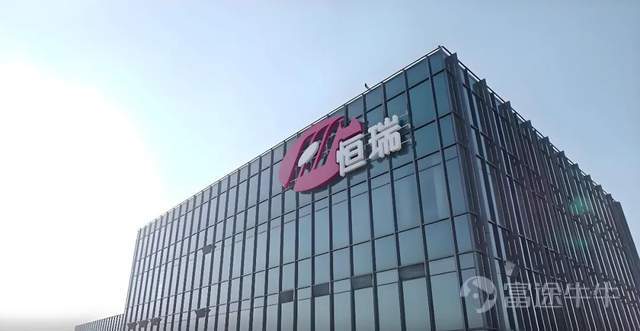

Why can't Hengrui Pharma ever get past the FDA?

On July 10, 2026, Hengrui Pharma received another rejection letter from the U.S. Food and Drug Administration (FDA).
This marked the third time its 'Shuang Ai' regimen—a combination of camrelizumab and apatinib for liver cancer treatment—had applied for U.S. market approval, and the third time it was turned down.
Three attempts, spanning nearly three years.
This shouldn’t be a repeated stumble for a company whose R&D capabilities rank number one domestically and place within the global top ten.
In fact, counting from its first submission to the FDA in August 2023, Hengrui Pharma has knocked on the FDA’s door three times—and failed to gain entry each time.
Yet passing through this door means more to Hengrui than just selling another drug; it’s about proving something far more important—that the company is not merely a traditional pharmaceutical firm reliant solely on the domestic market, but a genuinely capable innovator ready to stand on the global stage.
Rejected three times—each time for the same issue
The overseas journey of the 'Shuang Ai' combination dates back to 2018.
In December of that year, this combination therapy received approval to conduct large-scale clinical trials in the United States.
In 2021, camrelizumab was granted FDA 'orphan drug' designation—a status for rare diseases that offers expedited review and regulatory incentives—and Hengrui Pharma was confident this would become the company’s first truly homegrown innovative drug successfully commercialized in the U.S.
In July 2023, the formal marketing application was accepted by the FDA; three months later, Hengrui Pharma sold the global rights to this drug—excluding China and South Korea—to Elevar, a U.S.-based subsidiary of a South Korean listed company, effectively partnering with a local ally to advance the launch.
The first rejection occurred in May 2024.
The FDA cited failure to pass on-site inspections of the manufacturing facility, compounded by travel restrictions during the pandemic that prevented inspectors from visiting the site on schedule.
A subsequently leaked document revealed multiple deficiencies at a Hengrui Pharma factory in Suzhou: inadequate data documentation, insufficient contamination control procedures, and lax pre-release product testing.
In plain terms, the factory’s day-to-day operations lacked the rigor required to meet the FDA’s minimum standards.
Two months later, the FDA issued a warning letter to another Hengrui Pharma facility in Lianyungang, citing issues across eight areas including operational procedures, record-keeping, and sanitation.
Source: Official website of the U.S. FDA
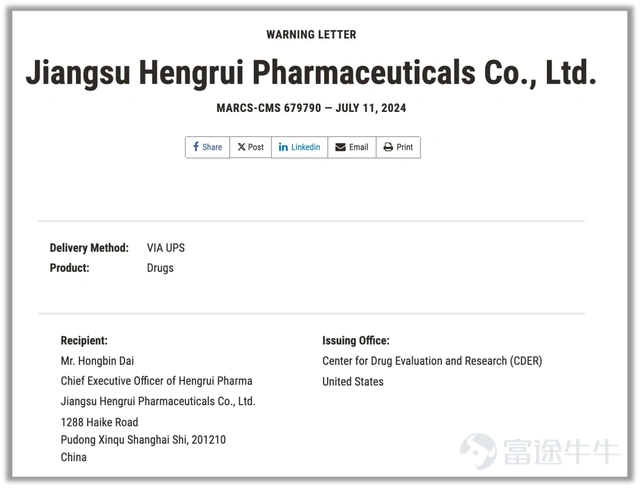
Source: Official website of the U.S. FDA
Hengrui Pharma spent several months implementing corrective actions and resubmitted its application.
However, in March 2025, a second rejection letter arrived—the issue again stemmed from the manufacturing facility, though this time the FDA did not disclose specific details.
According to Hengrui’s partner, South Korea’s HLB, the original ten issues identified at the Suzhou facility have now been narrowed down to three: contamination control, inspection procedures, and automation systems. Although the facility has not yet passed inspection, tangible progress has been made.
What truly surprised the market was the third rejection.
This time, the focus shifted from the production line for the PD-1 drug to that of apatinib. Notably, this apatinib production line had just undergone a routine FDA inspection in April this year and had recently passed an official review by the European Union in 2025. Given that EU and FDA standards are generally considered mutually recognized and equally stringent, Hengrui’s successful clearance in Europe makes its failure to pass the FDA inspection particularly unexpected.
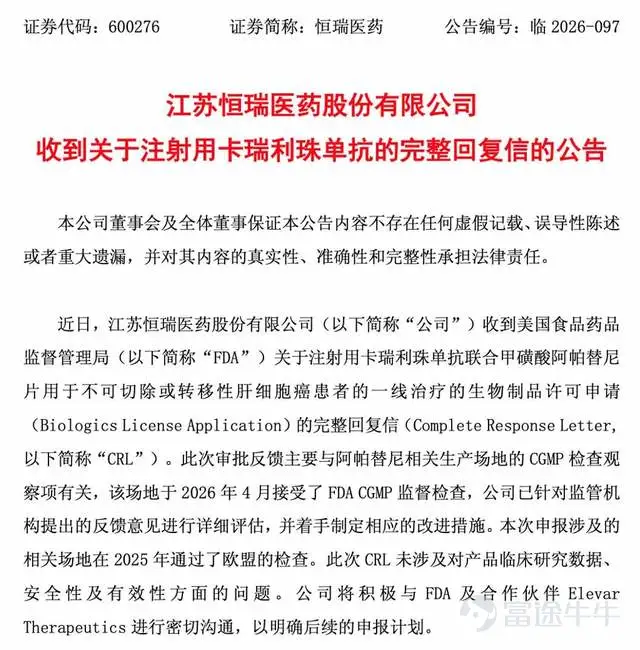
Source: Corporate Announcement
Hengrui stated that the latest issue does not involve the efficacy or safety of the drug itself, and the company will continue discussions with the FDA and Elevar to determine next steps.
Just as this article was nearing completion, Hengrui’s partner, South Korea’s HLB, issued a new announcement: the U.S. FDA has sent Hengrui a close-out letter regarding cGMP deficiencies at the active pharmaceutical ingredient (API) manufacturing site for the 'Shuang Ai' combination therapy.
All issues related to this round of facility inspections, which previously hindered approval, have now been fully rectified, and the FDA will no longer pursue these manufacturing discrepancies.

This news is certainly good for Hengrui Pharma—it at least indicates that the active pharmaceutical ingredient (API) manufacturing facility issue, which had been repeatedly flagged in the previous three inspections, has finally been put to rest.
However, this does not guarantee that the 'Shuang Ai' combination therapy will smoothly pass approval this time, for two reasons: First, the closure letter only covers the API manufacturing site. The finished-dosage manufacturing facility—responsible for turning APIs into final drug products—still has a Form 483 awaiting corrective action. This is precisely the same operational area where Hengrui Pharma has repeatedly stumbled in recent years: plant management. Second, even if both facilities eventually clear their compliance hurdles, the formal review process has not yet officially resumed. HLB still needs to hold another meeting with the FDA and complete the Type A meeting procedures before 'Shuang Ai' can truly be placed back on the approval track.
In other words, this 'case closure' has removed one obstacle blocking Hengrui’s path—but another one lies ahead. Hengrui still hasn’t finished solving this problem.
Looking at the three rejection letters together reveals a clear pattern: whether the drug actually works has never been Hengrui’s issue. After all, the survival data from the 'Shuang Ai' combination therapy for liver cancer remains the best among all currently approved regimens.
What has consistently tripped up Hengrui is the drug manufacturing process itself: whether plant operations are sufficiently compliant, whether documentation is robust enough, and whether every step can withstand unannounced inspections.
As industry insiders put it, Hengrui has always delivered excellent 'exam scores,' but keeps running into trouble over 'exam-room discipline.'
02 Why Hengrui Must Pass the FDA Test
Why is Hengrui so determined to secure FDA approval?
Because the domestic market’s ceiling is already clearly visible. In recent years,常态化医保控费 and centralized procurement have squeezed profit margins for many drugs extremely thin. Hengrui’s revenue growth has hovered just above 10% over the past three years—not particularly fast.
The real source of upside potential lies overseas—particularly in the U.S., the world’s largest and highest-priced pharmaceutical market.
For example, Junshi Biosciences’ PD-1 drug is priced in the U.S. at more than 30 times its domestic price; BeiGene’s zanubrutinib costs nearly $13,000 per month in the U.S., over ten times its price under China’s national health insurance scheme.
Hengrui Pharma allocates more than one-fifth of its annual revenue to R&D. If a promising drug continues to face delays entering the U.S. market, it will be difficult to recoup that investment with commensurate returns.
What makes Hengrui even more restless is that its peers have already surged ahead.
BeiGene’s zanubrutinib received U.S. approval as early as 2019, marking the first time a domestically developed anti-cancer drug truly entered the American market; Junshi Biosciences’ toripalimab was approved in 2023 as the first homegrown biologic to receive FDA approval; Legend Biotech and Hutchmed also secured their own FDA approvals around 2022.
Yet Hengrui—the company with the deepest pipeline and highest R&D spending—still hasn’t launched a single innovative drug in the U.S. that it fully developed and manufactured on its own.
In the industry, this has already become a striking gap.
This is also the key difference between Hengrui and companies like BeiGene: the latter was built from day one as a ‘natively global’ company, establishing facilities and teams to meet FDA standards from the outset; Hengrui, by contrast, is a large traditional pharmaceutical firm that must gradually retrofit its long-established legacy systems to comply with international standards.
Of course, Hengrui has spent substantial real money in recent years.
R&D expenses rose from RMB 4.954 billion in 2023 to RMB 6.961 billion in 2025; the company established Luzsana, a wholly owned U.S. subsidiary, in 2022 to build its own overseas team and run clinical trials; and in 2025, it opened a new clinical R&D center in Boston.
At the same time, Hengrui has also adopted a faster way to monetize its R&D capabilities—selling overseas rights to early-stage programs to big pharma, known in the industry as 'license-out.' In 2025 alone, Hengrui generated RMB 3.392 billion from such patent deals, a year-on-year increase of over 25%, transforming what was once an unexpected windfall into a stable revenue stream in its financial reports.
It is precisely for this reason that the repeated rejections—three times in total—of the 'Shuang Ai' combination appear especially regrettable.
Hengrui Pharma doesn’t lack promising projects or deep-pocketed buyers willing to pay, but what it truly lacks is a permit proving that 'the drugs I develop myself can also stand on the U.S. market through my own capabilities.' Without this permit, its internationalization story will always be missing the most crucial piece of the puzzle.
03 What Comes Next: Challenges Harder Than 'Passing the Test'
If the first three rejections tested whether Hengrui could fix its manufacturing facility, what lies ahead are even tougher challenges—ones that are not even in the same league in terms of difficulty.
The primary hurdle remains the possibility of stricter regulatory scrutiny.
At the end of April 2026, a U.S. House committee responsible for budget appropriations proposed a provision while setting the FDA’s fiscal year 2027 budget: going forward, the FDA would no longer accept or consider clinical trial data originating from China, Russia, Iran, or North Korea when reviewing new drug applications.
This proposal currently exists only as a sentence in the committee’s report. It still needs to pass a full House vote, Senate deliberation, and presidential signature before taking effect. Industry observers widely expect implementation to take several more months—if not longer—and anticipate that the provision may be amended or include exceptions by the final stage.
Nonetheless, the signal it sends is already crystal clear: U.S. attitudes toward Chinese innovative drugs are shifting from 'blocking factories' to 'blocking data.'
For companies like Hengrui, which typically conduct clinical trials domestically and then submit the compiled data to the FDA, this could mean having to move clinical trials overseas much earlier—an adjustment that would front-load both costs and timelines.
Moreover, resolving manufacturing facility issues isn’t as straightforward as it might seem.
Three rejection letters, all citing inadequate factory management, indicate the issue isn't bad luck during a single inspection but rather a fundamental gap between Hengrui Pharma's long-used production system and FDA standards.
Hengrui operates numerous factories and production lines; upgrading every single one to international standards is a multi-year endeavor requiring meticulous effort. Even if previous issues are resolved, new problems can still emerge when a different production line undergoes inspection—precisely what happened with the apatinib line at the Suzhou facility after its earlier issues were believed to have been addressed.
Secondly, the entire industry is becoming increasingly crowded, narrowing the window of opportunity for Hengrui.
In today’s global oncology drug development pipeline, target overcrowding is severe—with over 5,000 clinical trials globally underway related to PD-1 inhibitors alone.
Hengrui’s flagship camrelizumab faces growing difficulty in clearly articulating its differentiation in the U.S. market, where several domestic PD-1 drugs are already in the approval queue or have already been approved.
Meanwhile, competitors have already converted their first-mover advantage into tangible financial results: both BeiGene and Innovent Bio achieved profitability in 2025, with BeiGene’s market cap briefly surpassing Hengrui’s, making it the most direct benchmark in debates over 'who is China’s top pharmaceutical company.'
If Hengrui continues to face repeated rejections at the FDA’s doorstep, the cost won’t just be a few months’ delay in market entry—it will also erode capital markets’ confidence in its narrative of 'truly going global.'
Conclusion
Hengrui isn’t short on cash, and its pipeline is robust; what it lacks is a 'certificate of compliance' proving it can meet the world’s strictest regulatory standards.
This shows Hengrui isn’t facing a matter of luck, but rather an unavoidable hurdle for any traditional large manufacturer seeking genuine global reach: thoroughly overhauling its production management—the 'core infrastructure'—to meet international standards.
Currently, the U.S. Congress has yet to finalize its proposal regarding clinical data, while competition from peers intensifies daily—others are already securing the approvals that Hengrui is still waiting for.
Hengrui Pharma may have less time to address this weakness than it anticipates.
The issue concerning its active pharmaceutical ingredient (API) manufacturing facility appears to be resolved, but the company has yet to submit a corrective action plan for its finished-dose production site, and the formal process to restart regulatory approval remains incomplete—Hengrui still faces more than one hurdle ahead.
Risk Disclaimer: The above content only represents the author's view. It does not represent any position or investment advice of Futu. Futu makes no representation or warranty.Read more

Comments
to post a comment
1
1