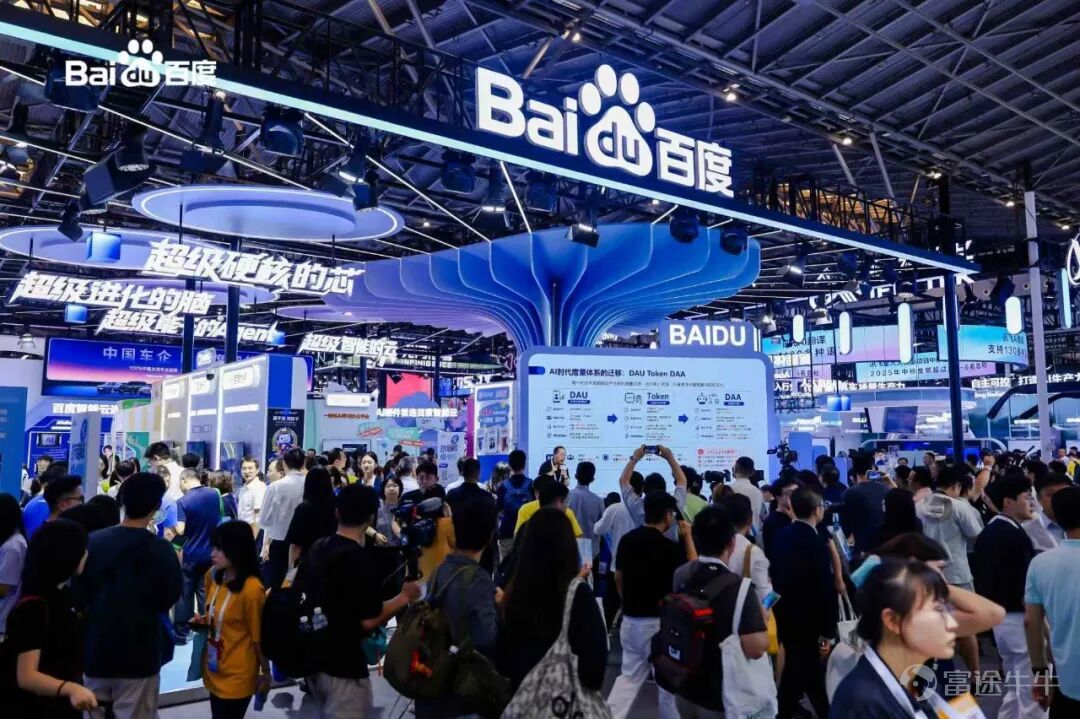

DAA evolves from a concept into a standard, marking Baidu's transformation in the intelligent economy era
Introduction:From an initial cutting-edge concept to an iterated system with a complete methodology, DAA has demonstrated its robust vitality in the era of the intelligent economy.

Lu Yan / Author Lishi Business Review / Produced
1
The Evolution of DAA
On July 17, the highly anticipated World Artificial Intelligence Conference 2026 (hereinafter referred to as WAIC 2026) was held in Shanghai. At this conference, a series of forward-looking industry concepts and technological achievements sparked extensive discussion across the sector.
Among these developments, IDC released the industry’s first 'DAA Research Report,' providing a systematic analysis and further refinement of the DAA (Daily Active Agents) concept originally introduced by Baidu founder Robin Li at the Create Conference. Just prior to WAIC, the People's Daily published an op-ed by Robin Li proposing DAA as a metric for measuring the intelligent economy.
The IDC 'DAA Research Report' elaborates on the DAA concept through a detailed indicator tree breakdown, introduces a DAA value formula, and offers comprehensive implementation guidance across dimensions including application scenarios, technical architecture, rollout roadmaps, and concrete case studies—transforming DAA from a cutting-edge idea into a complete methodology.

This methodology provides a more systematic framework for evaluating agent activity levels, business penetration, and tangible outputs, making it broadly applicable across diverse organizations. Government agencies formulating industrial policies, AI enterprises shaping strategic directions, and industry users seeking operational efficiency gains through artificial intelligence can all derive significant value from it.
2
From Concept to Comprehensive Methodology
The emergence of any new phenomenon invariably stems from an underlying need. The stronger the need, the greater its vitality. The DAA concept has garnered widespread industry attention primarily because the advancement of artificial intelligence now demands a new measurement language capable of scientifically quantifying AI’s value.
During the mobile internet era, DAU (Daily Active Users) served as a widely accepted metric; in the early generative AI phase dominated by large models, Token became the prevalent unit of measurement. However, as AI evolves into the intelligent economy era—centered on intelligent agent applications—these existing metrics are increasingly inadequate for capturing industry progress.
For example, DAU was originally designed to measure user scale and engagement for mobile apps, serving as a reference for assessing an app’s commercial and capital valuation. In the AI era, however, intelligent agents are far more decentralized and vastly more numerous than traditional apps. Their core value lies not in user counts but in solving real-world tasks within actual business contexts—rendering DAU ineffective for gauging the true worth of intelligent agents.
Tokens emerged during the generative AI phase, when large model developers and cloud providers dominated the industry landscape. This metric was defined from their perspective: the more tokens users consumed, the higher these companies’ commercial revenues. For enterprise users, however, tokens merely represent cost expenditure—not value creation—failing to reflect outcomes such as 'resolution of real business problems, risk reduction, sales conversion, or improvements in employee productivity.' Moreover, token-centric evaluation systems can incentivize inefficiencies like unnecessarily long prompt chains, redundant computations, suboptimal model routing, and excessive unproductive generation, potentially causing enterprises to lose control over their AI-related costs.
Against this backdrop, the AI industry urgently requires a new metric better aligned with the characteristics of the intelligent economy—one capable of scientifically measuring the true value generated by artificial intelligence.Baidu’s proposed DAA focuses on the value side, emphasizing how many intelligent agents actually enter business workflows, complete tasks, and create value each day—making it a metric dimension closer to output and value than token count. Hence, it has demonstrated strong vitality since its introduction.
The key highlight of IDC’s newly released 'DAA Research Report' lies in its expansion of DAA from a narrow metric measuring only the 'number of intelligent agents' into a more comprehensive indicator framework with broader connotations.Specifically, it breaks down into a six-layer indicator tree comprising metrics for active scale, task execution, effective tokens, human-agent collaboration, and governance and risk.
Based on these indicators, the report also innovatively proposes a DAA value formula to measure DAA return on investment (ROI): 'DAA Value (ROI) = (Number of Active Agents × Tasks per Agent × Task Completion Quality × Business Value per Task) ÷ Total Token Consumption and Operational Costs' (cost boundary).

From the keywords 'active,' 'task,' 'value,' and 'cost,' it is evident thatthe DAA value formula offers an evaluation approach grounded in the perspectives most critical to industry users, enabling more accurate assessment of DAA-driven value creation and thereby avoiding potential issues such as 'higher DAA leading to higher enterprise costs, greater risks, and increased management complexity.'
It is worth noting that the DAA value formula is not a precise financial accounting equation but rather a management model designed to help enterprises understand the logic behind DAA value. It effectively reminds industry users that DAA itself is merely a conceptual starting point: on one hand, it requires achieving active agents, stable task volume, reliable task quality, and clear per-task value; on the other hand, it necessitates controllable token usage and total operational costs to realize genuine value creation.
In addition to enriching and refining the DAA indicator system, the report also provides detailed implementation recommendations across multiple dimensions.For example, based on the alignment between different industry business scenarios and intelligent agents, it identifies finance, manufacturing, broad internet, healthcare, and education as the top five sectors best suited for DAA implementation. It also outlines four priority task directions: high-frequency tasks, high-value tasks, high-risk tasks, and highly collaborative tasks. Furthermore, it proposes a phased roadmap: 'Months 0–6: Establish DAA awareness and baseline scenarios; Months 6–18: Build agent fleets and DAA operational dashboards; Months 18–36: Transition toward an agent-first organizational structure'—helping enterprises implement DAA step by step in an orderly manner.
Particularly valuable is the report’s reminder that DAA is not merely a front-end application metric but an external manifestation of an enterprise’s back-end capability system.For an enterprise to possess high-quality DAA (Digital AI Agents), it cannot merely procure loosely integrated agent applications; instead, it must build a technical and operational architecture designed for the large-scale deployment of agents. This report proposes an architectural framework called the DAA Operating Foundation, comprising seven layers: the model layer, data and knowledge layer, tools and actions layer, agent orchestration layer, identity and permissions layer, evaluation and monitoring layer, and operations and business layer. This seven-layer architecture enables industry users to conduct detailed assessments and improvements of their agent platform capabilities.
No matter how refined the concepts, methodologies, and tools may be, their successful implementation ultimately depends on people within the organization—especially key decision-makers.Building upon Robin Li’s earlier assertion that 'CEOs need to adopt an agent-first strategy,' the DAA Research Report offers concrete recommendations for CXOs across various corporate functions on applying DAA. For example, it suggests that CEOs can use DAA to monitor the execution of AI strategies, CIOs can manage enterprise digital platform architectures, CFOs can measure return on investment, COOs can optimize process operations, CMOs can drive transformation in business growth paradigms, and CHROs can restructure organizational capabilities...
When an enterprise’s core decision-makers fully understand and effectively apply DAA concepts, methodologies, and tools, the company can achieve significantly greater efficiency in building an agent-first organization and unlocking the full business value of agents.
3
Baidu’s Opportunity in the Era of the Intelligent Economy
As Baidu has articulated and refined its DAA concept into a comprehensive methodology, global peers in the artificial intelligence industry have been engaging in similar reflections.
For instance, in international academia, research on AI Token Economics argues that 'tokens are gradually revealing fundamental flaws as they evolve from mere technical units of measurement—they fail to explain value creation, cannot accurately gauge productivity, and may even lead to cost misjudgments.'
In the industry, major tech giants have dramatically reversed their stance on 'token maxxing,' increasingly criticizing the misalignment between token consumption and actual value, as well as the inability to measure tangible output. For example, the Head of AI at BNP Paribas CIB pointed out that tokens are fundamentally computational units, not indicators of productivity, and that overreliance on tokens for cost and usage evaluation could trap enterprises in the pitfall of 'vanity metrics.' Palantir CEO Alex Karp noted that companies are currently paying for massive amounts of token consumption that 'do not translate into business value.'
Although international peers are engaged in similar lines of thinking, no company to date has presented a complete solution encompassing concepts, methodologies, and tools as comprehensively as Baidu has—earning our deep admiration for Baidu’s forward-looking insights and technological leadership.So, how exactly has Baidu achieved this?
As the originator of the DAA concept, Baidu founder Robin Li’s technical foresight and industrial vision are crucial. However, beyond Li’s personal capabilities, the author believes that Baidu’s long-term commitment—driven by its technological ideals and long-termist mindset—to deep investment in technology, engineering, and industrial implementation has resulted in its comprehensive 'chip–cloud–model–agent' full-stack architecture, which is of paramount importance.This full-stack architecture grants Baidu two core advantages that most companies cannot simultaneously possess: industry leadership in high-quality intelligent agents and robust infrastructure capabilities to help enterprise users build such agents.
For example, in the domain of high-quality intelligent agents, Baidu has already built the industry’s strongest agent product portfolio, comprising the general-purpose agent Baidu Dazi, the code-focused agent Miaoda, the digital human agent Yijing, and the decision-making agent Famou. This gives Baidu profound insights into the value propositions and pain points of intelligent agents. In assisting enterprise users to develop their own agents, Baidu leverages a systematic capability integrating search, cloud computing, Kunlun chips, large models, industrial AI, and enterprise services—an ecosystem that serves as fertile ground for developing high-quality intelligent agents.
At WAIC 2026, Baidu’s 'chip–cloud–model–agent' full-stack capabilities continued to evolve.
In the intelligent agent domain, Baidu Dazi was upgraded with multiple new capabilities and launched an enterprise version; Miaoda’s latest upgrade focused on growth and delivery features, helping developers streamline the entire workflow from application development and launch to monetization; and Baidu Yijing debuted a digital human video podcasting solution, breaking through in micro-expression technology to enable natural interjections and professional cinematic audiovisual language. Notably, Baidu Dazi stood out as the only product of its kind selected among the top ten 'Star Exhibits' at the conference, recognized for its excellence in technological sophistication, market potential, versatility, and socioeconomic impact.
In the fields of chips, large models, and cloud services, Baidu has also continuously improved performance and cost-efficiency to better support the large-scale operation of intelligent agents. For instance, at the chip level, Kunlun芯 showcased the latest progress on its super-node architecture: Tianchi 256 achieved a 25% throughput improvement over the previous generation and has been fully adapted to mainstream models including Wenxin, DeepSeek, GLM, and Minimax. Combined with inference system optimizations, model inference efficiency increased by 50%. A single Tianchi 512 super-node now supports training trillion-parameter models. At the model level, Wenxin 5.1 delivered leading performance at approximately 6% of the pretraining cost of similarly sized industry models and ranked first among domestic models on the LMArena leaderboard. At the cloud infrastructure level, Baidu Intelligent Cloud now serves 80% of China’s central state-owned enterprises and has consistently led in publicly disclosed tender awards throughout 2025, Q1 2026, and H1 2026.
Baidu’s dual strengths—industry leadership in high-quality intelligent agents and foundational infrastructure capabilities to empower enterprise users in building such agents—give it the deepest insights into user demands and pain points arising from the intelligent agent boom. This enables Baidu to not only pioneer the forward-looking DAA concept but also systematically refine and enrich it, ultimately transforming the idea into a complete methodology.
Beyond leading the AI value assessment framework in the era of the intelligent economy, Baidu is also positioned to become the greatest beneficiary of the upcoming intelligent agent application boom. According to IDC forecasts, the number of active intelligent agents worldwide will reach 79.4 million in 2026 and surge to 2.216 billion by 2030—an astonishing growth trajectory.

Recently, in a conversation with LangChain CEO and co-founder Harrison Chase, NVIDIA founder Jensen Huang barely mentioned GPUs or next-generation models. Instead, he centered the entire discussion on intelligent agents. In his view, large models are becoming a commodity across industries; what truly differentiates companies going forward will be their agent systems built around these models, along with the proprietary knowledge and workflows embedded within them. Huang stated that future corporate competition won’t be about who has the largest model, but who possesses the most powerful 'super agents'—hence every company must build its own specialized intelligent agents.
Both IDC’s forecast and Jensen Huang’s focus signal an imminent explosion in intelligent agents—a trend that will create the biggest business opportunities for companies that anticipated it early and prepared thoroughly. Baidu stands as the enterprise best positioned for this wave.
If Baidu’s high-quality intelligent agent matrix represents its own direct 'gold rush' in the era of the smart economy, then its full-stack 'chip-cloud-model-agent' infrastructure capabilities serve as a powerful toolkit enabling other gold prospectors—and constitute Baidu’s greatest confidence in achieving business transformation and performance breakthroughs in this new era.
Risk Disclaimer: The above content only represents the author's view. It does not represent any position or investment advice of Futu. Futu makes no representation or warranty.Read more

Comments
to post a comment
1