English
Back
Open Account
Tesla plunged after its earnings report—what’s the outlook ahead?

Futubull Options Sir
joined discussion · Jul 17 18:58 ·

Earnings Options Strategy | Tesla's earnings are coming—will energy storage, FSD, and AI deliver fresh surprises?

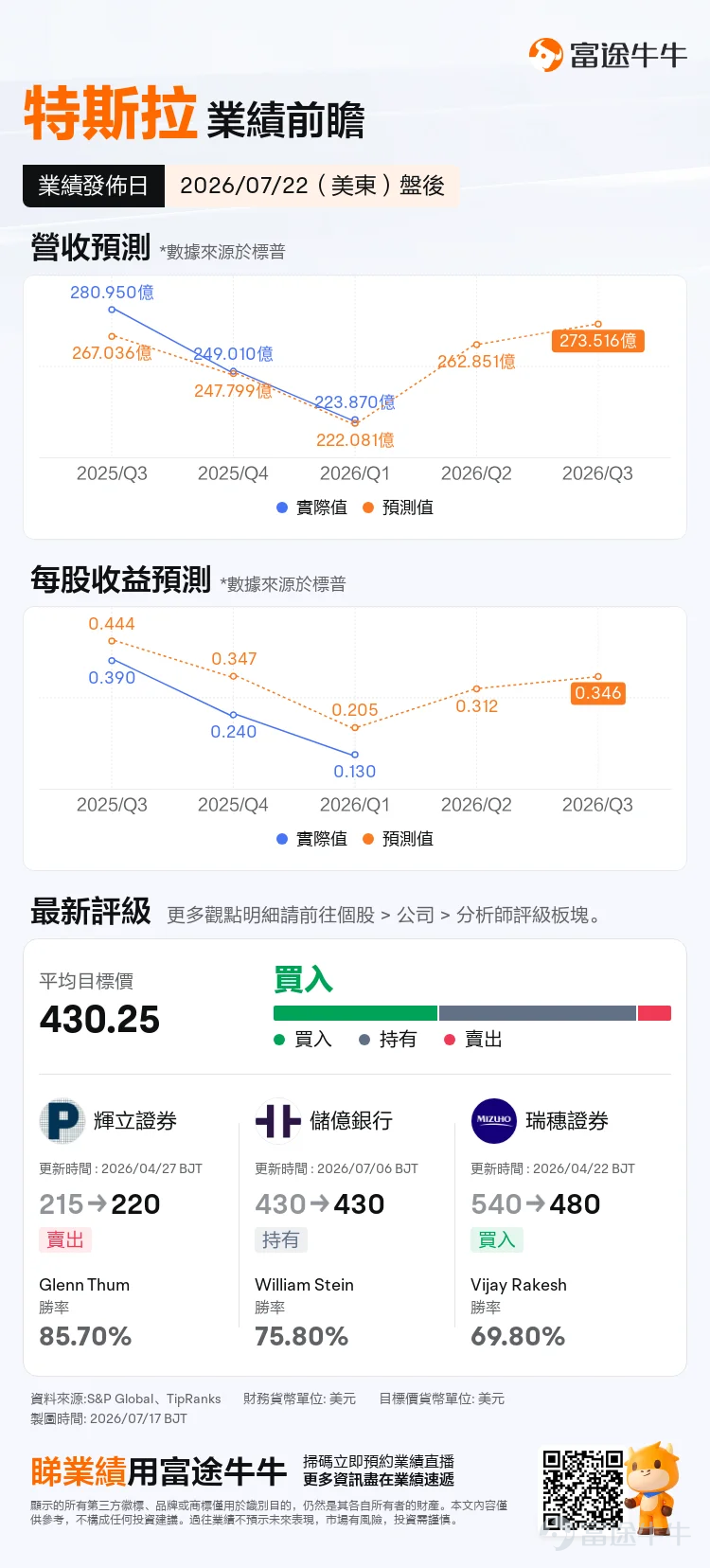
$Tesla (TSLA.US)$ Tesla will release its latest earnings after market close on Wednesday, July 22, 2026. Its stock price rebounded by 13.14% in the second quarter, partly reflecting tailwinds from rising oil prices and a surge in European auto sales. However, the market remains concerned about its persistently declining profit margins. Additionally, Tesla’s progress in artificial intelligence (AI) remains a key focus.
Currently,The market consensus expects Tesla’s second-quarter revenue to reach $26.285 billion, up 16.9% year-over-year. Earnings per share (EPS) are projected at $0.31, a 140% increase from Q1.
$Tesla (TSLA.US)$ Tesla will release its latest earnings after market close on Wednesday, July 22, 2026. Its stock price rebounded by 13.14% in the second quarter, partly reflecting tailwinds from rising oil prices and a surge in European auto sales. However, the market remains concerned about its persistently declining profit margins. Additionally, Tesla’s progress in artificial intelligence (AI) remains a key focus. Currently,The market broadly expects Tesla to report Q2 revenue of $26.285 billion, up 16.9% year-over-year. Earnings per share (EPS) are projected at $0.31, a 140% increase from Q1. Key Earnings Focus Areas 1. Automotive segment revenue: Can profitability (gross margin) be sustained? On July 2, Tesla announced it delivered 480,126 vehicles in the second quarter, a 25% year-over-year increase, marking its best-ever Q2 performance. However, its stock price plunged sharply that day. By model mix, Model 3 and Model Y accounted for 97.4% of total deliveries. Other models—including Model S, Model X, Cybertruck, and Semi—saw production of just 8,822 units (down 35% year-over-year) and deliveries of 12,364 units. With Model S and Model X now officially discontinued and Cybertruck’s production ramp progressing slowly,the declining share of high-margin vehicles is putting downward pressure on overall profitability....
Key Focus Areas for Earnings
$Tesla (TSLA.US)$ Tesla will release its latest earnings after market close on Wednesday, July 22, 2026. Its stock price rebounded by 13.14% in the second quarter, partly reflecting tailwinds from rising oil prices and a surge in European auto sales. However, the market remains concerned about its persistently declining profit margins. Additionally, Tesla’s progress in artificial intelligence (AI) remains a key focus. Currently,The market broadly expects Tesla to report Q2 revenue of $26.285 billion, up 16.9% year-over-year. Earnings per share (EPS) are projected at $0.31, a 140% increase from Q1. Key Earnings Focus Areas 1. Automotive segment revenue: Can profitability (gross margin) be sustained? On July 2, Tesla announced it delivered 480,126 vehicles in the second quarter, a 25% year-over-year increase, marking its best-ever Q2 performance. However, its stock price plunged sharply that day. By model mix, Model 3 and Model Y accounted for 97.4% of total deliveries. Other models—including Model S, Model X, Cybertruck, and Semi—saw production of just 8,822 units (down 35% year-over-year) and deliveries of 12,364 units. With Model S and Model X now officially discontinued and Cybertruck’s production ramp progressing slowly,the declining share of high-margin vehicles is putting downward pressure on overall profitability....
1. Automotive segment revenue: Can profit quality (gross margin) be sustained?
On July 2, Tesla announced it delivered 480,126 vehicles in the second quarter, a 25% year-over-year increase, marking its strongest-ever Q2 performance. However, its stock price dropped sharply that day.
By model mix, Model 3 and Model Y accounted for 97.4% of total deliveries. Other models—including Model S, Model X, Cybertruck, and Semi—produced only 8,822 units (down 35% year-over-year) and delivered 12,364 units. With Model S and Model X officially discontinued and Cybertruck ramping up production slowly,the declining share of high-margin models is putting pressure on overall profitability.
The surge in European sales during Q2 was partly driven by a cluster of government subsidy deadlines expiring simultaneously.In Italy, the landed price of the Model 3 after national subsidies fell as low as €24,990. Meanwhile, Spain’s ‘Programa Auto’ and France’s ecological bonus (bonus écologique) significantly boosted vehicle registrations in both countries from April to June.As a result, the market is concerned about whether this subsidy-driven recovery is sustainable.For example, Norway saw a 43% plunge in June registrations after reducing tax incentives, highlighting European sales’ heavy reliance on policy stimulus. Consequently, the market worries whether Tesla’s automotive business can maintain its gross margin under a volume-over-price strategy.
2. Energy generation and energy storage business: The second growth curve, delivering strong revenue and gross margin performance
Tesla's energy storage business is expected to rebound strongly in the second quarter, with deployments reaching 13.5 GWh, up 40.6% year-over-year, reversing the one-off decline seen in the previous quarter. This segment also includes solar and other businesses, with projected revenue of $3.79 billion, an increase of 35.9% year-over-year.
Tesla’s current energy products include Powerwall (residential storage), Powerpack (small commercial and industrial storage), and Megapack (grid-scale utility storage), which together represent Tesla's largest source of revenue and gross profit.
$Tesla (TSLA.US)$ Tesla will release its latest earnings after market close on Wednesday, July 22, 2026. Its stock price rebounded by 13.14% in the second quarter, partly reflecting tailwinds from rising oil prices and a surge in European auto sales. However, the market remains concerned about its persistently declining profit margins. Additionally, Tesla’s progress in artificial intelligence (AI) remains a key focus. Currently,The market broadly expects Tesla to report Q2 revenue of $26.285 billion, up 16.9% year-over-year. Earnings per share (EPS) are projected at $0.31, a 140% increase from Q1. Key Earnings Focus Areas 1. Automotive segment revenue: Can profitability (gross margin) be sustained? On July 2, Tesla announced it delivered 480,126 vehicles in the second quarter, a 25% year-over-year increase, marking its best-ever Q2 performance. However, its stock price plunged sharply that day. By model mix, Model 3 and Model Y accounted for 97.4% of total deliveries. Other models—including Model S, Model X, Cybertruck, and Semi—saw production of just 8,822 units (down 35% year-over-year) and deliveries of 12,364 units. With Model S and Model X now officially discontinued and Cybertruck’s production ramp progressing slowly,the declining share of high-margin vehicles is putting downward pressure on overall profitability....
3. Services and other: Focus on subscription revenue and per-vehicle revenue
Driven by growing vehicle fleet size and expansion of charging infrastructure, Tesla’s services business is expected to continue its upward trajectory. Market expectations for revenue from this segment stand at $3.69 billion, up 21.3% year-over-year. As of Q1, Tesla reported 1.28 million FSD (Full Self-Driving) subscribers, a 51% year-over-year increase.In Q2, the growth rate of new subscriptions and per-vehicle software revenue will be key drivers of incremental gains.
$Tesla (TSLA.US)$ Tesla will release its latest earnings after market close on Wednesday, July 22, 2026. Its stock price rebounded by 13.14% in the second quarter, partly reflecting tailwinds from rising oil prices and a surge in European auto sales. However, the market remains concerned about its persistently declining profit margins. Additionally, Tesla’s progress in artificial intelligence (AI) remains a key focus. Currently,The market broadly expects Tesla to report Q2 revenue of $26.285 billion, up 16.9% year-over-year. Earnings per share (EPS) are projected at $0.31, a 140% increase from Q1. Key Earnings Focus Areas 1. Automotive segment revenue: Can profitability (gross margin) be sustained? On July 2, Tesla announced it delivered 480,126 vehicles in the second quarter, a 25% year-over-year increase, marking its best-ever Q2 performance. However, its stock price plunged sharply that day. By model mix, Model 3 and Model Y accounted for 97.4% of total deliveries. Other models—including Model S, Model X, Cybertruck, and Semi—saw production of just 8,822 units (down 35% year-over-year) and deliveries of 12,364 units. With Model S and Model X now officially discontinued and Cybertruck’s production ramp progressing slowly,the declining share of high-margin vehicles is putting downward pressure on overall profitability....
4. Capital expenditures (CapEx): Monitor whether capital spending on FSD, AI, and humanoid robots exerts pressure on cash flow
Tesla’s quarterly capital expenditures have remained stable in the range of $2–2.5 billion.Artificial intelligence-related developments
1. Tesla previously disclosed in Q1 that the first phase of its Cortex 2 cluster—a 250-megawatt computing facility—officially came online in April, delivering total computational power equivalent to over 130,000 H100 chips. Investors are now watching whether Tesla can achieve its mid-year target of 500 megawatts (adding another 250 megawatts in Phase 2) and whether large-scale training of the Optimus humanoid robot has already commenced.
2. On April 10, following 18 months of compliance testing, the Netherlands became the first EU country to formally approve Tesla’s Supervised Full Self-Driving (FSD) for use on public roads. Between May and June, Lithuania, Estonia, Denmark, and Belgium subsequently approved FSD under the EU’s mutual recognition mechanism, bringing the total number of countries where FSD is available to five within just two months. However, key markets such as Germany, France, and Italy are still awaiting a full vote by the Technical Committee for Motor Vehicles (TCMV), meaning a unified pan-European approval could be delayed until 2027.
3. Although Tesla’s capital expenditures have not yet drawn broad market attention, advancing its in-house wafer fabrication project, Terafab, could place pressure on its cash flow. Full-year AI-related capital expenditures have been raised from $20 billion to $25 billion, with the majority of the increase allocated to computing data centers and chip manufacturing lines.
$Tesla (TSLA.US)$ Tesla will release its latest earnings after market close on Wednesday, July 22, 2026. Its stock price rebounded by 13.14% in the second quarter, partly reflecting tailwinds from rising oil prices and a surge in European auto sales. However, the market remains concerned about its persistently declining profit margins. Additionally, Tesla’s progress in artificial intelligence (AI) remains a key focus. Currently,The market broadly expects Tesla to report Q2 revenue of $26.285 billion, up 16.9% year-over-year. Earnings per share (EPS) are projected at $0.31, a 140% increase from Q1. Key Earnings Focus Areas 1. Automotive segment revenue: Can profitability (gross margin) be sustained? On July 2, Tesla announced it delivered 480,126 vehicles in the second quarter, a 25% year-over-year increase, marking its best-ever Q2 performance. However, its stock price plunged sharply that day. By model mix, Model 3 and Model Y accounted for 97.4% of total deliveries. Other models—including Model S, Model X, Cybertruck, and Semi—saw production of just 8,822 units (down 35% year-over-year) and deliveries of 12,364 units. With Model S and Model X now officially discontinued and Cybertruck’s production ramp progressing slowly,the declining share of high-margin vehicles is putting downward pressure on overall profitability....
What does the options market indicate?
Amid volatility in the memory storage market, a significant amount of risk-off capital has flowed into leading Magnificent Seven stocks, primarily driving up $Alphabet-C (GOOG.US)$ and $Apple (AAPL.US)$ their prices; however, based on trading volume, this has not yet had a substantial impact on Tesla.
$Tesla (TSLA.US)$ Tesla will release its latest earnings after market close on Wednesday, July 22, 2026. Its stock price rebounded by 13.14% in the second quarter, partly reflecting tailwinds from rising oil prices and a surge in European auto sales. However, the market remains concerned about its persistently declining profit margins. Additionally, Tesla’s progress in artificial intelligence (AI) remains a key focus. Currently,The market broadly expects Tesla to report Q2 revenue of $26.285 billion, up 16.9% year-over-year. Earnings per share (EPS) are projected at $0.31, a 140% increase from Q1. Key Earnings Focus Areas 1. Automotive segment revenue: Can profitability (gross margin) be sustained? On July 2, Tesla announced it delivered 480,126 vehicles in the second quarter, a 25% year-over-year increase, marking its best-ever Q2 performance. However, its stock price plunged sharply that day. By model mix, Model 3 and Model Y accounted for 97.4% of total deliveries. Other models—including Model S, Model X, Cybertruck, and Semi—saw production of just 8,822 units (down 35% year-over-year) and deliveries of 12,364 units. With Model S and Model X now officially discontinued and Cybertruck’s production ramp progressing slowly,the declining share of high-margin vehicles is putting downward pressure on overall profitability....
Currently, Tesla’s options market shows a call/put volume ratio of 0.8 and an open interest ratio of 0.76. The implied volatility (IV) stands at 53.76%, with an IV percentile of 66%.Market expectations for future volatility remain neutral, but investors are deploying put options to hedge against potential downside risks to the stock price.
$Tesla (TSLA.US)$ Tesla will release its latest earnings after market close on Wednesday, July 22, 2026. Its stock price rebounded by 13.14% in the second quarter, partly reflecting tailwinds from rising oil prices and a surge in European auto sales. However, the market remains concerned about its persistently declining profit margins. Additionally, Tesla’s progress in artificial intelligence (AI) remains a key focus. Currently,The market broadly expects Tesla to report Q2 revenue of $26.285 billion, up 16.9% year-over-year. Earnings per share (EPS) are projected at $0.31, a 140% increase from Q1. Key Earnings Focus Areas 1. Automotive segment revenue: Can profitability (gross margin) be sustained? On July 2, Tesla announced it delivered 480,126 vehicles in the second quarter, a 25% year-over-year increase, marking its best-ever Q2 performance. However, its stock price plunged sharply that day. By model mix, Model 3 and Model Y accounted for 97.4% of total deliveries. Other models—including Model S, Model X, Cybertruck, and Semi—saw production of just 8,822 units (down 35% year-over-year) and deliveries of 12,364 units. With Model S and Model X now officially discontinued and Cybertruck’s production ramp progressing slowly,the declining share of high-margin vehicles is putting downward pressure on overall profitability....
Historically,in 6 out of the past 11 earnings events, actual stock price swings exceeded the volatility priced into options, though the most recent three earnings reports have resulted in only modest movements.Tesla’s recent share price volatility has been primarily driven by vehicle delivery figures and new technology announcements, with the latest three earnings releases having relatively minor impacts on the stock price.
$Tesla (TSLA.US)$ Tesla will release its latest earnings after market close on Wednesday, July 22, 2026. Its stock price rebounded by 13.14% in the second quarter, partly reflecting tailwinds from rising oil prices and a surge in European auto sales. However, the market remains concerned about its persistently declining profit margins. Additionally, Tesla’s progress in artificial intelligence (AI) remains a key focus. Currently,The market broadly expects Tesla to report Q2 revenue of $26.285 billion, up 16.9% year-over-year. Earnings per share (EPS) are projected at $0.31, a 140% increase from Q1. Key Earnings Focus Areas 1. Automotive segment revenue: Can profitability (gross margin) be sustained? On July 2, Tesla announced it delivered 480,126 vehicles in the second quarter, a 25% year-over-year increase, marking its best-ever Q2 performance. However, its stock price plunged sharply that day. By model mix, Model 3 and Model Y accounted for 97.4% of total deliveries. Other models—including Model S, Model X, Cybertruck, and Semi—saw production of just 8,822 units (down 35% year-over-year) and deliveries of 12,364 units. With Model S and Model X now officially discontinued and Cybertruck’s production ramp progressing slowly,the declining share of high-margin vehicles is putting downward pressure on overall profitability....
1. If you don't currently hold any shares and simply want to speculate for short-term gains from Tesla's earnings report
Tesla is currently in a sideways consolidation phase. If you cannot predict the direction of the stock price but believe its volatility will remain within a narrow range, similar to the previous three instances, you could considerselling a straddle or selling a stranglestrategy. The approach involvesselling one call option and one put optionand as long as the stock price stays within the specified range at expiration, this strategy can generate positive option premium income.
Of course, as an options seller, you face the risk of assignment upon exercise, so be sure to maintain sufficient margin before opening the position~
(The design images shown on screen are for illustrative purposes only and do not constitute any investment advice or guarantee; market conditions change rapidly, and displayed prices may not reflect actual market values.)
$Tesla (TSLA.US)$ Tesla will release its latest earnings after market close on Wednesday, July 22, 2026. Its stock price rebounded by 13.14% in the second quarter, partly reflecting tailwinds from rising oil prices and a surge in European auto sales. However, the market remains concerned about its persistently declining profit margins. Additionally, Tesla’s progress in artificial intelligence (AI) remains a key focus. Currently,The market broadly expects Tesla to report Q2 revenue of $26.285 billion, up 16.9% year-over-year. Earnings per share (EPS) are projected at $0.31, a 140% increase from Q1. Key Earnings Focus Areas 1. Automotive segment revenue: Can profitability (gross margin) be sustained? On July 2, Tesla announced it delivered 480,126 vehicles in the second quarter, a 25% year-over-year increase, marking its best-ever Q2 performance. However, its stock price plunged sharply that day. By model mix, Model 3 and Model Y accounted for 97.4% of total deliveries. Other models—including Model S, Model X, Cybertruck, and Semi—saw production of just 8,822 units (down 35% year-over-year) and deliveries of 12,364 units. With Model S and Model X now officially discontinued and Cybertruck’s production ramp progressing slowly,the declining share of high-margin vehicles is putting downward pressure on overall profitability....
2. If you already hold Tesla shares and wish to lower your cost basis
you canhold the underlying stock while setting a target price aboveSellsell one call option at the strike price, forming aCovered Callstrategy. This approach allows you to collect an additional premium from selling the call option. If the stock price remains below the strike price at expiration, you can continue selling call options for income; if the stock price rises above the strike price, you can take profit and exit your stock position, waiting for the next opportunity to re-enter at a lower level.
(The design images shown on screen are for illustrative purposes only and do not constitute any investment advice or guarantee; market conditions change rapidly, and displayed prices may not reflect actual market values.)
$Tesla (TSLA.US)$ Tesla will release its latest earnings after market close on Wednesday, July 22, 2026. Its stock price rebounded by 13.14% in the second quarter, partly reflecting tailwinds from rising oil prices and a surge in European auto sales. However, the market remains concerned about its persistently declining profit margins. Additionally, Tesla’s progress in artificial intelligence (AI) remains a key focus. Currently,The market broadly expects Tesla to report Q2 revenue of $26.285 billion, up 16.9% year-over-year. Earnings per share (EPS) are projected at $0.31, a 140% increase from Q1. Key Earnings Focus Areas 1. Automotive segment revenue: Can profitability (gross margin) be sustained? On July 2, Tesla announced it delivered 480,126 vehicles in the second quarter, a 25% year-over-year increase, marking its best-ever Q2 performance. However, its stock price plunged sharply that day. By model mix, Model 3 and Model Y accounted for 97.4% of total deliveries. Other models—including Model S, Model X, Cybertruck, and Semi—saw production of just 8,822 units (down 35% year-over-year) and deliveries of 12,364 units. With Model S and Model X now officially discontinued and Cybertruck’s production ramp progressing slowly,the declining share of high-margin vehicles is putting downward pressure on overall profitability....
Finally, we have a small gift for fellow investors—feel free to claim yourOptions Beginner Pack
*This promotion is exclusively available to invited Hong Kong users. Click to learn moreDetailed event rules>>
Market conditions are complex and volatile,Options Strategyare plentiful—unsure which to choose? Futubull helps you build one in three simple steps.Options Strategy, and investing becomes simple and efficient!
$Tesla (TSLA.US)$ Tesla will release its latest earnings after market close on Wednesday, July 22, 2026. Its stock price rebounded by 13.14% in the second quarter, partly reflecting tailwinds from rising oil prices and a surge in European auto sales. However, the market remains concerned about its persistently declining profit margins. Additionally, Tesla’s progress in artificial intelligence (AI) remains a key focus. Currently,The market broadly expects Tesla to report Q2 revenue of $26.285 billion, up 16.9% year-over-year. Earnings per share (EPS) are projected at $0.31, a 140% increase from Q1. Key Earnings Focus Areas 1. Automotive segment revenue: Can profitability (gross margin) be sustained? On July 2, Tesla announced it delivered 480,126 vehicles in the second quarter, a 25% year-over-year increase, marking its best-ever Q2 performance. However, its stock price plunged sharply that day. By model mix, Model 3 and Model Y accounted for 97.4% of total deliveries. Other models—including Model S, Model X, Cybertruck, and Semi—saw production of just 8,822 units (down 35% year-over-year) and deliveries of 12,364 units. With Model S and Model X now officially discontinued and Cybertruck’s production ramp progressing slowly,the declining share of high-margin vehicles is putting downward pressure on overall profitability....
Options Risk Warning:An option is a contract that gives the holder the right, but not the obligation, to buy or sell an underlying asset at a predetermined price on or before a specified date. The price of an option is influenced by multiple factors, including the current price of the underlying asset, the strike price, time to expiration, and implied volatility. Implied volatility reflects the market’s expectation of future price fluctuations over the life of the option; it is derived by reverse-engineering the Black-Scholes option pricing model and is commonly viewed as a gauge of market sentiment. When investors anticipate greater volatility, they may be willing to pay higher prices for options to hedge their risk exposure, resulting in higher implied volatility. Traders and investors use implied volatility to assess the attractiveness of option prices, identify potential mispricings, and manage risk exposure.
Disclaimer:This content does not constitute an offer, solicitation, recommendation, advice, opinion, or any form of guarantee regarding any securities, financial products, or instruments. The risk of loss from trading options can be substantial. In certain circumstances, your losses may exceed the initial margin deposit. Even if you place contingent orders such as 'stop-loss' or 'limit' orders, there is no assurance that these will prevent losses. Market conditions may render such orders unexecutable. You may be required to deposit additional margin on short notice. If you fail to meet the margin call within the specified timeframe, your open positions may be liquidated. You remain liable for any resulting deficit in your account. Therefore, you should thoroughly research and understand options before trading, and carefully consider whether such transactions are suitable for you based on your financial condition and investment objectives. If you trade options, you should be familiar with the procedures for exercising options and handling expiration, as well as your rights and obligations upon exercise or expiration. Options trading involves a high degree of risk and is not suitable for all investors. Investors should carefully read"Characteristics and Risks of Standardized Options"
Risk Disclaimer: The above content only represents the author's view. It does not represent any position or investment advice of Futu. Futu makes no representation or warranty.Read more
Thumbs Up
25
Lol
3
Heart
2
618K Views
Report
Comment (1)
Write a Comment...
1
30
26