
Is the AI trading theme making a comeback? Japanese and South Korean stocks rebound strongly

5-Minute Hot Topics | South Korea resumes rate hikes; KOSPI triggers circuit breakers 7 times this year! Memory chip giants suffer massive market value losses—how to secure your portfolio?
Yesterday (July 16), the South Korean market was nothing short of “heart-stopping”—The Bank of Korea hiked rates for the first time in three and a half years, compounding panic spillover from a sharp selloff in U.S. memory semiconductor stocks., $Korea Composite Index (.KOSPI.KR)$ The index plunged 6.37% in a single day, once again breaking below the psychological 7,000-point level to close at 6,820.60. The memory chip duo took a heavy hit: $Samsung Electronics (005930.KR)$ fell 8.77%, $SK Hynix (000660.KR)$ and tumbled even more sharply by 11.53%. The Korea Exchange has now implemented temporary trading halts 37 times this year alone, pushing market sentiment to near-freezing levels. Adding to the anxiety, just one day earlier (July 15), the KOSPI had surged by 6.24%. A 6% rally one day followed by a 6% crash the next—this rollercoaster ride left many fellow investors exclaiming, “My heart can’t take it!” 。If you hold South Korean memory-related securities or are watching Korean equities and the semiconductor sector, please be sure to carefully read through today’s 5-Minute Hot Take.。
。If you hold South Korean memory-related securities or are watching Korean equities and the semiconductor sector, please be sure to carefully read through today’s 5-Minute Hot Take.。Why is South Korea raising rates? And why is the memory sector hit the hardest?
On July 16, the Bank of Korea announced a 25-basis-point rate hike, raising the base rate from 2.50% to 2.75%—its first rate increase since January 2023.Bank of Korea Governor Shin Hyun-soo stated explicitly:Inflation will remain above the 2% target level for a considerable period.
Some fellow investors might ask: Isn’t the Korean economy supported by semiconductor exports? Why is the central bank 'pouring cold water on itself'? Raising interest rates is like giving fever-reducing medicine to an overheating economy—it may cause temporary weakness, but not taking it could lead to serious complications. The Bank of Korea’s rationale is: it’s better to proactively 'apply the brakes' while the economy is still stable than to slam on the emergency brake after things spiral out of control. However, for the stock market, the short-term impact of 'braking' is—painful. So,Where exactly is the Korean economy 'running a fever'? There are four main 'symptoms':
Symptom 1: Prices are rising too fast, straining household budgets
Korea’s May and June CPI (Consumer Price Index) year-over-year growth rates both exceeded 3%, significantly higher than the Bank of Korea’s 2% target.
💡 Mini-lesson: CPI is the 'shopping basket index.' If you spent ₩100 on groceries last year and need more than ₩103 for the same basket this year, prices have risen by 3%. The faster prices rise, the more your real purchasing power erodes. One purpose of the central bank raising rates is to rein in inflation.
Symptom 2: Surging oil prices + KRW depreciation = a 'double whammy' on import costs
Factors like U.S.-Iran tensions have pushed global crude oil prices higher, while the Korean won has steadily weakened this year, with the KRW/USD exchange rate falling by around 6% at one point. A weaker won makes imported goods more expensive, further intensifying imported inflation pressures. As a country heavily reliant on energy imports, Korea sees costs rise across nearly every sector—from transportation to manufacturing—when oil prices climb and the won depreciates.
💡 Mini-lesson: KRW depreciation is like your Korean 'shopping voucher' losing value—if you used to exchange ₩1,000 for $1 worth of goods internationally, now you can only get $0.80 worth. For a nation that imports almost everything, this amounts to 'passive price hikes.' Central bank rate hikes can attract foreign capital inflows, support the won’s exchange rate, and indirectly ease imported inflation pressure.
Symptom 3: Housing prices and household debt are 'burning' hot
Housing prices in Seoul and surrounding areas continue to rise, and Korean household debt keeps expanding. During the era of low interest rates, many Koreans took on substantial debt to buy property and invest in stocks, pushing household leverage to historic highs.
Symptom 4: The economy has solid fundamentals, opening the door for rate hikes
If the economy were weak, the central bank would usually hesitate to raise rates, fearing it might worsen the situation. However, South Korea’s current position is strong: an AI investment boom has driven robust growth in semiconductor exports, prompting the government to revise its 2026 economic growth forecast upward to 3%. This ongoing growth gives the central bank the confidence to 'perform surgery.'
With the rate hike announcement, the entire South Korean stock market declined—but Samsung Electronics dropped 8.77% and SK Hynix plunged 11.53%, far exceeding the broader market’s 6.37% decline.This is also a question many fellow investors holding $CSOP SK Hynix Daily Max (2x) Leveraged Product (07709.HK)$ 、 $CSOP Samsung Electronics Daily Max (2x) Leveraged Product (07747.HK)$ want to ask:Why have the two memory chip giants become 'the hardest-hit among the hardest-hit'??Breaking it down, there are several key reasons:
?Breaking it down, there are several key reasons:Reason 1: Rate hikes precisely target high-valuation tech stocks
This is a fundamental principle of finance:The higher the interest rate, the less 'valuable' future money becomes.The valuation logic for memory stocks largely rests on the expectation of 'sustained growth in AI demand'—investors aren’t buying today’s profits, but rather a growth story spanning several future years. Andrate hikes significantly shrink the present value of these 'future earnings' in discounted cash flow calculations.
💡 Quick lesson: Suppose someone promises you $1 million in three years. If the interest rate is only 1%, that amount is worth roughly $970,000 today; but if rates rise to 5%, it’s worth only $860,000 today. The same future promise gets discounted by 10% or even 20% when rates go up. Memory stocks are among the most rate-sensitive assets in the entire market right now—because their valuations have already 'borrowed heavily' from the future.
Reason #2: The KOSPI index structure is 'heavily skewed.'
The South Korean equity market has a globally rare feature—the index is extremely concentrated, with a single semiconductor segment (memory chips) dominating the entire market’s valuation. Samsung Electronics and SK Hynix alone account for nearly 50% of the KOSPI’s total market capitalization. This'distorted' structure makes the entire Korean market highly vulnerable to fluctuations in memory chip cycles.Whenever memory stocks decline, the broader Korean market tends to get dragged down; and once the broader market falls, it triggers more passive selling, which in turn further depresses memory stocks—creating a vicious cycle.
Reason #3: Leveraged capital 'favors' memory stocks, leading to the most severe sell-offs during downturns.
How intense is Korean investors' frenzy over memory stocks? Data shows that margin financing balances in the Korean stock market reached a record high of KRW 38.6 billion in late June, with substantial funds concentrated in Samsung Electronics, SK Hynix, and related leveraged ETFs. As the memory sector declined, these leveraged positions were hit first: falling share prices → margin calls → forced liquidations → further price declines. As of July 13,more than 1.2 million leveraged retail investor accounts across the Korean market triggered margin calls(based on South Korea’s working-age population aged 15–64 of approximately 35.7 million,roughly 1 in every 30 adults faces the risk of forced liquidation),The forced liquidation rate surged from 2.1% to 10%.
Reason #4: Memory stocks plunged on Wall Street, spreading panic
Korea's rate hike isn't the only bearish factor. On July 15 during U.S. trading hours, Micron Technology dropped as much as 10% in a single day.Legendary investor Warren Buffett issued a rare public warning that AI-themed speculation is rampant and true value is increasingly hard to find in the market.Although he didn’t name any specific company, his remarks precisely captured the recent trading pattern in memory stocks—investors are reacting to every piece of news as if they’re 'betting on short-term moves' rather than making long-term judgments based on fundamentals.
Of course, Korea’s rate hike is not an isolated case. With rising inflation, major global central banks have clearly shifted their monetary policy stance. Aside from Korea,Since the beginning of this year, major central banks in advanced economies—such as the European Central Bank, the Bank of Japan, and the Reserve Bank of Australia—have successively joined the rate-hiking camp.The Federal Reserve has kept interest rates unchanged so far this year. Although recent inflation data temporarily cooled expectations for a rate hike,the market has not yet ruled out the possibility of the Fed raising rates later this year.
37 trading halts and 7 circuit breakers! How long will it take for the Korean stock market to recover after this sharp plunge?
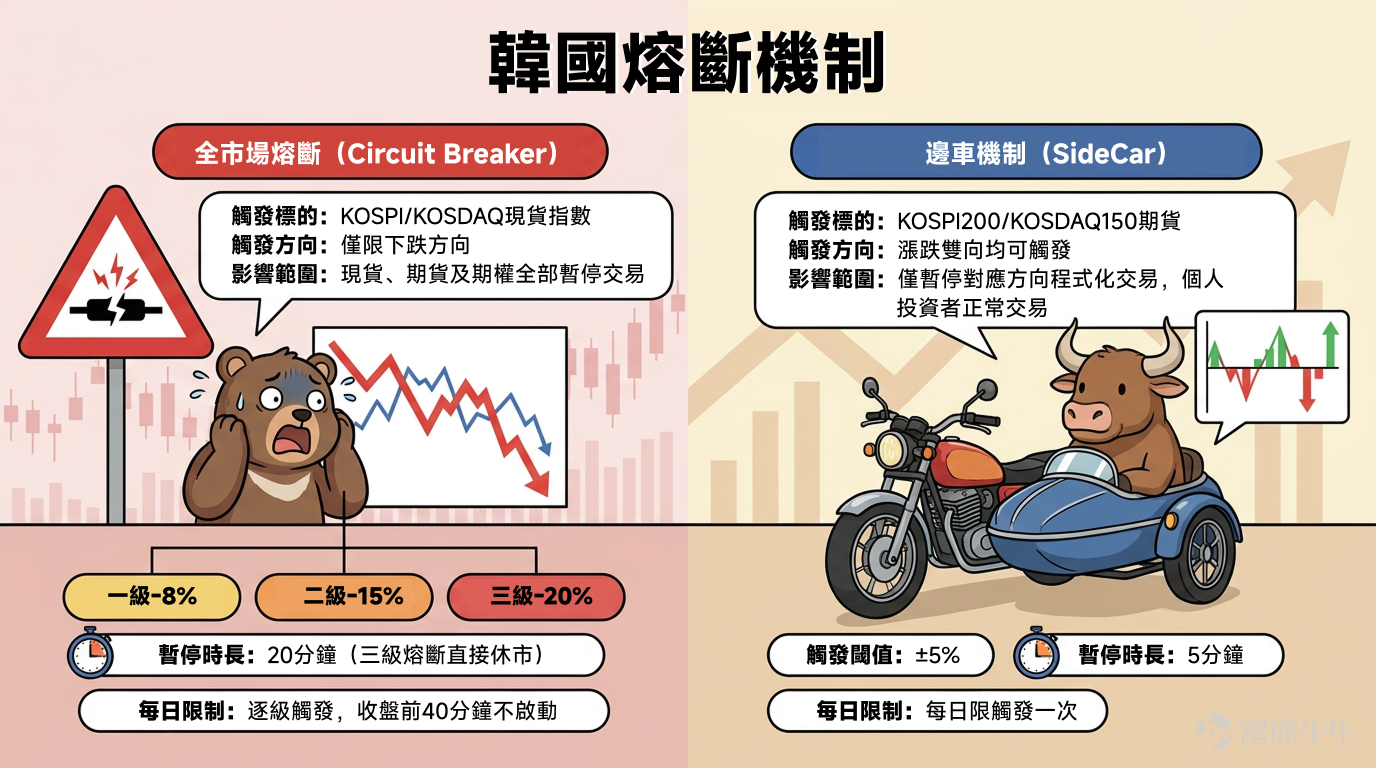
The Korean stock market currently has a two-tier 'circuit breaker' mechanism; see the diagram below for details.
![Yesterday (July 16), the South Korean market was nothing short of “heart-stopping”—The Bank of Korea hiked rates for the first time in three and a half years, compounding panic spillover from a sharp selloff in U.S. memory semiconductor stocks., $Korea Composite Index (.KOSPI.KR)$ The index plunged 6.37% in a single day, once again breaking below the psychological 7,000-point level to close at 6,820.60. The memory chip duo took a heavy hit: $Samsung Electronics (005930.KR)$ fell 8.77%, $SK Hynix (000660.KR)$ and tumbled even more sharply by 11.53%. The Korea Exchange has now implemented temporary trading halts 37 times this year alone, pushing market sentiment to near-freezing levels. Adding to the anxiety, just one day earlier (July 15), the KOSPI had surged by 6.24%. A 6% rally one day followed by a 6% crash the next—this rollercoaster ride left many fellow investors exclaiming, “My heart can’t take it!”[Toasted]。If you hold South Korean memory-related securities or are watching Korean equities and the semiconductor sector, please be sure to carefully read through today’s 5-Minute Hot Take.[Please]。 Why is South Korea raising rates? And why is the memory sector hit the hardest? On July 16, the Bank of Korea announced a 25-basis-point rate hike, raising the base rate from 2.50% to 2.75%—its first rate increase since January 2023.Bank of Korea Governor Shin Hyun-soo stated explicitly:Inflation will remain significantly above target for a considerable period...](https://nnqimage.futunn.com/sns_client_feed/999960/20260717/web-1784282975825-GNyM24rGd7.png/big?area=2&is_public=true&imageMogr2/ignore-error/1/format/webp)
As of July 16, the Korea Exchange hasTemporary trading halts have been triggered 37 times cumulatively, with the KOSPI index hitting Level-1 circuit breakers 7 times cumulativelyresembling a roller coaster.When seeing sharp index declines and circuit breakers triggered, many fellow investors’ first instinct is to 'cut losses and exit immediately.'However, such extreme panic-driven market moves are often the result of concentrated emotional selling rather than fundamental shifts.
When seeing sharp index declines and circuit breakers triggered, many fellow investors’ first instinct is to 'cut losses and exit immediately.'However, such extreme panic-driven market moves are often the result of concentrated emotional selling rather than fundamental shifts.![Yesterday (July 16), the South Korean market was nothing short of “heart-stopping”—The Bank of Korea hiked rates for the first time in three and a half years, compounding panic spillover from a sharp selloff in U.S. memory semiconductor stocks., $Korea Composite Index (.KOSPI.KR)$ The index plunged 6.37% in a single day, once again breaking below the psychological 7,000-point level to close at 6,820.60. The memory chip duo took a heavy hit: $Samsung Electronics (005930.KR)$ fell 8.77%, $SK Hynix (000660.KR)$ and tumbled even more sharply by 11.53%. The Korea Exchange has now implemented temporary trading halts 37 times this year alone, pushing market sentiment to near-freezing levels. Adding to the anxiety, just one day earlier (July 15), the KOSPI had surged by 6.24%. A 6% rally one day followed by a 6% crash the next—this rollercoaster ride left many fellow investors exclaiming, “My heart can’t take it!”[Toasted]。If you hold South Korean memory-related securities or are watching Korean equities and the semiconductor sector, please be sure to carefully read through today’s 5-Minute Hot Take.[Please]。 Why is South Korea raising rates? And why is the memory sector hit the hardest? On July 16, the Bank of Korea announced a 25-basis-point rate hike, raising the base rate from 2.50% to 2.75%—its first rate increase since January 2023.Bank of Korea Governor Shin Hyun-soo stated explicitly:Inflation will remain significantly above target for a considerable period...](https://nnqimage.futunn.com/sns_client_feed/999960/20260717/web-1784285933386-UNt3TFpuNm.png/big?area=2&is_public=true&imageMogr2/ignore-error/1/format/webp)
South Korea's circuit breakers this year have essentially beena concentrated eruption of three structural flaws under external shocks: extreme sector concentration (the two semiconductor giants account for more than half the index weight), highly leveraged retail investors across the board, and single-stock leveraged ETFs amplifying market volatility.Historical data reveals a fairly clear pattern:Most of this year's circuit breakers in the first half created short-term sentiment-driven 'dips,' not the end of the market trend.Following the first seven circuit breakers this year, Korean stocks mostly rebounded to varying degrees within one to three trading days, with some recovering most of their losses as early as the next day. Even after the record-setting 12% plunge on March 4, the market stabilized again within just a few trading days.
However, a note of caution is warranted:Since entering July, as deleveraging among retail investors deepened and the Bank of Korea shifted toward tightening, the market’s ability to recover has noticeably weakened, leaving it still in a 'technical bear market' range.Goldman Sachs characterizes this downturn as"liquidity-driven position unwinding,"approaching historical extremes in terms of magnitude, while warning that the true bottom may not yet be in place until retail investor participation fully dries up.。
。Risk management tip for beginners: When memory stocks plummet, how to strap on your account’s seatbelt
At this point, some fellow investors may still be panicking: 'I also hold memory stocks/semiconductor ETFs—what should I do next?' Futubull's advice is: don’t panic and liquidate your entire position, but you absolutely must take defensive actions. Below are four strategies, listed from most urgent to most advanced, explained step by step:
✅Reduce leverage—keeping your account alive is more important than making profits.
In this recent memory stock crash, those who suffered the heaviest losses weren't just investors who were fully invested—they were the ones who were fully invested and also maxed out on margin loans.Behind South Korea’s ₩2.3 trillion in forced liquidations lie countless painful stories of leveraged investors. 'The sharper the rally, the steeper the fall'—a phrase every investor should remember.
If you’re currently using a high level of margin leverage, please prioritize reducing your leverage ratio based on your personal risk tolerance and ensure you maintain sufficient margin buffer.When a storm hits, your first priority isn’t chasing rainbows—it’s making sure your boat doesn’t capsize. In extreme market conditions, your primary goal isn’t to 'make money' but to 'avoid a margin call.' As long as your account survives, there’s still hope!
✅Diversify your holdings—don’t put all your eggs in one sector.
One of the harsh lessons from this South Korean market turmoil is the cost of excessive concentration. When nearly half of the KOSPI index’s weight was tied to just two memory stocks, the entire market became hostage to a single sector. The same logic applies to individual investors:If 80% of your portfolio consists of semiconductor/memory/AI-related assets, this downturn has undoubtedly hit you hard.
During this AI sector correction, instead of continuing to heavily concentrate in AI, consider adopting a more prudent approach."Barbell" allocation, which means holding or staying positioned in fundamentally strong AI core assets on one hand, while simultaneously investing in undervalued defensive sectors on the other to weather market volatility—rather than taking extreme positions like fully exiting or going all-in on a single bet.The key benefit of diversified holdings is reducing risk from volatility in any single sector; a well-balanced multi-sector allocation can indeed effectively mitigate unsystematic risk.
In the current environment of rising interest rates and market volatility, whichdefensive sectorsare worth watching?
- High-dividend and income-generating assets:When market risk appetite declines and tech stocks become more volatile, high-dividend assets—with their stable cash flows and low valuations—become a natural safe haven for capital. Moreover, rising interest rates actually benefit banks. Sectors to watch include large financials, energy, and utilities.
- Healthcare and innovative pharmaceuticals:After adjustments in the first half of the year, healthcare sector valuations have returned to historically low levels, while fundamentals are quietly improving—making it one of the clear destinations for capital rotating out of overvalued areas.
Consumer Staples:When the rally in tech stocks starts to unwind, capital often flows into previously overlooked sectors with solid fundamentals and lower valuations—such as consumer staples.
✅Set a stop-loss level: Install a 'circuit breaker' for your losses
Setting a stop-loss is a critical step in investing. Many fellow investors follow this classic path to losses: down 5% → minor fluctuation, not worried; down 10% → it’s already dropped this much, let’s wait a bit longer; down 20% → cutting losses now would be too painful, so hold tight; down 40% → they can’t even bear to open their account anymore… Where did things go wrong? They failed to set a clear 'red line' in advance and ended up making decisions based on emotion.And human judgment is precisely at its worst when facing losses.Although taking a stop-loss is painful in the short term, it helps avoid long-term disaster. You canset a reasonable stop-loss level based on your own risk tolerance, and strictly adhere to it once losses reach that threshold.
✅Options hedging: Buy 'insurance' for your holdings
The previous three strategies are all defensive moves aimed at 'reducing exposure.' But what if you already hold positions, don’t want to reduce them, yet worry about further short-term declines?
A relatively straightforward approach isBuy a put option on the underlying asset, similar to buying 'car insurance' for your position—providing a payout if the price drops sharply, while only losing the premium if the price doesn’t fall or rises, without capping your upside potential.
An advanced approach to consider isa put spread strategy, that is,Buy one put with a higher strike price and simultaneously sell another put with the same expiration date but a lower strike price.This is equivalent to buying insurance for yourself (buying a put) while also selling insurance to the market (selling a put), using the premium received to offset your cost.
Moreover, attentive fellow investors may have already noticed thatFutubull AI has recently launched a major upgrade to its Expert Mode。This is Hong Kong’s first truly end-to-end AI investment assistant that seamlessly integrates 'information—decision—execution' across the entire investment workflow!In today's market environment, it can help you solve many practical problems: If you want to understand how Korea’s interest rate hiking cycle might evolve and its impact on the memory chip sector, there’s no need to scour news articles or hunt down institutional research. Just ask directly: 'Provide a deep analysis of the pace of Korea’s current interest rate hiking cycle and its medium- to long-term impact on the memory chip industry, including key risks and supporting factors.' Futubull AI’s Expert Mode will comprehensively break this down from angles such as monetary policy, industry supply-demand dynamics, and capital flows, delivering a clear, structured analysis report within minutes.ClickFutubull AI, come quickly to consult your"personal financial advisor"now!
。This is Hong Kong’s first truly end-to-end AI investment assistant that seamlessly integrates 'information—decision—execution' across the entire investment workflow!In today's market environment, it can help you solve many practical problems: If you want to understand how Korea’s interest rate hiking cycle might evolve and its impact on the memory chip sector, there’s no need to scour news articles or hunt down institutional research. Just ask directly: 'Provide a deep analysis of the pace of Korea’s current interest rate hiking cycle and its medium- to long-term impact on the memory chip industry, including key risks and supporting factors.' Futubull AI’s Expert Mode will comprehensively break this down from angles such as monetary policy, industry supply-demand dynamics, and capital flows, delivering a clear, structured analysis report within minutes.ClickFutubull AI, come quickly to consult your"personal financial advisor"now!![Yesterday (July 16), the South Korean market was nothing short of “heart-stopping”—The Bank of Korea hiked rates for the first time in three and a half years, compounding panic spillover from a sharp selloff in U.S. memory semiconductor stocks., $Korea Composite Index (.KOSPI.KR)$ The index plunged 6.37% in a single day, once again breaking below the psychological 7,000-point level to close at 6,820.60. The memory chip duo took a heavy hit: $Samsung Electronics (005930.KR)$ fell 8.77%, $SK Hynix (000660.KR)$ and tumbled even more sharply by 11.53%. The Korea Exchange has now implemented temporary trading halts 37 times this year alone, pushing market sentiment to near-freezing levels. Adding to the anxiety, just one day earlier (July 15), the KOSPI had surged by 6.24%. A 6% rally one day followed by a 6% crash the next—this rollercoaster ride left many fellow investors exclaiming, “My heart can’t take it!”[Toasted]。If you hold South Korean memory-related securities or are watching Korean equities and the semiconductor sector, please be sure to carefully read through today’s 5-Minute Hot Take.[Please]。 Why is South Korea raising rates? And why is the memory sector hit the hardest? On July 16, the Bank of Korea announced a 25-basis-point rate hike, raising the base rate from 2.50% to 2.75%—its first rate increase since January 2023.Bank of Korea Governor Shin Hyun-soo stated explicitly:Inflation will remain significantly above target for a considerable period...](https://nnqimage.futunn.com/sns_client_feed/999960/20260717/web-1784284242638-UxSKsdBogJ.png/big?area=2&is_public=true&imageMogr2/ignore-error/1/format/webp)
Written at the End
The Bank of Korea has raised interest rates, memory stocks have plunged sharply, and market sentiment is at a freezing point—these developments are indeed unsettling.
But Futubull AI would like to remind everyone:Every sharp market correction is a moment to test your investment framework.Short-term volatility isn't scary—the real danger lies in trading impulsively without a plan, chasing gains and cutting losses recklessly.Of course, we must also stay vigilant: if the Federal Reserve also enters a rate-hiking cycle, pressure from tightening liquidity could intensify further.Maintaining an appropriate position size and practicing sound risk management are far more meaningful than trying to guess whether the market will go up or down tomorrow.Manage your risk well, and time will ultimately be on your side.
Short-term volatility isn't scary—the real danger lies in trading impulsively without a plan, chasing gains and cutting losses recklessly.Of course, we must also stay vigilant: if the Federal Reserve also enters a rate-hiking cycle, pressure from tightening liquidity could intensify further.Maintaining an appropriate position size and practicing sound risk management are far more meaningful than trying to guess whether the market will go up or down tomorrow.Manage your risk well, and time will ultimately be on your side.The content of this article is provided for general market information and investor education purposes only. It does not constitute an offer, solicitation, recommendation, commitment, or investment advice regarding any securities, financial products, or instruments, nor should it be considered as a basis for any investment decision. Market views, data, charts, and related information referenced herein are derived from publicly available sources or third-party providers, and their accuracy, completeness, timeliness, or suitability is not guaranteed. Past performance is not indicative of future results. The market involves risks; please invest with caution.
Risk Disclaimer: The above content only represents the author's view. It does not represent any position or investment advice of Futu. Futu makes no representation or warranty.Read more


Comments (39)
to post a comment
87
55