
Apple and Amazon reported starkly contrasting earnings— which one are you bullish on?

Daily Options Income Strategy | SNDK Drops Nearly 40% Amid Sell-Off in Storage Sector: Start of a Downward Spiral or a Mispriced Opportunity?
I. Market Barometer
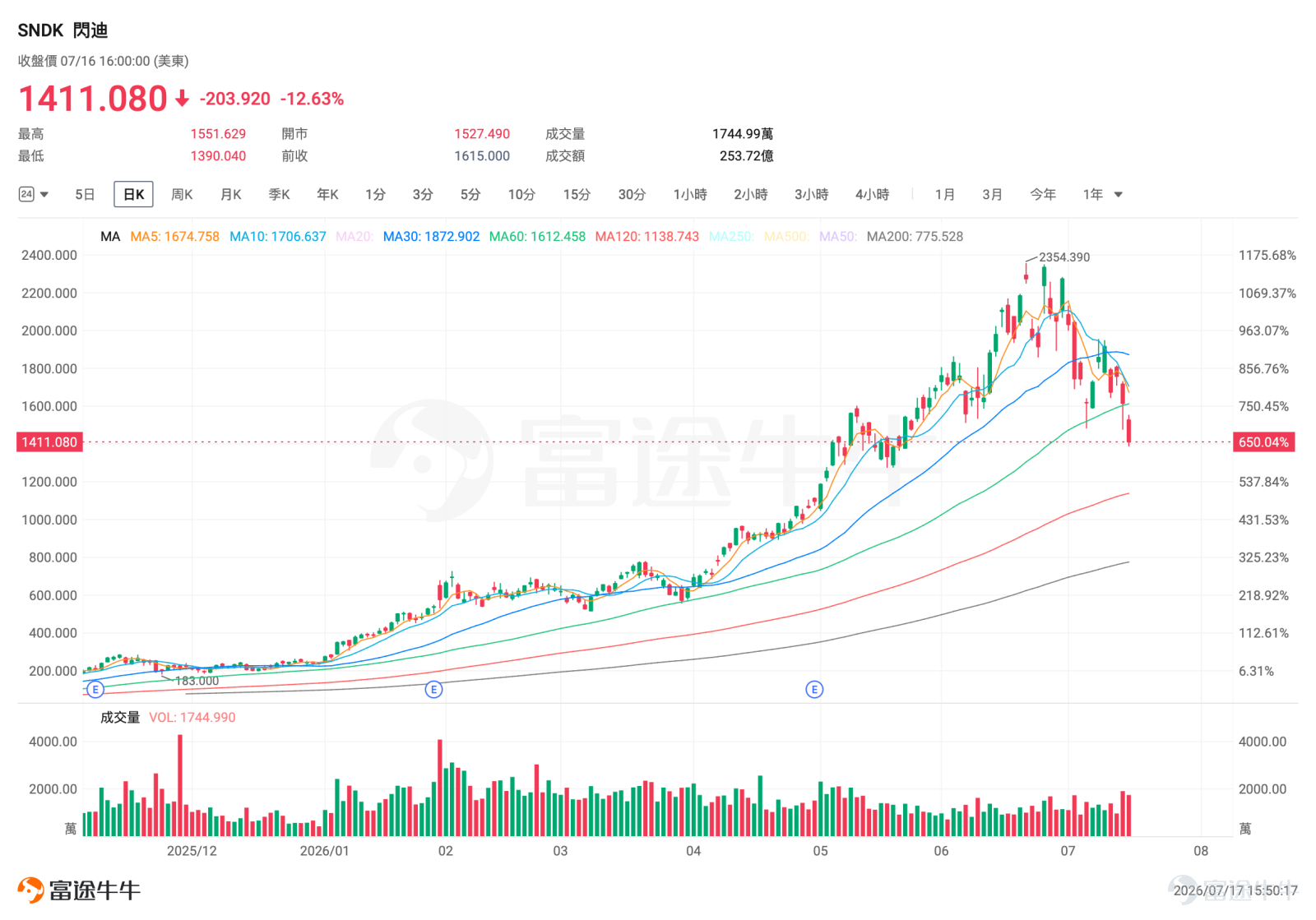
All three major U.S. equity indices closed lower in the previous trading session, as the storage chip sector faced intense selling pressure, $PHLX Semiconductor Index (.SOX.US)$ plummeting more than 4%. $SanDisk (SNDK.US)$ It plunged 12.63% in a single day to $1,411, marking a cumulative decline of nearly 40% from its June all-time high of $2,354. Panic sentiment has driven up volatility, opening a high-premium window for options sellers.
II. Watchlist Highlights
SNDK: Hit by Sector-Wide Selloff, Plunged Nearly 13% in Previous Session, Continues Declining in Pre-Market Today
$SanDisk (SNDK.US)$ It closed the previous session at $1,411.08, down sharply by 12.63%, hitting an intraday low of $1,390.04. Trading volume reached $25.372 billion, with a volume ratio of 1.266 and a turnover rate of 11.952%, indicating significant capital outflows. The stock continued to fall in pre-market trading today, with no clear sign of easing selling pressure.

From a technical perspective, SNDK displayed a classic high-open, low-close, high-volume crash pattern—opening at $152.749 below the prior close and then steadily declining, accelerating downward near the close. A single long bearish candle broke through multiple short-term moving average supports, shifting the short-term trading setup from prior high-level consolidation to a confirmed downtrend. Immediate support levels to watch include the psychological $1,300 and $1,200 marks; any near-term rebound will face heavy resistance from trapped long positions above.
The core trigger behind this sector-wide sell-off is closely tied to a systemic cooling of market sentiment.On July 15, Warren Buffett issued sharp criticism of the current market environment, stating, 'When everyone is obsessed with gambling and speculation, it becomes extremely difficult to find value investments with a margin of safety.'This comment intensified investors’ risk-aversion toward richly valued tech stocks.
Meanwhile, concerns are mounting over whether the memory/storage sector can sustain its above-consensus earnings growth momentum.The immediate catalyst for this correction was the South Korean Financial Services Commission (FSC) officially announcing tighter regulation of single-stock leveraged ETFs on July 16.Measures such as raising margin requirements and limiting position sizes have precisely targeted the leveraged capital that had previously flooded into memory stocks. After share prices declined and triggered rebalancing mechanisms, leveraged ETFs were forced to continuously sell, creating a negative feedback loop of 'decline → deleveraging → further decline,' significantly amplifying sector volatility.
JPMorgan notes that the core issue lies in the market’s transition from the 'AI infrastructure expansion' phase to the 'profit realization validation' phase. Specific concerns center on three aspects:
- Sustainability of capital expenditures:The market is beginning to worry whether hyperscale cloud service providers (CSPs) can continue to significantly exceed capital expenditure expectations, with declining free cash flow further intensifying these concerns.
- HBM price increase expectations:Buy-side participants broadly expect HBM prices to double by 2027, but JPMorgan is more cautious, forecasting only a 25%–30% increase.
- Supply-side concerns:ASML’s next-generation EUV lithography tools could accelerate HBM capacity expansion, prompting the market to reassess the timing of when current supply tightness might ease.
Despite the severe short-term pain, the fundamental drivers supporting the memory sector’s medium- to long-term outlook remain intact.Multiple institutions forecast that the tight supply-demand balance in memory will persist at least through 2027–2028. Memory manufacturers continue to express confidence—Micron executives reiterated that AI is still in its early stages and that the token economy will sustainably drive memory demand; SK hynix’s Chairman stated that SK hynix shares will trend upward over the long term.
The memory storage sector is currently in a phase of intense tug-of-war between short-term sentiment-driven selling and long-term fundamental revaluation, which implies the sector may continue to experience significant volatility in the near term due to macroeconomic headwinds and capital flows.
3. Options Premium Collection Strategy
1. Cash Secured Put
Sell 1 contract of $SanDisk (SNDK.US)$ SNDK Aug 21, 2026 $700 Put; estimated required margin (for reference only): $70,000 ($700 × 100)

Opportunity Rationale:
For investors who agree with the thesis of supply-demand imbalance in the memory market but have not yet established positions, SanDisk’s (SNDK) current share price has already pulled back nearly 40% from its all-time high.
By selling put options, investors can collect premium income if the stock price stabilizes in the current range or experiences a corrective rebound; if the price continues to decline due to sector-wide sentiment, they may also have the opportunity to establish positions at even lower levels.
2. Covered Call

Opportunity Rationale:
For investors already holding SanDisk (SNDK) positions and facing significant unrealized losses, the stock is under pressure from sector-wide systematic selling in the short term and faces technical resistance on any rebound attempts.
Investors who believe the industry outlook—characterized by persistent supply-demand imbalance through 2027—but are concerned about near-term sentiment-driven volatility could consider selling call options. If the stock price continues to decline, the collected premium would help lower their average holding cost; if the price subsequently recovers to around $2,000 and the option is exercised, it effectively allows them to realize partial profits at a key technical resistance level.
IV. Risk Management Advisory
Although seller strategies have a high win rate, investors must still implement proper risk management:
– Position sizing is key:The biggest risk of option selling strategies lies in black swan events. It is recommended that the margin allocated to any single underlying asset should not exceed 20% of total capital. Never sell options beyond your risk tolerance just for the sake of collecting premium.
– Timely rolling of covered calls:If a covered call becomes deeply in-the-money (i.e., the stock price significantly exceeds the strike price) and you remain bullish on the underlying stock, promptly 'roll' the position—close the current option by buying it back and simultaneously sell a new call with a later expiration and a higher strike price—to avoid having your shares called away at an unfavorable price.
– Beware of 'left-tail risk' with cash-secured puts:For cash-secured puts, if the stock price crashes due to fundamental deterioration (rather than normal pullbacks), do not hold on stubbornly. In such cases, exit with a stop-loss or 'roll down' the position to buy time and wait for volatility to normalize.
Make good use of the Option Seller Hub to understand potential income strategies for selling options,Earn option premiums!
Make good use of the Option Seller Hub to understand potential income strategies for selling options,Earn option premiums!

Options Risk Disclosure
An option is a contract that grants the holder the right—but not the obligation—to buy or sell an underlying asset at a fixed price on or before a specified date. The price of an option is influenced by various factors, including the current price of the underlying asset, the strike price, time to expiration, and implied volatility. Implied volatility reflects the market's expectation of future price fluctuations over the life of the option; it is derived by reverse-engineering the option’s price using the Black-Scholes pricing model and is commonly viewed as an indicator of market sentiment. When investors anticipate greater volatility, they may be willing to pay higher premiums for options to hedge their risk, leading to higher implied volatility. Traders and investors use implied volatility to assess the attractiveness of option prices, identify potential mispricings, and manage risk exposure.
Disclaimer
This content does not constitute an offer, solicitation, recommendation, advice, opinion, or any guarantee regarding any securities, financial products, or instruments. Trading options involves substantial risk of loss. In certain circumstances, your losses may exceed the initial margin deposit. Even if you place contingent orders, such as 'stop-loss' or 'limit' orders, you may not necessarily avoid losses, as market conditions may prevent these orders from being executed. You may be required to deposit additional margin on short notice. If you fail to provide the required amount within the stipulated time, your open positions may be liquidated. Nevertheless, you remain liable for any resulting deficit in your account. Therefore, you should thoroughly research and understand options and carefully consider whether trading them is suitable for you based on your financial condition and investment objectives. If you trade options, you should familiarize yourself with the procedures for exercising options and handling expiration, as well as your rights and obligations upon exercise or expiration. Options trading entails very high risk and is not appropriate for all investors. Investors should carefully read the document 'Characteristics and Risks of Standardized Options' before engaging in any options trading strategy.
Risk Disclaimer: The above content only represents the author's view. It does not represent any position or investment advice of Futu. Futu makes no representation or warranty.Read more


Comments (14)
to post a comment
32
80