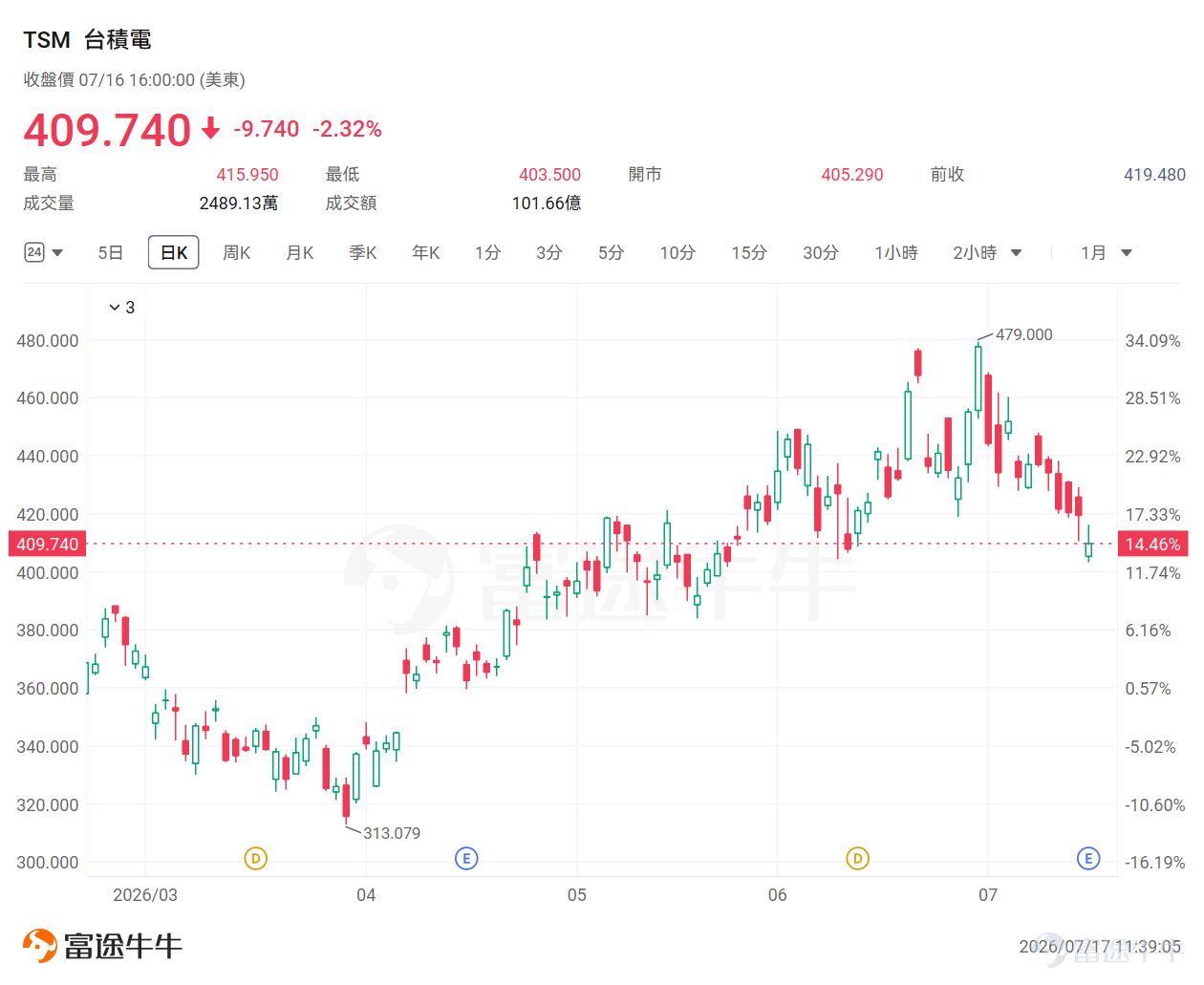

Taiwan Semiconductor's strong earnings fail to reverse AI sector weakness: How should investors respond amid capital rotation?
Data shows that the company’s second-quarter net profit surged 77% year-over-year, with revenue, gross margin, operating margin, and third-quarter revenue guidance all exceeding market expectations. Meanwhile, the share of advanced-node revenue continued to rise, with AI-related orders remaining the strongest growth driver.
This earnings report once again confirms that demand for AI computing power remains robust, and global investment in AI infrastructure has not cooled down.
However, the market responded quite differently.Following the earnings release, Taiwan Semiconductor shares fell more than 2%, as investors chose to take profits rather than chase the positive news after it was realized.

This reflects that AI investment has entered a new phase: previously, the market focused on whether AI demand would surge; now, it is questioning whether AI capital expenditures could become excessive and whether future overcapacity might emerge.
Just how strong was this earnings report?
Judging purely by the numbers, Taiwan Semiconductor remains at the heart of the AI wave. Over the past few years, its biggest transformation has been evolving from a traditional foundry into a core manufacturing platform for AI infrastructure.
NVIDIA GPUs, AMD AI accelerators, and cloud providers’ custom ASICs all heavily rely on Taiwan Semiconductor’s advanced process nodes. Second-quarter growth primarily came from: continued ramp-up of the 3nm advanced node, rising demand for AI GPUs, and increased HPC (high-performance computing) orders. AI has become the largest variable driving Taiwan Semiconductor’s profit growth.

Many investors used to view semiconductors with the belief: 'Semiconductors are inherently cyclical—after a peak in the boom cycle, a downturn is inevitable.' But Taiwan Semiconductor is changing this logic.
Traditional cycle: Chip prices rise → capacity expansion → oversupply → inventory correction
AI era cycle: Rising AI demand → increased investment in computing power → higher GPU demand → sustained tightness in advanced process nodes and advanced packaging
Taiwan Semiconductor’s biggest advantage is its position at the very core of this entire chain. In particular, segments like 3nm, 2nm, and CoWoS advanced packaging cannot be rapidly replicated in the short term.
Why is the stock price falling despite such strong earnings?
The answer is: The market trades not on actual earnings, but on expectation gaps.Taiwan Semiconductor’s share price has already risen by approximately 77% over the past year, as the market has already priced in substantial AI growth expectations ahead of time.So the current question isn’t: ‘Can Taiwan Semiconductor still grow?’ but rather: ‘Can it grow even faster than the market expects?’
Concern #1: Capital expenditures are too high—will AI investment returns decline?
This is the market’s biggest concern.Taiwan Semiconductor announced it will continue to significantly increase investment, including an additional $100 billion in the U.S., bringing its total U.S. investment plan to $265 billion. Its capital expenditure for 2026 is also expected to rise to $60–64 billion.
Explanation of increased capital expenditure: On the positive side—AI demand is indeed strong, and the company needs to expand capacity. However, the market worries—if AI demand growth slows in the future, could this new capacity become a burden?
Historically in the semiconductor industry, the most dangerous moments are often not when demand declines, but when all companies simultaneously believe demand will grow forever and aggressively ramp up production.
Concern #2: AI supply chain valuations have already been priced in ahead of time.
Over the past year, the market has already assigned very high valuations to the AI supply chain.
As a result, good news → rising stock prices is turning into: good news → confirmation of expectations → profit-taking.
This is a classic case of 'buy the rumor, sell the fact.'
Concern #3: Overseas fab construction impacts profit margins.
One of Taiwan Semiconductor’s biggest moats is its manufacturing base in Taiwan. However, for supply chain security, it must now establish operations in the U.S., Japan, and Europe.
The problem is: overseas manufacturing costs are significantly higher.Although strong short-term demand has masked the impact, the long-term market will focus on whether Taiwan Semiconductor's global expansion could come at the expense of its profit margins.
AI investment has now entered its second half: attention is shifting to the true bottleneck segments.
Although Taiwan Semiconductor’s stock price has declined, the underlying logic of its supply chain remains intact.
Multiple investment banks believe that Taiwan Semiconductor’s latest upward revision of its full-year outlook not only signals further strengthening of its own growth momentum but will also boost confidence across the entire AI semiconductor supply chain.Segments such as semiconductor equipment, advanced packaging, and memory are all expected to continue benefiting.Although the gross margin guidance is slightly below some optimistic expectations, institutions broadly view this as reflecting temporary pressures from the ramp-up of new process technologies, rather than a shift in the fundamental long-term upward trajectory of AI demand.
In fact, as AI infrastructure enters the phase of large-scale deployment, the bottleneck limiting compute capacity expansion is gradually shifting from chip design to manufacturing. The two most critical segments in this shift are:Advanced packaging and semiconductor equipment.
1. Advanced Packaging: AI chips are transitioning from a 'manufacturing problem' to an 'assembly problem.'
For decades, the semiconductor industry followed Moore’s Law—boosting single-chip performance by continuously shrinking transistor sizes. However, in the AI era, as large models scale from tens of billions to trillions of parameters, relying solely on process node scaling has become increasingly difficult. Now, NVIDIA’s Blackwell, AMD’s MI series, and cloud providers’ in-house AI chips are all adopting a new approach:Integrate GPU compute chips and HBM (High Bandwidth Memory) into a single package using advanced packaging technologies.This is also why HBM + CoWoS is becoming the 'standard configuration' for AI chips.
Take $Taiwan Semiconductor (TSM.US)$ Advanced packaging technologies, represented by CoWoS, have become one of the most critical bottleneck segments in the AI chip supply chain. Facing explosive demand for AI computing power, $Samsung Electronics (005930.KR)$ is accelerating its catch-up with Taiwan Semiconductor through an integrated strategy combining HBM and advanced packaging; $Intel (INTC.US)$ is continuously enhancing its Chiplet integration capabilities through 3D packaging technologies such as EMIB and Foveros, aiming to secure a foothold in the next-generation AI chip packaging race.
Moreover, due to the explosive surge in AI demand, Taiwan Semiconductor’s advanced packaging capacity has become tight, leading some steps in the process to spill over to outsourced assembly and test (OSAT) providers, such as $ASE Technology (ASX.US)$ 、 $Amkor Technology (AMKR.US)$ and other companies.
2. Semiconductor Equipment: The 'Shovel Sellers' Behind AI Capacity Expansion
If Taiwan Semiconductor maintains a high level of capital expenditure (CapEx) over the next few years, equipment companies will be among the biggest beneficiaries. Previously,“ASML Holding and Applied Materials Surge to New Highs! Capacity Expansion Ignites Semiconductor Equipment Supercycle—Who’s the Next Hidden Champion?”an article outlined the relevant companies:

If advanced packaging addresses 'how to integrate more computing power into a single chip,' semiconductor equipment addresses 'how to manufacture more—and more advanced—AI chips.' As Taiwan Semiconductor, Samsung, and Intel continue to expand their advanced process and advanced packaging capacities,Equipment suppliers are becoming key beneficiaries of AI infrastructure investment.
In wafer fabrication, etching, deposition, lithography, and inspection/metrology are the four most critical equipment segments.In etch equipment, the global leader $Lam Research (LRCX.US)$ has long held a leading position, with its tools widely used in advanced logic processes and HBM memory manufacturing; Japanese equipment giant $Tokyo Electron (8035.JP)$ covers multiple segments including etching, thin-film deposition, and coating/developing, making it a key supplier for semiconductor capacity expansion in Asia.
In deposition equipment, AI chips are becoming increasingly complex, requiring more thin-film layers and more precise material deposition processes, thereby driving higher equipment demand. The world's largest semiconductor equipment company $Applied Materials (AMAT.US)$ covers multiple areas including deposition, etching, and advanced packaging, making it a core beneficiary of the semiconductor capital expenditure cycle.
In lithography, advanced nodes are increasingly reliant on extreme ultraviolet (EUV) lithography. $ASML Holding (ASML.US)$ is the only company globally capable of mass-producing EUV lithography systems and is an irreplaceable equipment supplier for 2nm and below advanced nodes. Additionally, Japan-based $Nikon (7731.JP)$ has also been a long-standing participant in the lithography equipment market.
As the complexity of AI chip design increases, manufacturing challenges and yield pressure rise in tandem, further elevating the importance of inspection and metrology equipment. $KLA Corp (KLAC.US)$ is the global leader in wafer inspection, helping foundries improve yields in advanced processes; $Onto Innovation (ONTO.US)$ benefits from growing demand for advanced packaging inspection.
What should investors do now?
The biggest contradiction facing the market right now is not a turning point in AI demand,but rather the clash between a strong industry cycle and a weak funding environment.
On one hand, Taiwan Semiconductor's latest earnings once again confirm that investment in AI infrastructure remains in a phase of rapid expansion; on the other hand, global capital markets are undergoing a round of risk unwinding triggered by high leverage and crowded trades.This is also why investors are seeing fundamentals grow stronger while stock prices become increasingly difficult to push higher.
JPMorgan's latest report points out thatthe deleveraging process among U.S. investors that began in June is still ongoing.There remains room for further deleveraging in leveraged equity ETFs, the options market, and margin accounts, which could continue to weigh on stock market performance over the coming months.This means that even if company fundamentals do not deteriorate, passive selling pressure from funding dynamics could still trigger short-term corrections in high-quality assets.
For investors, the current environment isn't simply about being bullish or bearish on AI; it's more important to understand the evolving market phase.
Past: AI investing = buying the most certain leaders. Now: AI investing = seeking companies with earnings delivery capability and valuation alignment.
In the short term:Since deleveraging has not yet fully concluded, high-valuation AI assets may still be vulnerable to capital flow volatility,so investors should avoid blindly trying to catch a falling knife.。However, from a medium- to long-term perspective:if the AI capex cycle has not ended, the underlying industry trend remains intact.
Investors should focus more on companies that consistently deliver earnings, operate in supply-constrained segments, and whose valuations have not yet fully reflected their growth potential.
Summary
The decline in Taiwan Semiconductor’s share price does not signal the end of the AI rally. Rather, it reflects a critical market transition: shifting from 'believing the AI narrative' over the past year to 'validating AI profitability' over the next few years.
Macro deleveraging may create short-term volatility, but what truly determines long-term returns remains:Who can consistently secure orders during the AI infrastructure investment cycle and convert demand into profits.
Taiwan Semiconductor has demonstrated that AI demand remains robust, and in the next phase, the market will seek more undervalued winners across the AI supply chain.
Risk Disclaimer: The above content only represents the author's view. It does not represent any position or investment advice of Futu. Futu makes no representation or warranty.Read more


Comments (11)
to post a comment
31
88