
The White House launches 'Golden Eagle Initiative'! Could AI security become the next investment hotspot?
On July 14, the White House announced major news: the official launch of the 'Golden Eagle Initiative.'
This is not a traditional system upgrade or firewall, but rather a new AI-driven, nationally led cybersecurity information exchange center.
Crisis Looms: Why Was the 'Golden Eagle Initiative' Launched?
To understand the significance of the 'Golden Eagle Initiative,' one must first confront a harsh reality:AI development has already upended the traditional balance of cyber offense and defense.
In recent years, AI-enhanced cyberattacks have significantly lowered the barrier to entry. Cutting-edge large language models can not only assist in generating zero-day exploit tools but also bypass multi-factor authentication. Moreover, code generated by widely used AI-assisted programming tools (such as GitHub Copilot) often contains security vulnerabilities—effectively mass-producing security weaknesses while accelerating code output.
To address this AI-driven, imminent national information security threat, the Trump administration had already signed Executive Order 14409 on June 2, 2026, titled 'Advancing Innovation and Safety in Advanced Artificial Intelligence.'The executive order explicitly directed the federal government to establish an interagency AI vulnerability coordination platform.
After more than a month of preparation, the 'Golden Eagle Initiative' was launched. Spearheaded by the White House, it brings together the Department of the Treasury, the Department of Homeland Security, the Department of Defense, and key private-sector critical infrastructure giants. Its core objective is to leverage cutting-edge artificial intelligence technologies,to receive, coordinate, and remediate cybersecurity vulnerabilities at unprecedented speed and scale, thereby strengthening cyber defense capabilities.
Savvy capital: AI cybersecurity stocks surge year-to-date
Pricing in the capital markets for this paradigm shift in cybersecurity has long been underway. While market attention has centered on computing power and chips,the vast yet under-the-radar AI cybersecurity segment is quietly gaining momentum.
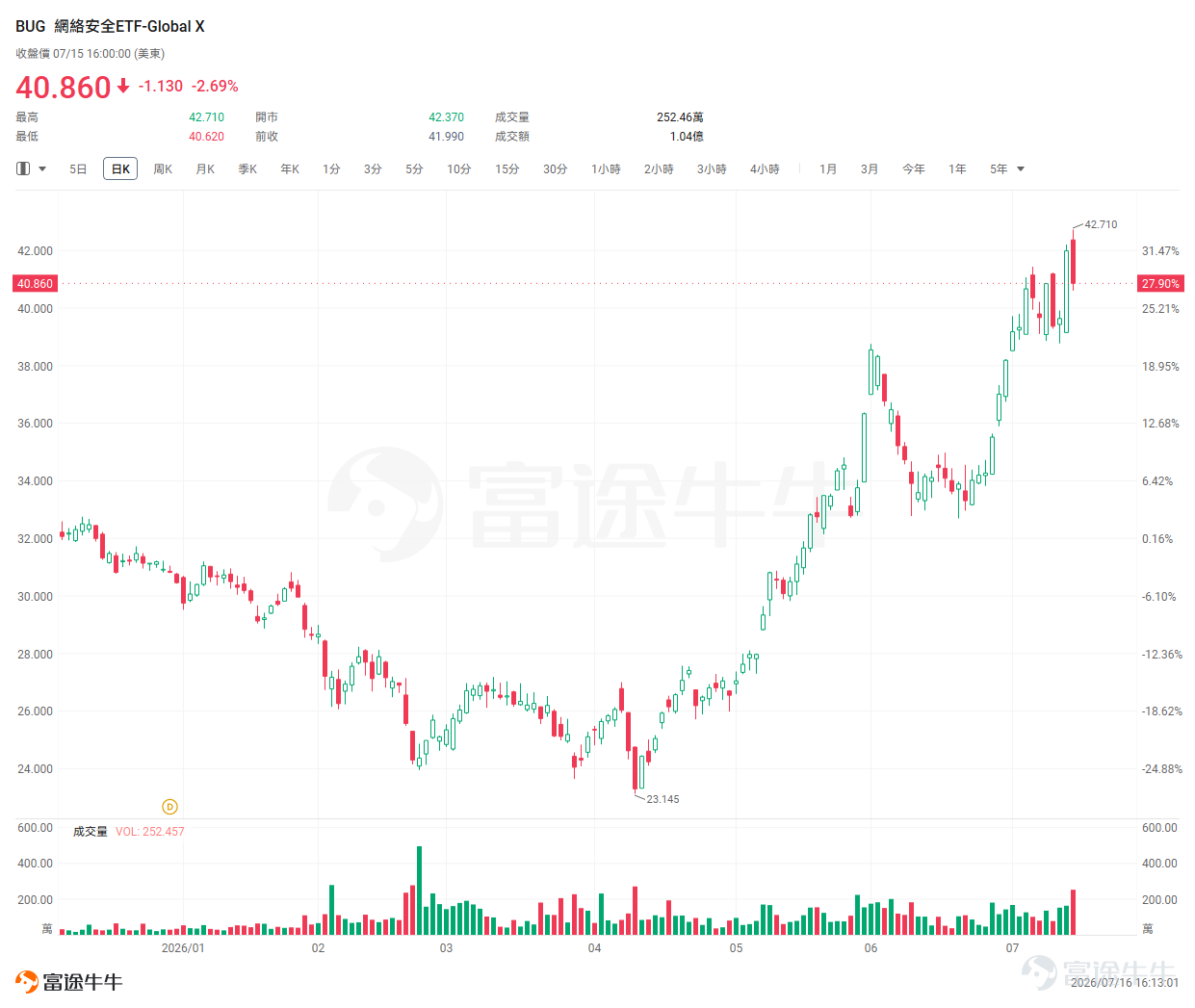
In the first half of 2026, Nasdaq cybersecurity-related indices and ETFs delivered exceptionally strong performance. Take $Global X Cybersecurity ETF (BUG.US)$ for example—this ETF posted a staggering 37% gain in May 2026 alone, rebounding over 75% from its late-April lows.

Among individual stocks, U.S.-listed cybersecurity giants have been particularly impressive, with the top performer up over 107% year-to-date. The following data is sourced from Futubull’s Cybersecurity Concept list (LIST2570), ranked by year-to-date gains:

As the data shows, global cybersecurity leaders such as $Fortinet (FTNT.US)$ 、 $A10 Networks (ATEN.US)$ 、 $Datadog (DDOG.US)$ have all gained more than 94%; meanwhile, cybersecurity platform behemoths like $Palo Alto Networks (PANW.US)$ closely followed, rising +92.19% year-to-date. Meanwhile, $CrowdStrike (CRWD.US)$ 、 $Okta (OKTA.US)$ 、 $Tenable Holdings (TENB.US)$ the performance of mid-tier players has also been robust. Even large-cap, traditionally stable industry giants like $Cisco (CSCO.US)$ have recorded a notable gain of +47.21%.
Opportunity Spotlight: Which thematic stocks deserve attention?
Amid continued policy tailwinds for cybersecurity, the global AI cybersecurity supply chain may be poised for a revaluation. As Futubull previously highlighted in the article titled ""The Hidden Winner Beyond Computing Power! A US Cybersecurity Giant Quietly Doubles—Deep Dive into the Three Core Drivers Behind the Surge》、《Trump plans to sign AI cybersecurity executive order! Which companies are worth watching?"

Specifically, the following sectors and stocks warrant close attention:
1、Vulnerability Management and IT Services
The 'Golden Eagle Initiative' is essentially a 'National Vulnerability Coordination Center.' Therefore, companies specializing in vulnerability exposure, as well as IT consulting giants deeply tied to government contracts, stand to benefit directly.
$Tenable Holdings (TENB.US)$: A global leader in 'preventive security,' its Nessus platform is the industry benchmark for vulnerability scanning. Against the backdrop of heightened emphasis on national-level, cross-agency vulnerability coordination, Tenable’s platform can automatically identify potential exposure points in cloud assets of enterprises and government agencies, proactively 'plugging gaps' before hackers strike.
$Rapid7 (RPD.US)$: Focused on dynamic vulnerability scanning and cloud attack surface management, it forms a twin-star duo with Tenable in the vulnerability space.

$Infosys (INFY.US)$: A global IT consulting giant. Unlike 'product-oriented' cybersecurity vendors that purely provide standardized software and hardware, Infosys plays the critical roles of an 'integrator' and 'implementer.'
$Leidos (LDOS.US)$/ $Booz Allen Hamilton Holding Corp (BAH.US)$/ $Parsons (PSN.US)$: These three companies are the largest IT and security services consulting contractors for the U.S. government, Department of Defense, and defense industrial groups. As national-level security projects move toward implementation, these enterprise-government think tanks and cyber warfare consultants—with top-tier classified credentials—are poised to become irreplaceable players.
2、Threat Detection
This is the most fiercely contested frontline in AI-driven offense and defense, featuring high market concentration, where capital assigns the most pronounced valuation premium to sector leaders.
$CrowdStrike (CRWD.US)$: As a disruptor in cloud-native security, its core asset is the Falcon platform. Leveraging a lightweight single-agent architecture, the platform aggregates real-time endpoint data from hundreds of thousands of enterprises worldwide into a cloud-based AI brain. Its AI predictive models analyze over tens of trillions of security events daily, enabling 'sub-second threat blocking.'
$Palo Alto Networks (PANW.US)$: A cybersecurity platforming powerhouse. Starting with 'next-generation firewalls (NGFW),' it has successfully transformed into the world’s most extensively covered end-to-end security giant. PANW aggressively pursues a 'platform strategy,' offering an all-in-one 'AI-powered, full-spectrum defense.'

$SentinelOne (S.US)$: An emerging endpoint security star specializing in 'autonomous AI' defense technology, using onboard AI to enable automatic device remediation and isolation even in offline environments.
$Akamai (AKAM.US)$: A leader in edge security and content delivery networks (CDN), leveraging its global edge nodes to intercept AI-driven distributed denial-of-service (DDoS) attacks as close to users as possible.
3、Cloud Security
As enterprise data and AI models accelerate their migration to the cloud, cloud security has become a critical battleground.
$Cloudflare (NET.US)$: An extremely high proportion of global web traffic runs directly on Cloudflare’s edge network. Its unique distributed architecture makes it not just a security company, but also a foundational 'infrastructure' layer of the internet.
$Okta (OKTA.US)$: The standard-setter in cloud identity and access management (IAM). In an era rife with AI-powered deepfakes and phishing attacks, it serves as the first line of defense for enterprises against credential leaks.

$Zscaler (ZS.US)$: A leader in Zero Trust Security Service Edge (SSE) and Secure Web Gateway solutions. It specializes in seamless isolation between 'users and applications' and 'applications and applications,' preventing attackers from moving laterally within enterprise clouds.
$Rubrik (RBRK.US)$: An emerging player in Zero Trust data security, focusing on ransomware protection and data backup—ensuring data integrity even if systems are compromised.
$Datadog (DDOG.US)$: A cloud-native observability platform that, amid the explosive adoption of large language models (LLMs), has timely launched LLM security monitoring to help enterprises detect vulnerabilities and anomalies in real time during AI model operations.
4、Cybersecurity vendors
AI defense demands immense computing power, driving a comprehensive upgrade in networking hardware and traffic governance systems toward 'AI-specific ASICs' and 'massive-scale data analytics.'
$Cisco (CSCO.US)$: Long known as the world's largest traditional networking hardware giant, it acquired Splunk—the leader in data analytics and observability—for a staggering $28 billion. This merger has positioned Cisco at the forefront of 'AI-driven network traffic security and massive-scale data monitoring.'
$Fortinet (FTNT.US)$: A firewall and SD-WAN powerhouse with proprietary, in-house ASIC chips. Leveraging 'chip-level acceleration' for exceptional cost-performance, it dominates the enterprise branch and hybrid work security markets.
$F5 Inc (FFIV.US)$: An expert in Application Delivery Controllers (ADC) and Web Application Firewalls (WAF) for multi-cloud environments, ensuring the security and stability of AI applications under high-concurrency traffic.
$Gen Digital (GEN.US)$: Formed from the merger of Norton and Avast, it focuses on consumer-grade cybersecurity and privacy protection, guarding individuals against AI-driven fraud.
$A10 Networks (ATEN.US)$: A pioneer in highly elastic automated cybersecurity and traffic orchestration, specializing in DDoS mitigation and application delivery in high-traffic environments.
$Check Point Software (CHKP.US)$: A veteran Israeli cybersecurity giant and pioneer of firewall technology, known for its robust technology and high customer stickiness.
5、Data Security and Identity Verification
$Varonis Systems (VRNS.US)$: An expert in automated data governance and compliance. Before enterprises train large AI models, they must perform 'secure data cleansing' on massive datasets—a critical need where Varonis is perfectly positioned.
$Clear Secure (YOU.US)$: A pioneer in biometric verification (iris, facial, and fingerprint recognition). As AI-generated deepfakes and synthetic voice clips render traditional authentication methods obsolete, its seamless and unforgeable authentication solution is emerging as the ultimate answer.
Risk Alert: Reflections Behind the Boom
Despite the bright prospects for the AI security sector under supportive policies, investors should remain cautious of the following risks:
Valuation Overextension and Earnings Volatility: The sector’s previous consecutive rallies have already priced in some expectations. For example, $CrowdStrike (CRWD.US)$ and $Palo Alto Networks (PANW.US)$ after delivering better-than-expected earnings, it experienced a sharp after-hours sell-off due to excessive gains and profit-taking by the market. Given elevated valuations, investors should avoid chasing prices at highs; instead, phased buying on pullbacks is a more prudent approach.
Increasing divergence within the sector: Not all companies cloaked in the guise of 'security' will soar. Security firms lacking foundational AI capabilities and relying solely on traditional signature-based methods will see their market share increasingly devoured by tech giants.
Policy implementation falling short of expectations: Although the 'Golden Eagle Initiative' is ambitious, reports suggest it currently lacks absolute enforcement power to compel enterprises to patch vulnerabilities, and further observation is needed on how its operational details are implemented on the ground.
Summary
The launch of the 'Golden Eagle Initiative' marks the elevation of AI-powered cybersecurity to a strategic dimension in great-power competition. As AI technology continues to iterate and evolve, cybersecurity has shifted from being a corporate 'cost center' to a 'lifeline' essential for survival. For investors, the AI security sector offers both strong industrial demand and long-term technological potential.Embracing industry leaders who are genuinely using AI to reshape their defensive capabilities may well be the key to capturing the next decade’s technology-driven upside.
Risk Disclaimer: The above content only represents the author's view. It does not represent any position or investment advice of Futu. Futu makes no representation or warranty.Read more


Comments (3)
to post a comment
34
127