
Apple and Amazon reported starkly contrasting earnings— which one are you bullish on?

‘Buy chips, sell megacaps’—trading logic flips as risk-off sentiment heats up in US equities; is the Magnificent 7 becoming a safe haven for capital?
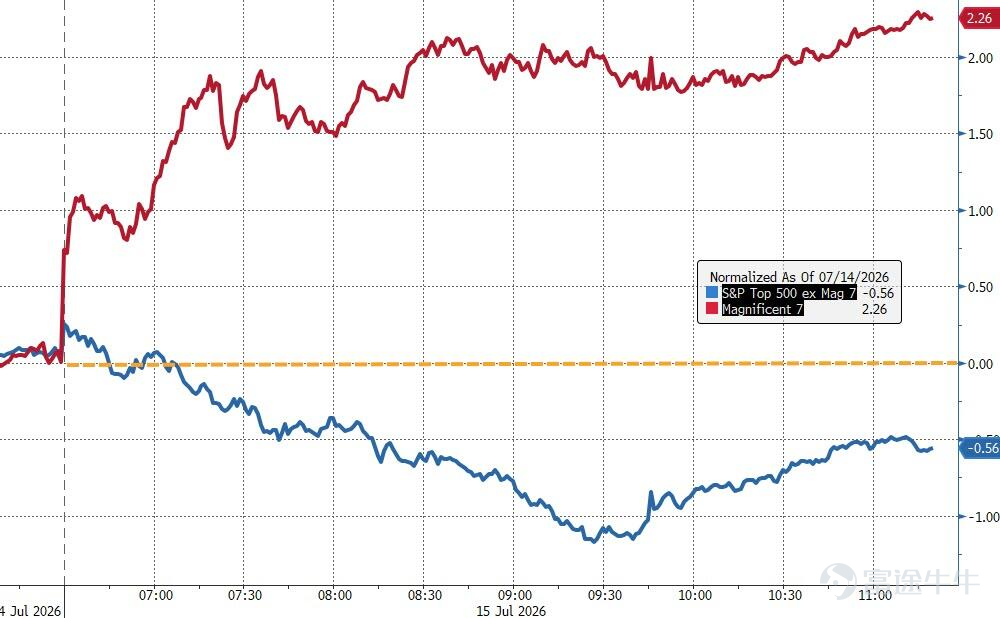
U.S. stocks showed clear divergence yesterday, with semiconductors plunging, $Micron Technology (MU.US)$ plummeting 8.02%, $SanDisk (SNDK.US)$ plunged 8.12%, $Western Digital (WDC.US)$ also fell by more than 7%. The memory chip sector became the day's biggest loser, with capital outflows at a rare pace. Among the 'Magnificent Seven' tech stocks, only $Tesla (TSLA.US)$ closed lower, $Apple (AAPL.US)$ even rose 4%, hitting a new all-time high;
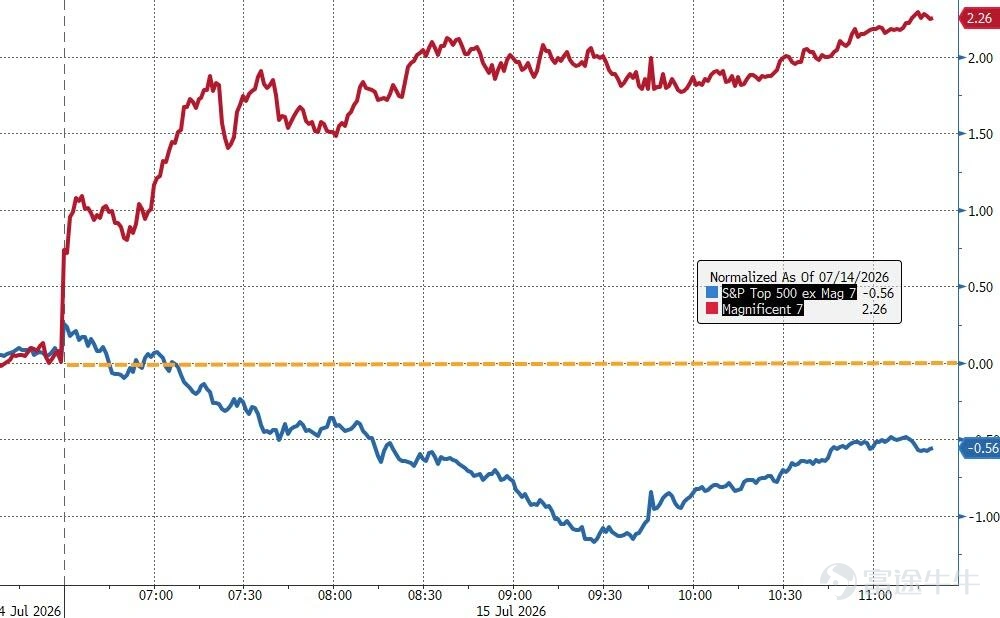
While 493 constituents of the S&P were being sold off, the Magnificent Seven significantly outperformed the Nasdaq.Since July, the semiconductor sector has declined by approximately 13%, $Roundhill Magnificent Seven ETF (MAGS.US)$ while rebounded by about 7.3%.
Expectations for semiconductor earnings are extremely high heading into the new earnings season.
As of July 10,FactSet data shows that the market expects second-quarter earnings for the 'Semiconductors & Semiconductor Equipment' industry to surge 131% year-over-year, with revenue up 75%.If the semiconductor industry is excluded, the expected profit growth rate for the information technology sector would decline from 63.3% to 25.8%.A significant portion of the earnings growth for the entire tech sector hinges on semiconductors.
A 131% profit growth implies that the market has already priced in an exceptionally strong upcycle.Current market expectations are extremely asymmetric: only a 'significant beat plus raised guidance' can push share prices higher, while even a slight miss triggers a severe sell-off.Meeting expectations merely validates prior gains; only clearly exceeding expectations and further raising guidance can drive additional re-rating of stock prices.
By comparison, FactSet estimates semiconductor sector profit growth at approximately 54% for Q4 2025, around 43% for some quarters in 2024, and during the peak cycle in 2021, growth reached roughly 50% to 60%.The market has now directly priced in 131% growth—an expectation rarely seen in recent semiconductor cycles.
$ASML Holding (ASML.US)$ ASML’s performance is a prime example. The company reported second-quarter revenue of EUR 9.3 billion and net profit of EUR 2.9 billion, both exceeding expectations, and significantly raised its full-year revenue guidance to EUR 43–45 billion. Despite such robust results, it failed to reverse the semiconductor sector’s decline, and ASML’s own intraday gains narrowed markedly. Good news can no longer sustain upward momentum, indicating that short-term positioning has entered an 'expectations-overshoot' phase.
M7 has regained investor favor, primarily due to valuation repair and cash flow certainty.
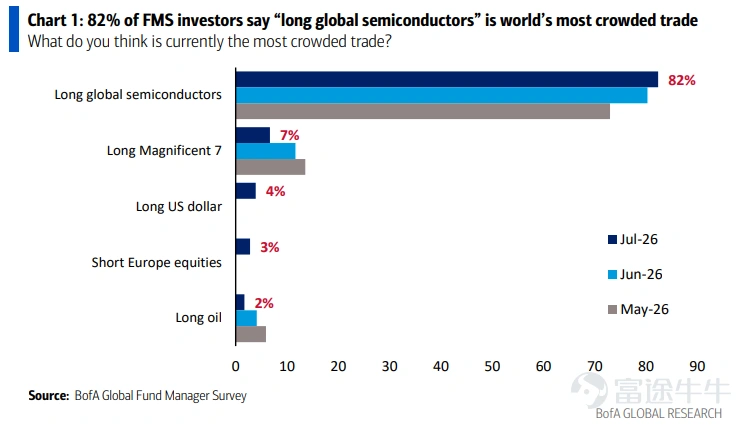
Bank of America’s July fund manager survey shows that82% of surveyed institutions listed 'long global semiconductors' as the most crowded trade in the market, ranking first for the third consecutive month and continuing to strengthen, far surpassing the second-place trade of going long the Magnificent Seven.
The Magnificent Seven were in precisely the opposite position earlier. Amid persistent market concerns over excessive AI capital spending and pressure on free cash flow, the M7 significantly underperformed in the first half of the year, with related ETFs nearly flat year-to-date at one point. Recent Goldman Sachs trading desk data shows thathedge funds have aggressively sold technology and communication services stocks, with selling pressure reaching the 98th percentile of the past year. Meanwhile, long-only institutions have net bought technology and communication services while selling consumer discretionary and healthcare, creating a clear divergence.
Relative valuations of some cloud computing giants have already returned to levels seen near the market lows of March 2020 and October 2022. Semiconductor expectations are elevated, while valuations and positioning of platform giants have been compressed, naturally prompting capital to seek contrarian trades.
Anthropic's potential IPO further reinforces the revaluation thesis for Google and Amazon.Both companies are not only major shareholders in Anthropic but also its primary cloud service partners. An increase in Anthropic’s valuation would boost their book investment value, and continued business expansion would drive additional demand for computing capacity from AWS and Google Cloud.
Public filings show thatGoogle holds approximately 14% of Anthropic’s equity; Amazon initially invested around $8 billion, and its stake had a carrying value of roughly $74.2 billion as of the February financing round this year.Both companies are also key cloud computing partners for Anthropic. A higher Anthropic valuation would generate investment gains, and business expansion would increase procurement of computing resources from AWS and Google Cloud.
This effectively provides Google and Amazon with a dual optionality of 'equity appreciation plus cloud revenue growth.' Compared with hardware companies that rely solely on chip pricing and order cycles, platform giants have more diversified revenue streams, making the market naturally inclined to increase allocations during periods of heightened volatility.
However, there is significant divergence within the Magnificent Seven (M7).NVIDIA itself remains a core semiconductor asset and cannot serve to mitigate cyclical risks in the chip sector; Tesla’s valuation and volatility are both high, making it unsuitable as a safe-haven asset; Apple has recently risen sharply, increasing the risk of chasing elevated prices.
Should we switch into the M7 now?
The chip sector’s main trend isn’t over yet, but trading difficulty has clearly increased. The semiconductor segment has already undergone some degree of position unwinding. If leading companies continue to deliver earnings above expectations and raise guidance, a rapid rebound could still occur. Fully exiting positions risks missing out on the subsequent recovery, while maintaining heavy exposure entails bearing significant volatility if results fall slightly short of expectations.
To assess whether this rotation is ending, watch for two signals:
First, whether chip stocks stop declining after positive news is released. If they no longer fall on good news, it suggests that high expectations and crowded positioning have already been digested.
Second, whether M7 companies can demonstrate that AI-related capital expenditures are translating into revenue, profit, and free cash flow. If cloud business growth improves and returns on AI investments begin to materialize, the rotation of capital toward platform-scale mega-caps could persist longer.。
The current market environment calls for an options strategy that simultaneously adds downside protection to chip holdings and allows limited-risk participation in the M7 rotation.
(1) Strategy One: Apply a low-cost collar to existing chip positions
Suitable for: Investors who already hold $VanEck Semiconductor ETF (SMH.US)$ 、 $Micron Technology (MU.US)$ 、 $SK hynix (SKHY.US)$ Chip or storage-related stocks are still supported by the medium-term industry trend, but there are concerns that valuations may continue to be compressed during earnings season.
Operationally, hold the underlying stock, buy a put option expiring in one to two months with a strike price below the current market price, and simultaneously sell a call option with the same expiration date but a strike price above the current market price. Use the premium received from selling the call to partially offset the cost of the protective put. The specific strike prices should be adjusted based on real-time option premiums, aiming for the sold call to cover 50%–80% of the protective put’s cost—there is no need to mechanically pursue a 'zero-cost' structure.
Because chip stocks exhibit relatively high volatility, buying puts outright can be expensive. Selling calls above the current price allows capturing higher implied volatility premiums. Locking in downside protection in advance also helps avoid being forced into stop-losses if the stock price declines despite earnings meeting expectations—a classic case of 'buy the rumor, sell the news.'
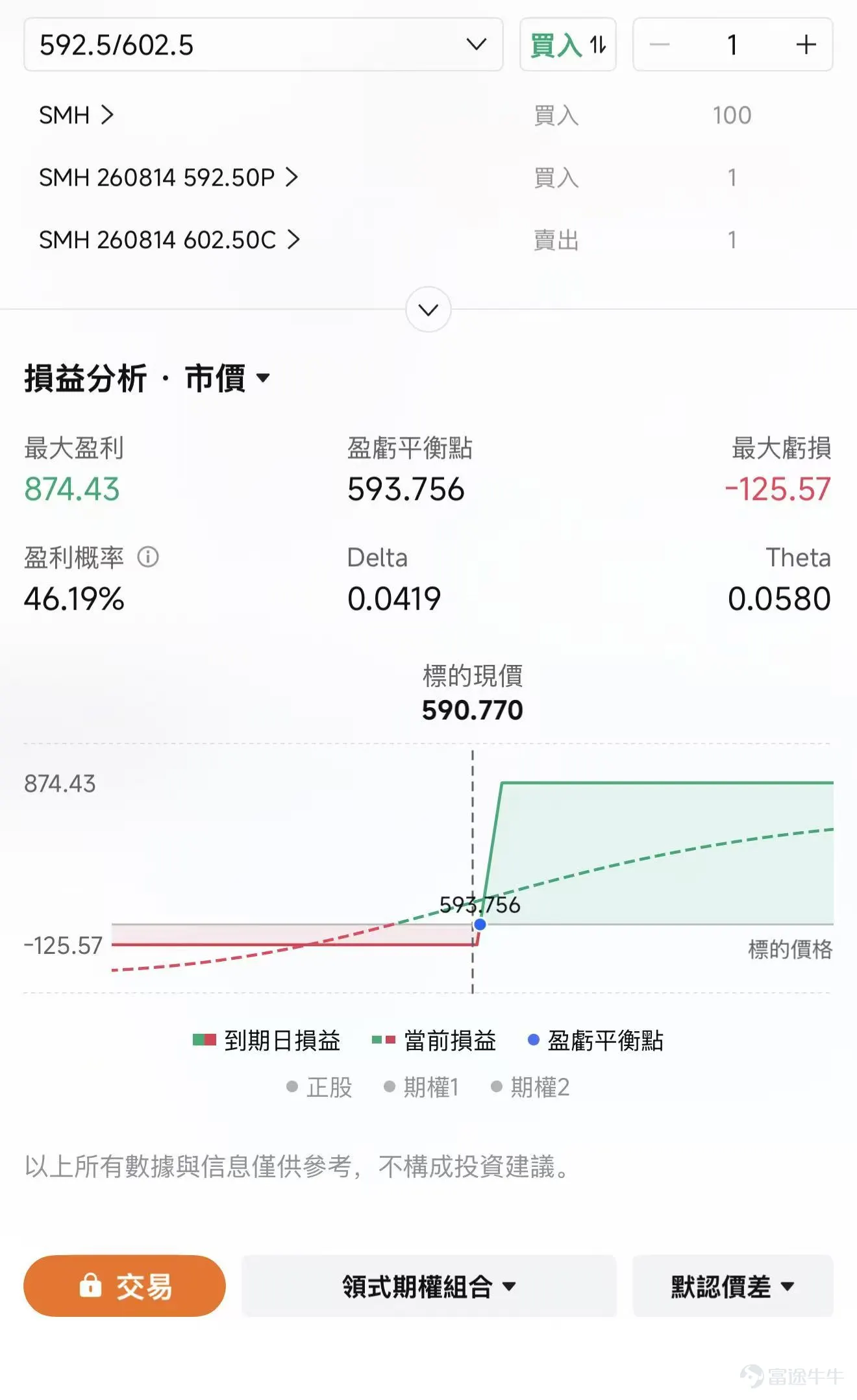
The trade-off is that upside potential is capped. If the semiconductor sector rebounds sharply and breaks above the call’s strike price, the underlying shares may be called away. Therefore, the short call should not be placed too close to the current price; ideally, it should be positioned just above prior consolidation zones or key technical resistance levels. Taking $VanEck Semiconductor ETF (SMH.US)$ as an example:
(The chart below illustrates the simulated profit and loss profile of this strategy at expiration. The displayed graphic is for demonstration purposes only and does not constitute investment advice or any guarantee; market conditions change frequently, and the prices shown do not reflect actual market data.)
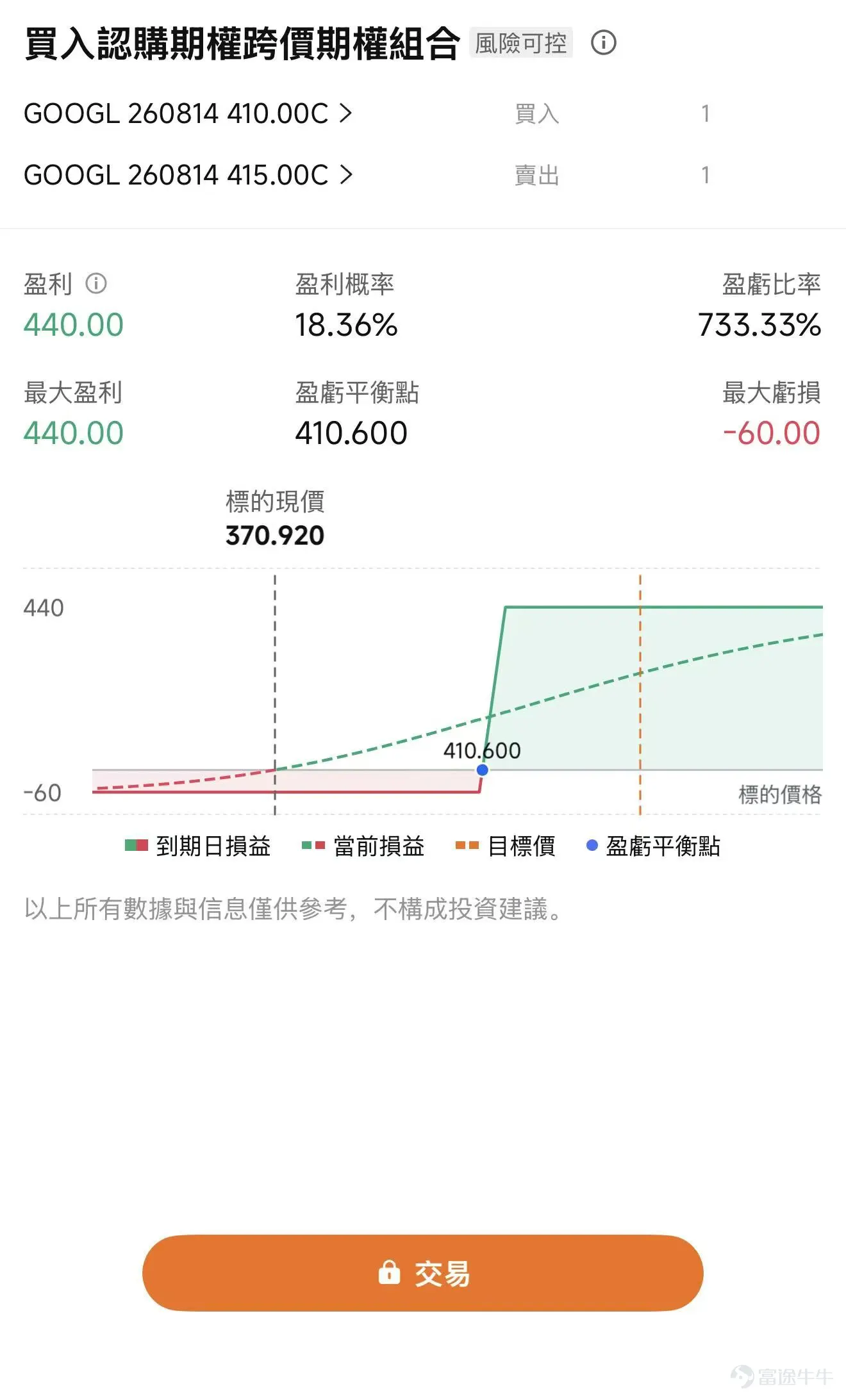
(2) Strategy Two: Use a Bull Call Spread to Participate in M7 Rotation
Target audience: Investors who expect capital to continue rotating from semiconductors into platform-type mega-cap stocks but are concerned about the heightened risk of chasing gains after M7’s consecutive rallies.
Compared to buying naked calls outright, a bull call spread reduces premium outlay and mitigates losses from declining implied volatility around earnings announcements. The maximum loss in such a structure is limited to the net premium paid, while the maximum gain equals the difference between the two strike prices minus the net cost. It is advisable to select an expiration date at least three to six weeks after earnings, avoiding a pure directional bet on a single earnings day and allowing more time for the rotation thesis to play out. Taking $Alphabet-A (GOOGL.US)$ as an example:
(The chart below illustrates the simulated profit and loss of this strategy at expiration. The design image shown on screen is for demonstration purposes only and does not constitute any investment advice or guarantee; market conditions change frequently, and the prices depicted do not reflect actual market conditions.)
Finally, Options Sir has a small gift for fellow investors—feel free to claim it!Options Beginner Pack
*This event is exclusive to invited HK users. Click to learn more.Detailed event rules>>
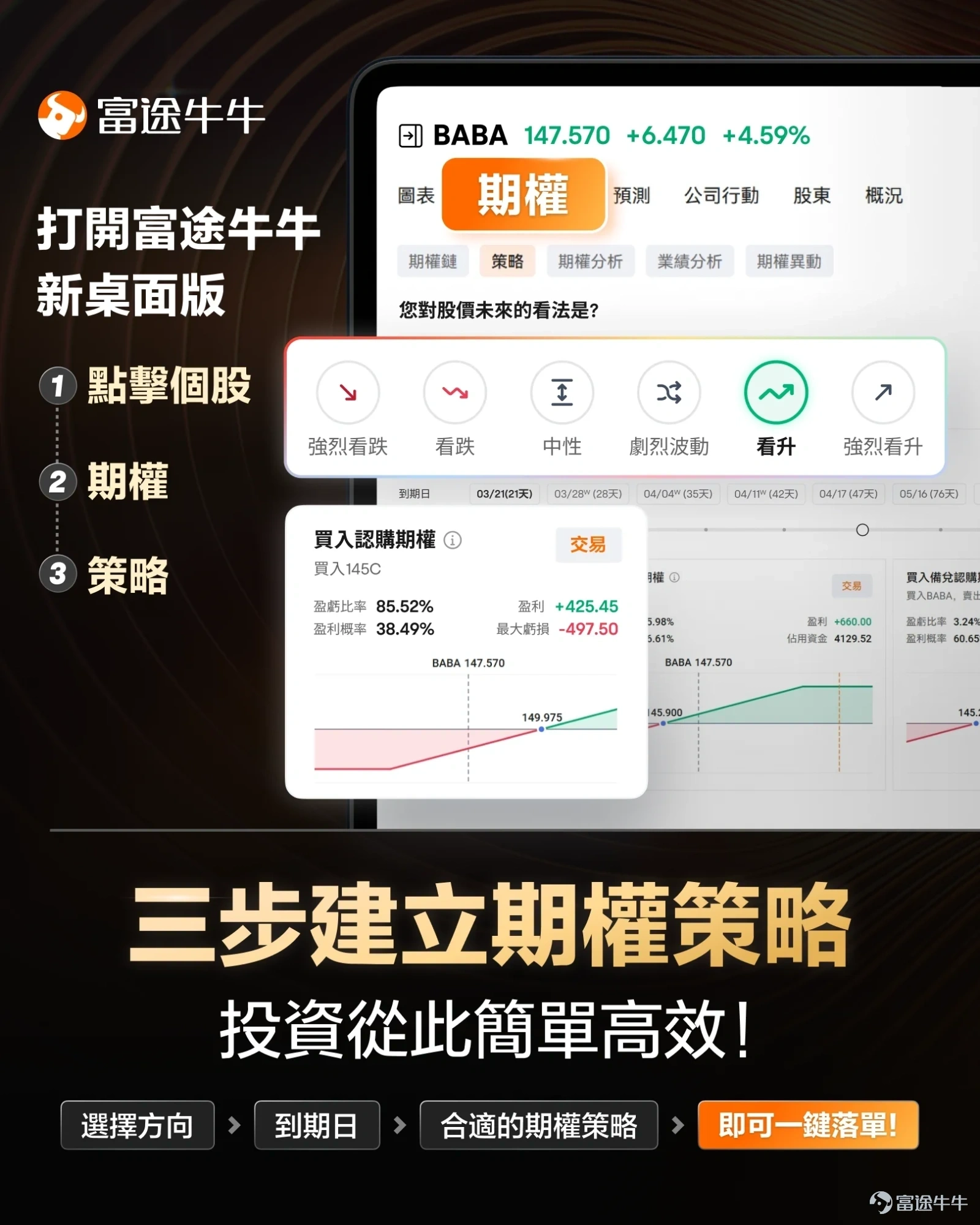
Market conditions are complex and volatile,Options StrategyOverwhelmed by too many choices? Futubull helps you set up your portfolio in three simple steps.Options Strategymaking investing simple and efficient!
Options Risk Disclosure:An option is a contract that grants the holder the right—but not the obligation—to buy or sell an underlying asset at a predetermined price on or before a specified date. Option prices are influenced by multiple factors, including the current price of the underlying asset, the strike price, time to expiration, and implied volatility. Implied volatility reflects the market’s expectation of future price fluctuations over the life of the option and is derived by reverse-engineering the Black-Scholes pricing model. It is commonly used as a gauge of market sentiment. When investors anticipate greater volatility, they may be willing to pay higher premiums for options to hedge risk, leading to elevated implied volatility. Traders and investors use implied volatility to assess the relative attractiveness of option prices, identify potential mispricings, and manage risk exposure.
Disclaimer:This content does not constitute an offer, solicitation, recommendation, advice, opinion, or any form of guarantee regarding any securities, financial products, or instruments. The risk of loss in trading options can be substantial. In certain circumstances, your losses may exceed the initial margin deposit you made. Even if you place contingent orders, such as 'stop-loss' or 'limit' orders, there is no assurance these will prevent losses. Market conditions may render such orders unexecutable. You may be required to deposit additional margin funds on very short notice. If you fail to meet such a margin call within the specified timeframe, your open positions may be liquidated. Nevertheless, you remain liable for any resulting deficit in your account. Therefore, you should thoroughly research and understand options before trading and carefully consider whether such transactions are suitable for you based on your financial condition and investment objectives. If you trade options, you should be familiar with the procedures for exercising options and handling expirations, as well as your rights and obligations upon exercise or expiration. Options trading involves substantial risk and is not appropriate for all investors. Investors should carefully read"Characteristics and Risks of Standardized Options"。
Risk Disclaimer: The above content only represents the author's view. It does not represent any position or investment advice of Futu. Futu makes no representation or warranty.Read more


Comments (11)
to post a comment
49
113