
NVIDIA's earnings report is set to be released on Thursday, putting AI-related trades to the test on

[Must-Read for New Investors] One Lithography Machine, One Wafer Fab: Understanding the Future of Semiconductors Through ASML and Taiwan Semiconductor’s Earnings?
Hello, fellow investors. Over the past month, investing in the semiconductor sector has not been easy.
Some AI hardware, memory, and semiconductor stocks that had risen sharply earlier have seen noticeable pullbacks, with heightened price volatility. Many fellow investors may have started paying attention to or buying these stocks during a period of strong market sentiment and are now facing unrealized losses on their holdings.
In this market environment, the latest Q2 2026 earnings reports from ASML and Taiwan Semiconductor warrant a fresh look.
These earnings reports do not necessarily mean the semiconductor stocks have finished correcting, nor do they guarantee a short-term price rebound.
Their greater value lies in helping us assess:whether AI demand remains robust, whether foundries continue expanding capacity, and whether the recent stock price declines reflect weakening fundamentals or merely a recalibration of market expectations, valuations, and investor positioning.。
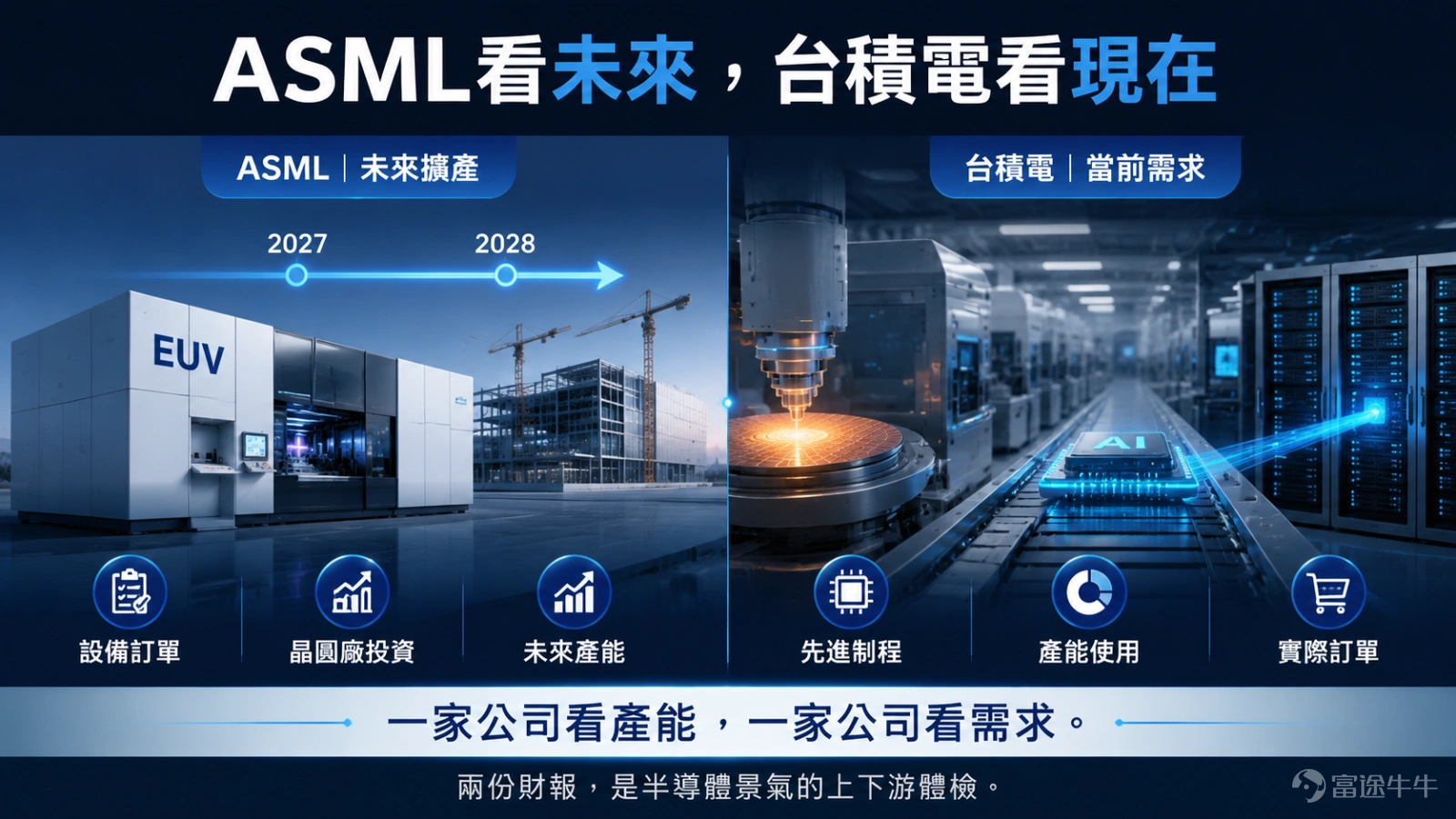
In simple terms: ASML primarily reflects whether future capacity will actually be built, while Taiwan Semiconductor reflects whether current demand for advanced chips has truly materialized.
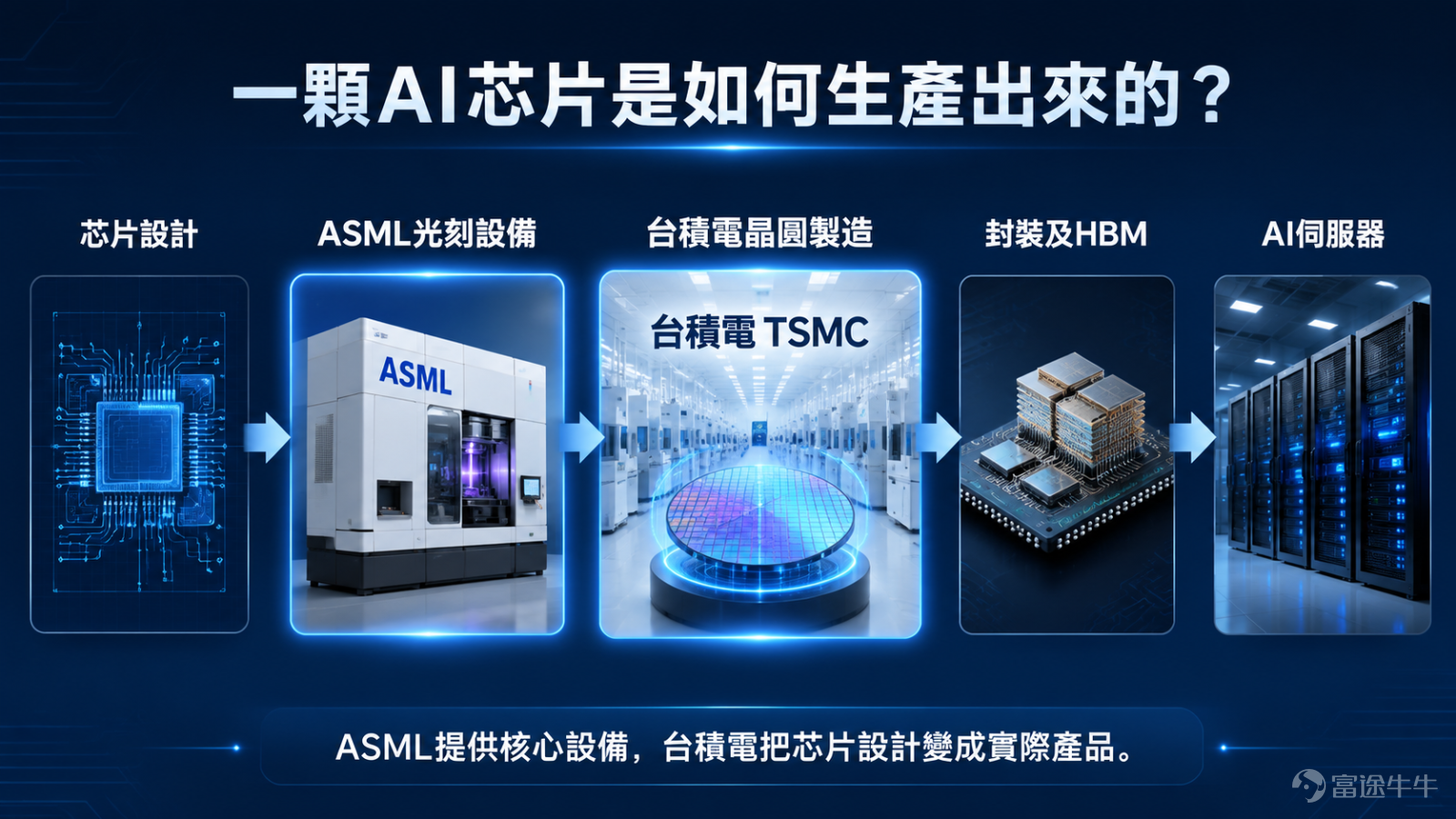
How is an AI chip manufactured?
When it comes to semiconductors, many fellow investors first think of chip design companies like NVIDIA and AMD.
However, turning an AI chip from a design blueprint into a product ready to be installed in servers involvesmultiple stages, including semiconductor equipment, wafer fabrication, memory, and packaging and testing.。
Chip manufacturing can be likened to constructing a skyscraper:
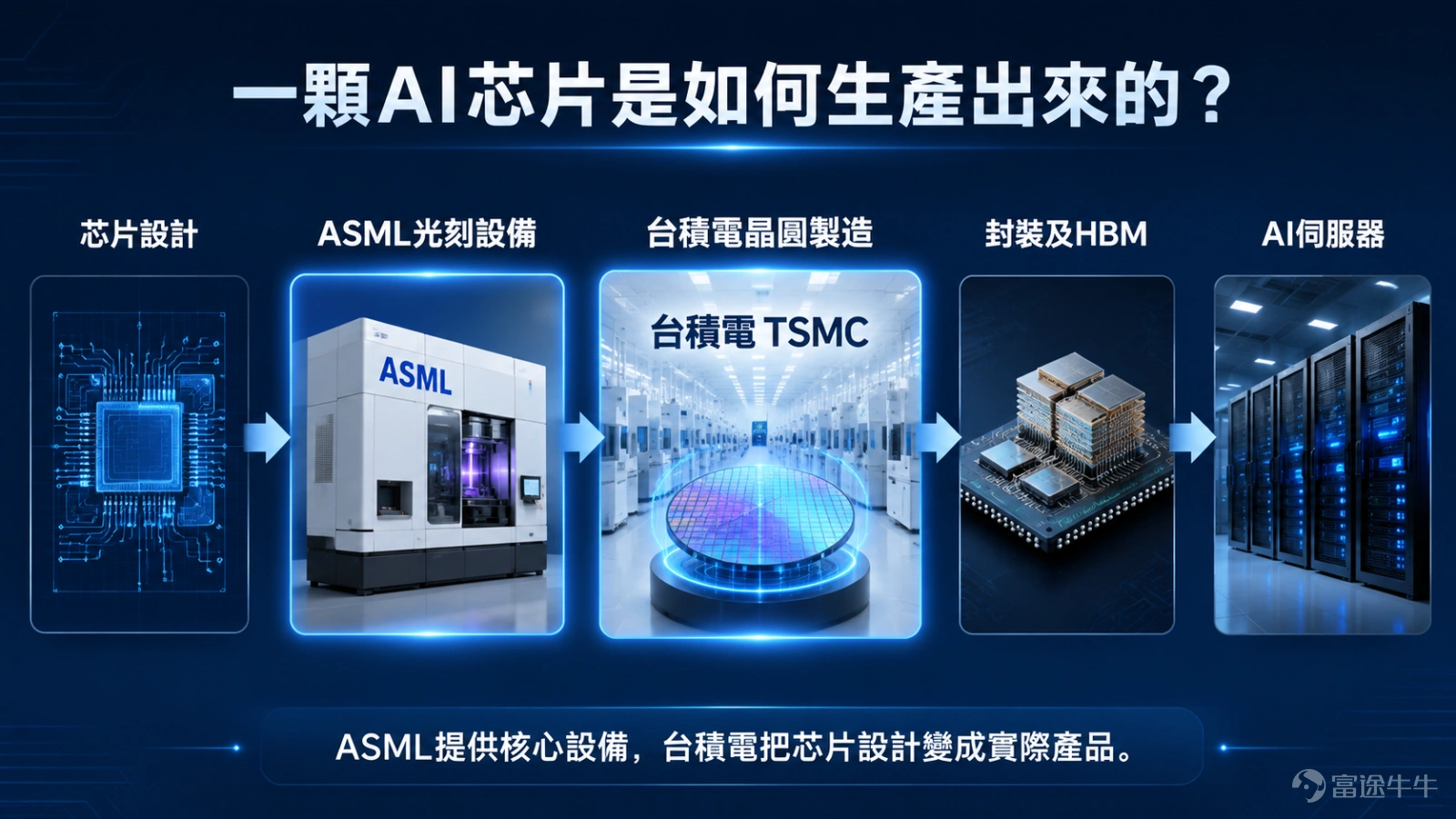
Chip design companies draw up the architectural blueprints; ASML provides the most precise and critical equipment used in construction; Taiwan Semiconductor is responsible for actually fabricating the chips in its wafer fabs based on those designs; and finally, after packaging and testing, the chips become usable products.
ASML’s lithography machines function somewhat like an extremely precise 'printer,' projecting intricate circuit patterns onto silicon wafers. The more advanced the chip process node, the higher the demands on lithography equipment, manufacturing processes, and yield rates.
Therefore, ASML’s orders and financial performance indicate whether wafer fabs are willing to expand capacity for the next few years, while Taiwan Semiconductor’s revenue from advanced nodes and capacity utilization reflect whether there is genuine customer demand for that capacity right now.
ASML: Wafer fabs are still expanding capacity for the future
ASML reported for the second quarterNet sales of €9.326 billion, up approximately 21% year-over-year; net profit of €2.918 billion, up approximately 27% year-over-year; and a gross margin of 54%。
The company also forecast full-year 2026 revenue of €43–45 billion, significantly raising its guidance this time.
More noteworthy than the single-quarter results is that ASML’s demand sources are becoming increasingly diversified.
In the quarter, ASML’s new equipment sales totaled approximately €6.6 billion, with logic chip-related revenue accounting for 51% and memory chip-related revenue accounting for 49%; EUV equipment sales amounted to approximately €3.8 billion.
Meanwhile, revenue from equipment maintenance, upgrades, and service reached approximately €2.8 billion. This means ASML earns not only from selling new machines but also from ongoing servicing, software updates, and performance enhancements for installed systems.
More importantly, ASML expects sales of equipment related to advanced logic wafer fabs in 2026 to grow by more than 25%,while sales of memory-related equipment could surge by over 75%.。
This signal deserves attention alongside the recent sharp pullback in memory stocks.
Recently, some memory stocks have declined significantly, reflecting market concerns that prior gains were excessive, positions became overly crowded, and whether memory prices can remain strong amid expected future supply increases.
However, judging from ASML's equipment demand, memory manufacturers are still expanding capacity for HBM and DRAM. This indicates that industry investment has not abruptly halted—rather, stock prices may have already priced in overly optimistic expectations.
Taiwan Semiconductor: Demand for advanced nodes is now translating into real revenue
If ASML reflects wafer fabs’ confidence in the future, Taiwan Semiconductor reveals whether current demand truly exists.
Taiwan Semiconductor’s second-quarter revenue in USDreached USD 40.2 billion, up 33.7% year-over-year; in New Taiwan Dollars, revenue amounted to approximately NT$1.27 trillion, an increase of 36% year-over-year。
The company reported a gross margin of 67.7% and an operating margin of 60.3%, both exceeding prior guidance.
Advanced process nodes were the core highlight of this earnings report.
In the second quarter,Taiwan Semiconductor’s 2-nanometer process contributed 3% of wafer revenue for the first time, while 3nm, 5nm, and 7nm accounted for 30%, 33%, and 11% of revenue, respectively. Combined, advanced nodes at 7nm and below now represent 77% of wafer revenue.
This indicates that Taiwan Semiconductor’s revenue is increasingly concentrated in advanced chips that demand higher technical expertise, are more difficult to manufacture, and carry relatively higher unit prices.
From an application market perspective, high-performance computing accounted for 66% of Taiwan Semiconductor’s revenue, up 20% quarter-over-quarter; smartphone-related business accounted for 22%, down 4% quarter-over-quarter.
However, high-performance computing does not entirely equate to AI—it may also include server CPUs, networking chips, and other high-performance computing products. Therefore, a more accurate understanding is:AI is a key driver behind Taiwan Semiconductor’s high-performance computing demand, but the associated revenue should not be directly treated in full as AI-related revenue.
Taiwan Semiconductor’s net profit in the second quarter grew 77.4% year-over-year, significantly outpacing revenue growth on the surface.
Part of this stems from strong growth in core operations and improved profitability, but it also includes one-time non-operating gains from the sale and revaluation of its stake in Vanguard International Semiconductor.
Therefore, when assessing a company’s true operational quality, one should not rely solely on net profit growth, but also pay attention to revenue, operating profit, gross margin, and future earnings guidance.
What clues do these two earnings reports offer for the semiconductor sector’s Q2 earnings season?
ASML and Taiwan Semiconductor are among the first companies to report results this quarter in the semiconductor earnings season, and their financial reportsIt also provides an initial framework for observing upcoming chip, memory, equipment, and AI hardware companies.。
First, AI demand continues to translate into actual production and capacity investment.
Taiwan Semiconductor’s advanced process and high-performance computing revenue continue to grow, and ASML also sees demand for logic chips, memory, and equipment upgrades. This reflects that AI investment is still propagating along the supply chain and is not merely confined to market narratives or company stories.
Second, memory sector earnings will be a key point of divergence this quarter.
ASML expects a significant increase in memory-related equipment sales, indicating that memory manufacturers are still expanding capacity. However, recent pullbacks in memory stocks also show that the market is starting to worry about supply growth, pricing cycles, and elevated valuations.
When reviewing memory companies’ earnings going forward, investors should look beyond revenue growth and also pay attention to DRAM and NAND prices, HBM orders, gross margins, capital expenditures, and management’s outlook on future supply and demand.
Third, chip design companies’ earnings require simultaneous assessment of both demand and market expectations.
When NVIDIA, AMD, Intel, and other semiconductor companies report earnings, the market will focus not only on whether revenue and profits have grown but also closely monitor AI chip demand, product shipments, gross margins, data center business performance, and guidance for the next quarter.
Given high market expectations, even if a company delivers solid results, its stock price could still fall if the pace of growth or forward guidance fails to exceed expectations further.
Fourth, semiconductor equipment companies’ orders and guidance remain critical.
ASML reflects confidence in upstream capacity expansion. Investors should also monitor orders, backlog, memory customer demand, and wafer fab capital expenditures of other semiconductor equipment and materials companies.
How should we view the current semiconductor market correction?
The past month’s semiconductor market performance reminds us thateven if long-term industry demand remains intact, stock prices will not rise indefinitely in a single direction.。
When market expectations become too elevated, positions are overly concentrated, or investor risk appetite declines, even fundamentally strong companies may experience significant corrections—especially memory, AI hardware, and high-valuation stocks, which typically exhibit greater short-term volatility.
Fellow investors who already hold relevant positions should first re-evaluate their original rationale for buying, position sizing, and risk tolerance. It’s unwise to blindly add positions solely due to short-term declines, nor necessary to make impulsive decisions driven by market panic.
Fellow investors still watching for semiconductor opportunities need not rush to deploy all their capital at once.
Market volatility has intensified,bringing both opportunities from earnings growth and industrial upgrading, as well as risks from valuation pullbacks, expectation gaps, and capital outflows.At this stage, it’s advisable to observe more closely, add more candidates to your watchlist, and thoroughly research company earnings and guidance before gradually deploying capital in tranches according to your personal risk tolerance.
When investing in semiconductors, what matters most is not predicting every short-term price move, but rathergradually building an understanding of the industry chain, company fundamentals, and market expectations.。
ASML tells us whether the industry is still building future capacity; Taiwan Semiconductor tells us whether this advanced capacity is already being utilized by real customers.
In Q2 2026, both companies continued to send relatively positive signals about the sector, but future stock performance will still depend on whether subsequent earnings reports can consistently validate demand and whether current valuations have already priced in overly optimistic expectations.
If you don’t want to bet solely on a single stock, how else can you gain exposure to semiconductors?
For fellow investors who are just starting out, semiconductor ETFs offer instant diversification across multiple chip design, wafer fabrication, and semiconductor equipment companies, reducing idiosyncratic risks such as missed earnings, product delays, or sharp stock price declines from any single company.
Some of the more representativesemiconductor ETFs include SOXX and SMH.。
SOXX covers U.S.-listed companies across the semiconductor supply chain, holding both chip and equipment firms, making it generally well-suited as a core tool for tracking the broader semiconductor sector.
SMH primarily invests in large-cap, highly liquid U.S.-listed semiconductor and equipment companies, with a portfolio relatively concentrated among industry leaders. It may also include overseas semiconductor firms listed in the U.S., thus it is more heavily influenced by the performance of major AI chip and advanced manufacturing leaders.
It’s important to note that ETFs can only diversify the risk associated with individual companies, not eliminate cyclical and valuation risks across the entire semiconductor industry. When chip demand weakens, memory prices decline, or the market lowers its growth expectations for AI, related ETFs may also experience significant corrections.
When selecting an ETF, you can compare its portfolio concentration, weight of leading stocks, coverage across industry segments, management fees, and trading liquidity. Given that market volatility remains high at this stage, fellow investors may consider adding relevant ETFs to their watchlists first, observing whether Q2 earnings season continues to validate demand, and then gradually invest in tranches according to their own risk tolerance—avoiding chasing a sharp single-day rally all at once.
Have more questions? Just ask Futubull AI directly:

Risk Disclaimer: The above content only represents the author's view. It does not represent any position or investment advice of Futu. Futu makes no representation or warranty.Read more


Comments
to post a comment
8
9