
Learn Investing from the Masters | From 'Didn't Understand It' to 'Massive Investment'! Why Did Buffett Ultimately Choose Google?
Buffett’s stance on Google has undergone a full transformation—from 'I don’t understand it, so I won’t touch it' → 'publicly admitting his mistake and regret' → 'finally making a massive investment.' This stands as one of the most iconic examples in value investing history of being 'late but not absent.'
On July 15, 2026, 95-year-old Buffett sat before CNBC’s cameras and uttered a sentence that left all of Wall Street breathless:"I initiated this investment."
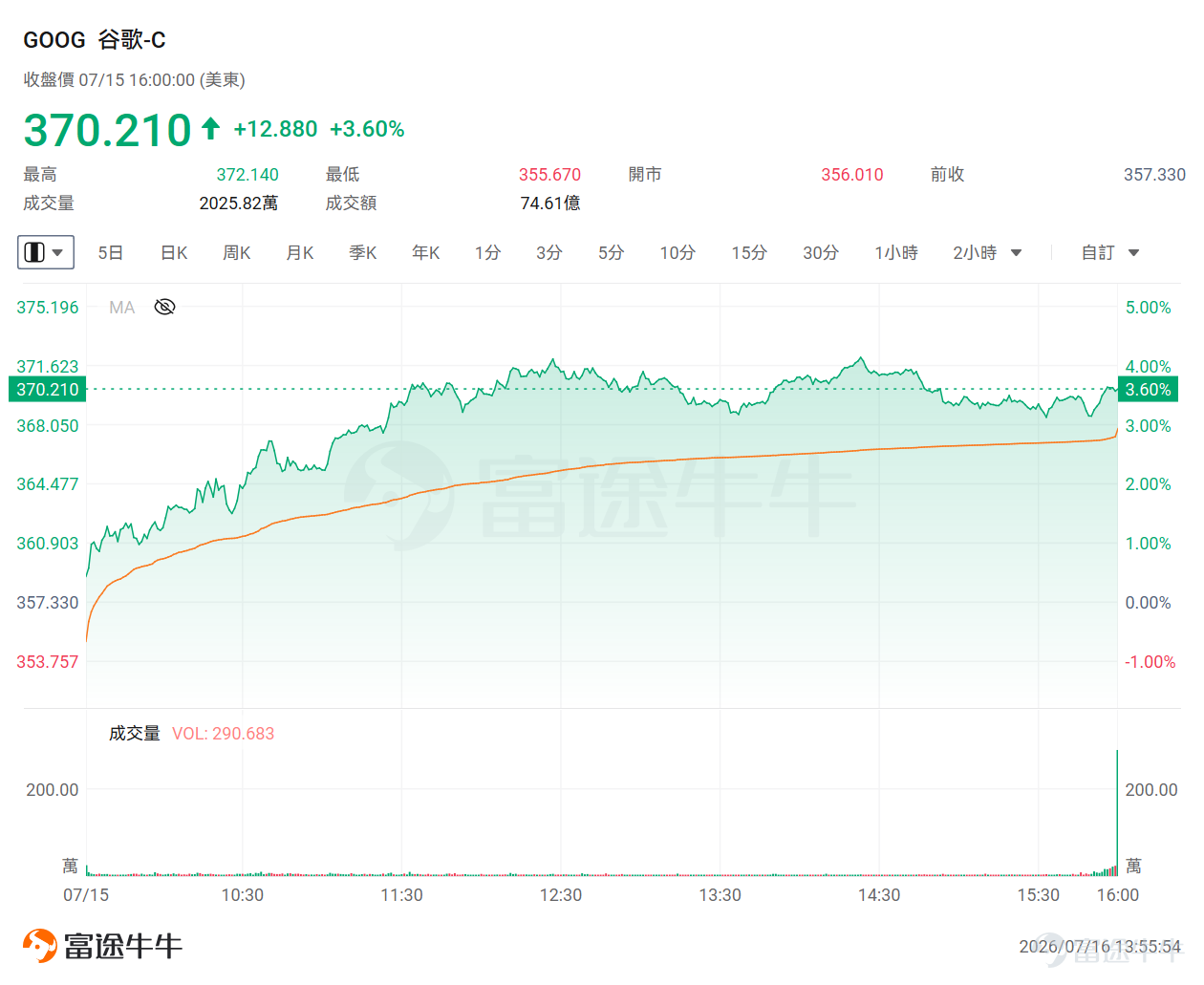
These words put an end to months of market speculation— $Berkshire Hathaway-A (BRK.A.US)$ the bet on $Alphabet-C (GOOG.US)$ Google was not a tech gamble by new CEO Greg Abel, but an active decision made personally by Buffett himself. On the same day, Google’s stock surged 3.6% to $370.21.

But what truly deserves reflection isn’t the day’s price gain, but the 22-year mental journey behind this decision—from rejecting Google founders’ pitch in Omaha back in 2004 to personally signing a $10 billion private equity check in 2026.Buffett spent two decades answering one question: When is a money-printing machine worth buying?
1. Buffett’s Latest Interview: He’s Not Chasing AI—He’s Hunting for the 'Next-Generation Cash Flow Machine'
In this interview, Buffett began not with Google, but with a stern warning about the entire market.
"When everyone is obsessed with gambling and speculation, it becomes extremely difficult to find value investments with a margin of safety."
He compared the U.S. stock market in 2026 to 'a church with a casino attached'—the church representing long-term value investing, and the casino symbolizing pure speculation detached from fundamentals. He specifically criticized the explosive growth of zero-day-to-expiration (0DTE) options, calling it outright 'gambling.'
But after his sharp criticism of the market, Buffett shifted tone and turned to Google—“Looking at Google’s past performance, I believe its likelihood of ultimately becoming a winner is higher than 90%, even 95%, of the investment opportunities Wall Street promotes.”
However, his view on Google is far more nuanced than simple optimism. He made three key statements:
First: “There are at least four or five companies in our portfolio that I like more than Google.”
This is an exceptionally rare 'cooling-off' remark. An investor who has just poured $31 billion into a position publicly states that this investment is 'not his favorite'—this is either extreme candor, a deliberate attempt to temper market expectations, or, in Buffett’s case, both.
Second sentence: 'Google and all its competitors now face a real issue: they’re all pouring in hundreds of billions of dollars—and this is real, hard cash.'
Third sentence: 'In the past, when they were doing computer software, they weren’t playing this kind of game.'
Taken together, these three sentences form the most honest footnote to this investment.Buffett isn’t just 'embracing AI'; he’s buying a business with an exceptionally wide moat and abundant cash flow—at a reasonable price.However, this company is undergoing a fundamental transformation—from a capital-light software firm into an AI infrastructure player requiring continuous, massive investments.
Buffett specifically clarified decision-making authority: 'I won’t do anything that Ajit doesn’t approve of, and he won’t make any decisions I disagree with. We communicate frequently, but ultimately, the final call rests with him.'
This 'dual-core consensus' mechanism sends two signals: first, although Buffett is already 95 years old, his investment judgment still deeply influences Berkshire; second, Ajit isn’t merely an executor—he participates throughout the process as the 'final decision-maker.'
II. Buffett and Google’s 22-Year Journey—from 'Watching the Money Printer Run' to 'Finally Hitting the Buy Button'
Looking back over the past 22 years, Berkshire’s relationship with Google stands as one of investing’s most classic tales of 'missed opportunity and redemption.'

Missed IPO in 2004:Google's founders personally traveled to Omaha to pitch their company, but Buffett politely declined, citing his principle of 'not investing in tech stocks he doesn't understand,' thereby missing the chance to get in early on what would become a 'money-printing machine.'
Public acknowledgment of mistake (2017–2019):Buffett and Munger repeatedly reflected deeply at annual shareholder meetings, candidly admitting they had 'overlooked' Google's formidable advertising moat—a major strategic error.
Turning point reached in Q3 2025:Taking advantage of Google’s dual pressures from 'AI-related fears and antitrust lawsuits,' which pushed its forward P/E ratio below 20x, Berkshire precisely identified the valuation bottom and initiated a position, immediately making Google its tenth-largest holding.
Aggressive position increase in Q1 2026:After new CEO Abel took over, Berkshire boosted its Google stake by 200%–300% and initiated a new position in Class C shares, propelling Google into its top seven holdings.
Historic private placement in June 2026:Berkshire committed $10 billion to participate in Google’s private placement. Following this transaction, Berkshire’s total Google position will rise to approximately $32 billion—roughly 10% of its equity portfolio—and Google will rank among Berkshire’s top five publicly held positions.
Investment stance formalized in July 2026:Buffett personally confirmed to CNBC that he initiated this investment himself. He highlighted Google's long-term high returns on capital, stating its odds of success far exceed those of 90% of Wall Street stocks; however, he also issued a rare risk warning—AI infrastructure is entering a 'cash-burning' battle at the hundred-billion-dollar scale, which starkly contrasts with the traditional software industry’s asset-light model.
III. Why Google? — A Four-Layer Breakdown of Buffett’s Investment Logic
Layer One: The Moat Has Finally Been Validated as 'Sustainable'
Buffett’s core investment criterion has always been 'achieving high returns on capital over the long term.'Google Search holds over 92% global market share and has remained unchallenged for 20 years; YouTube, Gmail, and Android likewise possess dominant positions.More importantly, AI has not disrupted search—it is actually enhancing it.
In Q1 2026, Google’s search and related ad revenue rose 19% year-over-year to $60.4 billion—directly refuting the pessimistic expectation that 'AI would erode traditional search.'

Layer Two: An Exceptionally Attractive 'Valuation Window'
When Berkshire first established its position in Q3 2025, Google’s forward P/E ratio had been compressed to below 20x. For a giant with over 20% revenue growth and a global monopoly in digital advertising, such a valuation was highly compelling.
Even after the subsequent price appreciation, given its robust Q1 2026 results (revenue up 22% year-over-year, with Google Cloud sales surging 63%), its current forward P/E stands at approximately 25x—below the industry average. This suggests its valuation remains in a reasonable range where strong growth can comfortably justify any premium.

Layer Three: Buy the 'Railroads' of the AI Era—Invest in Infrastructure, Not Hype
This is key to understanding Buffett’s logic: he isn’t buying into AI hype but rather the infrastructure of the AI era. The rationale mirrors his historic purchase of BNSF Railway—if railroads collect tolls regardless of what cargo runs on them, then similarly, foundational digital infrastructure earns steady returns no matter which AI applications dominate. The explosive growth of Google Cloud validates this thesis:
– Cloud revenue surged 63% year-over-year in Q1 2026, surpassing $20 billion in a single quarter for the first time.
– Cloud backlog (unfulfilled contracted revenue) nearly doubled sequentially, exceeding $460 billion, with margins expanding to 27%. Berkshire’s $10 billion participation in the equity offering essentially provides capital for the 'power grid of the digital age' to alleviate its acute shortage of computing capacity.

Layer Four: Massive Cash Flow Provides a Safety Cushion in the 'Burn-Rate Race'
Buffett explicitly noted that AI-related capital expenditures are unprecedented in scale. Google is transitioning from a light-asset software company to a heavy-asset infrastructure giant (with 2026 capex guidance of $180–190 billion). Yet Buffett’s confidence in making a major investment stems from Google’s formidable cash-generating ability:
Exceptionally strong operating cash flow: Q1 2026 operating cash flow reached $45.79 billion (+27% YoY), totaling approximately $174 billion over the past year—nearly enough to fully cover annual capital expenditures.
Ample liquidity: Despite Q1 capital expenditures hitting a record high of $35.67 billion, free cash flow remained positive at $10.12 billion, and cash and cash equivalents on the balance sheet stood at $38.06 billion.

In short, Google's financing is aimed at 'accelerating its infrastructure timeline,' not rescuing its balance sheet—a fundamental distinction from startups that rely on fundraising to stay afloat.
IV. Risks and Trade-offs: Three Key Concerns That Cannot Be Ignored
There is no perfect investment target. While committing tens of billions of dollars to vote in favor of Google’s 'moat,' Buffett has also been exceptionally candid with the market about the hidden costs underlying this AI infrastructure boom—costs that simply cannot be avoided.
1. From 'Asset-Light Cash Machine' to 'Capital-Intensive Infrastructure'
This is the most thought-provoking part of Buffett’s three statements. Google’s core appeal over the past 20 years lay in its zero-marginal-cost advertising model—each additional search click generated ad revenue with virtually no extra cost. That was precisely the essence of what made Buffett describe it in 2004 as 'watching a money printer run.'
But the AI era has changed this equation. Every AI inference call and every cloud computing task now requires real GPU compute power, electricity, and cooling systems. Google is transforming from a 'digital advertising company' into an 'AI infrastructure company'—one whose capital intensity far exceeds that of its former self.
The shift in free cash flow (FCF) best illustrates this point: full-year 2025 FCF stood at $73.3 billion, but by Q1 2026, quarterly FCF had already plummeted to $10.1 billion (down 46.6% year-over-year). If capital expenditures continue to rise, FCF could face further pressure.
2. Fierce Competition: No Clear Winner in the Hundred-Billion-Dollar 'Arms Race'
Google now faces unprecedented competition in the race for computing power. Pressured by Amazon AWS, Microsoft Azure, Meta, and emerging players like OpenAI and Anthropic, the combined capital expenditures of the four tech giants are projected to exceed $700 billion in 2026. In a capital-intensive battle of this magnitude, even a company with an extremely strong cash-flow moat cannot claim certainty of victory.
3. Hidden Costs: Dilution Effects from the $100 Billion Equity Financing
Google's equity financing of up to approximately $80 billion essentially trades existing shareholders' equity for a ticket to computational power in the AI era. Although Berkshire Hathaway, leveraging its financial scale, secured a 6.5% discounted private placement, ordinary public-market investors must now confront the implicit cost of equity dilution as an immediate investment risk.
5. Summary
Buffett’s 22-year relationship with Google ultimately does not deliver a narrative of 'tech stock comeback,'but rather serves as a model of how investment discipline and cognitive evolution can coexist.
He did not change his principles—still investing only in businesses with deep moats, strong cash flows, and reasonable valuations.But he evolved his understanding—acknowledging that AI infrastructure can become a perpetual asset like railroads, recognizing that Google’s search dominance is not a 'volatile business' but a 'fixed structure,' and admitting that waiting 20 years itself constituted a kind of 'mistake.'
Ultimately, this roughly $30 billion investment is essentially Buffett’s judgment at age 95:Among all tech giants engaged in the AI arms race, Google is the most likely to transform 'burning cash' into 'perpetual money printing'—because it simultaneously possesses search advertising as a cash cow (moat), cloud computing as a growth engine (second curve), and the world’s largest data flywheel (AI training barrier).
But Buffett's candor also reminds us: this is not an investment with 'extremely high certainty'—otherwise, it would rank ahead of Apple, not 'several spots behind.'Whether capital returns in the AI era can justify the hundreds of billions of dollars in actual cash investments is the key variable determining the ultimate success or failure of this bet.
As Buffett has said:"The secret to investing is finding businesses that can consistently generate high returns on capital over a very long period of time."Google has demonstrated this over the past 20 years. Whether AI infrastructure can sustain this logic over the next 20 years is Berkshire's wager—and the ultimate question for the entire tech industry.
Risk Disclaimer: The above content only represents the author's view. It does not represent any position or investment advice of Futu. Futu makes no representation or warranty.Read more


Comments (12)
to post a comment
72
220