
Oversold rebound: inflows from US equity markets drove a modest weekly gain of 1.09% in Bitcoin | Bitcoin | Research Report | Cryptocurrency Market Analysis | Late Stage of Bear Market
During the reporting period (July 5–11), global financial markets continued to face dual pressures from the escalation of Middle Eastern geopolitical tensions and persistently sticky inflation. Overall macro-financial conditions remained tight, creating significant headwinds for high-risk asset valuations. Nevertheless, the cryptocurrency market demonstrated notable microstructural resilience amid volatility. Despite volume contraction caused by macro headwinds, Bitcoin posted a modest weekly gain of 1.09%.
This performance was primarily driven by the easing of pessimistic sentiment following the sharp sell-off since late June, reduced liquidation pressure, capital inflows through Bitcoin ETF channels, and bullish positioning in the futures market. However, restrictive financial conditions—such as persistently high 10-year U.S. Treasury yields—remain in place, and the cyclical deleveraging process is still incomplete. We therefore maintain our view that the market remains in the 'late stage of a cyclical bear market.'

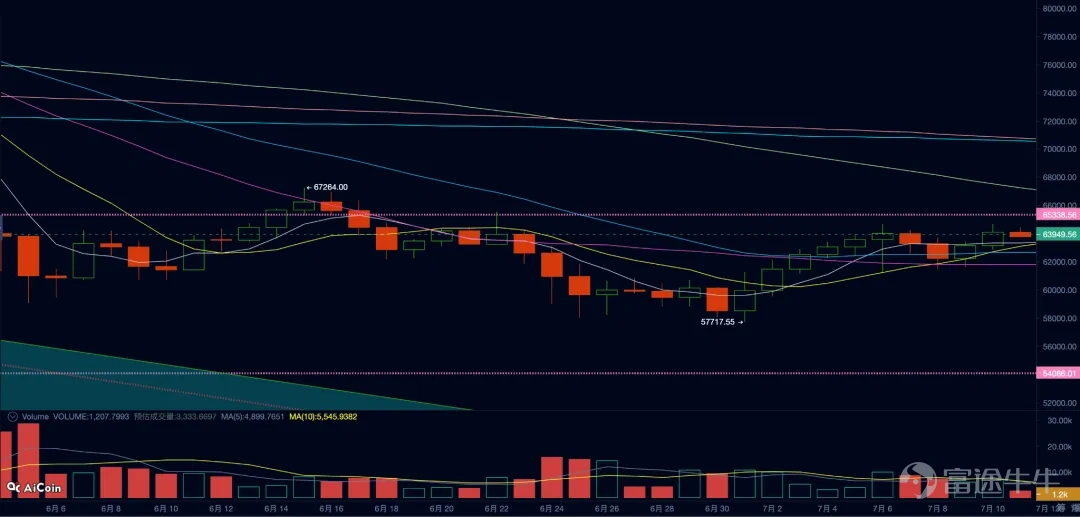
Bitcoin Daily Price Chart
Macro Financial Conditions
In terms of liquidity and monetary policy, several key indicators this week showed slightly looser funding conditions. However, due to strong macro headwinds, the transmission mechanism from liquidity to risk assets has been materially impaired.
The Federal Reserve’s net liquidity rose by 0.22% week-over-week, while the Secured Overnight Financing Rate (SOFR) declined to 3.53%, down 11 basis points from the prior week, indicating ample liquidity supply in the short-term interbank market. Nevertheless, newly released inflation data for the real economy rebounded broadly, forcefully offsetting the positive impact of liquidity at the expectations level: U.S. headline CPI came in at 4.20% year-over-year (previous: 3.80%), core CPI at 2.90% (previous: 2.80%), and the Producer Price Index (PPI) surged to 6.50% (previous: 5.70%). Additionally, Personal Consumption Expenditures (PCE) rose 0.45% month-over-month (previous: 0.41%), with core PCE up 0.32% (previous: 0.25%). The broad-based resurgence in key inflation metrics confirms persistent inflation stickiness, which not only constrains the scope for marginal monetary easing but also limits the flow of abundant liquidity into high-risk assets.
On the interest rate and valuation front, nominal U.S. Treasury yields and the U.S. Dollar Index (DXY) moved higher amid rising inflation expectations and geopolitical risk aversion. The 2-year U.S. Treasury yield closed the week at 3.69%, up 2 basis points week-over-week; the more macro-sensitive 10-year yield closed at 4.57%, jumping 8 basis points from the prior week. The 10-year Treasury Inflation-Protected Securities (TIPS) yield hit a new high for the year at 2.308%, reflecting the bond market’s repricing of inflationary headwinds from higher energy prices. Meanwhile, the DXY closed at 100.97, up 0.11% week-over-week, underscoring the dollar’s strength and its implicit downward pressure on global asset valuations. Elevated rates and a stronger dollar directly weigh on the valuation of non-yielding assets like cryptocurrencies.
On the geopolitical front, tensions in the Middle East escalated sharply on July 8, with multiple commercial vessels attacked in the Strait of Hormuz. The U.S. promptly revoked its general license permitting Iranian oil sales and declared the ceasefire framework invalid. This high-impact event sent Brent crude prices surging nearly 6% midweek, breaching $76 per barrel, reinforcing market concerns over inflation. The surge in risk-off sentiment dominated short-term asset pricing, leading to structural divergence in equity markets: the industrials-heavy Dow Jones Industrial Average closed at 52,637.01 points, down 0.50% week-over-week, while the tech-heavy Nasdaq Composite and S&P 500 showed greater resilience, closing at 26,281.61 points (+1.74%) and 7,575.39 points (+1.23%), respectively.
Taking liquidity, interest rates, and geopolitical shocks together, despite a marginal increase in Fed net liquidity, persistent inflation stickiness and heightened risk aversion triggered by geopolitical turmoil have kept overall financial conditions 'tight' this week, creating clear headwinds for Bitcoin.
Cryptocurrency market
In contrast to tightening macro-financial conditions, internal crypto market dynamics showed reduced selling pressure driven by spot demand, slightly stronger buying interest, and modest price gains stemming from exchange inventory drawdowns. However, trading volumes contracted significantly, reflecting extreme caution across the market and poor price sustainability.
Bitcoin opened the week at $63,086 and closed at $63,773, posting a weekly gain of 1.09%. Prices fluctuated between $61,250 and $64,669 during the week, for a range of +5.42%. Although prices rebounded modestly and successfully reclaimed the 30-day moving average ($62,688), they remained significantly below both the 90-day moving average ($70,805) and the 200-day moving average ($73,953). Suppressed by macro-driven risk aversion, overall market liquidity contracted, with the 7-day average trading volume falling to 66,118 BTC—a sharp 25.31% decline from the prior week—highlighting extremely cautious buying behavior absent supportive macro catalysts.
At the level of capital flows and supply-demand dynamics, compliant channels and on-exchange stablecoin supply have shown clear divergence. Bitcoin ETFs recorded a modest net inflow of approximately $200 million for the week; in contrast, on-exchange stablecoin liquidity remained weak, with total supply declining slightly by $103 million over the week. This indicates that incremental capital is currently being driven primarily by compliant spot allocations. Meanwhile, exchange-held Bitcoin balances decreased by 7,028.62 BTC, with a net outflow of 2,442.69 BTC, reflecting continued migration of spot holdings from trading platforms to wallets, partially digesting the surge in sell-side inventory seen in June.
In terms of trading and derivatives structure, open interest remained stable. Long traders actively increased leverage to go long, but funding rates stayed low, indicating the market has not overheated. Derivatives open interest (OI) declined to $57.87 billion, down 1.52% week-over-week, while the 7-day average derivatives trading volume also fell by 10.45% compared to the prior week, reaching $36.27 billion. Total liquidations for the week amounted to $249 million, comprising $129 million in long liquidations and $190 million in short liquidations.
At the holder structure and behavior level, coins are accelerating their shift toward long-term holders. The overall MVRV ratio edged up slightly to 1.20, still within the historically low range of 1.10 to 2.29. Long-term holder MVRV stood at 1.30 (up 0.01 week-over-week), while short-term holder MVRV was 0.91 (also up 0.01 week-over-week), indicating short-term holders continue to face widespread unrealized losses. In terms of supply changes, long-term holder supply increased significantly by 31,325 BTC this week, while short-term holder supply decreased by 21,777 BTC. Over the single cycle, long-term holders continued their bear-market capitulation selling, with long-term SOPR dropping to an intraday low of 0.70.
Based on the micro-level indicators observed this week—including price stabilization, inflows into compliant spot ETFs, net outflows of spot Bitcoin from exchanges, continued accumulation by long-term holders, and deleveraging in derivatives—the internal structure of the crypto market is assessed as being driven by spot buying following an emotional bottoming-out rebound. Sustainability hinges on whether capital continues flowing in from U.S. equity markets.
Market Implication
Integrating the macro tightening environment with crypto market microstructure, we can reconstruct the complete causal transmission chain for this week: Middle East geopolitical crisis (macro event) → sharp rise in crude oil prices and surge in U.S. Treasury yields (transmission variables) → contraction in on-exchange trading volume and leveraged position unwinding in derivatives (pressure on crypto market structure) → Bitcoin price posted a modest weekly gain, supported by ETF inflows and spot accumulation (price outcome).
1. Global financial markets faced significant macro tightening this week due to Middle East geopolitical tensions and sticky inflation rebounding (CPI reached 4.20%). Against this backdrop, Bitcoin price nonetheless rose modestly by 1.09% to $63,773, on-exchange leverage was cleared (OI down 1.52%), and spot holdings further shifted toward long-term holders.
2. Macro tightening suppressed overall risk appetite, causing crypto trading volume to plunge by 25.31%. However, due to the oversold conditions in June, the crypto market generated an internal rebound: compliant spot channels (ETFs saw $200 million in weekly inflows) continued providing incremental spot buying demand, long-term holders kept accumulating, and exchange spot balances recorded net outflows. This strong on-exchange spot accumulation effectively offset valuation pressures from the macro environment.
3. Macro transmission showed 'partial failure.' Typically, macro tightening variables such as a stronger U.S. dollar index (100.97) and rising 10-year Treasury yields (+8 bps) would directly trigger a sharp contraction in crypto asset valuations. This week, the transmission mechanism held true at the capital channel level—evidenced by a slight $103 million decline in on-exchange stablecoin supply and a 25.31% drop in 7-day average trading volume—confirming that macro tightening indeed blocked new on-exchange capital inflows. However, at the price level, this transmission failed: Bitcoin did not weaken significantly alongside macro tightening but instead gained 1.09%. This 'partial failure' confirms that after a sharp correction, crypto asset prices can exhibit strong resilience against external shocks due to their inherent capital-attracting power.
4. This week, the relationship between macro conditions and crypto exhibited 'divergence and hedging.' Although external macro financial conditions remained tight and headwinds persisted, the market had already priced in oversold conditions, and the $60,000 price level proved attractive enough to draw substantial spot inflows, which offset deleveraging pressures and pushed prices slightly higher. However, if external macro tightening intensifies further and risk-free rates continue rising, any price gains unsupported by sustained ETF inflows and lacking incremental stablecoin liquidity will struggle to persist.
Market outlook
Next week, market focus will center on the convergence of key inflation data and Federal Reserve policy signals. Specific events requiring close monitoring include the following:
1. U.S. June CPI inflation data (Tuesday, July 14, 8:30 a.m. ET): Markets expect the year-over-year CPI growth rate to ease below 4.0% in June (down from May’s three-year high of 4.2%), primarily due to marginal relief in energy prices such as crude oil. However, core CPI is projected to remain stubbornly at 2.9%, matching the highest level since last September. Given that half of Fed officials previously signaled at least one rate hike in 2026 in the latest FOMC meeting minutes, any upside surprise in next week’s CPI or core CPI data would significantly reinforce the Federal Reserve’s hawkish stance, pushing up U.S. Treasury yields and the dollar index, thereby exerting direct valuation pressure on Bitcoin. Conversely, if the data comes in weaker than expected, it would alleviate market anxiety over inflation and boost risk assets like BTC.
2. Federal Reserve Chair Kevin Warsh’s Congressional testimony (July 14 & 15, ET): Newly appointed Fed Chair Warsh will deliver his first semi-annual monetary policy testimony before the House Financial Services Committee and the Senate Banking Committee. Markets will closely monitor his remarks regarding the likelihood of a September rate hike, signs of cooling in the labor market, and potential Fed reforms. Hawkish comments emphasizing inflation risks would support the dollar and weigh on Bitcoin valuations, while more balanced or growth-oriented remarks could stimulate risk appetite and provide upward momentum for crypto assets.
The above analysis is provided by EMC Labs.
———————————————————————
About EMC Labs
EMC Labs is a strategic partner of Victory Securities. Together, they have launched the Victory EMC BTC Cycle Fund—the only virtual asset fund approved by the Securities and Futures Commission to accept stablecoin subscriptions. EMC Labs was co-founded by seasoned digital asset investors and data scientists, with a core team drawn from JD Finance, Bell Labs, and Marsbit. EMC Labs has invested significant resources in building a proprietary engine to analyze Bitcoin on-chain data and technical indicators.
Disclaimer
Investment involves risks, and investors should take note. The value of securities and investments can go up as well as down and is not guaranteed. Investors may not get back the original investment amount, and past performance is not necessarily indicative of future results. Victory Securities’ securities trading services are provided by Victory Securities Limited (hereinafter referred to as “Victory Securities”). This document was prepared and authorized for release on this platform by Victory Securities Limited, and the information contained herein is for reference purposes only. Victory Securities Limited reserves the right to make changes or terminate at any time without prior notice. All information provided on this platform, including this document and its contents, may not be reproduced, linked, reposted, or otherwise copied for publication or commercial use by any media, website, or individual without prior written authorization from Victory Securities. Authorized users must acknowledge that the source material originates from Victory Securities when using this document and its content, and commit to complying with relevant laws and all international conventions regarding internet usage, refraining from illegal purposes or unlawful use of this document. Violators will bear all associated legal and financial responsibilities. Data or figures quoted in this document may come from third parties; Victory Securities does not guarantee the accuracy of such third-party data or materials, nor will it assume liability for the fairness, accuracy, timeliness, completeness, or correctness of any data, forecasts, and/or opinions contained herein, nor the benchmarks upon which such forecasts and/or opinions are based. Any forward-looking statements in this document do not constitute guarantees of future performance, and actual circumstances or developments may differ significantly. This document is not and should not be considered or construed as an offer, invitation, solicitation, recommendation, advice to buy or sell any investment products, or as a basis for investment decisions, nor should it be interpreted as professional advice. Readers or those making investment decisions should fully understand the risks involved and the legal, tax, and accounting characteristics and consequences, and decide whether investing aligns with personal objectives and risk tolerance. Seek appropriate professional advice if necessary. In certain countries, the distribution and circulation of this document may be restricted by law or regulation, and recipients should be aware of and comply with such restrictions.
Risk Disclaimer: The above content only represents the author's view. It does not represent any position or investment advice of Futu. Futu makes no representation or warranty.Read more
Comments
to post a comment