
Joinn Laboratories surges toward a trading limit up on strong profit guidance: Monkeys know best whether innovative drugs are any good
(This article was written by Songguo Finance and published by TMT Post with authorization)
By Songguo Finance
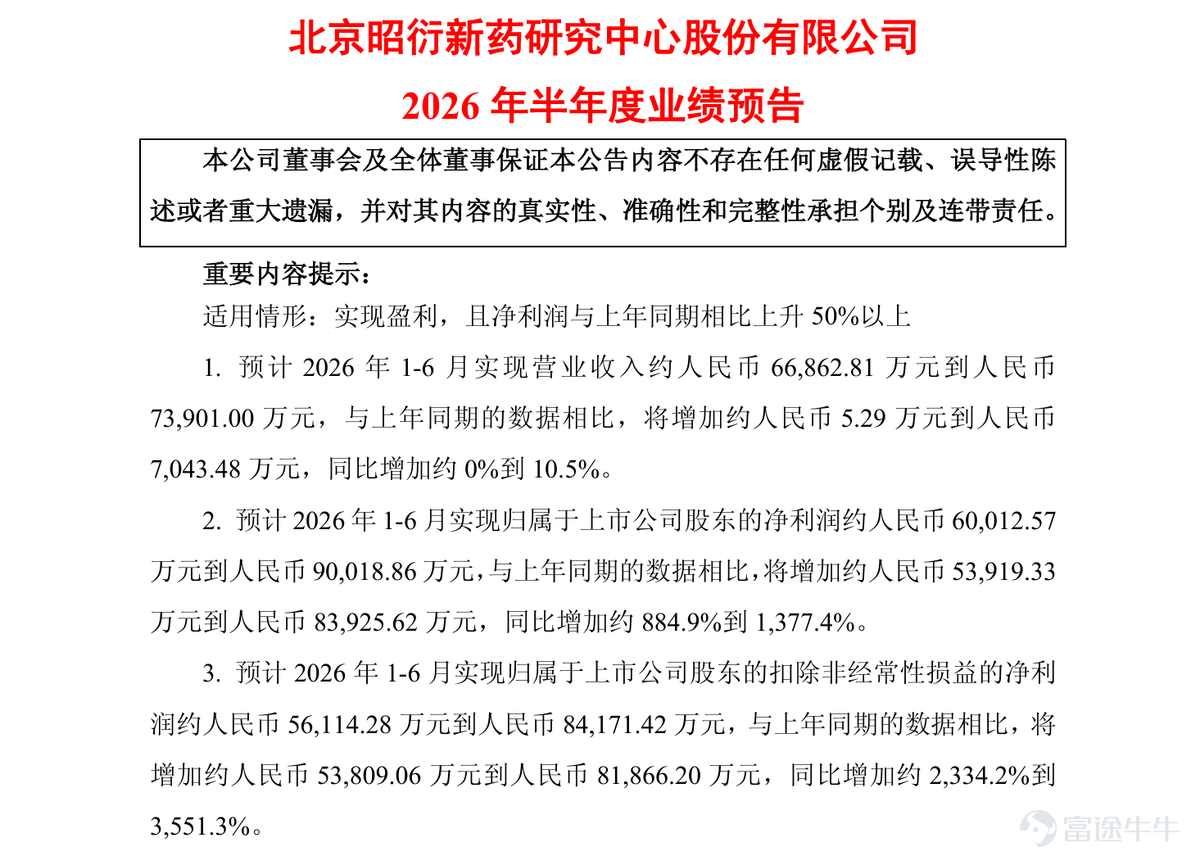
On July 15, Joinn Laboratories opened sharply higher and quickly hit its daily trading limit, maintaining strength throughout the day. Its interim earnings guidance for the first half of 2026 indicated that the company expects attributable net profit to reach approximately RMB 600 million to RMB 900 million, representing an increase of 885% to 1,377% year-over-year—surpassing its total revenue.
Specifically, revenue from Joinn Labs’ core laboratory services business saw only modest growth, with gross margins still in recovery. The primary driver behind the explosive profit surge was the positive change in the fair value of biological assets—in plain terms, the price of the lab monkeys it breeds has risen sharply. This single factor contributed roughly RMB 700 million in net profit. For this reason, internet memes such as 'monkey module' and 'standing with the monkeys' quickly went viral.

However, viewed seriously, as a relatively upstream player in the CXO industry, the rising price of lab monkeys clearly reflects an accelerating recovery across the entire supply chain. Two or three years ago, lab monkey prices had fallen to a trough of RMB 70,000–90,000 per animal, with market discussions centering on whether prices could fall further. Just over a year later, the same cohort of monkeys now fetches RMB 178,000 or more each—a textbook case of 'gains and losses stemming from the same source.'
Behind this reversal lies an overlooked dynamic in the CXO sector: barriers created by control over critical resources matter far more than short-term order fluctuations in determining a company’s profitability and industry standing.
The technology sector—including the CXO industry—has long been dominated by a prevailing investment narrative: the 'engineer dividend.' The underlying logic is simple: China possesses a large pool of high-quality, low-cost chemistry and biology talent, giving domestic CXO firms a natural comparative advantage in outsourced drug development services. The rise of companies like Wuxi Apptec, Pharmaron, and Asymchem has largely been a realization of this dividend.

However, if we broaden our perspective slightly, as the total number of engineers across the CXO industry continues to grow, laboratory space expands, and clinical service teams scale up, the scarcest resource—and the one experiencing the sharpest price increases—is not people, but monkeys. This isn’t meant to compare the value of humans versus monkeys, but rather to underscore that the industry’s most critical asset is resources—whether human intellect and experience or the experimental utility of monkeys.
In June of this year, the winning bid price for a cynomolgus monkey meeting experimental standards reached RMB 178,000, with premium supplies in some regions quoted above RMB 200,000—more than double the bottom prices seen around the end of 2024. Meanwhile, other experiment-related costs have not risen significantly.
Engineers, as part of this resource base, can be hired, trained, and retained with higher salaries; their supply elasticity, while limited, is at least adjustable. Experimental monkeys, however, are not. They are biological assets requiring a breeding cycle of over seven years, constrained by natural reproductive rhythms, and impossible to rapidly scale through short-term capital investment.
A key reason is that ADCs, bispecific antibodies, multispecific antibodies, gene therapies, and cell therapies—the molecular modalities dominating China’s current new drug pipelines—mostly require non-human primates during preclinical safety evaluation. Their target mechanisms mean that results from rat or dog studies cannot substitute for those from monkey trials. Species-specific biological responses dictate scientific conclusions, which in turn drive demand for these biological assets.
When over 70% of new molecular development projects in the market become mandatory users of experimental monkeys, yet annual supply remains capped at around 30,000 animals due to physical constraints, the resulting supply-demand imbalance becomes especially acute.
Joinn Laboratories was among the earliest companies in this industry to grasp this dynamic. Years ago, when Chinese CXOs competed on many fronts, Joinn made heavy bets by acquiring monkey farms, building breeding facilities, and stockpiling breeding colonies. At the time, skepticism abounded—investing heavily in a group of monkeys entailed long payback periods, poor asset liquidity, and financial statement volatility due to fluctuations in fair value.
In hindsight, every link in an industrial chain always has its significance. Ultimately, its value is determined by the scarcity of that link and the constraints on its expansion.
Research monkeys have not experienced price cycles for the first time in history. From 2020 to 2022, monkey prices soared sharply due to the dual impact of pandemic-induced disruptions to cross-border logistics and a concentrated surge in demand for new drug development. The unit price of research monkeys climbed from several thousand yuan to around RMB 160,000. That rally brought companies like Joinn Laboratories—known for stockpiling monkeys—their first wave of attention in capital markets.
Subsequently, from 2023 to 2024, monkey prices dropped rapidly again, falling as low as RMB 70,000 to 90,000 per animal, causing the market to reclassify monkeys from 'core assets' back to 'assets with depreciation risk.'
During this pricing rollercoaster, most monkey farms and speculative breeders behaved similarly: when prices were high, they aggressively sold their existing inventory to realize cash, unwilling to retain breeding-age females for herd expansion; when prices fell, they rushed even harder to liquidate, as they saw no expectation of future price increases.
Such short-term, momentum-driven behavior intensifies supply-demand imbalances in the next cycle each time it occurs.
The real reason Joinn can now report over RMB 700 million in net profit for just six months—driven largely by fair-value adjustments—is not because it accurately predicted short-term monkey price movements, but because between 2019 and 2024, at every stage of the monkey price cycle, it refrained from choosing the path of 'recouping cash as quickly as possible.'
The underlying industry judgment behind this sustained operational strategy is simple but difficult to stick to: in the innovative drug development value chain, the reserve cycle for upstream critical resources must align with the fluctuation cycle of downstream demand. From target identification to IND submission, new drug development takes at least two to three years. If a company waits until IND filings begin rising and monkey supply starts tightening before initiating breeding expansion, it will take at least seven to eight years to bring meaningful capacity online. Any management team focused solely on current-year financial statements will miss the optimal timing for strategic positioning.

Some even argue that in the CXO industry, biological assets offer more reliable assurance of future earnings than existing order books. Current orders may be fulfilled within a year or two, and renewal depends on competitive dynamics. But a healthy breeding female monkey can produce one offspring annually for up to eight years. Each offspring, once matured into a research monkey, can generate highly predictable revenue—because downstream clients have virtually no alternatives.
This represents a remarkable form of compounding, derived from a 'selling shovels' business model combined with downstream demand growth. Undoubtedly, at certain stages, this compounding effect has provided companies with certainty and instilled broad confidence in the recovery and growth potential of both the CXO sector and innovative drug development—an adage best captured as 'when innovation thrives, research monkeys know first.'
During the past golden decade of the global CXO industry, competition centered on 'scale'—who had the larger labs, more engineers, and a broader mix of contracts. But as the industry matures, the marginal returns from scale advantages are diminishing. Labs can be expanded, engineers can switch employers, proprietary technologies can be licensed out, and even differences in clinical data management systems are narrowing due to standardization.
It’s not just the innovative drug sector—across many industries, similar dynamics have led capital to favor the 'selling shovels' business model. Just as semiconductor equipment suppliers benefit from chipmakers’ capacity expansions, downstream capacity build-outs often carry significant risk of oversupply and collapsing prospects (as seen previously in photovoltaics and currently in optical fiber). Yet expansion always requires equipment—and equipment vendors rarely lose money.
In the innovative drug space, such strategic resources are also abundant. Non-human primate colonies are one example. Production capacity for solid-phase peptide synthesis reactors is another. Integrated manufacturing lines for ADC conjugation and toxin-linker production represent a third. These resources share key characteristics: long lead times, high sunk costs, and once built, they create barriers that make it extremely difficult for newcomers to replicate equivalent capacity in the short term.
In the CDMO sector, building a commercial-scale ADC production line compliant with international cGMP standards typically takes three to five years—from project initiation to certification and delivery. During this period, global innovator biopharma companies will continue filing marketing applications and ramping up production for their ADC pipelines. Whoever secures capacity first locks in long-term contracts with these clients.
In recent years, leading CXO firms have directed significant capital expenditures toward securing dedicated capacity and scarce resources. Wuxi AppTec’s heavy investments in peptide synthesis reactors, Asymchem’s commissioning of its ADC facility in Fengxian, and JOINN Laboratories’ long-term primate colony reserves all reflect a shared strategic logic at their core. If there exists a strategic node that, once captured, becomes nearly impossible to overtake, then that node inherently carries premium valuation.
Thus, although valuing companies based on monkey prices may seem humorous, the market remains willing—at this stage—to accommodate such valuation narratives, even if the resulting paper gains entail uncertainty.
Historically, the market has relied on metrics like P/E ratios, order backlog coverage, and quarterly revenue growth to assess CXO valuations. But in the 'resources-are-king' era, these financial indicators merely reflect outcomes from the previous competitive cycle, not the strategic assets that will define the next. A truly forward-looking evaluation framework must quantify how much of a lead a company holds in critical resources likely to face supply bottlenecks in the coming years.
Some assets may not generate immediate profits—and might even weigh down financial statements during depreciation periods—but when industry sentiment rebounds and resource scarcity emerges, they become irreplaceable, non-replicable sources of profit that competitors simply cannot access or replicate.
When monkey prices hit new highs, those debating whether prices will rise further next quarter are focused on short-term earnings elasticity; others are looking at moats. The gap between these two perspectives represents the market’s time lag in recognizing a company’s true intrinsic value.
Risk Disclaimer: The above content only represents the author's view. It does not represent any position or investment advice of Futu. Futu makes no representation or warranty.Read more
Comments
to post a comment
1