Seres, immersed in the 'Jie' ecosystem
(This article was written by Xiang Xianzhi and published by TMT Post with authorization.)
By Xiang Xianzhi
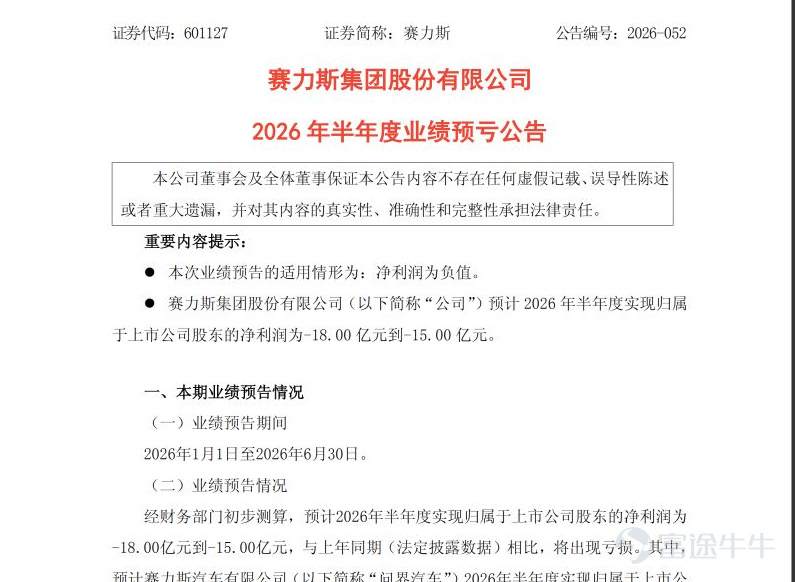
After Seres projected a loss of RMB 1.5 to 1.8 billion for the first half of the year, voices declaring 'Seres is done for' flooded in, or claims that 'Huawei has finally drained all of Seres’s profits.'
This narrative is emotionally charged but offers nothing new.

Seres relies on AITO, and AITO relies on Huawei. As Harmony Intelligent Mobility expanded from one brand to five, the technological, channel, and branding advantages that AITO once enjoyed almost exclusively are now being diluted. The market has debated this issue for years, and Seres’s stock price has continually fluctuated in response to ongoing discussions about its business partnership with Huawei.
The real question now is:Where will Seres’s next turning point come from, and can it survive beyond AITO?
The answer isn’t particularly optimistic.
Seres’s true path to independence still lies beyond the 'Jie' ecosystem, but its nearest financial inflection point may emerge within it.Yinwang transforms Seres from a payer in Huawei’s automotive business into a shareholder, while AITO’s overseas expansion takes the brand into new markets; AIVA is the real test of whether Seres can build a good car without Huawei.
The first two paths can improve the financial results. Only the last one could potentially become Seres' true second growth curve.
On the evening of July 12, Seres forecast a net loss attributable to shareholders of RMB 1.5 billion to RMB 1.8 billion for the first half of 2026, with a non-GAAP net loss of RMB 2.2 billion to RMB 2.5 billion. Its core subsidiary, Wenjie Auto, is expected to report a first-half loss of RMB 1.05 billion to RMB 1.3 billion, including a second-quarter loss alone of RMB 19 billion to RMB 21.5 billion. The company cited rising prices of memory chips, industrial metals, and lithium carbonate, as well as technology upgrades and model transitions that reduced the usability of certain existing assets, necessitating adjustments to their book values.
The interim report hasn’t been released yet, so it’s unclear how much of the loss stems from operating losses versus asset impairments. Calculating 'how much each Wenjie vehicle sold loses' by dividing total losses by sales volume at this stage would only produce a misleading but highly shareable figure.
However, market concerns aren’t entirely unfounded.
In 2025, Seres reported revenue of RMB 165.05 billion, net profit attributable to shareholders of RMB 5.96 billion, a new energy vehicle gross margin of 28.8%, and net operating cash flow of RMB 28.914 billion—a remarkably strong annual report. By Q1 2026, revenue was still up 34.5% year-over-year, but non-GAAP net profit had plummeted to just RMB 1.03 billion, down 73.87% year-over-year, while operating cash flow turned sharply negative at minus RMB 20.95 billion. Then, in Q2, Wenjie Auto suddenly pre-announced a nearly RMB 2 billion loss, cracking open the profitability narrative Seres had built over the past two years.
Previously, it was possible to argue that rising Wenjie sales volumes would eventually absorb R&D, marketing, and factory investments through economies of scale. Now, despite first-half Wenjie deliveries reaching 160,779 units—an increase of 5.6% year-over-year—profits have declined.
Even if the M6, M9, or the new M7 drives another sales peak, the market will still ask: how much additional investment in new models, sales incentives, and write-downs of legacy assets will this growth require?
Moreover, this 5.6% growth occurred in a market where competitors have not exited. In June, Aito sold 30,331 vehicles, down 30.19% year-over-year; in the same month, Li Auto delivered 30,895 vehicles and is preparing to launch its new L6 model in July; Xiaomi Auto has already delivered over 30,000 vehicles per month for three consecutive months, and the YU7 is becoming a new variable in the RMB 200,000–300,000 SUV segment.
Public data cannot prove how many Aito orders were directly poached, but it clearly shows that the M6 and M7 are no longer facing just one or two static rivals—instead, they are up against a group of products continuously undergoing upgrades and scaling up production capacity.
Therefore, Aito’s monthly sales rebound can only be considered operational recovery. As long as the company’s revenue, profit, and valuation remain dominated by the same set of Aito models, Seres remains stuck in the same old problems.
But that doesn’t mean it should immediately leave Huawei.
Aito remains Seres’ only proven premium brand and the largest contributor to Harmony Intelligent Mobility Alliance (HIMA) sales. If Seres were to proactively sever ties now, it would be like scuttling its first boat before launching a second one. A more realistic option is to stay within the 'Jie' ecosystem while seeking ways to reposition itself within it.
The expansion of the 'Five Jies' is generally seen as bad news for Seres. Aito is backed by Seres, while Zhijie, Xiangjie, Zunjie, and Shangjie are respectively partnered with Chery, BAIC, JAC, and SAIC. Huawei’s technology and distribution channels are no longer exclusive to Aito; consumers entering the same HIMA portal now face an increasing number of similarly priced alternatives.
This assessment isn’t wrong, but it overlooks a card Seres still holds.
Seres spent RMB 11.5 billion to acquire a 10% stake in Shenzhen Yinwang.As other shareholders joined, Seres’ ownership stake decreased to 9.36% by the end of 2025. This investment is accounted for as a long-term equity investment and is not consolidated. According to the notes to the annual report on long-term equity investments, Seres recognized RMB 1.7000 billion in investment income from Yinwang in 2025 under the equity method.
The net equity-method investment income from all jointly controlled and associate enterprises reported in the financial statements amounts to RMB 801.8 million, due to losses from projects such as Ruichi offsetting other gains—it is not because Yinwang alone contributed only RMB 800 million. Yinwang remains far from transforming Seres’s profit structure, yet it is no longer just a narrative confined to valuation models.
That’s precisely where things get interesting.
The more 'Jie' brands Huawei adds, the smaller Aito’s share within Harmony Intelligent Mobility Alliance may become; meanwhile, Huawei’s intelligent automotive solutions will cover an increasing number of vehicle models and customers.In 2025, Huawei’s intelligent automotive solutions business generated RMB 45.018 billion in revenue, up 72.1% year-over-year, shipped over 38 million intelligent auto components, and partnered with more than 600 companies. According to Huawei’s annual report, this segment was its fastest-growing business.
Huawei’s expansion of Harmony Intelligent Mobility from Aito to five 'Jie' brands aims to reduce reliance on a single automaker. Seres, by holding equity in Yinwang, is attempting to convert this dilution into another form of gain: while Seres still loses vehicle-level profits for every Aito car not sold, it now has the opportunity—as a shareholder—to share in the platform’s growth as more brands and automakers adopt Yinwang’s intelligent automotive solutions.
In other words, Seres previously stood solely on the payment side of Huawei’s automotive business; now, for the first time, it has placed one foot on the earnings side. In 2025, Seres purchased goods and services from Yinwang totaling RMB 22.335 billion; in the same year, it recognized RMB 170 million in investment income from Yinwang. These two figures are not measured under the same accounting basis and cannot be directly used to calculate a rate of return, but viewed together, they clearly indicate that this strategic shift has only just begun.
As a result, Yinwang now sits closest to Seres’s income statement. It already has revenue, customers, and products, and thus does not need to scale up from zero like a new brand would. However, its RMB 170 million impact on earnings in 2025 remains small relative to Seres’s RMB 5.96 billion net profit attributable to shareholders. Investment income alone cannot fix Aito’s per-vehicle gross margin, inventory issues, or operating cash flow.
More critically, this path has not reduced dependence on Huawei. Seres has merely shifted from 'relying on Huawei to sell cars' to 'simultaneously relying on Huawei’s platform to generate earnings.'
It has changed its position within the 'Jie' ecosystem—but has not yet stepped outside it.
The same holds true for Aito’s overseas expansion.
In February 2026, AITO signed an agreement with a UAE dealer, launching test drives of the overseas version of the M9—named the AITO 9—in the local market and securing initial orders for 200 units.The company plans to first enter the Middle East and Central Asia, while preparing for markets in Europe, Asia-Pacific, and both left- and right-hand drive regions. AITO’s entry into the UAE represents a relatively pragmatic incremental approach: rather than rebuilding its brand and products from scratch, it is introducing the already validated WENJIE (AITO) model to another market.
This initiative differs fundamentally from Seres’ previous overseas ventures. Earlier international operations were primarily based on Dongfeng Sokon micro vehicles, commercial vehicles, and fuel-powered SUVs like the Fengguang 580, with total vehicle exports reaching approximately 26,000 units in 2019. The Lantu brand itself was mainly positioned as a cost-effective new energy vehicle product line targeting the domestic market and is not a direct predecessor to AITO’s overseas expansion. What AITO is exporting this time are high-end products, a premium brand, and intelligent driving experiences already validated in China. The former strategy relied heavily on distribution channels and cost competitiveness, whereas the latter must re-establish brand premium overseas.
The reality gap remains substantial. By geographic segment of core operations, Seres reported RMB 2.379 billion in overseas revenue in 2025, accounting for only about 1.4% of group revenue—a 43.32% year-over-year decline. Gross margin from overseas operations stood at 16.26%, 12.13 percentage points lower than that of domestic operations. Overseas sales of new energy vehicles totaled just 7,778 units, down 15.32% year-over-year. Seres’ annual report does not depict an explosive growth trajectory but rather a business segment that has only recently restarted.

Exporting premium vehicles is significantly more challenging than shipping budget models. Dealer networks, after-sales service, spare parts logistics, data compliance, mapping, and advanced driver-assistance capabilities all require extensive adaptation. How much of Huawei’s superior user experience—Wenjie’s strongest asset in China—can be retained overseas is a critical question AITO must address.
Even if successful, it would only expand Wenjie’s market boundaries. Seres would still remain within the 'boundary'—it’s simply pushing that boundary further outward.
In May this year, Chongqing Landian Technology received a capital injection of RMB 6.671 billion and was subsequently renamed Saidu Technology. Chongqing’s state-owned investment platform became the largest shareholder, reducing Seres’ stake to 32.96%. Employee shareholding platforms, CATL, Bojun Technology, and Xingyu Shares also joined as shareholders. Following the capital increase, Seres lost control of the company.
One month later, Saidu unveiled AIVA, with its first mass-production model—the ME7—scheduled to debut within the year. Volcano Engine will provide the Doubao large language model and cockpit capabilities, while Seres contributes manufacturing expertise, supply chain management, quality systems, and engineering experience. Public reports also indicate that AIVA’s advanced driver-assistance system will be supplied by DeepRoute.ai, diverging from Huawei’s Qiankun ADS solution.
This technical configuration is critical.
For the first time, AIVA has placed Seres’ automotive business outside Huawei’s technological ecosystem: the cockpit comes from Volcano Engine, ADAS from YuanRong Qixing, and manufacturing and engineering capabilities from Seres.Of course, this doesn’t prove that Seres already possesses independent software capabilities, but it does test something more fundamental—how much value Seres’ accumulated manufacturing expertise retains once separated from Harmony Intelligent Mobility’s product definition, branding, and distribution channels.
This deal may appear to be a concession, but in reality, it could represent Seres’ most pragmatic design for a second growth curve at this stage.
Landian has not proven itself in the past. Building a new car brand requires factories, distribution channels, technology, and tens of billions of yuan in cash. If Seres continued to invest solely with its own capital, any pressure on AITO would drain cash from both lines simultaneously. Now, by proactively reducing its stake to 32.96%, Seres has brought in local state-owned capital, employees, CATL, and component suppliers to share the risk. If AIVA succeeds, Seres stands to benefit from equity appreciation, investment returns, and manufacturing orders; if AIVA fails, the losses will no longer rest entirely on Seres’ financial statements.
What Seres may be learning here is not how to create another AITO, but rather how not to foot the entire bill for its second entrepreneurial venture alone.
A non-Huawei path does not automatically equate to established competitiveness. AIVA is targeting the market above RMB 200,000, which is already crowded with the Li Auto L6, Xiaomi YU7, AITO M5, and M6; meanwhile, BYD continues pushing advanced driver-assistance systems into lower price segments. For consumers, 'not using Huawei' isn't a reason to buy, nor is 'also offering advanced intelligent driving.' AIVA must explain why customers should spend the same amount of money on a less mature brand.
It also faces another layer of awkwardness: even if this new growth curve succeeds, its revenues won’t fully flow into Seres’ listed entity. Seres has already lost control and can no longer unilaterally decide on products, budgets, or dividends; Volcano Engine is merely a technology supplier without an equity stake, and Doubao’s user base won’t automatically translate into car orders. From its unveiling later this year to mass deliveries and eventual profitability, AIVA still has several hurdles to clear.

Robotics remains even further off. Seres has already established Phoenix Technology, co-founded Sehang Embodied Intelligence with Beihang University, and signed an embodied intelligence cooperation framework with Volcano Engine; its annual report also lists intelligent robots as a long-term growth driver. However, what’s confirmed so far are only entities, agreements, and R&D directions—not yet verifiable scale products, orders, or revenue. While it can fuel investor imagination, it cannot yet deliver a turning point.
Seres’ next financial improvement may initially come from Yinwang; if AITO’s overseas expansion proves successful, it will add a new market segment for AITO.Both are important, yet neither reduces Seres’ dependence on Huawei’s ecosystem.
AIVA faces a different test. It must demonstrate that Seres’ manufacturing, supply chain, and engineering capabilities still command market demand even without Huawei. However, to mitigate the cost of potential failure, Seres has voluntarily relinquished control again. This makes it easier for AIVA to survive, but also means that even if it succeeds, the portion flowing back into the listed company’s financial statements will be smaller.
Therefore, going forward, don’t just focus on how many Aito vehicles are sold next month. The upcoming half-year report must first clearly separate asset impairments from operational pressures; whether investment income from Yinwang can continue to grow will determine if reshuffling within the 'Aito ecosystem' holds any real significance. Moreover, when overseas operations transition from a 200-unit order to consistent deliveries matters far more than another product launch event.
As for a genuine path toward independence, first watch whether the ME7 debuts as scheduled, then see if AIVA can establish its own sales channels and secure its first batch of real customers. In robotics, at least one verifiable product or order must emerge before it warrants inclusion in any inflection-point discussion.
Aito brought Seres back to life. The question now isn’t whether it can immediately exit Aito, but whether—while still operating within the 'Aito ecosystem'—it has left itself a door open to the outside world.
Risk Disclaimer: The above content only represents the author's view. It does not represent any position or investment advice of Futu. Futu makes no representation or warranty.Read more

Comments
to post a comment
1
1