
Daily Options Outlook | SK Hynix surges 27% but drops 6.33% in pre-market; ASML Holding rises 3.84% in pre-market on better-than-expected earnings; Intel up 3.84% in pre-market
Today's Options Market Outlook
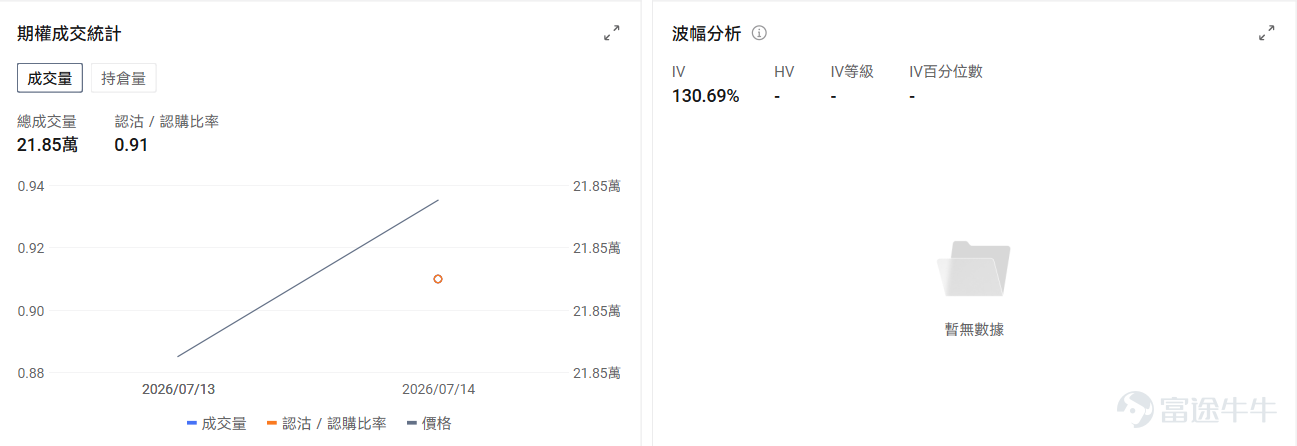
At the individual stock level, $SK hynix (SKHY.US)$ On the first day of options listing, stock price volatility intensified—after a 27% surge, shares fell 6.33% in pre-market trading. Currently, SK Hynix’s U.S.-listed ADR trades at a premium of approximately 42%, though arbitrage mechanisms remain unavailable. On the first trading day, SK Hynix’s options implied volatility (IV) reached 130.69%, reflecting market bets on significant price swings.

$ASML Holding (ASML.US)$ ASML Holding rose 3.84% in pre-market trading after delivering Q2 results that beat expectations across the board and raising its full-year guidance once again, including a 30% increase in low-NA EUV capacity by 2027. Options market data shows the stock’s put/call volume ratio declined to 0.82, with implied volatility at 65.05%.

At the individual stock level,$Intel (INTC.US)$Intel gained 3.74% in pre-market trading as yields for its 18A process node improved to 85%, securing foundry orders from NVIDIA, OpenAI, and several other companies. Options market data shows the stock’s put/call volume ratio dropped to 0.41, with implied volatility reaching 98.31%.

Review of yesterday's options market
Index Options
On July 14 in U.S. Eastern Time, trading volume in the U.S. equity index options market declined, with a total of 5.33 million contracts traded. The put/call volume ratio fell to 1.01.
In the upcoming expiration cycle,$S&P 500 Index (.SPX.US)$ options volume distribution exhibited the following characteristics: put option volume peaked at the 7,540 strike, while call option volume peaked at the 7,600 strike.

Individual stock options
$Micron Technology (MU.US)$rose 4.92%, with 551,600 options contracts traded, and the put/call volume ratio increased to 1.05. KeyBanc analysts raised Micron's price target to $1,750, forecasting memory prices to continue rising through 2027.

$IBM Corp (IBM.US)$fell 25.21%, with 494,400 options contracts traded, and the put/call volume ratio rose to 0.81. IBM released preliminary second-quarter results, reporting revenue of $17.2 billion, below expectations, causing its stock to plunge 25%—a historic drop.

Top Option Volume Rankings
Among the top 10 stocks by option volume,$Micron Technology (MU.US)$had the highest put/call volume ratio, reaching 1.05.


Implied Volatility Rankings (underlying market cap > $1 billion and option volume > 100,000 contracts)
$Lucid Group (LCID.US)$Implied volatilityrecorded the highest and fastest-growing put/call volume ratio, surging 288.42%, an increase of 168.50% from the previous trading day. Lucid Group denied bankruptcy rumors, stating the company has sufficient liquidity to sustain operations into next year.

$CleanSpark (CLSK.US)$saw the second-largest increase in implied volatility, rising to 116.00%, up 18.80% from the previous trading day. CleanSpark signed a $6.6 billion, 20-year data center lease agreement with a global technology company.

Risk Warning
An option is a contract that gives the holder the right, but not the obligation, to buy or sell an asset at a fixed price on a specific date or before that date. The price of an option is influenced by various factors, including the current price of the underlying asset, the strike price, time to expiration, and implied volatility.
Implied volatility reflects the market's expectation of the option's volatility over a certain period in the future. It is derived inversely from the BS pricing model of options and is generally considered an indicator of market sentiment. When investors anticipate greater volatility, they may be more willing to pay higher prices for options to hedge risks, resulting in higher implied volatility.
Traders and investors use implied volatility to assessOption priceto enhance attractiveness, identify potential mispricing, and manage risk exposure.Disclaimer
This content does not constitute an offer, solicitation, recommendation, advice, opinion, or any form of guarantee regarding any securities, financial products, or instruments. The risk of loss in trading options can be substantial. In certain circumstances, your losses may exceed the initial margin deposit you made. Even if you place contingent orders, such as 'stop-loss' or 'limit' orders, there is no assurance these will prevent losses. Market conditions may render such orders unexecutable. You may be required to deposit additional margin funds on very short notice. If you fail to meet such a margin call within the specified timeframe, your open positions may be liquidated. Nevertheless, you remain liable for any resulting deficit in your account. Therefore, you should thoroughly research and understand options before trading and carefully consider whether such transactions are suitable for you based on your financial condition and investment objectives. If you trade options, you should be familiar with the procedures for exercising options and handling expirations, as well as your rights and obligations upon exercise or expiration. Options trading involves substantial risk and is not appropriate for all investors. Investors should carefully read"Characteristics and Risks of Standardized Options"。
This content does not constitute an offer, solicitation, recommendation, advice, opinion, or any form of guarantee regarding any securities, financial products, or instruments. The risk of loss in trading options can be substantial. In certain circumstances, your losses may exceed the initial margin deposit you made. Even if you place contingent orders, such as 'stop-loss' or 'limit' orders, there is no assurance these will prevent losses. Market conditions may render such orders unexecutable. You may be required to deposit additional margin funds on very short notice. If you fail to meet such a margin call within the specified timeframe, your open positions may be liquidated. Nevertheless, you remain liable for any resulting deficit in your account. Therefore, you should thoroughly research and understand options before trading and carefully consider whether such transactions are suitable for you based on your financial condition and investment objectives. If you trade options, you should be familiar with the procedures for exercising options and handling expirations, as well as your rights and obligations upon exercise or expiration. Options trading involves substantial risk and is not appropriate for all investors. Investors should carefully read"Characteristics and Risks of Standardized Options"。
Risk Disclaimer: The above content only represents the author's view. It does not represent any position or investment advice of Futu. Futu makes no representation or warranty.Read more

Comments (2)
to post a comment
7
5