
Technology Research Institute: CPI data is about to be released! What opportunities are there amid t

60-Second Visual Breakdown | Semiconductors Stage a Strong Rebound—Is the Toughest Period Behind Us?
Recently, US equity market volatility has noticeably intensified. Semiconductor and high-valuation growth stocks have faced repeated pressure. While major indices remain near recent highs on the surface, clear internal divergences have already emerged. Two weeks ago, the market’s biggest concern was whether crowded positioning, leveraged capital, and technical selling pressure might trigger a deeper correction;Following Monday’s strong rebound, has this round of pullback already ended?
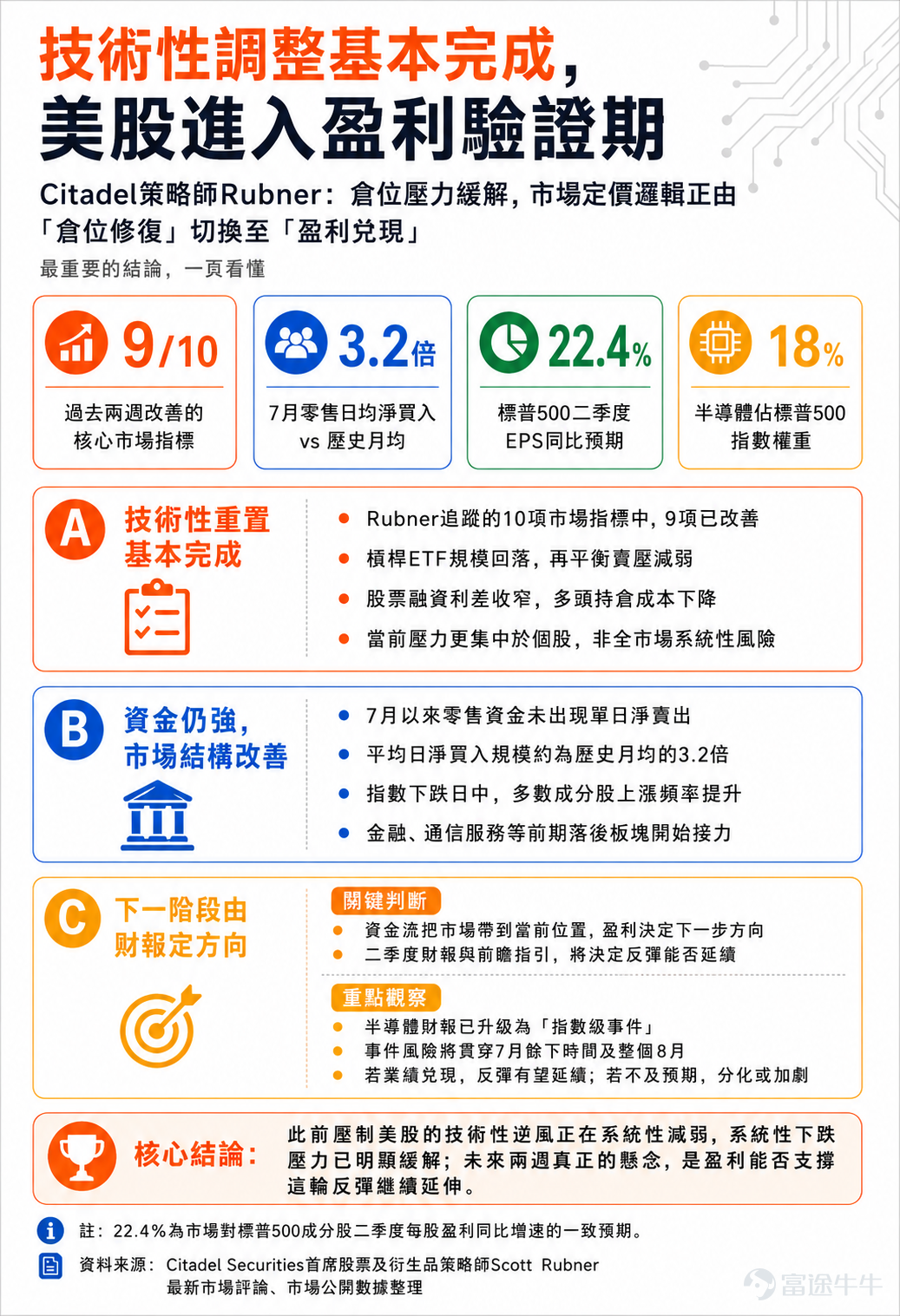
According to Scott Rubner, Chief Equity and Derivatives Strategist at Citadel Securities:The pressure previously caused by crowded positions, leveraged capital, and rebalancing-related selling has been significantly relieved.
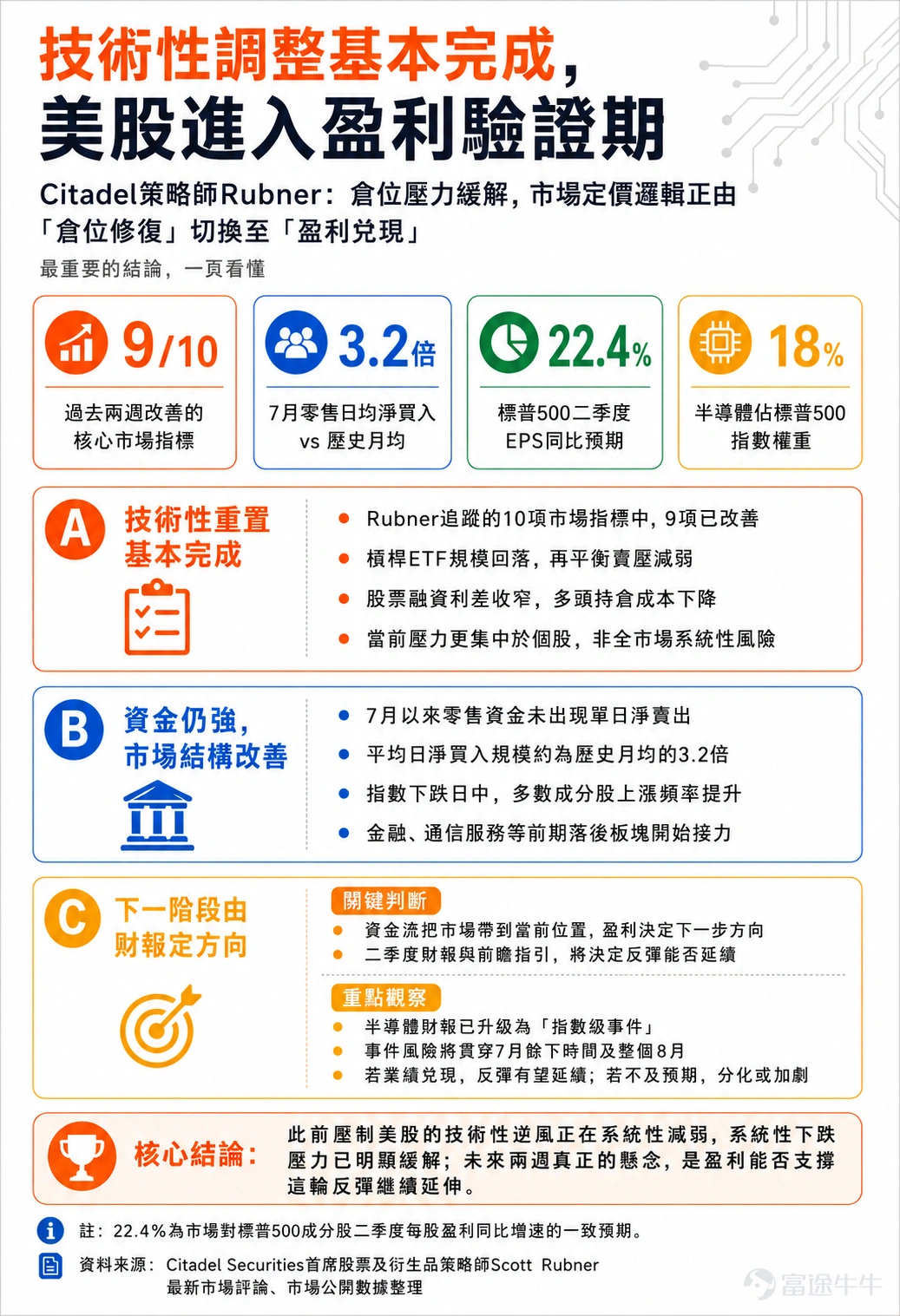
As shown in his report, the clearest evidence is that9 out of the 10 market indicators tracked have already shown meaningful improvement.Leveraged ETF assets have declined, margin financing spreads have narrowed, and index-level hedging demand remains under control. Current market stress is largely confined to high-volatility sectors like semiconductors and has not escalated into broad-based systemic risk.
Meanwhile, retail investor buying activity remains robust., the average daily net buying in July was approximately 3.2 times the historical monthly average; previously lagging sectors such as financials and communication services have started to take the lead, and the breadth of the market rally is also expanding.
This means the core pricing driver for the next phase of the U.S. equity market has already shifted.The first phase—addressing capital flows and position adjustments—has been completed; the focus now turns to whether corporate earnings can sustain momentum. The market currently expects S&P 500 Q2 earnings per share to grow by 22.4% year-over-year, which is a relatively high expectation.
The semiconductor sector currently accounts for approximately 18% of the S&P 500 index, and semiconductor earnings reports are no longer just a sector-specific event,they have become an index-level event.Semiconductor companies' earnings releases are not concentrated in a single week but are spread throughout the earnings calendar, meaning related event risks will persist through the remainder of July and into August.
If tech megacaps and semiconductor companies deliver strong results and provide supportive forward guidance, the rally could continue to broaden; conversely, if earnings fall short, stock-specific divergence and sharp post-earnings volatility will likely intensify significantly.
Systemic downside pressure has clearly eased, but earnings will ultimately determine the market’s next move.
$Nasdaq Composite Index (.IXIC.US)$ $S&P 500 Index (.SPX.US)$ $Dow Jones Industrial Average (.DJI.US)$ $Invesco QQQ Trust (QQQ.US)$ $PHLX Semiconductor Index (.SOX.US)$ $PHLX Semiconductor Index (.SOX.US)$ $VanEck Semiconductor ETF (SMH.US)$ $SK hynix (SKHY.US)$ $Micron Technology (MU.US)$ $SanDisk (SNDK.US)$ $NVIDIA (NVDA.US)$ $Direxion Daily Semiconductor Bull 3x Shares ETF (SOXL.US)$ $Advanced Micro Devices (AMD.US)$ $Intel (INTC.US)$
Risk Disclaimer: The above content only represents the author's view. It does not represent any position or investment advice of Futu. Futu makes no representation or warranty.Read more


Comments (2)
to post a comment
9
26