
Storage giants launch collective buybacks: Where does the supercycle stand?

Daily Options Income Strategy | The entire memory sector rebounds! DRAM surged nearly 7% in the previous trading session—how to position with options?
I. Market Barometer
Major U.S. indices all rose in the previous trading session. Memory-related stocks led the market higher, $SK hynix (SKHY.US)$ taking the lead in driving gains, with capital flowing heavily into the memory chip segment—this high-volatility environment offers an attractive window for options selling strategies.
II. Watchlist Highlights
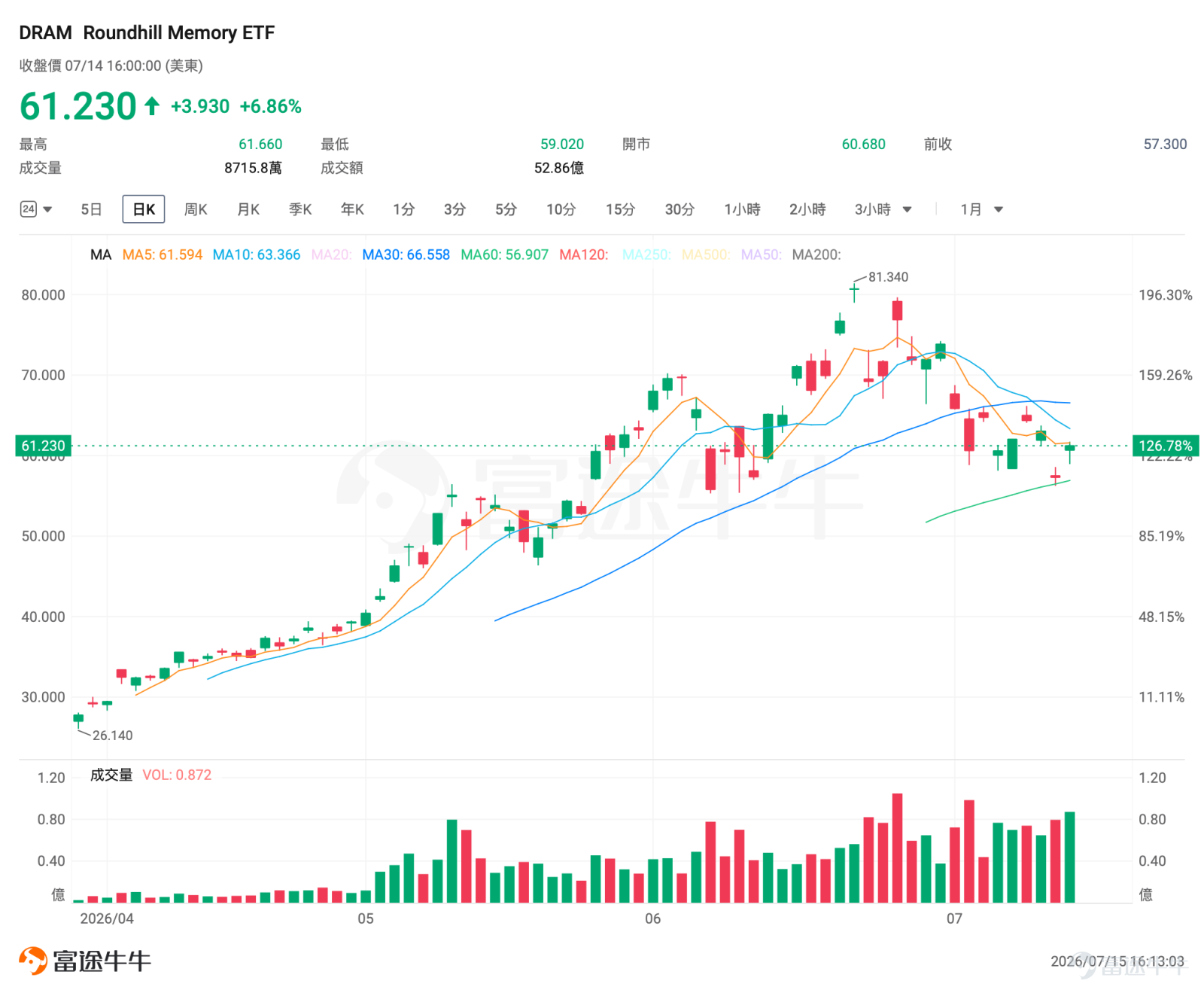
DRAM: The leading ETF in the memory sector jumped nearly 7% in a single day, with capital flowing in to buy the dip.
$Roundhill Memory ETF (DRAM.US)$ It closed up 6.86% in the previous trading session, with a trading volume of $5.286 billion, a volume ratio of 1.173, and a turnover rate as high as 21.45%, indicating strong capital inflows.

From a technical standpoint, DRAM gapped up sharply at the open, breaking above its prior consolidation range—a classic sign of a strong breakout on high volume.In the short term, the intraday high of $61.66 serves as immediate resistance; a decisive break above this level would open further upside potential. On the volume front, the turnover rate exceeding 21% coupled with a volume ratio of 1.17 confirms the breakout is backed by genuine capital flows rather than speculative momentum, placing the stock in an acceleration phase following a strong breakout.
Notably, unusually active call option trading was observed in the options market on Tuesday.The put/call ratio has dropped sharply, indicating some funds are beginning to bet on the continuation of the rebound.

From a news perspective, the core driver behind this sharp rally is the collective surge in the memory chip sector.The memory-related sector posted a significant gain on the day, $SK hynix (SKHY.US)$ becoming the standout performer of the day, closing with a staggering gain of 27%, $SanDisk (SNDK.US)$ up more than 5%, $Micron Technology (MU.US)$ and rising nearly 5%. Major memory stocks had suffered steep losses over the past week—Samsung Electronics, Micron, and SK Hynix all saw significant pullbacks—but the underlying industry fundamentals, driven by continuously expanding AI computing demand pushing up prices for HBM and DRAM products, remain largely unchanged.
The most critical catalyst was $SK hynix (SKHY.US)$ the official commencement of mass shipments of 12-layer HBM4 to NVIDIA. This marks the first time HBM has been supplied to NVIDIA’s next-generation AI platform 'Vera Rubin' in its final specification, having passed all quality certifications. Starting September this year, shipment volumes will significantly ramp up, fully meeting NVIDIA's demand for high-end computing chips. This news directly confirms that strong AI-driven demand for high-end memory is now translating into concrete orders and earnings, greatly boosting market confidence.
Beyond sector-specific positive developments, an improving macro environment also provided tailwinds for the sector’s rally:
- U.S. inflation cooled more than expected:The U.S. June CPI data released today came in below expectations across the board, rising 3.5% year-over-year and declining month-over-month for the first time in six years. This significantly eased market concerns about further Fed rate hikes and tightening policies, leading to a notable rebound in risk appetite and directly benefiting high-valuation tech growth stocks.
- South Korean government market rescue:South Korea’s stock market had previously plunged due to deleveraging-driven sell-offs, but after four government agencies urgently intervened to curb excessive leverage practices, the KOSPI staged a sharp V-shaped recovery.
3. Options Premium Collection Strategy
1. Cash Secured Put
Sell 1 contract of $Roundhill Memory ETF (DRAM.US)$ 260821 40P; estimated required margin (for reference only): $4,000 ($40 × 100)

Opportunity Rationale:
For investors who acknowledge the long-term structural thesis behind AI memory but have not yet established positions, DRAM prices have already pulled back significantly from their June highs, and volatility remains elevated.
JPMorgan data shows institutional capital continues to flow steadily into the memory sector. By selling put options, investors can collect premium income in this high-volatility environment if the stock stabilizes or continues to rebound from current levels; if the price dips again due to short-term sentiment swings, they also gain the opportunity to establish positions at more prudent cost bases.
2. Covered Call

Opportunity Rationale:
For investors already holding DRAM positions and facing unrealized losses, the stock price still faces technical resistance at the 30-day moving average following the recent rebound.
Investors who remain bullish on the long-term AI memory thesis but are concerned about near-term volatility can sell call options. If the stock consolidates around current levels, the option premium received will help lower their cost basis; if sector sentiment continues to improve and drives the price up toward $85—triggering assignment—they effectively achieve a phased profit-taking exit.
IV. Risk Management Advisory
Although seller strategies have a high win rate, investors must still implement proper risk management:
– Position sizing is key:The biggest risk of option selling strategies lies in black swan events. It is recommended that the margin allocated to any single underlying asset should not exceed 20% of total capital. Never sell options beyond your risk tolerance just for the sake of collecting premium.
– Timely rolling of covered calls:If a covered call becomes deeply in-the-money (i.e., the stock price significantly exceeds the strike price) and you remain bullish on the underlying stock, promptly 'roll' the position—close the current option by buying it back and simultaneously sell a new call with a later expiration and a higher strike price—to avoid having your shares called away at an unfavorable price.
– Beware of 'left-tail risk' with cash-secured puts:For cash-secured puts, if the stock price crashes due to fundamental deterioration (rather than normal pullbacks), do not hold on stubbornly. In such cases, exit with a stop-loss or 'roll down' the position to buy time and wait for volatility to normalize.
Make good use of the Option Seller Hub to understand potential income strategies for selling options,Earn option premiums!
Make good use of the Option Seller Hub to understand potential income strategies for selling options,Earn option premiums!

Options Risk Disclosure
An option is a contract that grants the holder the right—but not the obligation—to buy or sell an underlying asset at a fixed price on or before a specified date. The price of an option is influenced by various factors, including the current price of the underlying asset, the strike price, time to expiration, and implied volatility. Implied volatility reflects the market's expectation of future price fluctuations over the life of the option; it is derived by reverse-engineering the option’s price using the Black-Scholes pricing model and is commonly viewed as an indicator of market sentiment. When investors anticipate greater volatility, they may be willing to pay higher premiums for options to hedge their risk, leading to higher implied volatility. Traders and investors use implied volatility to assess the attractiveness of option prices, identify potential mispricings, and manage risk exposure.
Disclaimer
This content does not constitute an offer, solicitation, recommendation, advice, opinion, or any guarantee regarding any securities, financial products, or instruments. Trading options involves substantial risk of loss. In certain circumstances, your losses may exceed the initial margin deposit. Even if you place contingent orders, such as 'stop-loss' or 'limit' orders, you may not necessarily avoid losses, as market conditions may prevent these orders from being executed. You may be required to deposit additional margin on short notice. If you fail to provide the required amount within the stipulated time, your open positions may be liquidated. Nevertheless, you remain liable for any resulting deficit in your account. Therefore, you should thoroughly research and understand options and carefully consider whether trading them is suitable for you based on your financial condition and investment objectives. If you trade options, you should familiarize yourself with the procedures for exercising options and handling expiration, as well as your rights and obligations upon exercise or expiration. Options trading entails very high risk and is not appropriate for all investors. Investors should carefully read the document 'Characteristics and Risks of Standardized Options' before engaging in any options trading strategy.
Risk Disclaimer: The above content only represents the author's view. It does not represent any position or investment advice of Futu. Futu makes no representation or warranty.Read more


Comment (1)
to post a comment
18
36