
Options Hub: SpaceX's second wave of lock-up expiration takes effect today! How should options strat

SK Hynix options trading is about to launch—how will it impact the underlying stock?
1. SK Hynix options are about to debut
According to an announcement from MIAX Options Exchange, $SK hynix (SKHY.US)$options trading will officially commence after the market opens on July 14 Eastern Time(Please refer to the company’s official announcement for specifics.) SK Hynix ADR was priced at $149 on July 10, opened at $170 on its first trading day, and closed at $168.49. The stock price subsequently declined rapidly, and the options are launching precisely as IPO enthusiasm cools and the market reassesses the ADR premium.
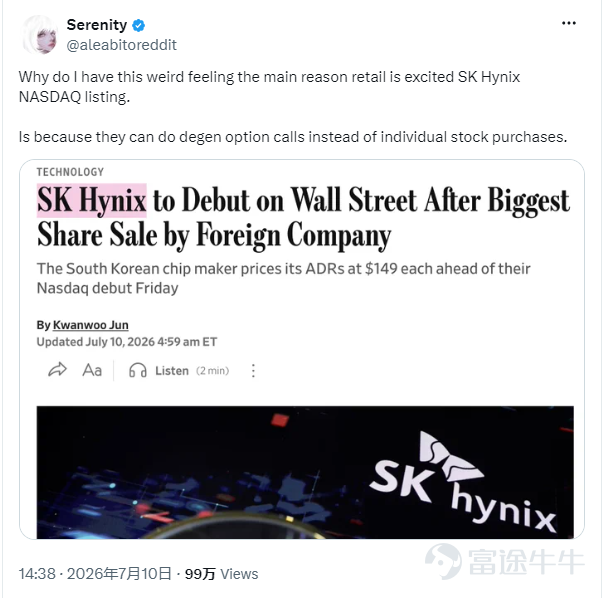
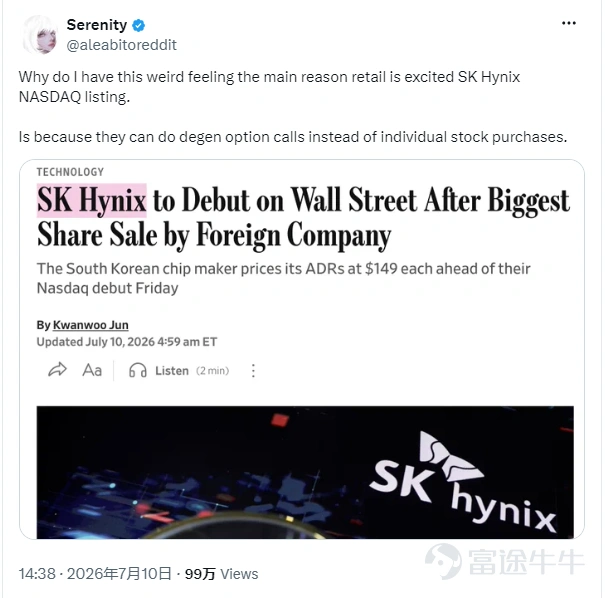
On July 11,‘White-Haired Stock Sage’ Serenity previously posted on X that retail investors’ excitement over SK Hynix ADR listing on Nasdaq may stem less from direct stock investmentand more from the prospect of gaining access to highly leveraged options trading opportunities following the listing.
2. What typical market patterns emerged after SPCX options launched? What implications does this have for SKHY?
$SpaceX (SPCX.US)$ SPCX is the most relevant recent case, as both companies are newly listed stocks attracting significant market attention.
SpaceX options also became available two trading days after the underlying stock debuted, with a first-day volume of approximately 1.8 million contracts, quickly ranking among the top three most actively traded single-stock options in the U.S. market. Calls accounted for nearly 1 million contracts.On that day, capital flowed heavily into short-dated, out-of-the-money calls, while SPCX shares rose roughly 5%, exhibiting extremely volatile intraday price swings.
1. What similarities exist between SKHY and SPCX?
Both exhibited a degree of share scarcity in the early stages following their listings.After its listing, SPCX had a relatively low public float, making its share price highly sensitive to new inflows of capital. For SKHY, newly issued ADRs accounted for less than 3% of the company’s total shares outstanding, and U.S.-based investors previously had limited direct access to invest in SK Hynix; furthermore, the supply of new ADRs was constrained by conversion procedures.
Retail and short-term speculative participation has been similarly high for both stocks. Cboe noted that orders for SPCX options on the first trading day were primarily driven by retail investors—these participants typically favor near-term, round-strike, out-of-the-money calls, which tends to concentrate trading activity in a small number of contracts.
For both stocks, options were listed very shortly after the underlying shares began trading. At that stage, the underlying stocks had not yet established stable historical volatility, and the options markets lacked mature open interest, skew, and term structure.Market makers had to build pricing models from scratch and typically quoted elevated volatility premiums and wider bid-ask spreads during the opening phase.
Under such conditions, short-dated options trading can have a significantly greater impact on the underlying stock price compared to more mature equities.With relatively limited available shares and concentrated order flow, if market makers are forced to continuously buy or sell the underlying stock for hedging purposes, intraday price swings can rapidly amplify.
2. Options listing may amplify price movements, but it cannot determine their direction.
After SKHY options launch, if capital flows concentrate on actively buying at-the-money or slightly out-of-the-money calls, market makers typically need to buy the underlying stock to manage risk. The closer the stock price is to the relevant strike price, the faster the call's delta changes, potentially intensifying hedging demand. During phases with relatively limited available shares, such buying pressure can accelerate the underlying stock’s upward move, creating a short-term positive gamma feedback loop.
If put-based hedging demand dominates, the dynamic reverses. After selling puts, market makers may reduce their delta exposure by selling the underlying stock. As the stock price declines, the absolute value of the put’s delta continues to increase, prompting market makers to add more short positions, further amplifying the downward momentum.
This means the long-short positioning battle in SKHY will noticeably intensify.
3. Key Differences Between SKHY and SPCX
SKHY has an additional constraint that SPCX does not: Korean common shares provide a clear pricing reference.After the SK hynix ADR listing, it initially traded at a premium of approximately 36% over the converted value of its Korean shares. Although limited ADR supply and cross-market conversion constraints have prevented this premium from quickly dissipating, when SKHY is pushed higher by options-related flows, institutional investors may choose to sell SKHY calls, reduce ADR holdings, or construct relative-value positions using Korean common shares and derivatives. Selling pressure from above will gradually increase as the premium widens.
Therefore,SKHY could still experience gamma-driven price action similar to SPCX, but sustained one-sided upside will be more difficult.Korean common shares, the ADR premium, and Micron’s valuation will continuously serve as benchmarks, limiting SKHY’s ability to sustainably trade far above prices implied by the Korean market.
III. Key Price Levels and Monitoring Indicators for SKHY After Options Launch
In the initial phase following the launch of new options, implied volatility is typically elevated.Market makers lack historical data and need to build in a larger safety margin for new stock volatility, order flow uncertainty, and inventory risk.
For example, when SPCX options were first listed, the implied volatility (IV) of near-term contracts briefly reached around 160%. As trading gradually stabilized, the IV declined from approximately 110%.
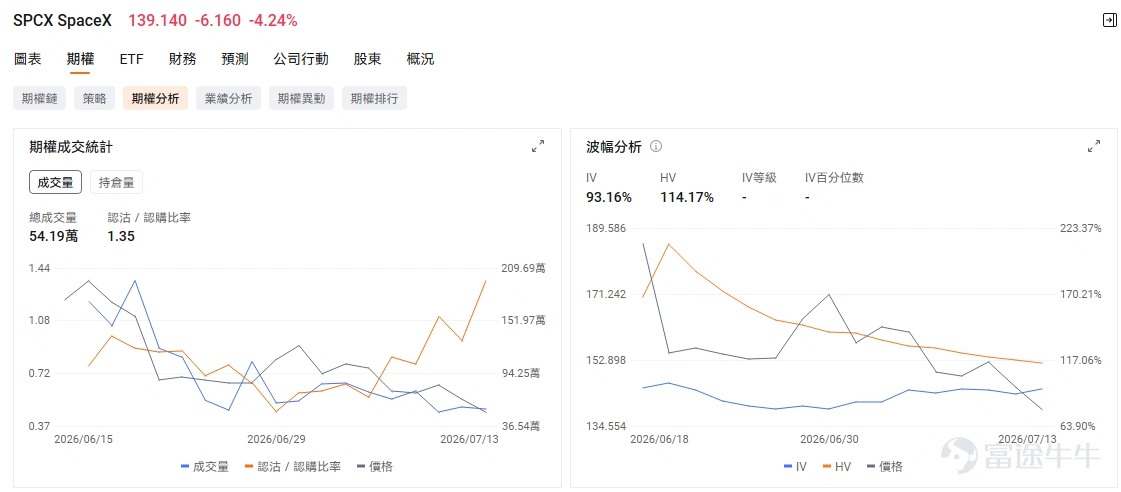
This was also the reason behind the simultaneous losses in both calls and puts ('double kill') for SPCX at that time.Option prices are influenced by the underlying stock’s direction, implied volatility (IV), and time value. When IV drops sharply from an extremely high level, both calls and puts suffer vega losses; short-dated options also experience accelerated time decay. If the underlying stock’s upside is insufficient while IV collapses rapidly, calls may decline instead of rising. Similarly, if the underlying stock drops but quickly stabilizes, puts may lose value due to declining volatility and time decay. This effect becomes more pronounced as expiration approaches.
Therefore, after SK hynix options are listed, even with a correct directional view on the underlying stock, naked calls or naked puts could still incur losses.
For bullish investors, a bull spread can be constructed in two ways: a bull call spread involves selling a call option with a higher strike price to offset the premium cost driven by high implied volatility (IV), though this caps the upside profit potential; alternatively, a bull put spread can be used, which involves selling a put at a higher strike price and buying a put at a lower strike price to establish a bullish position.
For bearish investors, a bear spread can similarly be constructed using either calls or puts. A bear put spread—buying a put vertical spread—reduces the cost of insurance compared to holding a naked put. Alternatively, a bear call spread can be implemented by selling a call vertical spread: selling a call at a lower strike price and buying a call at a higher strike price to establish a bearish position.
After the options launch, the following key price levels warrant attention:
$149–150
– Near the IPO offering price; $150 is also the most common round-number strike price in the options market
– Likely to become the zone with the highest concentration of call and put open interest
– Determine whether the short-term price action holds above the IPO price and rebounds, or enters into below-IPO trading
USD 160
– First-phase rebound target
– If call options see concentrated aggressive buying, it may trigger market makers to buy more shares for delta hedging, pushing the stock price toward $160
USD 170
– Approaching the IPO day's trading range, where significant positions were accumulated by initial buyers
– Trapped longs, profit-taking positions, and covered call sellers may increase, collecting option premiums in a high implied volatility (IV) environment
– Even if the underlying stock experiences a gamma squeeze rebound, the pace of upward movement is likely to slow upon reaching this zone
$140–$145
– Potential downside battle zone if $150 is breached
– If $150 is broken and there’s concentrated aggressive buying in the $145 put, market makers’ short hedging could amplify the decline
– $140 could serve as the second key level where the market reassesses the ADR’s fair premium
Finally, we have a small gift for our fellow investors—feel free to claim it!Options Starter Pack
*This promotion is exclusively available to invited HK users. Click to learn more.Detailed terms and conditions of the promotion >>
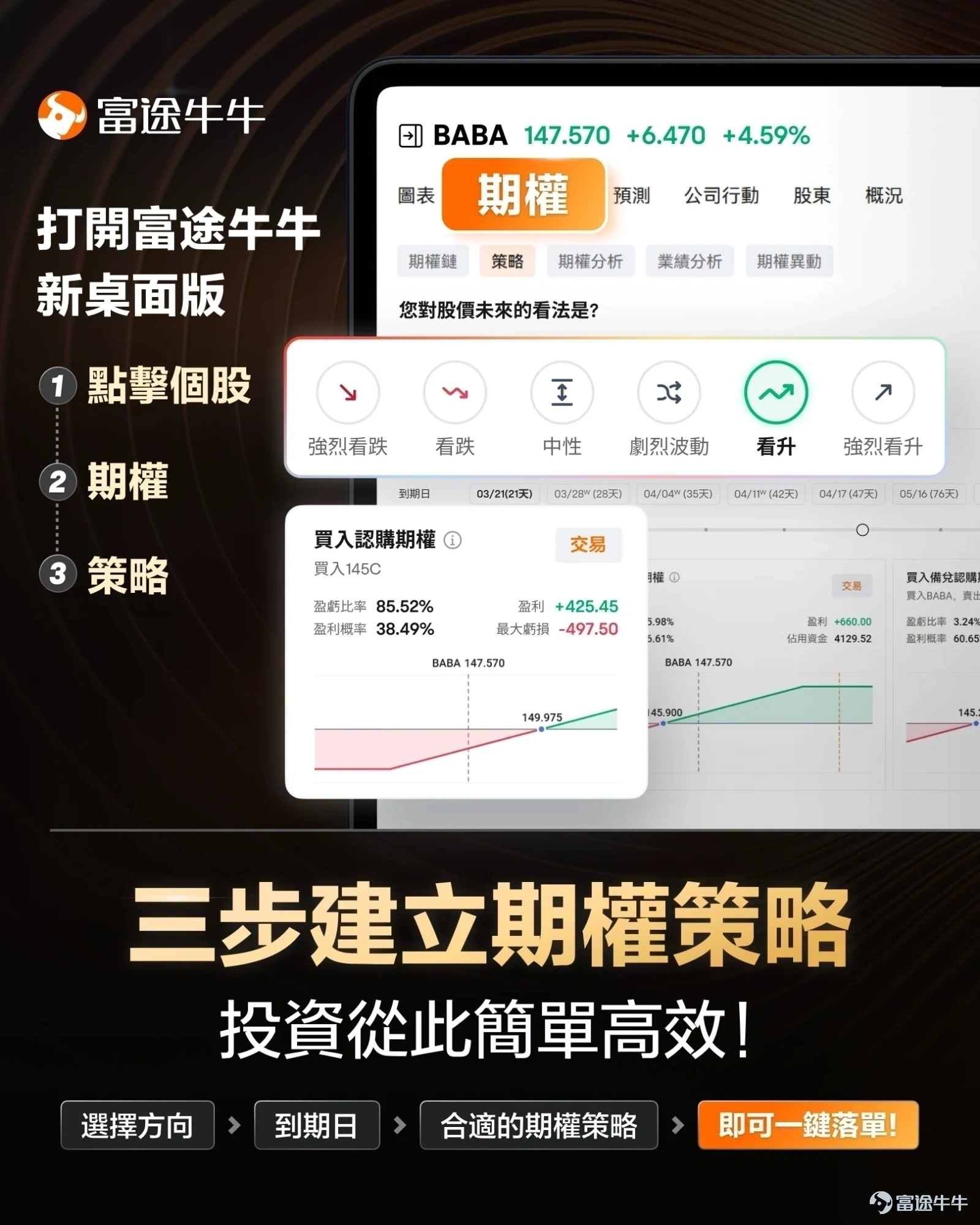
Market conditions are complex and ever-changing,Options strategiesToo many choices and unsure how to decide? Futubull helps you build yourOptions strategies, making investing simple and efficient from now on!
Options Risk Disclosure:An option is a contract that gives the holder the right—but not the obligation—to buy or sell an underlying asset at a predetermined price on or before a specific date. Option prices are influenced by multiple factors, including the current price of the underlying asset, the strike price, time to expiration, and implied volatility. Implied volatility reflects the market’s expectation of future price fluctuations over the option's life and is derived by reversing the Black-Scholes option pricing model. It is commonly viewed as a gauge of market sentiment. When investors anticipate greater volatility, they may be willing to pay higher premiums for options to hedge their risk, resulting in higher implied volatility. Traders and investors use implied volatility to assess the attractiveness of option prices, identify potential mispricings, and manage risk exposure.
Disclaimer:This content does not constitute an offer, solicitation, recommendation, advice, opinion, or any guarantee regarding any securities, financial products, or instruments. The risk of loss in trading options can be substantial. In certain circumstances, your losses may exceed the initial margin deposit. Even if you set contingent orders such as 'stop-loss' or 'limit' orders, there is no assurance these will prevent losses. Market conditions may render such orders unexecutable. You may be required to deposit additional margin on short notice. If you fail to meet the margin call within the specified timeframe, your open positions may be liquidated. You remain fully liable for any deficit balance in your account resulting from such liquidation. Therefore, prior to trading options, you should thoroughly research and understand options and carefully consider whether such trading aligns with your financial situation and investment objectives. If you trade options, you should be familiar with the procedures for exercising options and handling expiration, as well as your rights and obligations upon exercise or expiration. Options trading involves substantial risk and is not suitable for all investors. Investors should carefully read"Characteristics and Risks of Standardized Options"。
Risk Disclaimer: The above content only represents the author's view. It does not represent any position or investment advice of Futu. Futu makes no representation or warranty.Read more


Comments (6)
to post a comment
36
150