
US Stock Market Chat | NVIDIA is about to report earnings; can it avoid a drop this time?

Hot Topics in 5 Minutes | Q2 US Earnings Season Officially Kicks Off Tonight! Full Practical Guide Inside
The Q2 U.S. earnings season officially kicks off tonight, Tuesday, July 14.
As the traditional 'starting gun,' $JPMorgan (JPM.US)$ will be the first to report its Q2 2026 results before the U.S. market open. Other Wall Street giants, including $Bank of America (BAC.US)$ 、 $Citigroup (C.US)$ 、 $Goldman Sachs (GS.US)$ and $Wells Fargo & Co (WFC.US)$ , will also release their earnings on the same day. For investors, earnings season is not only a litmus test for companies’ true performance but also a critical window for positioning portfolios in the second half of the year.
This article will guide you from the basics to deeper insights, covering market expectations for this earnings season, practical interpretation techniques, and key focal points going forward.
Q2 U.S. earnings are expected to sustain strong growth, with AI remaining the decisive factor.
Most U.S. companies follow the calendar year for their fiscal reporting, so the Q2 earnings season primarily reflects corporate performance from April to June. The intense reporting period typically runs from mid-July through mid-August.
By Wall Street convention, large banks always open the earnings season.This is because the banking sector sits at the nexus of the real economy—corporate financing, consumer spending, and signs of credit expansion or contraction are all faithfully reflected on banks’ balance sheets. As such, earnings from major banks like JPMorgan are often viewed as a 'thermometer' for the entire U.S. earnings season and a 'stress test' for the broader U.S. macroeconomy.
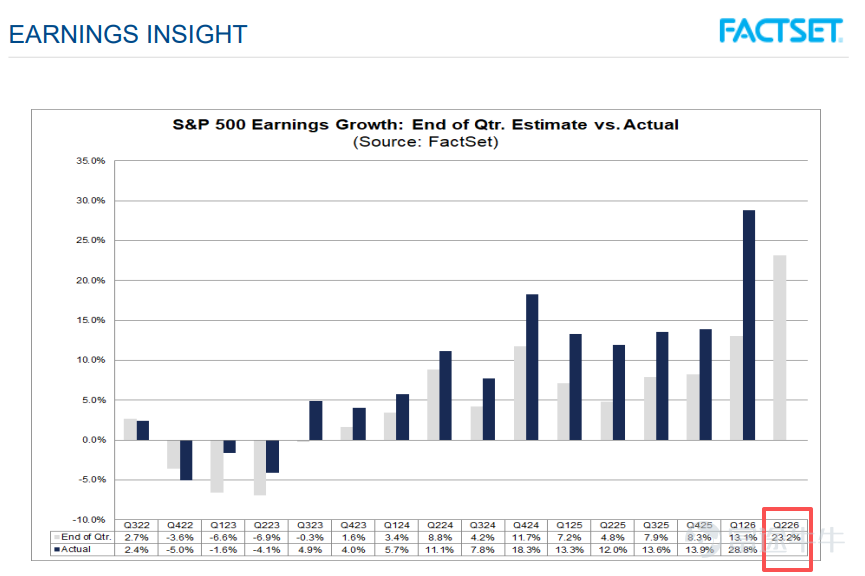
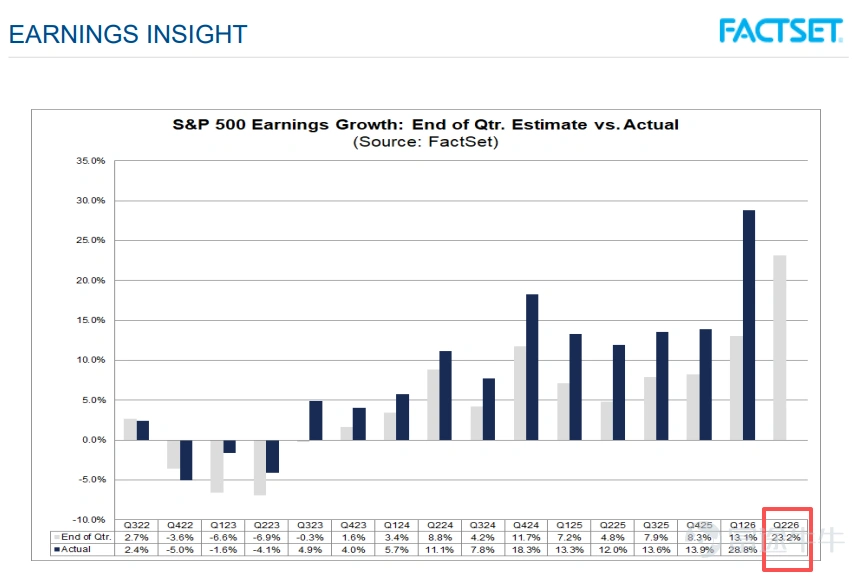
Market expectations for this quarter's earnings are quite optimistic. According to the latest forecast from data provider FactSet, $S&P 500 Index (.SPX.US)$ second-quarter earnings for index constituents are expected to grow by 23.2% year-over-year, extending the strong performance seen in the first quarter.
For the bank stocks kicking off earnings reports tonight, investors should focus on three key dimensions.First is guidance on net interest income—watch whether management revises its outlook due to shifts in the interest rate path, which would directly set expectations for banks’ second-half revenue. Second is credit quality and loan loss provisions, which reflect consumers’ repayment capacity; a significant increase in provisions could signal underlying cracks in the broader economy. Third is capital return plans, particularly the scale of share buybacks, which directly impacts shareholders’ interests. Additionally, $SpaceX (SPCX.US)$ large IPOs and robust trading activity in U.S. equities are also expected to boost revenues for these major banks.
Of course, banks are just the appetizer—the AI sector is currently the key driver of U.S. market direction.AI-related stocks now account for 42% of the total market capitalization and are expected to contribute more than half of the earnings growth this reporting season.
Earnings Season Practical Guide: Step-by-Step Interpretation
Faced with an overwhelming amount of earnings data, beginners often don’t know where to start. Using BullBull tools effectively can significantly boost your efficiency.
Before earnings season begins, you can start by checking the 'Earnings Calendar.'U.S. companies typically release their earnings before or after market hours. Converted to Beijing time (Daylight Saving Time), pre-market releases correspond to 16:00–21:30 on the same day, while after-hours releases fall between 04:00–08:00 the following morning.Using an earnings calendar to mark in advance the release dates of stocks you're watching can help you avoid last-minute panic and prepare your position management ahead of time.

After earnings are released, go to the 'Company' page and focus on several key metrics.The most fundamental figures are earnings per share (EPS) and revenue—these two numbers form the bedrock for assessing a company's profitability.However, looking at absolute values alone isn't enough; you must compare them against Wall Street analysts’ 'consensus estimates.' If actual results beat expectations, it's considered 'better-than-expected,' which usually drives short-term stock price gains; conversely, missing expectations often triggers a pullback. For tech companies, both EPS and revenue typically need to beat estimates simultaneously to truly ignite market enthusiasm.
Yet even more critical than current-quarter historical results is 'guidance.' Earnings reflect the past three months of operations, but the stock market trades on future expectations. Management’s forecast for next quarter’s—or even the full year’s—revenue and profits during the earnings call is what truly determines stock price direction. A company can deliver mediocre current-quarter results yet see its stock soar if it significantly raises guidance; conversely, even if quarterly profits double, a bleak outlook can still send the stock plunging.
After reviewing the numbers, don’t miss the 'earnings call.' This is where the CEO and CFO directly engage with analysts, and it often contains far richer insights than the cold, hard data in earnings tables.
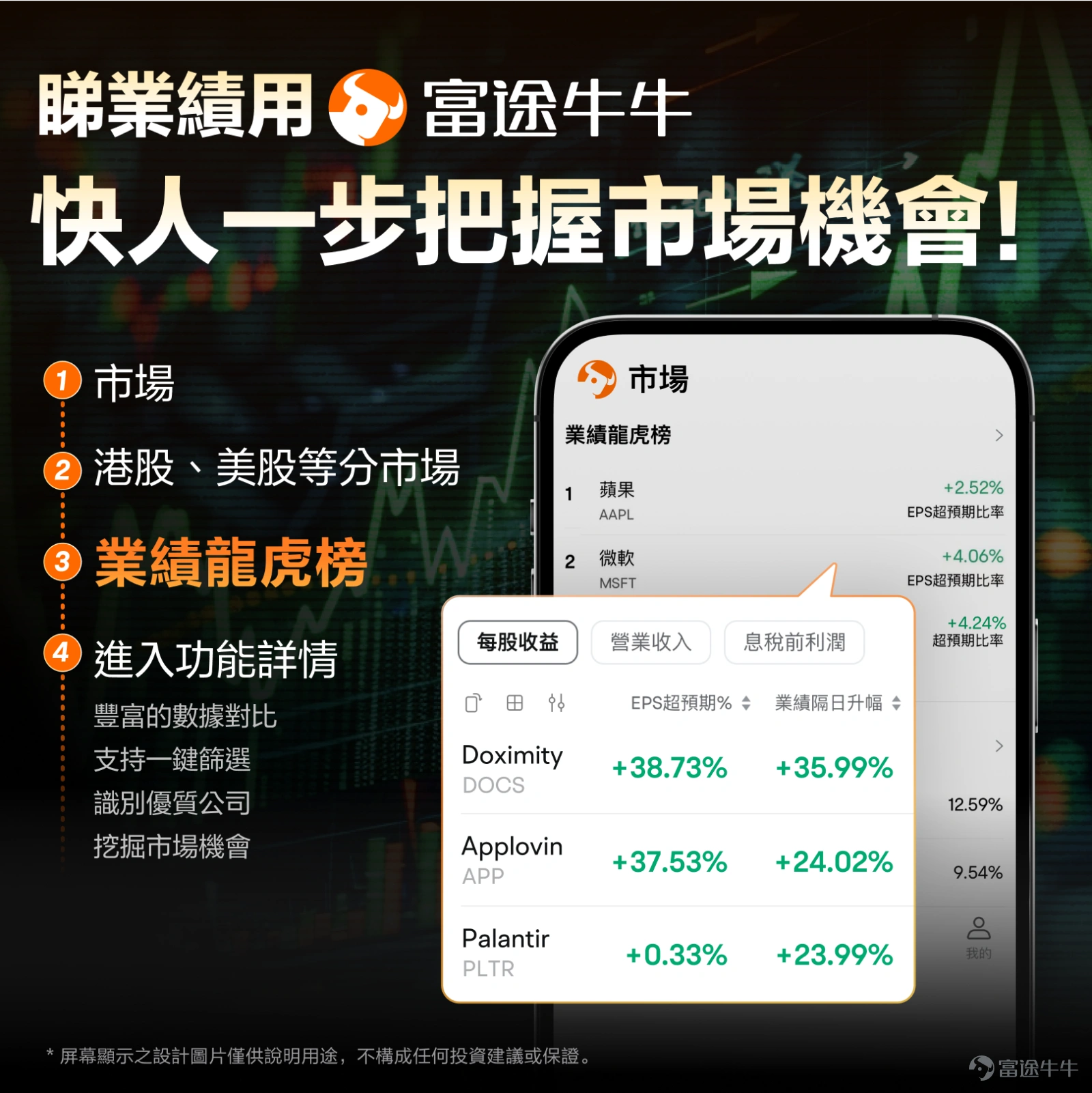
Niuniu’s 'Earnings Flash' feature helps you quickly get a big-picture view by consolidating performance data for all stocks that have reported earnings.The 'Earnings Leaderboard' aggregates financial results from all companies that have reported, making it easy to quickly identify which sectors are collectively beating expectations and which are experiencing widespread disappointments—helping you spot sector rotation opportunities.
Earnings announcements are inherently high-risk events, and their directional impact is hard to predict. If you’re concerned about volatility around earnings, consider moderately reducing your position in a stock one or two weeks before the release. Avoiding pure 'earnings bets' is a prudent risk-control strategy. Wait until results are out, then decide whether to re-enter based on the outcome and guidance. If a stock tumbles despite beating expectations, this is often a 'sell-the-news' reaction—meaning the market may have already priced in the positive news—and it’s unwise to blindly buy the dip in such cases.
Moreover, if you’d like to avoid the volatility risk of individual stocks, you could consider using ETFs (such as those tracking the Nasdaq 100 $Invesco QQQ Trust (QQQ.US)$or semiconductor ETFs $iShares Semiconductor ETF (SOXX.US)$) instead of individual stocks. This way, even if one company reports a major earnings miss, diversification can help smooth out the risk.At the same time, pay attention to sector-wide联动 effects—earnings from industry leaders often set the tone for the entire sector’s performance. For example, NVIDIA beating expectations typically lifts the entire AI chip supply chain broadly.
Key focus areas this week and beyond
This week (July 13–18) marks the first true 'super week' of the second half of 2026, where macroeconomic data and corporate earnings will collide dramatically. Three key themes will shape the direction of U.S. equities for the rest of the year.
The most critical day is July 14.On this day, not only will JPMorgan and four other major banks kick off Q2 earnings season, but the U.S. June CPI data will also be released that evening. Additionally, it will be new Fed Chair Wallsh’s first Congressional testimony since the June FOMC meeting.
Persistently high inflation underpins the current high-rate environment. Goldman Sachs economists forecast that headline CPI for June will come in at -0.11%, primarily dragged down by energy prices, while core CPI is expected to rise 0.17% month-over-month. If inflation continues its cooling trend, market concerns about an overly hawkish Fed would ease significantly. Wallsh’s congressional testimony will be scrutinized word-for-word by markets, and any hint regarding the July rate decision could trigger sharp volatility. Currently, the market-implied probability of a July rate hike stands at just 24%; a dovish tone from Wallsh would provide strong liquidity support for equities.
The second key theme centers on the semiconductor and AI sectors. After banks open earnings season, the baton will pass to tech giants.On July 15, European semiconductor equipment giant $ASML Holding (ASML.US)$ will release its earnings results. The market will closely watch its orders for advanced-process equipment and its capital expenditure outlook related to AI chips.
Then on July 16, $Taiwan Semiconductor (TSM.US)$ Taiwan Semiconductor will report Q2 earnings. As the sole core foundry for global AI computing chips, TSMC’s results serve as the ultimate litmus test for the authenticity of AI demand. Investors should closely monitor its AI-related revenue share, utilization rates of advanced-process capacity, and whether its full-year capex guidance is raised. After market close the same day, streaming giant Netflix will also report earnings; its subscriber growth and progress in monetizing its ad-supported tier will test the profitability of tech stocks outside the AI space.
Looking ahead to the rest of earnings season, late July to early August will bring a concentrated wave of reports from the Mag 7. Their capital expenditure guidance will directly determine how long the AI compute supply chain can sustain its current boom.
In summary, tonight’s JPMorgan earnings are just the beginning. From major banks’ credit data to cooling CPI inflation, from Taiwan Semiconductor’s capacity utilization to the Mag 7’s capex guidance, this week will subject U.S. equities to a comprehensive stress test.For new investors, this is the most vivid investment classroom of the year. Rather than trying to precisely predict every market move, it’s better to stay calm, leverage available tools, and learn to interpret the underlying business logic behind earnings reports.
As Benjamin Graham, the father of value investing, once said: 'In the short run, the market is a voting machine; in the long run, it is a weighing machine.'Ultimately, earnings season measures whether companies can translate the tailwinds of the era into tangible capital returns.Stay calm and interpret results rationally—you’ll find your own course through the turbulent earnings season.
Risk Disclaimer: The above content only represents the author's view. It does not represent any position or investment advice of Futu. Futu makes no representation or warranty.Read more


Comments
to post a comment
16
20