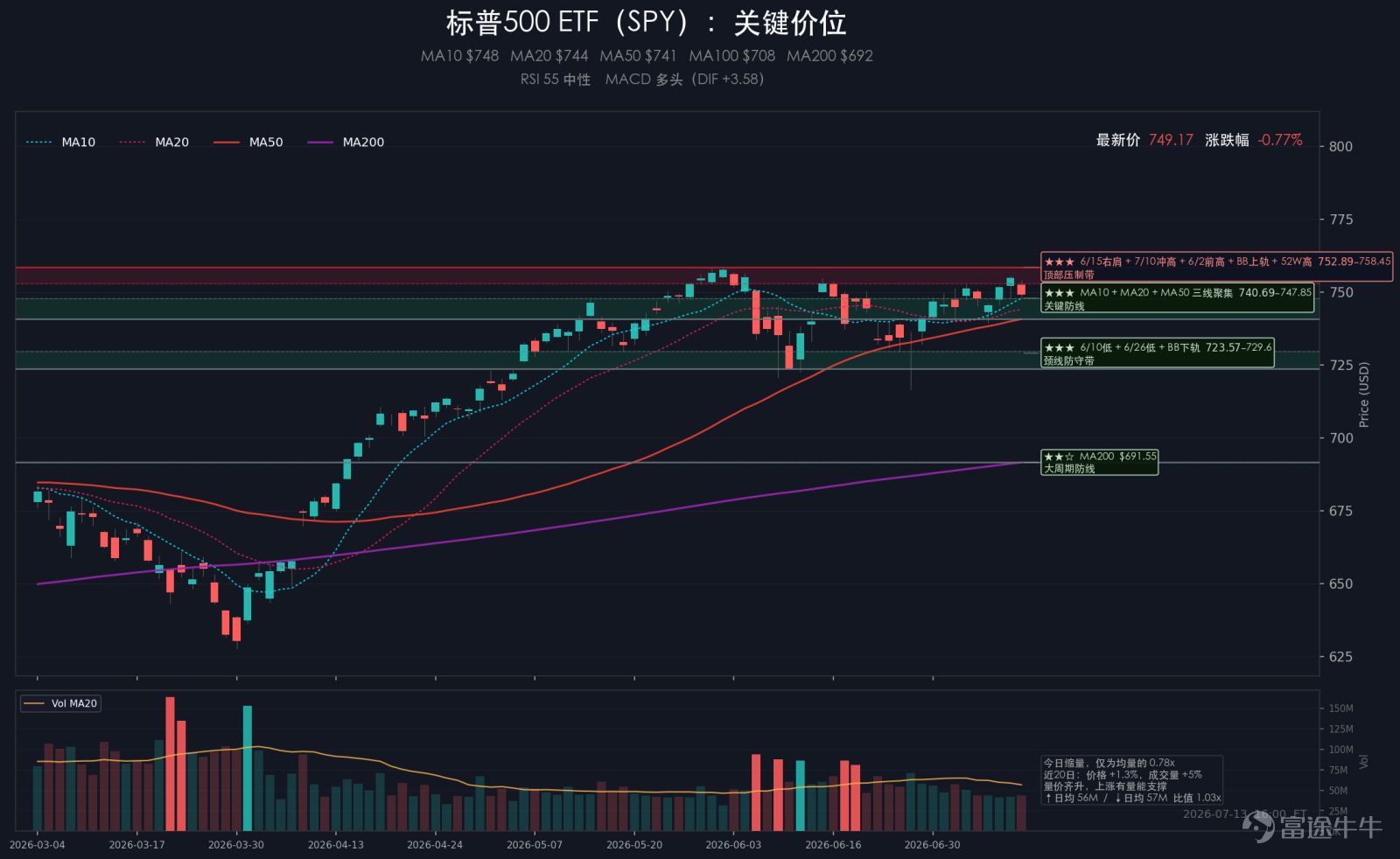

Wall Street Brief (July 14): U.S. equities retreated across the board on Monday, led by the Nasdaq and semiconductor sectors, with sentiment indicators turning notably cautious; markets repriced geopolitical and inflation risks, pushing oil prices and U.S. Treasury yields higher.
Summary: U.S. equities declined across the board on Monday, with the S&P 500 down 0.79%, the Nasdaq falling 1.55%, the Dow Jones Industrial Average dropping 0.26%, and the Russell 2000 slipping 0.83%. The Nasdaq’s steeper decline relative to the more resilient Dow suggests the market primarily compressed high-valuation tech and growth segments. The VIX rose to 17.16, up 14.17% on the day, reflecting a clear shift toward risk-off sentiment. Trump announced a renewed blockade on Iran and proposed charging fees for cargo passing through the Strait of Hormuz, prompting markets to reprice upward expectations for oil prices, inflation, and long-term interest rates. In sector performance, energy stocks gained despite the broader sell-off, while semiconductors, memory chips, and high-beta growth names came under pressure. Across major asset classes, the 10-year U.S. Treasury yield rose 0.88%, gold fell 2.86%, crude oil surged 9.08%, Bitcoin dropped 3.07%, and the U.S. Dollar Index climbed 0.32%.

I. Major Events
1. Trump Announces Renewed Iran Blockade and Proposes Fees for Strait of Hormuz Transit
On July 13, Trump stated that the U.S. would reinstate its blockade on Iran and proposed imposing fees on cargo transiting the Strait of Hormuz. As one of the world’s most sensitive energy transit chokepoints, this statement prompted markets to reprice risks related to supply disruptions and higher shipping costs. Oil prices quickly surged, dragging up inflation expectations, long-term interest rates, and the dollar in tandem, while valuation pressures on tech and growth assets intensified accordingly.
2. Fed Governor Waller: Policy Tightening Possible Soon If Inflation Remains Elevated
On July 13, Waller noted that the U.S. economy and labor market remain robust, but if incoming data over the next few weeks continues to show inflation running high or even accelerating, monetary policy tightening may be warranted soon. He highlighted tariffs, energy prices, and spillovers from AI infrastructure investment as key current drivers of price pressures. This made it harder for markets to dismiss the day’s oil-driven shock as a one-off noise event, fueling further upside in long-end yields and intensifying the pressure on high-valuation segments like the Nasdaq and semiconductors.
II. Major Trends
All four major indices retreated on Monday, but the divergence was clear. The Nasdaq saw the largest decline, while the Dow held up relatively better, indicating the market wasn’t simply engaging in broad risk-off behavior but rather repricing sectors that are more sensitive to interest rates and carry higher valuations.
From a medium-term structural perspective, growth-style assets remain dominant. QQQ rose 15.41% over three months, continuing to outperform DIA’s 9.19%; SPYG gained 11.82% over the same period, also significantly outpacing SPYV’s 6.80%. The intermediate-term theme of this rally hasn’t been fundamentally broken, though short-term volatility has clearly intensified.
In the short term, SPY gained 1.10% over two weeks, while IWM fell 1.84%, showing small caps have already weakened first. Meanwhile, QQQ dropped 1.70% over two weeks and XMAG declined 1.03%, indicating leading tech stocks have entered a pullback phase. The market currently appears to be consolidating at elevated levels rather than re-entering a broad-based rally.
III. Market Sentiment
Market sentiment cooled noticeably on Monday. The VIX rose to 17.16, up 14.17% in a single day; the CNN Fear & Greed Index fell to 44 from the previous reading of 48. As volatility picked up, sentiment indicators also shifted toward a more cautious stance, with the market beginning to reprice geopolitical and inflation risks.
The CBOE total put/call ratio stood at 0.79, with the index options put/call ratio at 1.12 and the equity options put/call ratio at 0.67. There was no sign of widespread panic in individual stocks, but demand for index protection rose markedly—consistent with the day’s pattern of a weaker Nasdaq and a relatively resilient Dow.
IV. Market Scan
1. Index ETFs
On Monday, the divergence among major index ETFs was primarily between large-cap vs. small-cap and tech-weighted exposure. QQQ fell 1.90%, the worst performer, while IWM declined 0.81%, and DIA held up relatively better. This structure suggests capital is exiting high-valuation tech and more volatile segments first, rather than indiscriminately selling all risk assets.
2. Sector Performance
Energy (XLE) led gains with a 3.01% rise, while technology (XLK) was the weakest, down 2.42%, and consumer discretionary (XLY) fell 1.02%. The sector logic was straightforward that day: surging oil prices boosted energy, while rate and valuation pressures weighed on tech and growth names.
At the sub-industry level, oil & gas exploration (XOP) rose 4.17%, leading gains. On the downside, DRAM plunged 9.11%, uranium mining (URA) fell 5.24%, semiconductors (SMH) dropped 4.16%, solar (TAN) declined 3.35%, and both copper miners (COPX) and gold miners (GDX) fell 2.86%. Aside from energy, high-beta segments broadly came under pressure, with chips and memory-related names seeing especially pronounced pullbacks.
3. The Magnificent Seven Tech Stocks
Among the Magnificent Seven tech stocks, Microsoft rose 1.53%, making it the relative outperformer, while NVIDIA fell 3.52% and Tesla dropped 3.19%. Not all mega-cap tech names weakened together; investors showed greater willingness to stay invested in companies with stronger earnings and cash flow visibility.
4. Chinese ADRs
U.S.-listed Chinese stocks lacked a unified direction. NetEase rose 2.66%, JD.com gained 2.41%, and Baidu fell 3.52%. Market activity that day was primarily driven by U.S. macroeconomic and interest rate dynamics, with U.S.-listed Chinese stocks showing greater divergence on an individual basis.
5. Cryptocurrencies
Bitcoin dropped 3.07%, CRCL declined 4.75%, and MSTR fell 2.68%. As risk appetite waned, crypto assets and related equities came under simultaneous pressure, reflecting a clear decline in market tolerance for these highly volatile assets.
$S&P 500 Index (.SPX.US)$ $SPDR S&P 500 ETF (SPY.US)$ $NASDAQ 100 Index (.NDX.US)$ $Invesco QQQ Trust (QQQ.US)$ $Dow Jones Industrial Average (.DJI.US)$ $State Street® SPDR® Dow Jones Industrial Average® ETF Trust (DIA.US)$ $Russell 2000 Index (.RUT.US)$ $iShares Russell 2000 ETF (IWM.US)$ $Roundhill Magnificent Seven ETF (MAGS.US)$ $USD (USDindex.FX)$ $U.S. 10-Year Treasury Notes Yield (US10Y.BD)$ $iShares 20+ Year Treasury Bond ETF (TLT.US)$ $XAU/USD (XAUUSD.CFD)$ $SPDR Gold ETF (GLD.US)$ $CBOE Volatility S&P 500 Index (.VIX.US)$ $CME-Bitcoin RR Futures (AUG6) (BTCmain.US)$ $iShares Ethereum Trust ETF (ETHA.US)$ $NVIDIA (NVDA.US)$ $Tesla (TSLA.US)$ $Meta Platforms (META.US)$ $Amazon (AMZN.US)$ $Alphabet-C (GOOG.US)$ $Microsoft (MSFT.US)$ $Apple (AAPL.US)$
Risk Disclaimer: The above content only represents the author's view. It does not represent any position or investment advice of Futu. Futu makes no representation or warranty.Read more


Comment (1)
to post a comment
7