
IPO Preview | Outsourced R&D Exposes Hollowed-Out Technology; Rongxin Shulian’s AI Story Falters Amid Accelerating Profit Recognition
The global generative AI boom is now thrusting decision-making AI into the spotlight of capital markets.
Following BAI RONG YUN-W (06608) $BAIRONG AI-W (06608.HK)$ which became the first to list on the Hong Kong Stock Exchange in 2021, the decision-making AI segment in Hong Kong saw significant acceleration in 2026, with HaiZhi Technology (02706) $HAIZHI TECH GP (02706.HK)$ , DeepIntent Intelligence (02723) $DEEPZERO (02723.HK)$ , and Zhongke Wenge (01956) $WENGE AI (01956.HK)$ all completing their initial public offerings within the year.
Meanwhile, Huayuan Computing and Rongxin Shulian have also filed prospectuses, positioning themselves for imminent listings on the Hong Kong Stock Exchange. Transitioning from 'solo breakthroughs' to 'cluster listings,' the Hong Kong market is gradually establishing a comprehensive valuation framework for the decision intelligence sector.
Zhitong Finance observed that on June 17, Rongxin Shulian submitted its listing application to the Main Board of the Hong Kong Stock Exchange, with Hony Capital serving as the sole sponsor. According to Frost & Sullivan data, based on revenue in 2025, Rongxin Shulian ranked ninth in China's decision intelligence applications industry, holding a market share of approximately 1.3%.
Notably, Rongxin Shulian has already achieved profitability. From 2023 to 2025, Rongxin Shulian’s revenue was approximately RMB 280 million, RMB 281 million, and RMB 381 million, respectively, demonstrating steady growth; during the same period, its adjusted net profit amounted to RMB 22.035 million, RMB 29.923 million, and RMB 42.787 million, representing a compound annual growth rate of 39.28%.
Compared to the industry norm of listing while incurring widespread losses, Rongxin Shulian's achievement of profitability is undoubtedly a major highlight. However, precisely because of this, potential underlying concerns facing Rongxin Shulian have also come to light.
"Cost reduction and efficiency enhancement" accelerates profit realization, while outsourced R&D reveals technological "hollowing out"
Founded in 2015, Rongxin Shulian has consistently focused on decision intelligence solutions. To date, the company’s decision intelligence solution integrates four core modules: 'Dai'—an intelligent data-driven decision suite, 'Han'—a converged analytics data platform, 'Ge'—a data governance toolkit, and 'Jun'—a secure and trusted data framework. Leveraging these four modules, Rongxin Shulian’s decision intelligence solution delivers end-to-end capabilities across the entire data lifecycle, enabling customers to systematically acquire, integrate, analyze, and operationalize data to support intelligent decision-making.
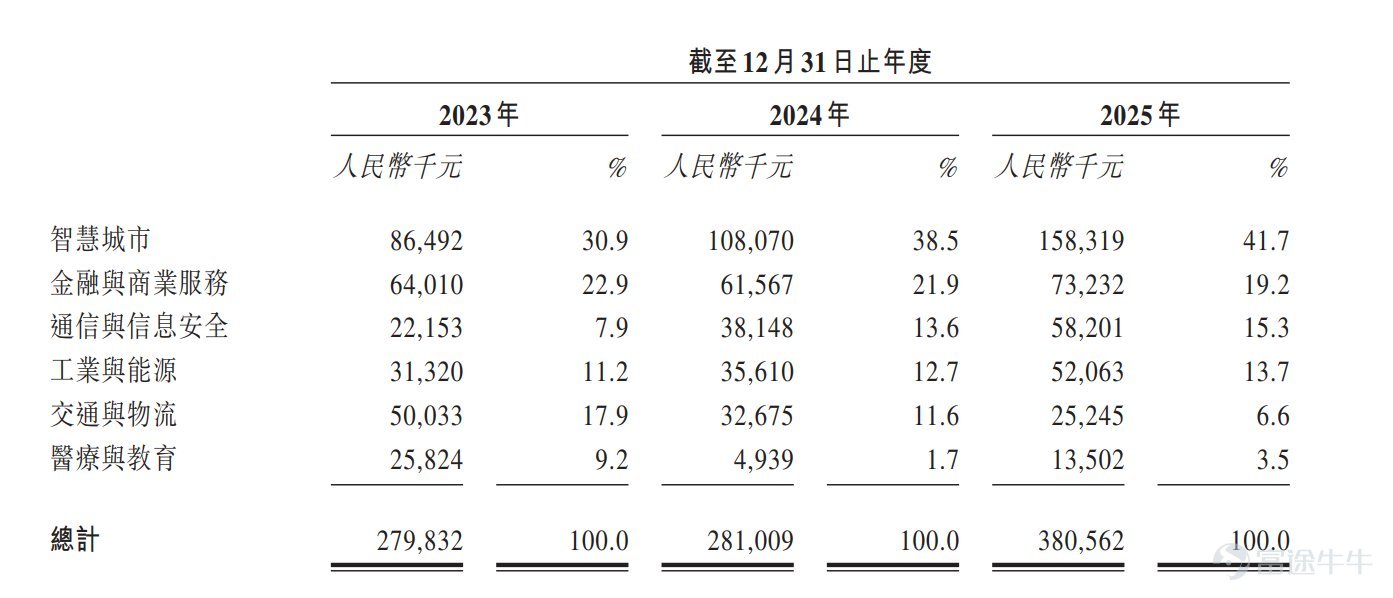
According to the prospectus, Rongxin Shulian’s decision intelligence solutions have achieved full-scenario penetration across six sectors: smart cities, financial and commercial services, communication security, industrial energy, transportation and logistics, and healthcare and education. Among these, smart cities serve as the core pillar, contributing 41.7% of revenue in 2025; financial and commercial services, communication and information security, and industrial and energy followed closely with respective shares of 19.2%, 15.3%, and 13.7%; transportation and logistics, along with healthcare and education, currently account for smaller proportions at 6.6% and 3.5%, respectively.

Rongxin Shulian’s steady yet growing revenue since 2023 is primarily attributed to the continuous expansion of its products across various sectors. Revenue from smart cities rose steadily from RMB 86.492 million in 2023 to RMB 158 million in 2025, consistently acting as a stabilizing anchor. Meanwhile, communication and information security, as well as industrial and energy segments, also recorded sustained revenue growth. Only the transportation and logistics segment experienced continuous revenue decline.
Amid steady revenue growth, Rongxin Shulian’s accelerated profit realization mainly stems from the continuous decline in total operating expenses as a percentage of total revenue. From 2023 to 2025, total operating expenses accounted for 27.08%, 23.36%, and 16.84% of total revenue, respectively—a drop of over 10 percentage points in two years.
This profit boost driven by 'cost reduction and efficiency enhancement' essentially reflects operational leverage adjustment rather than direct evidence of organic business growth momentum. As expense ratios approach a critical threshold, the marginal effectiveness of this strategy may gradually diminish. Moreover, a deeper breakdown of the three major expense categories reveals even more critical details.
Taking 2025 as an example, Rongxin Shulian’s sales and marketing expenses, general and administrative expenses, and R&D expenses accounted for 2.44%, 3.02%, and 11.38% of total revenue, respectively, with relatively low shares for sales and marketing and administrative expenses. This is largely because Rongxin Shulian does not follow the conventional AI company playbook of building a 'sales army + brand-driven field promotion + SaaS customer acquisition.' Instead, it relies on a model centered on winning tenders, subcontracting through third-party integrators, and securing long-term relationships with major clients.
According to the prospectus, in 2025, revenue from private-sector clients accounted for 65.5% of total revenue—mostly derived from third-party integrators—while revenue from state-owned enterprises and government entities made up the remaining 34.5%. Additionally, revenue from the top five clients exceeded 50% of total revenue in both 2024 and 2025. Given this client structure, Rongxin Shulian does not need to maintain a large in-house sales team, thereby achieving relatively low sales and marketing and administrative expense ratios.

Rongxin Shulian’s client structure is largely shaped by its product design. The company’s 'Data Intelligence Graph' technology—the integrated matrix of Dai, Han, Ge, and Jun—addresses only a specific segment of the value chain: 'data → integration → analysis → decision-making.' It does not offer full-stack, end-to-end solutions covering hardware procurement, application delivery, or ongoing operations and maintenance. Consequently, most of its products are embedded into prime contractors’ broader solutions as modular subcontractors, making the company’s procurement costs nearly equivalent to its cost of sales. In 2025, procurement costs accounted for as much as 96.9% of total cost of sales.

The allocation of R&D expenses further exposes the 'hollowed-out' technological foundation of Rongxin Shulian. According to its prospectus, in 2024 and 2025, 'R&D collaboration costs' accounted for as much as 93.7% and 93.9% of its total R&D expenditures, respectively. This so-called 'R&D collaboration' essentially involves outsourcing core technology development to academic institutions such as Peking University and third-party tech firms, which deliver results and provide guidance per contractual agreements.

Thus, Rongxin Shulian’s 'sustained profitability' is merely a financial reflection of its positioning as a 'module subcontractor': at the front end, it relies heavily on integrator channels and highly concentrated clients, compressing sales and marketing expenses to the bare minimum; at the midstream, it replaces in-house delivery with procurement costs amounting to 96.9% of revenue, effectively shifting sales expenses into cost of operations; and at the back end, it outsources core R&D under the guise of 'collaboration,' thereby avoiding the capital-intensive burden of maintaining an in-house technical team.
In today’s AI industry—where companies typically 'heavily invest in elite sales teams, relentlessly pursue proprietary technological moats, and fiercely compete for top talent'—Rongxin Shulian’s contrarian 'asset-light' strategy fully reveals its true business nature. Rather than labeling it an AI technology company, it would be more accurate to define it as a 'solution assembler' that depends on external technology inputs and excels at project integration.
Declining gross margins signal weak pricing power, and the number of newly signed projects continues to shrink.
In fact, Rongxin Shulian faces additional underlying operational risks beyond those already mentioned. A deeper review of its prospectus reveals more red flags that warrant investor caution, such as its persistently declining gross margin.
Prospectus data shows that between 2023 and 2025, Rongxin Shulian’s gross margin fell from 39.0% to 35.5%, marking three consecutive years of decline. The company attributes this primarily to securing more projects in the smart city and communications and information security sectors—projects that are typically large-scale and complex, entailing higher procurement costs, which consequently drag down gross margin levels.
This explanation implicitly acknowledges its 'volume-over-margin' growth strategy. Under a business model heavily reliant on third-party integrators and hardware procurement, Rongxin Shulian has had to concede profit margins to win large contracts, passively accepting the reality of 'high procurement costs and low gross margins.' This directly reflects its weak pricing power as a 'module subcontractor' within the industrial chain—its revenue scale may appear to be expanding, but its gross margin ceiling remains firmly capped.
Moreover, the number of newly signed projects by Rongxin Shulian continues to decline, potentially signaling weakening growth momentum. From 2023 to 2025, the company added 166, 105, and 92 new projects, respectively, showing a persistent downward trend. As of April 30, 2026, it had added only 36 new projects.

In terms of project value, at the beginning of both 2024 and 2025, the total contract value stood above RMB 110 million, providing a solid foundation for stable annual revenue. However, by early 2026, the value of unfulfilled contracts had sharply dropped to RMB 62.812 million, creating some pressure on 2026 performance realization. If the value of new contracts signed during the year fails to increase significantly, it could weigh on 2026 results—a test of the company’s ability to secure new orders.

Notably, although the decision AI sector remains a golden investment track, the intensity of competition cannot be overlooked. Frost & Sullivan forecasts that China’s decision intelligence application market will grow from RMB 38.1 billion in 2025 to RMB 80.4 billion by 2030, representing a compound annual growth rate of 20.5%, with the overall market sustaining double-digit expansion.
However, due to the rapid evolution of AI technology and the accelerating influx of new entrants, although the market remains relatively fragmented, competition is intensifying. In China's decision intelligence application market in 2025, the top five players held a combined market share of approximately 12.8%, while Rongxin Shulian ranked only ninth by revenue in 2025, with a market share of 1.3%. Given the ongoing intensification of market competition and Rongxin Shulian’s lack of scale advantage, there remains significant uncertainty as to whether its outsourced R&D model can establish a sustainable competitive edge.
Risk Disclaimer: The above content only represents the author's view. It does not represent any position or investment advice of Futu. Futu makes no representation or warranty.Read more
Comments
to post a comment