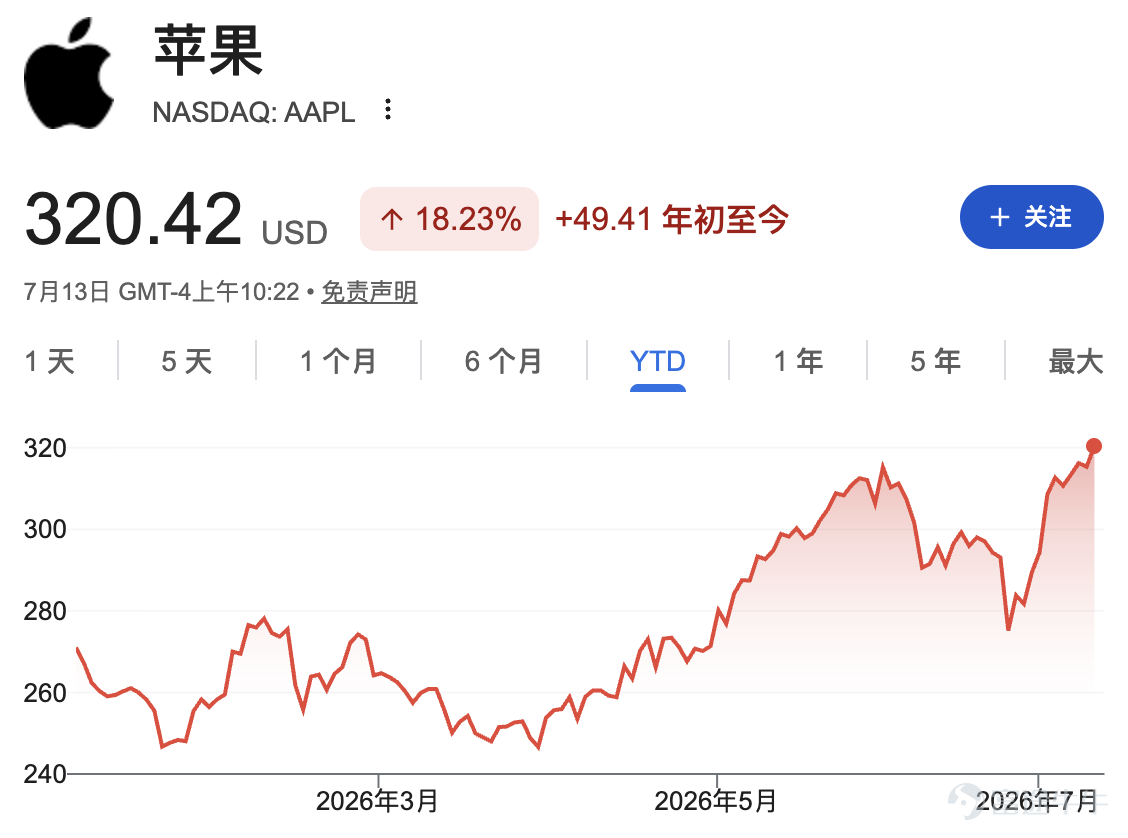

Cooling AI trade creates new winners: Apple leads the Mag 7 this year, rebounding 16% from its low and adding $650 billion in market value
Article author: Yang Chen
Source: Wall Street News
Amid mounting investor skepticism about the return outlook for artificial intelligence spending, capital has flowed back into Apple in force. Since hitting a low on June 25, Apple’s stock has risen 16%, adding roughly $650 billion in market value, and reached a record high on Monday. Meanwhile, the Philadelphia Semiconductor Index declined about 10% over the same period, while the Nasdaq 100 edged up just 0.3%.
Apple has risen 18% year-to-date, outperforming all other members of the Mag 7. In contrast, both Alphabet and Amazon have retreated more than 10% from their May highs, while Microsoft is down 20% this year—the worst annual performance since 2022.

Apple's strong performance reflects growing investor concerns about the AI infrastructure boom, which is shaking the traditional logic underpinning tech stocks. As chipmakers and cloud-computing giants come under pressure, Apple—having avoided deep involvement in the data-center arms race—is increasingly seen by investors as a stable safe haven.
Meanwhile, the highly anticipated foldable iPhone, set to launch in September, is expected to further boost market confidence.
The reversal in market sentiment is fundamentally the result of mounting investor skepticism over whether massive AI investments will actually deliver returns.
“The market is going through a realignment, and Apple is benefiting right now from staying outside the AI storm,” said Mark Bronzo, Chief Investment Strategist at Rye Strategic Partners:
“Investors are concerned whether hyperscale cloud providers’ AI spending will yield reasonable returns, and some also believe semiconductor stocks have already run too far ahead. Together, these factors are driving capital back into Apple—a stable investment without these risks.”
Although it has recently pulled back amid doubts over the sustainability of AI-related computing spending, the Philadelphia Semiconductor Index is still up 78% year-to-date and is on track for its best annual performance since 1999.
Apple’s recent rally is not without challenges. Rapidly rising memory chip prices directly threaten the company’s profit margins. On June 25, Apple announced price increases across its entire lineup of Macs, iPads, and home devices, triggering its steepest single-day stock decline since April 2025.
This price increase did not include the iPhone, but the company hinted that more products could follow in the future. However, analysts generally believe the impact of higher prices on Apple's sales volume will be limited.
"Long-term trends suggest that pricing has had limited impact on multi-year sales opportunities. Apple has significantly raised prices across its product portfolio in the past, yet sales volumes have consistently grown," wrote JPMorgan analyst Samik Chatterjee in a research note dated July 7.
On the other hand, the foldable iPhone expected to launch in September is seen as a significant catalyst. According to Nikkei, Apple has informed suppliers that its production target for this year’s foldable iPhone is around 10 million units, higher than the previous forecast of 7 to 8 million units. The device is expected to carry a premium price tag, potentially encouraging more users to upgrade.
Louis Navellier, Chief Investment Officer at Navellier & Associates, stated:
"Although Apple isn’t weighed down by AI-related weakness, the main reason investors are reluctant to sell is the strong likelihood that the company is about to launch a blockbuster product. The foldable phone’s pricing advantage should more than offset the margin pressure from memory-related issues, and robust demand will meaningfully support the company’s growth."
On a fundamental level, Apple’s financial performance is accelerating.
Apple’s revenue for fiscal year 2026 (ending September 30) is projected to grow by nearly 15%, marking its fastest pace since 2021—when pandemic-driven demand sharply boosted electronics sales. Net income for the same period is expected to rise by 17%.
Cash flow performance stands out even more. Apple’s free cash flow this year is forecast to reach a record $140 billion, an increase of over 40% compared to 2025.
In contrast, Alphabet’s free cash flow is expected to decline by approximately 67% this year, to $21 billion. Against the backdrop of massive AI-related capital spending, Apple’s conservative expenditure strategy means it is accumulating cash far faster than other major tech companies.
Investors are paying a premium for the aforementioned advantages that is far from cheap.
Based on expected earnings over the next 12 months, Apple trades at approximately 34 times earnings—second only to Tesla among the Mag 7 and significantly above its historical average of 23 times over the past decade.
This partly explains why only 61% of Apple’s sell-side analysts tracked by Bloomberg assign it a buy rating—far below the roughly 90% buy ratings for Microsoft, Amazon, Meta, and NVIDIA, respectively.
Mark Bronzo of Rye stated:
“I currently hold NVIDIA rather than Apple because NVIDIA offers more compelling growth prospects and valuation appeal. However, as long as market uncertainty persists, Apple’s cash flow and services business will drive its stock price higher gradually. If you believe AI capital spending will continue to expand, buy NVIDIA; if you think it will slow down, Apple is the better choice.”
Risk Disclaimer: The above content only represents the author's view. It does not represent any position or investment advice of Futu. Futu makes no representation or warranty.Read more

Comments
to post a comment
1
1