
HK Stock Market Barometer | Divergence in Tech and Internet Stocks, Precious Metals Rebound! How to

Warrants Market Focus Stocks Observation | Funds are flowing back into banks and platform stocks, but what investors should really watch out for is: 'The stronger the rebound, the closer the call warrants get.'
Today, individual Hong Kong-listed stocks showed mixed performance. ICBC $ICBC (01398.HK)$ continued its upward trend, while CATL $CATL (03750.HK)$ rebounded from a low; Tencent $TENCENT (00700.HK)$ , Meituan $MEITUAN-W (03690.HK)$ gave back some gains following its earlier sharp rally, and Ganfeng Lithium $GANFENGLITHIUM (01772.HK)$ has declined for six consecutive days, hitting a year-to-date low.
Focusing solely on price changes makes it easy to interpret the market as 'strong stocks keep rising, weak ones await rebounds.' However, when examining together the underlying stock trends, institutional fund flows, warrant open interest movements, and key levels of bull/bear warrants, it becomes evident that these five spotlighted stocks are each in entirely different tactical positions.
To clarify: the warrant open interest data cited here is as of July 10, lagging behind the underlying stocks’ closing data as of July 13. Therefore, it should only be viewed as a footprint of investor positioning and does not reflect real-time capital direction on the day. Market observation data clearly distinguishes between these two sets of dates.

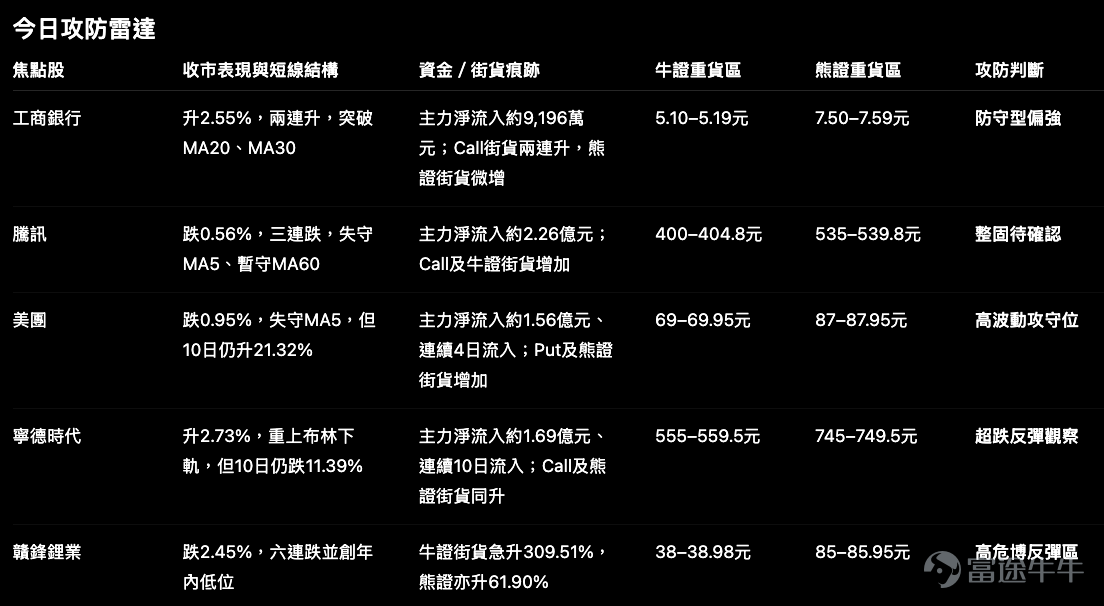
1. ICBC: The uptrend isn’t particularly aggressive; instead, it shows a relatively complete offensive-defensive structure today.
ICBC closed at HK$6.83, up 2.55%, with turnover of approximately HK$1.251 billion and net inflow of main force funds of about HK$919.6 million. Its volume ratio stands at 1.11. The stock has risen 6.22% over the past five days, 3.17% over the past ten days, and has posted gains for two consecutive days, breaking above both the 20-day and 30-day moving averages.
This stock is characterized not by explosive momentum, but by greater alignment among price movement, trading volume, and fund flow direction. Unlike some tech stocks that surge sharply only to retrace afterward, ICBC’s uptrend more closely reflects gradual capital rotation back into defensive sectors.
However, the footprint left by structured warrants (CBBCs) is not entirely one-sided. Call warrant open interest has risen for two consecutive days, reflecting that some investors are following the upward trend to position themselves; bear warrant open interest has also increased for two straight days, though the single-day increase was only 0.22%, possibly indicating that some traders are still establishing small short positions at higher levels.
How should we interpret the CBBC strike levels?
The major concentration zone for ICBC bull warrants lies between HK$5.10 and HK$5.19, which is quite far from the current price of HK$6.83; the bear warrant concentration zone is between HK$7.50 and HK$7.59, relatively closer to the upside.
This distribution indicates that:
– The bull warrant concentration zone currently poses no immediate knock-in risk;
– If the stock continues its upward momentum, the bear warrant zone near HK$7.50 will gradually draw market attention;
– However, a move from HK$6.83 to HK$7.50 would require an increase of nearly 10%, so forced buy-ins (short squeezes) are not imminent yet.
Product Strategy
For a moderately bullish position, prioritize slightly out-of-the-money call warrants with sufficient time to expiration, and avoid excessively out-of-the-money products merely for higher leverage. If using bull certificates, even if the current price is far from the recall price zone, it doesn’t mean all bull certificates are safe—terms with recall prices too close to the current price should still be avoided.
This stock is better handled with a 'trend continuation' mindset rather than expecting a sharp rally within a day or two.
2. Tencent: Funds are still present, but after increasing bull certificate positions, the key focus should be on downside resilience during pullbacks.
Tencent closed at HK$457.60, down 0.56%, with trading volume of approximately HK$11.25 billion. Mainstream funds recorded a net inflow of about HK$226 million, marking two consecutive days of inflows. The stock is still up 11.12% over the past 10 days, but has declined for three straight sessions and broken below the 5-day moving average (MA5), currently holding above the 60-day moving average (MA60).
This combination shouldn’t be simplistically interpreted as a sign of weakening.
The share price has pulled back, yet mainstream funds still show net inflows—resembling profit-taking after a sharp rally, while new buying interest remains. However, the volume ratio stands at only 0.51, with no clear signs of renewed trading expansion yet. Thus, this appears more like consolidation rather than the start of a new upward wave.
Open interest in call warrants rose for two consecutive days, and bull certificate open interest also increased for two straight days, up 8.86% in a single day. Conversely, put and bear certificate open interest continued to decline.
This indicates that, as of July 10, investor positioning clearly favored long positions. However, due to data lag, we wouldn’t directly interpret this as active buying today. More importantly, after the increase in long positions, market sensitivity to support levels will rise if the underlying stock continues to retrace.
What does the major open interest zone reveal?
The major open interest zone for Tencent bull certificates lies between HK$400 and HK$404.80, while that for bear certificates is between HK$535 and HK$539.80.
Neither side is particularly close to the current price, so there’s no clear short-term pinning pressure yet. However, the increase in bull warrant open interest suggests investors still lean toward betting on a rebound. If the stock fails to hold above the 60-day moving average (MA60), bull warrant holders may shift from 'waiting for a bounce' to 'forced position reduction.'
Product Strategy
At this stage, bullish investors should avoid chasing solely with high-leverage bull warrants and instead consider:
– Bull warrants whose call prices are sufficiently distant from the dense open interest zone between HK$400 and HK$404.8;
– Or slightly in-the-money, longer-dated call warrants, giving the underlying stock time to consolidate.
Bearish traders should not rush into bear warrants just because of a three-day decline. Tencent has still posted double-digit gains over the past 10 days, and institutional capital has not shown clear outflows yet. A genuine sign of weakness would be a break below MA60 without any buying support afterward.
III. Meituan: High risk-reward ratio, but both bullish and bearish positions are starting to accumulate pressure
Meituan closed at HK$77.95, down 0.95%, with turnover of approximately HK$3.122 billion and net institutional inflows of about HK$156 million—marking the fourth consecutive day of inflows. Although the share price dipped below the 5-day moving average (MA5), it is still up 4% over the past five days and a notable 21.32% over the past ten days.
On the surface, Meituan remains a stock with relatively strong short-term momentum; however, after a sharp 20% rally, it has now entered a phase where further upside requires new catalysts, while any pullback could easily amplify selling pressure.
Open interest patterns are also starting to reflect a defensive stance: call warrant open interest has declined for nine straight days, while put warrant open interest rose by 13.69% in a single day; bull warrant open interest dropped by 3.08%, whereas bear warrant open interest increased by 5.61%.
This does not directly equate to broad market bearishness, but it reflects that some investors have started reducing their long positions and increasing downside hedges after the sharp rally.
HK$69 and HK$87 form a clear support-resistance framework.
The major concentration zone for Meituan bull certificates lies between HK$69 and HK$69.95, while the next significant bear certificate zone is between HK$87 and HK$87.95.
Based on a reference price of HK$77.95, both zones are within approximately 12%—closer to the current price than those of other large-cap stocks. This implies that if Meituan’s price volatility expands further in either direction, it will more easily trigger market attention toward these heavy-position zones.
– Downward pullback: Bull certificate risk gradually rises near HK$69;
– Upside breakout: Bear certificates near HK$87 could become the next focal point;
– Mid-range scenario: The stock price may oscillate repeatedly between these two positioning zones.
Product Strategy
If you believe Meituan will continue its rebound, avoid selecting bull certificates too close to the HK$69 heavy-position zone. For call warrants, note that implied volatility may already be elevated following the sharp rally.
If you anticipate a near-term pullback, put warrants can help reduce mandatory call risk; however, avoid establishing bear certificates prematurely before the underlying stock confirms a breakdown below support, as Meituan’s capital flows have not yet fully weakened.
Meituan is currently not simply trending upward or downward, but rather entering a phase of widening volatility, marking key support and resistance levels.
4. CATL: Mainland institutional funds have flowed in for ten consecutive days, yet the stock price remains in a recovery phase following a decline.
CATL closed at RMB 603, up 2.73%, with a trading volume of approximately RMB 1.972 billion and net inflow of institutional funds amounting to about RMB 169 million, marking ten consecutive days of inflows.
However, the other side shouldn’t be ignored: the stock is still down 9.73% over the past five days, 11.39% over the past ten days, and 8.91% over the past twenty days. Market observations indicate that the price has merely rebounded back to the lower Bollinger Band.
This combination of 'sustained fund inflows alongside a still-weak share price' typically suggests two possible scenarios:
First, institutions may be accumulating shares at lower levels while awaiting trend recovery; second, the prior decline was too sharp, and current inflows are still insufficient to reverse selling pressure.
In terms of open interest, call options increased by 15.75%, while put options have declined for seven consecutive days; bull warrant open interest rose slightly, but bear warrant open interest surged by 189.11%.
This reflects that, as of July 10, the market simultaneously exhibits two opposing forces—those betting on a rebound and those chasing further declines—with clear divergence evident.
The major open interest zones are not close to the current price, but the directional divergence warrants closer attention.
The bull warrant concentration zone lies between RMB 555 and RMB 559.5, while the bear warrant concentration zone is between RMB 745 and RMB 749.5.
At RMB 603, the price is about 7%–8% away from the dense bull warrant zone and much farther from the bear warrant zone. Therefore, in the short term, the bull warrant support level below deserves more attention than the bear warrants above.
Product Strategy
For a mildly bullish stance, it’s unwise to chase leveraged products based solely on a single-day rebound. A more reasonable approach is to wait and see whether the stock price can consistently hold above the lower Bollinger Band before considering:
– Bull warrants with call prices well below the dense zone at RMB 555;
– Or longer-dated call warrants with lower degrees of out-of-the-moneyness.
Those leaning bearish should also note that institutional funds have recorded net inflows for 10 consecutive days. Even if the trend remains weak, it doesn’t mean one should unconditionally chase bear warrants after a sharp drop.
5. Ganfeng Lithium: What’s most noteworthy isn’t the decline itself, but the 309% surge in street-held bull warrants.
Ganfeng Lithium closed at RMB 40.6, down 2.45%, with turnover of approximately RMB 368 million. The share price has declined for six consecutive days, hitting a year-to-date low intraday; it fell 17.85% over the past 5 days, 16.97% over the past 10 days, and as much as 30.30% over the past 20 days.
Although institutional funds still recorded a slight net inflow of about RMB 1.29 million, this amount is negligible relative to the trading volume and cannot be seen as significant buying support.
What truly stands out is the change in street-held warrants:
– Call warrant outstanding holdings have risen for five consecutive days;
– Bull warrant outstanding holdings surged by 309.51% in a single day;
– Bear warrant outstanding holdings also rose by 61.90%.
This reflects that while the stock price continues to hit new lows, some market participants are aggressively betting on a rebound, while others are following the downtrend. The sharp increase in bull warrant holdings, in particular, suggests investors are continuously adding leveraged long positions amid the decline, rather than signaling an actual trend reversal.
The current price is already very close to the bull warrant concentration zone.
Ganfeng Lithium’s bull warrant concentration zone is between HK$38 and HK$38.98, while its bear warrant concentration zone is much higher, between HK$85 and HK$85.95.
At HK$40.60, the stock price is only about 4% below the upper boundary of the bull warrant concentration zone. Among the five focus stocks, this one carries the most immediate bull warrant risk.
If the stock price tests the HK$39 level again, the concentration zone could face significant pressure. Even if the underlying stock rebounds afterward, deeply out-of-the-money bull warrants may have already been called (knocked out) by then.
Product Strategy
For this stock, it is not appropriate to equate 'a large decline' directly with 'a good opportunity to buy bull warrants.'
If truly betting on a rebound, it is more reasonable to use call warrants without mandatory call mechanisms, while controlling the degree of out-of-the-moneyness and time to expiry. If bull certificates must be used, their call price must be significantly below the HK$38 heavy-position zone, rather than choosing products solely based on low price.
Bearish traders should also avoid unconditionally chasing bear certificates after six consecutive days of decline, as any short-term technical rebound could trigger extremely sharp product volatility.
Derivatives trading reminder: Street positions are footprints, not trading signals.
Today’s five focus stocks actually represent five distinct market conditions:
– ICBC reflects a defensive uptrend with alignment between capital flows and trend;
– Tencent shows accumulation of long positions followed by consolidation;
– Meituan exhibits both bull and bear positions gradually converging after a sharp rally;
– CATL demonstrates a tug-of-war between capital inflows and weak price performance;
– Ganfeng Lithium shows a sharp increase in bull certificate positions during its breakdown below previous lows.
There are four operational points worth reiterating.
First, street inventory data as of July 10 can only be used to identify how positions have accumulated in the past and should not be directly treated as intraday fund flows on July 13.
Second, a high-concentration zone is not necessarily support or resistance. It is simply an area where a large number of products share similar call prices; when the underlying stock approaches this zone, product risk and market sensitivity typically increase.
Third, a sharp decline in the underlying stock does not automatically make at-the-money bull certificates attractive. Ganfeng Lithium is a classic example: its share price was very close to the bull certificate concentration zone, and when betting on a rebound, choosing the wrong product could result in early recall before the underlying stock recovers.
Fourth, when the market direction is unclear, use longer-dated, closer-to-the-money warrants to buy time; only consider leveraged bull/bear certificates once direction becomes clear—but even then, prioritize knock-in distance over product price.
The market is most prone to causing investor mistakes not when direction is absent, but when the underlying stock’s direction appears obvious—leading investors to overlook whether the product itself can withstand interim volatility.
Risk Disclaimer: The above content only represents the author's view. It does not represent any position or investment advice of Futu. Futu makes no representation or warranty.Read more


Comments
to post a comment
4