
Storage giants launch collective buybacks: Where does the supercycle stand?

ETF Showdown | SK Hynix U.S. ETFs Take the Stage This Week! How to Respond? And What’s the Difference from HKEX 7709?
Last Friday (July 10), $SK hynix (SKHY.US)$it officially debuted on the Nasdaq, closing up sharply by 12.8%, representing a significant premium of approximately 17% over its Korean-listed shares.
However, this Monday (July 13), the situation took a sharp turn: $Korea Composite Index (.KOSPI.KR)$ it plunged more than 8% intraday, triggering a full circuit breaker; SK Hynix’s Korean shares also tumbled sharply, breaking below the KRW 200,000 mark, marking a cumulative decline of 33% from its all-time high reached on June 25. Its Hong Kong-listed shares $CSOP SK Hynix Daily Max (2x) Leveraged Product (07709.HK)$ plummeted even more dramatically in a single day.
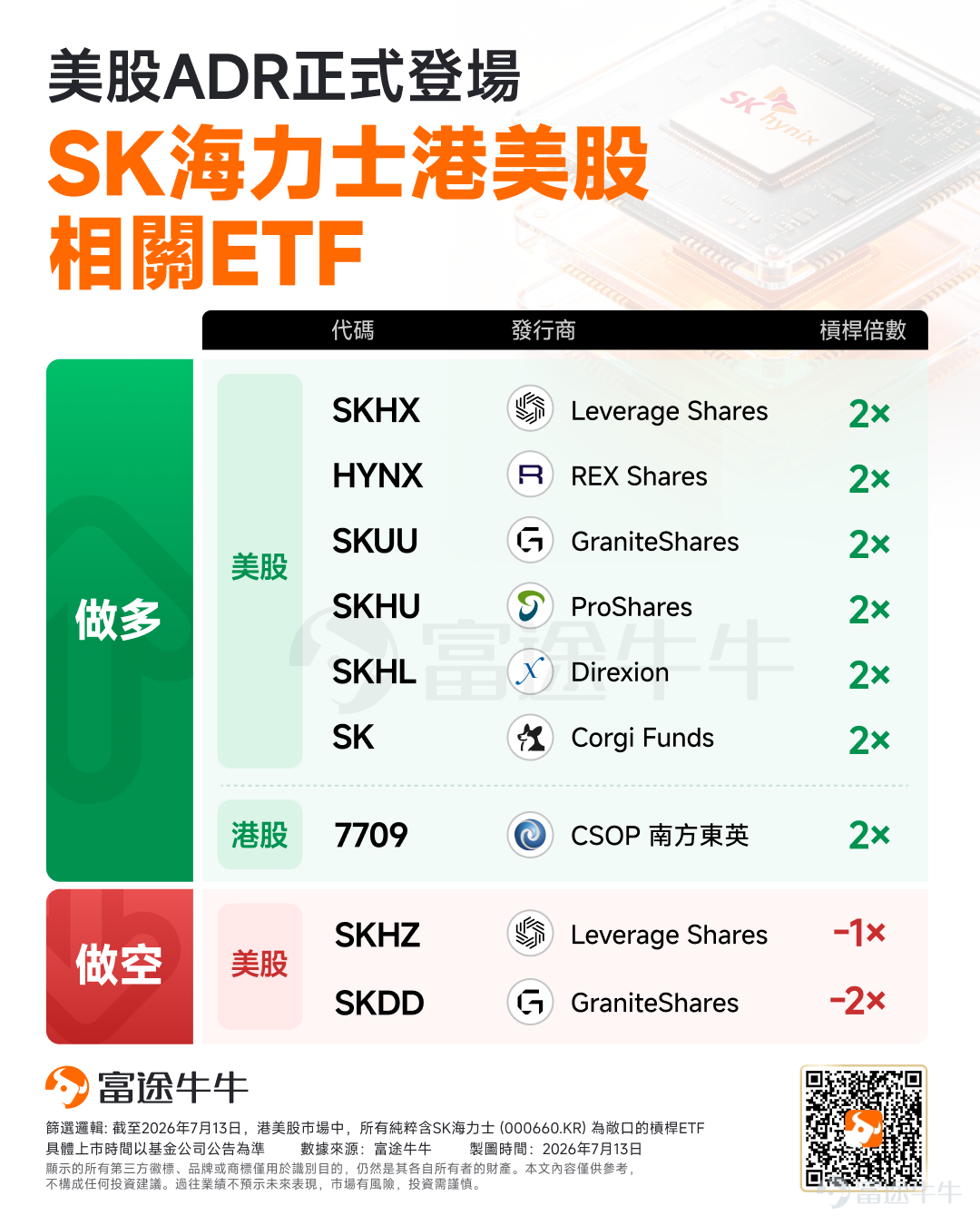
Against this backdrop of stark divergence, starting this Monday, several leveraged and inverse ETFs linked to SK Hynix ADRs will begin trading sequentially. What are the essential differences between these two types of products? And what opportunities and risks do U.S. leveraged ETFs entail? This article will provide fellow investors with an in-depth breakdown.

U.S. vs. Hong Kong Stocks: Core Differences in Leveraged ETFs
Before the listing of SK Hynix's US ADR,7709 was one of the few convenient avenues for retail investors to gain leveraged exposure to the memory chip leader. Its assets under management once exceeded $16 billion, making it the world’s largest of its kind.However, with the direct launch of US-listed leveraged ETFs, the operational differences between the two products could become starkly apparent.
7709 employs a synthetic replication strategy, using swap contracts to track the daily price performance of SK Hynix shares listed on the Korea Exchange (KRX) in Seoul.This means 7709 tracks the South Korean-listed shares $SK Hynix (000660.KR)$, not the US-listed SKHY.
The normal price transmission sequence is: US ADRs signal overnight → South Korean underlying shares are repriced the next day → 7709 then applies 2x leverage based on that day’s movement in the Korean shares.
This introduces an inherent 'time-zone pricing blind spot':During Hong Kong trading hours, the Korean market is often either already closed or not yet open, leaving 7709 without a real-time pricing anchor and prone to premium/discount volatility.The most extreme example occurred when 7709 exhibited a 17% abnormal premium because it missed a day of decline due to a Hong Kong holiday. However, such premiums are intermittent spikes that only appear during periods of extreme volatility and calendar misalignment, and they quickly revert to net asset value afterward.
In contrast, the U.S.-listed leveraged ETF launching this week is directly linked to SK Hynix's U.S. ADR.Since U.S. stocks and ADRs trade during the same session, their pricing is anchored in real time, theoretically resulting in smaller tracking error and eliminating the risk of pulse-like premium volatility caused by the time difference between Korean and Hong Kong market closures.
Previously, during U.S. trading hours, Korean stocks had already closed; thus, the Korean holdings in the ETF essentially reflected the market’s guess about the next day’s opening price in Seoul, leading to significant pricing deviations. After SKHY’s listing, a real-time tradable price became available during U.S. hours, shifting the ETF’s intraday pricing from 'guesswork' to 'anchoring.'
Previously, negative news affecting Korean memory stocks was only fully priced in after the Seoul market opened the next day, with U.S. trading relying mainly on correlated moves in stocks like Micron and SanDisk.Following the ADR listing, the U.S. leveraged ETF will absorb market shocks in real time during U.S. trading hours, enabling more direct volatility transmission.
It’s also important to note (as we’ve repeatedly emphasized to fellow investors recently) that whether it’s the Hong Kong-listed 7709 or the newly launched U.S. product, both operate on a 'daily rebalancing' mechanism. The fund adjusts its derivative positions at each market close based on that day’s net asset value to reset the leverage ratio back to its target level (e.g., 2x).
This mechanism leads to 'volatility decay.'Suppose SK Hynix rises 10% on Day 1—its 2x leveraged ETF gains 20%. On Day 2, if SK Hynix falls 10%, the ETF drops 20%. Over the two days, the underlying stock ends at 0.99 (a 1% loss), but the leveraged ETF ends at 1.2 × 0.8 = 0.96 (a 4% loss).The greater the underlying asset’s volatility and the longer the holding period, the more pronounced this 'negative compounding' effect becomes. Therefore, such products are inherently short-term trading instruments, best suited for short-term trades or hedging purposes.
Why did the U.S. ADR surge while Korean shares plummeted?
Behind this lies a shift in pricing power within the global memory storage sector and asymmetric arbitrage mechanisms.According to SEC filings, SK Hynix's ADR conversion is unidirectional and asymmetric:Investors can freely cancel their U.S.-listed ADRs to receive ordinary shares listed in Korea, but converting Korean-listed shares into ADRs requires approval from Korean regulators and is subject to quota limits (market estimates suggest the convertible cap is approximately 15%–20%).
This structural friction creates a hard floor for ADR discounts (as arbitrage can eliminate them), but no hard ceiling for premiums (since arbitrage is constrained). A precedent is Taiwan Semiconductor’s ADR, which still trades at a premium over its Taiwan-listed shares.UBS Group, a leading Wall Street investment bank, has adopted a unified trading strategy of 'going long on ADRs and shorting Korean-listed shares' to bet on widening price differentials between the two markets.
More importantly, however, are shifts in fundamental expectations. In a pre-market report released on July 13, KIS Securities forecast SK Hynix’s Q2 operating profit at KRW 6.04 trillion, roughly 8% below the consensus market estimate of KRW 6.5 trillion.
Today, Niu Niu Classroom published a separate article analyzing this development; fellow investors interested canview it here。
When a stock is trading near highs, 'not good enough' often inflicts more damage than outright poor results. Compounding this, SK Hynix just listed on the U.S. market last Friday, prompting some investors who bet on the IPO to cash out after the ADR listing, further intensifying selling pressure. On the same day, the Bank of Korea released a report dismissing concerns that 'the semiconductor cycle has peaked,' asserting that the AI-driven supercycle is expected to persist for some time yet,but markets have already shifted focus in the short term to managing pressures from crowded positioning and liquidity contraction.
Why can't we see the night session now?
Many investors noticed last Friday thatOn its first day of listing, SK Hynix appeared unavailable for regular pre-market and after-hours trading, and the night session prices are still not visible today.This is not a system issue, but rather due to specific listing arrangements.
On its listing day, SK Hynix commenced trading under a pre-offering trading model using the temporary ticker symbol 'SKHYV.' Under this model, certain advanced trading features (such as night sessions) may not be fully enabled.Starting this Monday (July 13), the stock officially transitioned to regular trading with the ticker symbol changed to 'SKHY,' and night session as well as pre-market and after-hours trading capabilities will gradually become available.
For investors focused on cross-border U.S. equity assets, trading hour restrictions are often the biggest pain point. Major brokers like Futu offer 24/7 U.S. stock trading precisely to break down these time barriers. Through Futu, investors will soon be able to trade SK Hynix (SKHY) and its leveraged ETFs not only during regular U.S. market hours but also respond in real time to breaking news from Asian markets during night sessions.

In scenarios like today—where Korean equities plunge sharply and U.S. stocks may experience significant volatility the next day—having a trading terminal capable of responding around the clock to cross-market price discrepancies becomes a critical tool for retail investors to seize opportunities or cut losses promptly.
The index inclusion wealth code: When will passive funds enter?
One core reason SK Hynix chose to list on Nasdaq is to gain inclusion in major indices and attract passive fund inflows. However, index inclusion is not immediate; investors need to understand the following key steps and timelines:
(1) Nasdaq Composite Index: Already swiftly included
Because the inclusion threshold for the Nasdaq Composite Index is relatively low—requiring only a listing on the Nasdaq exchange and meeting basic liquidity and market capitalization requirements—SK Hynix was automatically added to the Nasdaq Composite Index upon its Nasdaq debut, benefiting from initial passive fund allocations.
(2) Nasdaq-100 Index: Must wait until ADR market cap meets eligibility criteria
This is the main event drawing the most market attention, but note the following:Inclusion in the Nasdaq-100 Index is based on ADR market capitalization, not the company’s total market cap.Since this IPO only released an additional 2.5% of total shares, SK Hynix must wait until its ADR float market capitalization reaches the index inclusion threshold, with potential inclusion expected during the scheduled review in December this year.
The Philadelphia Semiconductor Index (SOX) requires a stock to have been listed for at least three months before inclusion.As SK Hynix listed in July, it narrowly missed the SOX’s annual review window in September. Therefore, investors will need to patiently wait until September 2027 to see concentrated buying from SOX-linked passive funds.。
How should investors respond?
Amid the sharp decline in Korean equities today and the concurrent launch of SK Hynix's US-listed ADR and leveraged ETFs, retail investors should stay clear-headed: leveraged ETFs are short-term trading instruments, and holding them long-term inevitably leads to volatility decay. Investors seeking long-term exposure to SK Hynix should likely avoid leveraged ETFs and instead opt for the underlying stock.
Additionally, distinguish between short-term noise and fundamental deterioration.KIS Securities explicitly stated in its report that this downward revision is not driven by earnings concerns, but rather reflects updated assumptions incorporating the pricing terms of already-signed long-term supply agreements (LTAs). The brokerage expects that as HBM4 begins mass shipments starting in Q3, rising average selling prices (ASPs) will lift overall ASPs, allowing SK Hynix’s ASP growth to realign with market averages. It forecasts the company’s operating profit margin will reach a record-high 74.6% in Q2 2026.KIS maintains its target price of KRW 3.8 million and its 'Buy' rating, viewing this forecast revision as short-term noise that does not alter the medium- to long-term upward earnings trajectory.
In the near term, watch whether the 'Korean-style volatility' will reappear on Wall Street following the listing of US leveraged ETFs this week, but remain cautious about reflexivity risks in the memory sector: Hynix has raised nearly USD 30 billion to fund new capacity, while Samsung is also expanding production simultaneously. The reflexive cycle—valuation recovery → low-cost equity financing → capacity expansion → forward-looking oversupply suppressing prices—is a shared risk across the memory industry.Today’s circuit breaker in Korean equities has already demonstrated that when the sector broadly shifts toward risk aversion, premiums, arbitrage opportunities, and product structures all take a back seat to systemic beta.
Going forward, the market will focus less on vague demand narratives and more on concrete order execution, margin improvement, and return on capital.In the latter phase of the AI compute boom, understanding the rules and rigorously managing risk matter far more than blindly chasing rallies or panic selling.Today’s plunge in Korean equities serves both as a stress test and an opportunity to reassess one’s investment framework.
Risk Disclaimer: The above content only represents the author's view. It does not represent any position or investment advice of Futu. Futu makes no representation or warranty.Read more


Comments (15)
to post a comment
110
311