
[IPO Watch] Swings from profit to loss, share price plunges nearly 68%—can Seres (09927.HK) hold on?
On July 13, shares of Seres Group plunged sharply across both its A- and H-share listings, suffering a severe blow to their prices.
As of press time,Seres Group’s H-shares$SERES (09927.HK)$gapped down sharply on heavy trading volume, falling 10.67% to close at HKD 42.70 per share, with an intraday low of HKD 42.50 per share—the lowest level in the stock’s history;Seres Group’s A-shares$Chongqing Sokon Industry Group Stock (601127.SH)$also came under simultaneous pressure, dropping 9.87% to close at RMB 53.99 per share.
Clearly, market sentiment is extremely weak, showing signs of active selling.The trigger that sparked this sharp stock price decline was the company’s announcement the previous evening, which forecast a net loss for the first half of the year.。

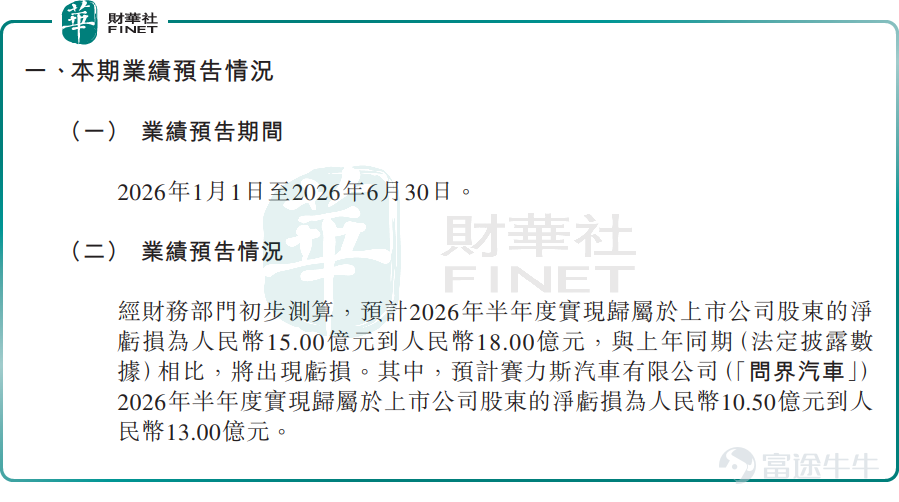
On July 12, Seres issued a profit warning, expecting a net loss attributable to shareholders of RMB 1.5 billion to RMB 1.8 billion for the first half of 2026, compared with a net profit of RMB 29.41 billion in the same period of 2025—marking a shift from profit to loss. The loss attributable to shareholders after adjusting for non-recurring items is expected to be between RMB 22.00 billion and RMB 25.00 billion, versus a profit of RMB 29.41 billion in the corresponding period of 2025.
As the core business segment of the company, Aito Motor is the primary driver of this loss.According to the announcement, Aito Motor is expected to report a net loss attributable to shareholders of RMB 10.50 billion to RMB 13.00 billion for the first half of 2026, with an adjusted net loss (excluding non-recurring items) of RMB 17.00 billion to RMB 19.50 billion.
What warrants even greater market caution is the following:In the second quarter of 2026 alone, Aito Motor’s net loss attributable to shareholders reached RMB 19.00 billion to RMB 21.5 billion.This means that Aito Motor’s Q2 net loss attributable to shareholders completely erased its Q1 net profit, making it the fundamental reason behind the overall loss for the first half of the year.
Regarding the reasons for this sharp earnings reversal,Seres provided two explanations: first, rising prices of upstream raw materials—including memory chips, industrial metals, and lithium carbonate—have directly increased production costs; second, in accordance with the principle of accounting prudence, the company has written down the carrying value of existing assets whose applicability has been limited due to technological iteration and model transitions, recognizing asset impairment losses to strengthen balance sheet quality.
From the market’s perspective, however, these are merely surface-level triggers. The core issue lies in sustained heavy investment in new vehicle development, accelerated offline channel expansion, and elevated marketing expenses—none of which have yet translated into scaled revenue and profits, resulting in earnings falling significantly short of expectations.
Compounded by the ongoing price war in the new energy vehicle (NEV) sector, downward pressure on terminal selling prices has squeezed both costs and revenues, severely weighing on profitability and intensifying market skepticism about the viability and long-term earnings resilience of its premium vehicle business model.
Meanwhile, as Harmony Intelligent Mobility’s multi-brand strategy rolls out fully, Huawei’s channel traffic and technical resources are being increasingly diverted, rapidly eroding AITO’s product exclusivity. The brand now faces not only intense external price competition within the NEV industry but also direct internal rivalry from its ‘sibling’ brands under the same ecosystem.
Looking over a longer time horizon, Seres has already entered a bear market in its share price.Since its Hong Kong listing in November 2025, the stock has consistently underperformed, sliding steadily to hit a new all-time low today. It is now down 67.5% from its IPO price, deeply underwater and leaving investors heavily trapped.
Its A-share listing has similarly been in relentless decline. After peaking at RMB 173.55 per share in September 2025—the highest level in its history—Seres’ stock has suffered consecutive losses, with a cumulative drop approaching 70% over this period.
Although Seres emphasizes that it maintains ample cash reserves and a sound asset-liability structure, providing sufficient risk resilience and sustainable operational capacity, the emergence of a turning point where earnings shifted from profit to loss has nonetheless shaken market confidence.
It should be noted that, as a core participant in the NEV sector, Seres—empowered by Huawei—still retains sales resilience.In the first half of 2026, Seres delivered a total of 178,800 new energy vehicles, an increase of 3.87% year-over-year; of this, the AITO series accounted for 160,800 units, up 5.60% year-over-year.
Industry analysts point out that for Seres today, the critical variable determining whether its share price can stabilize and reverse its downtrend lies in whether new models can successfully scale up, drive sustained sales growth, and ultimately convert prior heavy capital investments into tangible operating results.
Also worth noting, preparations are now underway for the 13th edition of the 'Top 100 Hong Kong Stocks' awards.. Although Seres has faced pressure on both its financial performance and share price, as a leading domestic premium new energy vehicle manufacturer and the first luxury EV maker to achieve dual A+H share listings, it remains a closely watched player. Whether the company ultimately succeeds in making it onto the ranking is a major point of market speculation.
Risk Disclaimer: The above content only represents the author's view. It does not represent any position or investment advice of Futu. Futu makes no representation or warranty.Read more
Comments
to post a comment