
Technology Research Institute: CPI data is about to be released! What opportunities are there amid t

Produced by AceCamp | AI Supply Chain Risk Map: Who Holds Real Scarcity, and How the Bullwhip Effect Propagates
First published on AceCamp's official website on July 11—get the freshest insights faster!
01 Key Takeaways
This round of upstream AI market rally is driven by two forces. The first is genuine bottlenecks. GPUs, HBM, CoWoS, networking, power, and liquid cooling are indeed constraining the pace of AI infrastructure expansion—many supply chain segments cannot be scaled up merely through rhetoric. The second is the scarcity narrative. The market has extrapolated these real bottlenecks into a broader assumption that 'all AI demand will linearly translate into shortages of high-end hardware, allowing upstream players to enjoy supernormal rents indefinitely.'
When the prevailing narrative weakens, different segments of the supply chain will not react uniformly. Real bottlenecks won’t vanish instantly due to a single event, but valuations may compress first. Some cyclical segments could experience the bullwhip effect, further intensifying pricing and order pressures. Meanwhile, segments benefiting from narrative-driven premiums may face re-evaluations of their cash flow models. The key to investment judgment isn’t simply asking, 'Can we still buy AI upstream stocks?' but rather: 'Is this segment selling an irreplaceable bottleneck, or is it merely capturing price elasticity driven by temporary shortages?'
In my view, three terms can help frame supply chain risks: genuine scarcity, the bullwhip effect, and economic rent. Genuine scarcity defines long-term barriers; the bullwhip effect reveals how order, inventory, and price volatility get amplified across layers; and economic rent determines whether current valuations can be sustained. As the market shifts from an assumption of 'infinite shortage' to one of 'strong demand requiring ROI validation,' these three dimensions help distinguish the sources of risk across companies and segments.
02 Seven Key Segments
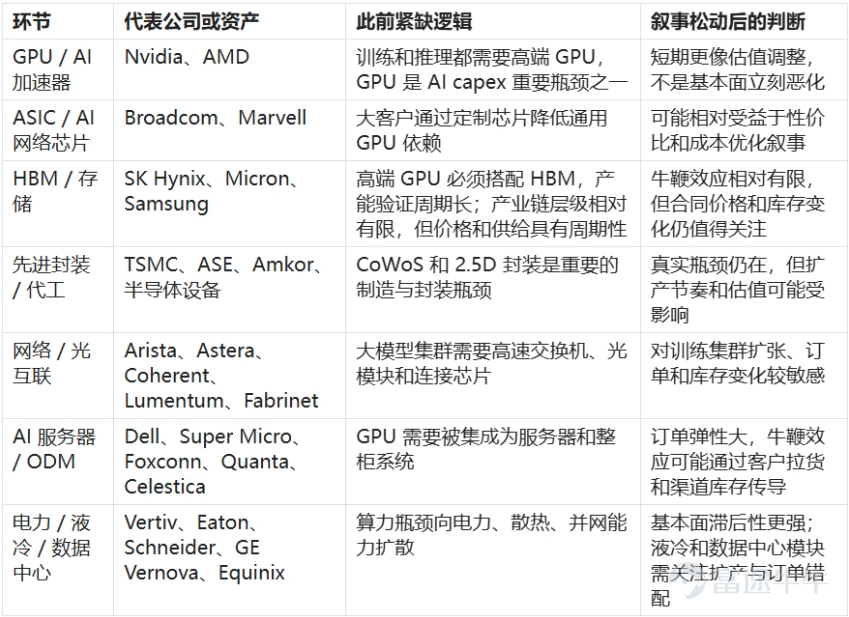
AI infrastructure isn't a single-point product but a very long chain. GPU shortages ripple into HBM; the combination of GPUs and HBM affects advanced packaging; large-scale cluster deployments then propagate impacts to networking, servers, liquid cooling, power, and data centers. Each layer has its own bottlenecks and may be affected differently by shifts in demand expectations.

The purpose of this table isn’t to list specific companies or rigidly rank segments, but to differentiate how risks propagate. Nvidia and TSMC face risks primarily tied to valuation shifts—from 'absolute scarcity' toward 'high growth but cyclical.' The HBM supply chain is relatively shallow but still requires monitoring of supply cycles, contract pricing, and inventory levels. Optical modules and servers are more exposed to fluctuations in orders, channel inventory, pricing, and margins. Liquid cooling, power infrastructure, and data center modules need attention regarding capacity expansion and demand mismatches along extended supply chains. GPU leasing and neocloud businesses mainly face re-evaluation of their asset utilization models.
03 Genuine Scarcity Remains, But Valuations May Adjust First
The first category includes assets where genuine scarcity still exists, but valuations may adjust ahead of fundamentals. This group includes Nvidia, TSMC, Broadcom, Arista, Vertiv, Eaton, Schneider, and GE Vernova. Their products or capabilities remain critical to AI infrastructure, and their fundamentals shouldn’t be judged solely based on isolated industry events, quarterly market swings, or short-term price disruptions.
GPU platforms remain essential for cutting-edge training and complex inference. TSMC and advanced packaging still control key bottlenecks in high-end semiconductor manufacturing and packaging. Broadcom and Marvell represent the custom ASIC and networking directions and could even benefit partially from cost optimization trends. Power, liquid cooling, and data center infrastructure are also influenced by broader trends beyond AI—including general data center upgrades, grid modernization, and energy mix transitions—resulting in stronger fundamental lag effects.
However, genuine scarcity doesn’t mean valuations are risk-free. Markets previously assigned these assets not just high-growth multiples, but 'perpetual shortage' valuations. Once investors stop believing that high-end compute capacity will remain perpetually scarce, valuation anchors may shift downward first. In other words, companies may still be growing, orders may still be strong, and industry leadership may remain intact—but stock prices might no longer reward positive news.
04 Cyclical Elasticity Segments: Amplification of Orders, Inventory, and Expectations
The second category comprises segments whose short-term fundamentals remain strong but are highly sensitive to cyclical shifts, order timing, and price volatility. This includes certain memory, optical module, AI server ODM, and select connector companies. Their issue is not necessarily weak current demand, but rather that customer pre-orders during price-increase periods, channel inventory restocking, and supplier capacity expansions may have inflated apparent demand along the supply chain beyond actual end-market demand. When demand expectations shift, this built-up inventory and backlog of orders could amplify price and margin volatility in the opposite direction.
In AI-related contexts, inventory may not necessarily manifest as finished goods already sitting in warehouses. It can also take three forms of 'invisible inventory': signed but undelivered orders, expanded capacity that has not yet come online, and anticipated inventory embedded in capital expenditure budgets and analyst demand forecasts. While these elements may not yet be fully reflected in financial statements, they can still influence product pricing, capacity planning, and asset valuations.
HBM warrants separate analysis. High-end GPUs must be paired with HBM, which involves long validation cycles and strong customer lock-in, resulting in substantial profit elasticity during upturns. However, HBM operates at a relatively constrained layer of the supply chain, so the bullwhip effect may not be as pronounced as in downstream assembly and module segments. Meanwhile, the memory industry itself is inherently cyclical; once supply catches up, customer inventory rebuilding concludes, or contract prices soften, margins could still face downward pressure. Optical modules and servers are more directly affected by changes in customer pull-in timing, channel inventory levels, and order visibility.
For cyclical segments impacted by the bullwhip effect, the key focus should not be on an immediate collapse in demand, but rather on marginal shifts: revenue continues to grow, but at a slowing pace; prices remain elevated, but their rate of increase decelerates; gross margins stay healthy, but no longer improve; order books remain full, but lead times shorten; customers continue purchasing, but stop locking in orders early due to inflationary expectations. Capital markets often price in these changes ahead of time.
In traditional industries, the bullwhip effect typically becomes evident only after price momentum begins to wane. In contrast, the AI sector is more expectation-driven—news such as major tech firms releasing excess compute capacity could trigger a reassessment of orders, capacity utilization, and production plans even before prices actually peak.
05 Business Model Risk: High Depreciation, High Financing Needs, and Reliance on High Utilization Assumptions
This represents a distinct risk dimension from supply chain bullwhip effects. Risks are more concentrated among neocloud providers, GPU lessors, crypto mining facilities transitioning into data centers, low-barrier server integrators, and small optical module or connector companies heavily reliant on a single large customer’s orders. The core assumptions underpinning these business models include high compute rental rates, high utilization, strong customer demand with waiting lists, and continued access to financing to support expansion.
Should GPU lease rates decline, or if major customers shift from 'scrambling for compute' to 'bidding on price,' multiple operating variables for these companies could come under simultaneous pressure: lower average revenue per unit, declining utilization, unchanged depreciation expenses, steady financing costs, rising customer bargaining power, and downward pressure on renewal pricing. For platform-type leaders, this might merely result in a valuation reset; for highly leveraged compute operators, however, it could further strain cash flow models.
This also explains why market reactions are so strong to news about hyperscalers releasing spare compute capacity. Such developments may not signal collapsing demand, but they prompt the market to reevaluate a critical question: if hyperscalers themselves begin offering excess capacity externally, can the scarcity-driven rental premiums enjoyed by GPU cloud and neocloud providers be sustained over the long term?
06 Three-Stage Assessment Framework
If the narrative around high-end computing power continues to evolve, a more reasonable assessment is not an immediate bearish stance but rather a three-phase process. The first phase involves valuation and expectation adjustments. Fundamentals remain strong, but the market is no longer willing to price assets as if shortages will persist indefinitely. This phase may manifest as strong earnings reports accompanied by flat stock prices, companies raising guidance only to see the market sell off, and higher-beta small-cap names declining first while large caps hold up relatively better.
The second phase is marked by marginal shifts in orders, pricing, inventory levels, and capacity utilization. Signals include shorter GPU lead times, softening HBM contract prices, CoWoS capacity no longer being fully booked, falling prices for 800G/1.6T optical modules, declining GPU cloud rental rates, decreasing neocloud utilization, cloud providers refraining from further upward revisions to capex guidance, AI server orders being delayed, slower delivery cadence of signed-but-undelivered orders, postponements of capacity expansion projects, or rising channel inventory.
The third phase occurs when fundamental pressures are confirmed. If hyperscalers explicitly cut AI-related capex, model developers scale back training cluster expansions, GPU leasing firms lower prices without boosting utilization, inventories of HBM and high-end GPUs rise, suppliers begin offering discounts or extending payment terms, data center projects are canceled (not merely postponed), and phantom inventory gradually turns into real inventory, these would serve as strong confirmation signals that the market has moved beyond valuation adjustments into genuine fundamental stress.
In the author’s view, the market is currently closer to the first phase, though certain segments more susceptible to the bullwhip effect warrant early monitoring for signs of the second phase. The AI investment theme isn’t necessarily over, but the era of 'buying every company selling shovels' is ending; going forward, investors should focus on bottlenecks, efficiency, and real cash flows.
Risk Warning
The views expressed in this article represent solely the author’s personal research and analysis and do not constitute any investment advice. Company, industry, and market analyses referenced herein are based on publicly available information and reasonable assumptions, and may be subject to information lags or interpretive errors. Investing involves risks; please exercise caution.
Risk Disclaimer: The above content only represents the author's view. It does not represent any position or investment advice of Futu. Futu makes no representation or warranty.Read more
Comments
to post a comment
1