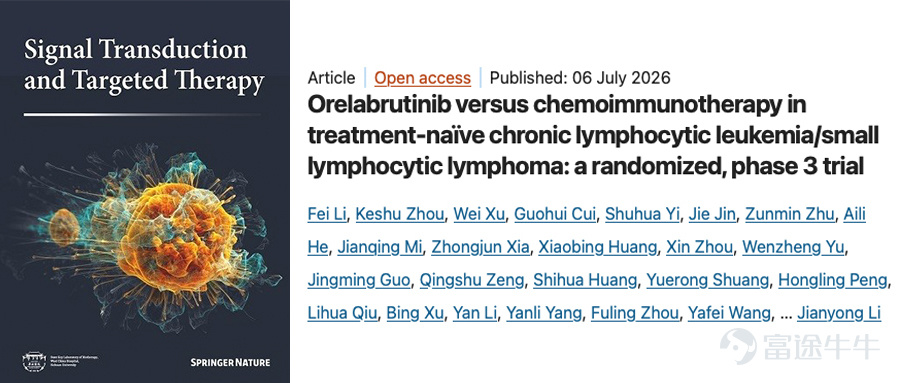

IF=81.2! Orelabrutinib study in treatment-naïve CLL/SLL published in international journal STTT, showing significantly prolonged PFS
Signal Transduction and Targeted Therapy (STTT), an international academic journal under Nature, recently published a paper titled 'Orelabrutinib versus Chemoimmunotherapy as First-Line Treatment for Chronic Lymphocytic Leukemia/Small Lymphocytic Lymphoma: A Randomized Phase III Trial.' The paper states that orelabrutinib significantly prolongs progression-free survival (PFS), reducing the risk of disease progression or death by 68%, achieving deeper and more durable responses, demonstrating a higher overall response rate (ORR), and exhibiting an excellent safety profile, making it an effective first-line treatment option for CLL/SLL.

The paper’s co-corresponding authors are Professor Li Jianyong from Jiangsu Province Hospital and Professor Qiu Lugui from the Institute of Hematology & Blood Diseases Hospital, Chinese Academy of Medical Sciences. The co-first authors are Professor Li Fei from the First Affiliated Hospital of Nanchang University, Professor Zhou Keshu from Henan Cancer Hospital, and Professor Xu Wei from Jiangsu Province Hospital.
The primary endpoint of this Phase III trial was progression-free survival (PFS) assessed by an Independent Review Committee (IRC). Secondary endpoints included overall response rate (ORR), duration of response (DoR), and safety, as evaluated by both the IRC and investigators.
Results assessed by the Independent Review Committee (IRC) showed that orelabrutinib significantly prolonged progression-free survival, with a hazard ratio (HR) of 0.32 (p<0.0001). The research team observed consistent benefits across all pre-specified subgroups—older patients, those with more advanced disease stages, and individuals with high-risk features such as del(11q), unmutated IGHV status, or bulky disease—all demonstrated superior survival outcomes with orelabrutinib compared to the control group.
The overall response rate (ORR) in the orelabrutinib group reached 90.1%, significantly higher than the 79.2% in the control group. A post-hoc updated analysis with 30 months of follow-up showed a complete response (CR) rate of 12.1% in the orelabrutinib group. The duration of response (DOR) was also significantly longer in the orelabrutinib group versus the control group, with a hazard ratio (HR) of 0.30.
In terms of safety, the incidence of treatment-related adverse events (TRAEs) of any grade was similar between the orelabrutinib and control groups, despite the median treatment duration in the orelabrutinib group (nearly 19.3 months) being almost four times that of the control group (5.2 months).
Orelabrutinib demonstrated an excellent safety profile, with most treatment-related adverse events being grade 1–2. The incidence of grade ≥3 TRAEs was significantly lower in the orelabrutinib group compared to the control group, and no treatment-related atrial fibrillation, major hemorrhage, or second primary malignancies were observed.
Patient-reported quality-of-life data indicated better overall health status in the orelabrutinib group than in the control group. After 16 cycles of follow-up, the proportion of patients achieving clinically meaningful improvements in quality of life remained consistently higher in the orelabrutinib group, with the gap widening over time.
Orelabrutinib, as a first-line treatment for CLL/SLL, was approved for marketing in China in 2025 and has been included in the National Reimbursement Drug List, benefiting an increasing number of patients.
Chronic lymphocytic leukemia (CLL) is one of the most common types of leukemia in adults. In recent years, BTK inhibitors have reshaped the treatment landscape for CLL/SLL, gradually replacing high-intensity, high-toxicity chemoimmunotherapy regimens as the standard of care.
Signal Transduction and Targeted Therapy (STTT) is a high-impact international academic journal under the Nature portfolio, publishing original research, reviews, and articles on clinical advances. Its SCI impact factor, announced in June 2026, reached an impressive 81.2.
Note: The content of this press release is derived from the aforementioned published article.
Risk Disclaimer: The above content only represents the author's view. It does not represent any position or investment advice of Futu. Futu makes no representation or warranty.Read more
Comments
to post a comment