
English
Back
Open Account
ME News
wrote a column · Jul 12 20:45

Not elated by external gains, nor saddened by personal losses—how should we view the recent tech stock correction?

Author and source: Chen Ming's In-Depth Strategy Insights
GF Securities Strategy has been among the most steadfast optimists in this AI industry cycle. At every critical juncture marked by significant market divergence, we have maintained a strategic bullish stance on the AI sector.
In particular, when the U.S.-Iraq war broke out in March this year, market participants were deeply concerned about high oil prices, elevated interest rates, and expectations of further rate hikes. Yet at that most pessimistic moment—when the index fell below 3,800—we advised looking beyond oil prices and geopolitical conflict and focusing instead on the underlying strength of the industry itself. In hindsight, whether one had the conviction to bottom-fish AI stocks in March proved to be the decisive move of the year—at least for the first half.
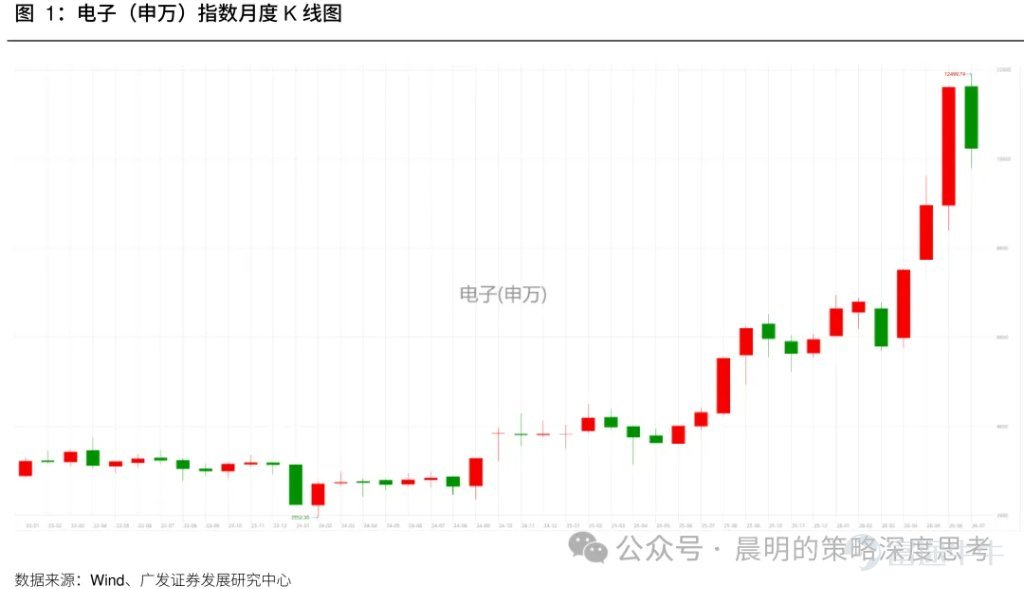
Indeed, over the past three months, China A-share electronics and telecom indices, along with the Philadelphia Semiconductor Index in the U.S., have posted their strongest three consecutive monthly gains since the AI industry emerged in 2023. Although near-term high-frequency industry data remains solid, pullbacks following three straight monthly rallies are normal, given increased volatility in external markets, growing debate around the sector, and intensified positioning among various types of capital.
How should we interpret the current magnitude and duration of the AI sector’s correction? This article offers further discussion.
GF Securities Strategy’s research report analyzes the magnitude and duration of the recent AI sector correction. Drawing on historical data from 35 corrections across 13 major A-share market themes, the average correction lasted 21 trading days with a 19% decline. Since 2023, the U.S. tech sector has experienced six corrections averaging 40 trading days, during which the Philadelphia Semiconductor Index fell by 17.6%. The report notes that the current A-share tech correction has likely exhausted most of its downside potential, though the duration remains slightly insufficient. Unlike the 2015 ChiNext leveraged bull market or the 1990s dot-com Y2K narrative, the current AI cycle follows a 'frame-by-frame validation' approach, relying more heavily on fundamental tracking. Earnings season is expected to validate the underlying industry logic, supporting a healthy 'two steps forward, one step back' trend. Author and source: Chen Ming's In-Depth Strategy Insights Report Summary GF Securities Strategy has been among the most steadfast optimists in this AI industry cycle. At every critical juncture marked by significant market divergence, we have maintained a strategic bullish stance on the AI sector. In particular, when the U.S.-Iran conflict erupted in March this year, market participants were deeply concerned about high oil prices, elevated interest rates, and renewed rate hike expectations. Yet at that moment of peak pessimism—when the index dipped below 3,800—we advised investors to look past oil prices and geopolitical tensions and instead focus squarely on sector fundamentals. In hindsight, the willingness to bottom-fish in AI during March proved to be the pivotal decision determining success this year—at least for the first half. Indeed, over the past three months, both the A-share electronics and telecommunications indices and the U.S. Philadelphia Semiconductor Index have posted their strongest three consecutive monthly gains since the AI industry rally began in 2023. Although near-term high-frequency industry data remains reassuring, as...
Assuming the wheels of technological progress continue turning forward, how much drawdown—in both time and magnitude—should tech investors tolerate? Historical examples from China A-shares suggest that if the underlying industry trend has not ended, corrections during bull markets driven by various factors typically last around 21 trading days and entail declines of roughly 19%. U.S. equities show similar correction magnitudes but longer durations (discussed in detail in the main text).
Empirically, the current correction in China’s tech sector appears sufficiently deep in terms of price, though its duration remains slightly shorter than historical precedents.
From a medium-term perspective, AI investments advancing in a 'two steps forward, one step back' pattern—aligned with tangible industry progress such as model upgrades, hardware iterations, token usage surges, and earnings guidance—should represent a healthier and more sustainable trajectory. This stands in stark contrast to the 2015 ChiNext 'leverage-driven bull market' and the late-1990s dot-com bubble.
The 2015 rally was fueled by rapid inflows of leveraged capital, creating a 'one-off shock' that was swiftly invalidated by the June 2015 crackdown on margin financing.
In the late 1990s, the dot-com boom was propelled by Y2K-related demand narratives—a 'one-off shock' that essentially front-ran anticipated millennium bug-driven spending. This speculative surge detached valuations from near-term fundamentals and was rapidly discredited as the new millennium approached.
Once these one-off shocks faded, the bursting of bubbles in both episodes appeared almost inevitable.
GF Securities Strategy’s research report analyzes the magnitude and duration of the recent AI sector correction. Drawing on historical data from 35 corrections across 13 major A-share market themes, the average correction lasted 21 trading days with a 19% decline. Since 2023, the U.S. tech sector has experienced six corrections averaging 40 trading days, during which the Philadelphia Semiconductor Index fell by 17.6%. The report notes that the current A-share tech correction has likely exhausted most of its downside potential, though the duration remains slightly insufficient. Unlike the 2015 ChiNext leveraged bull market or the 1990s dot-com Y2K narrative, the current AI cycle follows a 'frame-by-frame validation' approach, relying more heavily on fundamental tracking. Earnings season is expected to validate the underlying industry logic, supporting a healthy 'two steps forward, one step back' trend. Author and source: Chen Ming's In-Depth Strategy Insights Report Summary GF Securities Strategy has been among the most steadfast optimists in this AI industry cycle. At every critical juncture marked by significant market divergence, we have maintained a strategic bullish stance on the AI sector. In particular, when the U.S.-Iran conflict erupted in March this year, market participants were deeply concerned about high oil prices, elevated interest rates, and renewed rate hike expectations. Yet at that moment of peak pessimism—when the index dipped below 3,800—we advised investors to look past oil prices and geopolitical tensions and instead focus squarely on sector fundamentals. In hindsight, the willingness to bottom-fish in AI during March proved to be the pivotal decision determining success this year—at least for the first half. Indeed, over the past three months, both the A-share electronics and telecommunications indices and the U.S. Philadelphia Semiconductor Index have posted their strongest three consecutive monthly gains since the AI industry rally began in 2023. Although near-term high-frequency industry data remains reassuring, as...
Returning to the present, this round of AI industry investment has seen closer tracking and discussion of sector developments due to the high degree of integration in global capital markets and deep participation by diverse investor types. Unlike in 1999, there is no grand narrative like the 'Y2K bug' to support optimistic demand, nor is there the extreme leverage seen in China’s A-share market in 2015. Stakeholders across the industry are now verifying demand, capital expenditures, and return on investment almost 'frame by frame.' Adjustments driven by divergent views can still resume once the underlying industry trend is confirmed.
Whether in U.S. equities or China’s A-share market, the next earnings reporting season is approaching quickly. Many recent debates and disagreements at the industry level will likely find further validation clues during this earnings season. After short-term sentiment-driven volatility subsides, returning to rational fundamental analysis and verification becomes even more critical.
GF Securities Strategy’s research report analyzes the magnitude and duration of the recent AI sector correction. Drawing on historical data from 35 corrections across 13 major A-share market themes, the average correction lasted 21 trading days with a 19% decline. Since 2023, the U.S. tech sector has experienced six corrections averaging 40 trading days, during which the Philadelphia Semiconductor Index fell by 17.6%. The report notes that the current A-share tech correction has likely exhausted most of its downside potential, though the duration remains slightly insufficient. Unlike the 2015 ChiNext leveraged bull market or the 1990s dot-com Y2K narrative, the current AI cycle follows a 'frame-by-frame validation' approach, relying more heavily on fundamental tracking. Earnings season is expected to validate the underlying industry logic, supporting a healthy 'two steps forward, one step back' trend. Author and source: Chen Ming's In-Depth Strategy Insights Report Summary GF Securities Strategy has been among the most steadfast optimists in this AI industry cycle. At every critical juncture marked by significant market divergence, we have maintained a strategic bullish stance on the AI sector. In particular, when the U.S.-Iran conflict erupted in March this year, market participants were deeply concerned about high oil prices, elevated interest rates, and renewed rate hike expectations. Yet at that moment of peak pessimism—when the index dipped below 3,800—we advised investors to look past oil prices and geopolitical tensions and instead focus squarely on sector fundamentals. In hindsight, the willingness to bottom-fish in AI during March proved to be the pivotal decision determining success this year—at least for the first half. Indeed, over the past three months, both the A-share electronics and telecommunications indices and the U.S. Philadelphia Semiconductor Index have posted their strongest three consecutive monthly gains since the AI industry rally began in 2023. Although near-term high-frequency industry data remains reassuring, as...
Historically, dominant thematic market trends often follow a pattern of 'trend – consolidation – trend continuation or termination.' If a trending sector falls more than 5% below its 20-day moving average, the rally is likely entering a consolidation phase. Whether this consolidation leads to trend resumption or termination primarily depends on the underlying industry trend itself. If industry fundamentals remain strong, the sector may consolidate temporarily and then resume its upward trajectory once earnings confirm the trend.
Based on 35 adjustments across 13 major thematic trends in China’s A-share market from 2012 to date, the average correction lasted 21 trading days with an average decline of 19%. After adjusting for volatility, the magnitude of corrections from elevated levels is roughly equivalent to five times the average daily candlestick size over the prior month. Even as quant-driven trading has grown in prominence, this rule of thumb for drawdowns in leading sectors remains applicable, with no systemic increase observed.
GF Securities Strategy’s research report analyzes the magnitude and duration of the recent AI sector correction. Drawing on historical data from 35 corrections across 13 major A-share market themes, the average correction lasted 21 trading days with a 19% decline. Since 2023, the U.S. tech sector has experienced six corrections averaging 40 trading days, during which the Philadelphia Semiconductor Index fell by 17.6%. The report notes that the current A-share tech correction has likely exhausted most of its downside potential, though the duration remains slightly insufficient. Unlike the 2015 ChiNext leveraged bull market or the 1990s dot-com Y2K narrative, the current AI cycle follows a 'frame-by-frame validation' approach, relying more heavily on fundamental tracking. Earnings season is expected to validate the underlying industry logic, supporting a healthy 'two steps forward, one step back' trend. Author and source: Chen Ming's In-Depth Strategy Insights Report Summary GF Securities Strategy has been among the most steadfast optimists in this AI industry cycle. At every critical juncture marked by significant market divergence, we have maintained a strategic bullish stance on the AI sector. In particular, when the U.S.-Iran conflict erupted in March this year, market participants were deeply concerned about high oil prices, elevated interest rates, and renewed rate hike expectations. Yet at that moment of peak pessimism—when the index dipped below 3,800—we advised investors to look past oil prices and geopolitical tensions and instead focus squarely on sector fundamentals. In hindsight, the willingness to bottom-fish in AI during March proved to be the pivotal decision determining success this year—at least for the first half. Indeed, over the past three months, both the A-share electronics and telecommunications indices and the U.S. Philadelphia Semiconductor Index have posted their strongest three consecutive monthly gains since the AI industry rally began in 2023. Although near-term high-frequency industry data remains reassuring, as...
As illustrated above, the current correction in China’s A-share technology sector aligns closely with historical case-study averages in terms of depth. The only difference is that the pace of adjustment has been unusually rapid, possibly implying insufficient time for full digestion. Patience is warranted, along with continued respect for underlying industry trends.
Since 2023, on average: corrections have lasted 40 trading days, with drawdowns of -8.8% for the S&P 500, -12.0% for the Nasdaq Composite, -13.4% for the Magnificent Seven (MAG7), and -17.6% for the Philadelphia Semiconductor Index (SOX).
In the current correction cycle, the Philadelphia Semiconductor Index has declined by as much as 16% from its late-June peak—already approaching the historical average in terms of magnitude. However, from a time perspective, it may still require another phase of digestion.
GF Securities Strategy’s research report analyzes the magnitude and duration of the recent AI sector correction. Drawing on historical data from 35 corrections across 13 major A-share market themes, the average correction lasted 21 trading days with a 19% decline. Since 2023, the U.S. tech sector has experienced six corrections averaging 40 trading days, during which the Philadelphia Semiconductor Index fell by 17.6%. The report notes that the current A-share tech correction has likely exhausted most of its downside potential, though the duration remains slightly insufficient. Unlike the 2015 ChiNext leveraged bull market or the 1990s dot-com Y2K narrative, the current AI cycle follows a 'frame-by-frame validation' approach, relying more heavily on fundamental tracking. Earnings season is expected to validate the underlying industry logic, supporting a healthy 'two steps forward, one step back' trend. Author and source: Chen Ming's In-Depth Strategy Insights Report Summary GF Securities Strategy has been among the most steadfast optimists in this AI industry cycle. At every critical juncture marked by significant market divergence, we have maintained a strategic bullish stance on the AI sector. In particular, when the U.S.-Iran conflict erupted in March this year, market participants were deeply concerned about high oil prices, elevated interest rates, and renewed rate hike expectations. Yet at that moment of peak pessimism—when the index dipped below 3,800—we advised investors to look past oil prices and geopolitical tensions and instead focus squarely on sector fundamentals. In hindsight, the willingness to bottom-fish in AI during March proved to be the pivotal decision determining success this year—at least for the first half. Indeed, over the past three months, both the A-share electronics and telecommunications indices and the U.S. Philadelphia Semiconductor Index have posted their strongest three consecutive monthly gains since the AI industry rally began in 2023. Although near-term high-frequency industry data remains reassuring, as...
Over the past three months, whether it’s the electronics and communications sector indices in China’s A-share market or the Philadelphia Semiconductor Index in the U.S. equity market, all have posted the strongest three monthly bullish candles since the AI industry emerged in 2023, accumulating substantial gains while also attracting significantly higher volumes of leveraged capital.
Against this backdrop, although short-term high-frequency industry data remains solid, recent pullbacks following these three strong up months are attributable to heightened volatility in external markets, growing debates at the industry level, and complex positioning among various types of capital. Such corrections fall well within normal market expectations—though the pace of the adjustment has been relatively swift.
Assuming the wheels of industrial advancement continue moving forward, how should we view the typical duration and depth of corrections along previous growth-driven market themes? We will elaborate below with empirical evidence drawn from both U.S. and A-share market cases.
Our core conclusion is this: as long as the underlying industry trend has not ended, adjustments during a sectoral bull market—triggered by various factors—typically last around 21 trading days and entail declines of approximately 19%. Empirically speaking, the current correction in A-share tech stocks has already seen sufficient downside; however, its duration remains slightly shorter than historical precedents.
GF Securities Strategy’s research report analyzes the magnitude and duration of the recent AI sector correction. Drawing on historical data from 35 corrections across 13 major A-share market themes, the average correction lasted 21 trading days with a 19% decline. Since 2023, the U.S. tech sector has experienced six corrections averaging 40 trading days, during which the Philadelphia Semiconductor Index fell by 17.6%. The report notes that the current A-share tech correction has likely exhausted most of its downside potential, though the duration remains slightly insufficient. Unlike the 2015 ChiNext leveraged bull market or the 1990s dot-com Y2K narrative, the current AI cycle follows a 'frame-by-frame validation' approach, relying more heavily on fundamental tracking. Earnings season is expected to validate the underlying industry logic, supporting a healthy 'two steps forward, one step back' trend. Author and source: Chen Ming's In-Depth Strategy Insights Report Summary GF Securities Strategy has been among the most steadfast optimists in this AI industry cycle. At every critical juncture marked by significant market divergence, we have maintained a strategic bullish stance on the AI sector. In particular, when the U.S.-Iran conflict erupted in March this year, market participants were deeply concerned about high oil prices, elevated interest rates, and renewed rate hike expectations. Yet at that moment of peak pessimism—when the index dipped below 3,800—we advised investors to look past oil prices and geopolitical tensions and instead focus squarely on sector fundamentals. In hindsight, the willingness to bottom-fish in AI during March proved to be the pivotal decision determining success this year—at least for the first half. Indeed, over the past three months, both the A-share electronics and telecommunications indices and the U.S. Philadelphia Semiconductor Index have posted their strongest three consecutive monthly gains since the AI industry rally began in 2023. Although near-term high-frequency industry data remains reassuring, as...
More importantly, viewed rationally, AI-related investments should ideally follow tangible industry progress—such as model upgrades, hardware iterations, token usage surges, and earnings guidance—to produce a healthier, more sustainable 'two steps forward, one step back' upward trajectory. We recognize clearly that neither the fragility introduced by rapid inflows of leveraged capital nor valuations excessively detached from fundamentals represents a viable long-term investment approach.
From this perspective, the price trajectory of A-share AI-related stocks since 2023 differs markedly from both the ChiNext internet+ bull market of 2015 and the late-1990s dot-com bubble.
1. Unlike the 2015 ChiNext internet+ bull market, where leveraged capital inflows drove prices far beyond fundamentals, ultimately triggering a crash upon capital withdrawal
The rapid bubble formation in the ChiNext market during the first half of 2015 was directly tied to the influx of leveraged funds, and its subsequent collapse closely followed the comprehensive crackdown on leverage and abrupt capital outflows initiated in June 2015.
During this period, numerous mergers and acquisitions on the ChiNext board failed to meet promised earnings targets, planting the seeds for future goodwill impairment risks. Fundamentally, such aggressive price appreciation lacked support. As illustrated below, the ChiNext market’s earnings advantage over the main board only became clearly evident in 2016—indicating that stock prices had significantly front-run future industry expectations.
The 'one-off shock' caused by leveraged capital led to a sharp surge—and equally sharp plunge once capital flows reversed. In June, multiple brokerages shut down HOMS trading interfaces, and on June 13, the China Securities Regulatory Commission (CSRC) announced a strict crackdown on off-exchange margin financing, marking a critical turning point.
However, since the current AI industry cycle began, regulatory scrutiny has continuously tightened regarding leveraged capital (higher margin requirements), unusual trading activity (stricter disclosure rules), and speculative hype around concepts—all representing proactive, preemptive risk-mitigation measures by regulators. As illustrated in the chart below, since 2025, stock prices over the medium term have not significantly deviated from their relative fundamental performance, exhibiting a 'two steps forward, one step back' pattern: short-term upward momentum has grown steeper, while subsequent consolidation phases reflect a strategy of trading time for space.
GF Securities Strategy’s research report analyzes the magnitude and duration of the recent AI sector correction. Drawing on historical data from 35 corrections across 13 major A-share market themes, the average correction lasted 21 trading days with a 19% decline. Since 2023, the U.S. tech sector has experienced six corrections averaging 40 trading days, during which the Philadelphia Semiconductor Index fell by 17.6%. The report notes that the current A-share tech correction has likely exhausted most of its downside potential, though the duration remains slightly insufficient. Unlike the 2015 ChiNext leveraged bull market or the 1990s dot-com Y2K narrative, the current AI cycle follows a 'frame-by-frame validation' approach, relying more heavily on fundamental tracking. Earnings season is expected to validate the underlying industry logic, supporting a healthy 'two steps forward, one step back' trend. Author and source: Chen Ming's In-Depth Strategy Insights Report Summary GF Securities Strategy has been among the most steadfast optimists in this AI industry cycle. At every critical juncture marked by significant market divergence, we have maintained a strategic bullish stance on the AI sector. In particular, when the U.S.-Iran conflict erupted in March this year, market participants were deeply concerned about high oil prices, elevated interest rates, and renewed rate hike expectations. Yet at that moment of peak pessimism—when the index dipped below 3,800—we advised investors to look past oil prices and geopolitical tensions and instead focus squarely on sector fundamentals. In hindsight, the willingness to bottom-fish in AI during March proved to be the pivotal decision determining success this year—at least for the first half. Indeed, over the past three months, both the A-share electronics and telecommunications indices and the U.S. Philadelphia Semiconductor Index have posted their strongest three consecutive monthly gains since the AI industry rally began in 2023. Although near-term high-frequency industry data remains reassuring, as...
2. Unlike the 1990s tech bubble, the 'Y2K' narrative provided such a grand demand backdrop that it effectively turned industry investment into a 'one-off deal.'
In fact, during the 1995–1998 tech boom, there were several instances when slower-than-expected hardware progress triggered skepticism about the sector’s trajectory and caused sharp stock price swings. At the time, technology investments advanced amid disagreement, rising only as hypotheses were validated.
For example, after strong PC shipment growth and DRAM capacity expansion in 1995, PC shipments slowed in 1996 and DRAM prices plunged by more than 70%. Micron’s stock fell 80% from its September 1995 peak to July 1996. Some Wall Street analysts at the time sharply noted that the 'new economy' would not eliminate the cyclical nature of hardware as a capital good, and that overcapacity would squeeze hardware companies’ profit margins. Influenced by this view, the Nasdaq dropped 19% between January and July 1996.
Another example: following the outbreak of the 1997 Asian financial crisis, major hardware manufacturers saw a sharp decline in orders from emerging markets (including South Korea, Taiwan, and Southeast Asia), which manifested in 1998 as negative semiconductor sales growth, Intel’s revenue growth deceleration, and relatively pessimistic forward guidance.
Thus, it is evident that U.S. tech stocks from 1995 to 1998 also largely followed a 'two steps forward, one step back' trajectory, with progress repeatedly tested amid ongoing market disagreement.
GF Securities Strategy’s research report analyzes the magnitude and duration of the recent AI sector correction. Drawing on historical data from 35 corrections across 13 major A-share market themes, the average correction lasted 21 trading days with a 19% decline. Since 2023, the U.S. tech sector has experienced six corrections averaging 40 trading days, during which the Philadelphia Semiconductor Index fell by 17.6%. The report notes that the current A-share tech correction has likely exhausted most of its downside potential, though the duration remains slightly insufficient. Unlike the 2015 ChiNext leveraged bull market or the 1990s dot-com Y2K narrative, the current AI cycle follows a 'frame-by-frame validation' approach, relying more heavily on fundamental tracking. Earnings season is expected to validate the underlying industry logic, supporting a healthy 'two steps forward, one step back' trend. Author and source: Chen Ming's In-Depth Strategy Insights Report Summary GF Securities Strategy has been among the most steadfast optimists in this AI industry cycle. At every critical juncture marked by significant market divergence, we have maintained a strategic bullish stance on the AI sector. In particular, when the U.S.-Iran conflict erupted in March this year, market participants were deeply concerned about high oil prices, elevated interest rates, and renewed rate hike expectations. Yet at that moment of peak pessimism—when the index dipped below 3,800—we advised investors to look past oil prices and geopolitical tensions and instead focus squarely on sector fundamentals. In hindsight, the willingness to bottom-fish in AI during March proved to be the pivotal decision determining success this year—at least for the first half. Indeed, over the past three months, both the A-share electronics and telecommunications indices and the U.S. Philadelphia Semiconductor Index have posted their strongest three consecutive monthly gains since the AI industry rally began in 2023. Although near-term high-frequency industry data remains reassuring, as...
By 1998–1999, however, the narrative surrounding U.S. tech stocks began to shift, as mainstream media started amplifying the 'Y2K' story.
The core logic of the 'Y2K' thesis was that date-coding bugs would trigger massive, unpredictable replacement demand—spanning mainframes, servers, personal PCs, and even operating systems. At its most optimistic, the market believed this demand would cascade from businesses to consumers and from large enterprises down to individuals, creating a profound and far-reaching impact that would extend across the turn of the century.
Consequently, after 1998, as this grand narrative took hold, the tech sector increasingly became desensitized to negative information. Even in 1999, when key companies reported declining ROE and slowing earnings growth, the market largely ignored these signals, convinced that an even stronger wave of demand would eventually materialize to justify valuations.
The overwhelming consensus around Y2K ultimately made the late-stage tech rally resemble a 'one-off deal' that front-ran anticipated Y2K-driven demand, thereby detaching market performance from near-term fundamental validation and caution.
The fundamental expectations underpinned by the 'Y2K bug' narrative were debunked the moment January 1, 2000 arrived—the Y2K bug never materialized, and the media labeled it a 'massive hoax' in the tech industry. Demand had been front-loaded, inventories piled up, PC shipments plummeted, and semiconductor sales dropped sharply, leading to a rapid collapse in fundamental data—this was the core reason behind the bursting of the dot-com bubble.
GF Securities Strategy’s research report analyzes the magnitude and duration of the recent AI sector correction. Drawing on historical data from 35 corrections across 13 major A-share market themes, the average correction lasted 21 trading days with a 19% decline. Since 2023, the U.S. tech sector has experienced six corrections averaging 40 trading days, during which the Philadelphia Semiconductor Index fell by 17.6%. The report notes that the current A-share tech correction has likely exhausted most of its downside potential, though the duration remains slightly insufficient. Unlike the 2015 ChiNext leveraged bull market or the 1990s dot-com Y2K narrative, the current AI cycle follows a 'frame-by-frame validation' approach, relying more heavily on fundamental tracking. Earnings season is expected to validate the underlying industry logic, supporting a healthy 'two steps forward, one step back' trend. Author and source: Chen Ming's In-Depth Strategy Insights Report Summary GF Securities Strategy has been among the most steadfast optimists in this AI industry cycle. At every critical juncture marked by significant market divergence, we have maintained a strategic bullish stance on the AI sector. In particular, when the U.S.-Iran conflict erupted in March this year, market participants were deeply concerned about high oil prices, elevated interest rates, and renewed rate hike expectations. Yet at that moment of peak pessimism—when the index dipped below 3,800—we advised investors to look past oil prices and geopolitical tensions and instead focus squarely on sector fundamentals. In hindsight, the willingness to bottom-fish in AI during March proved to be the pivotal decision determining success this year—at least for the first half. Indeed, over the past three months, both the A-share electronics and telecommunications indices and the U.S. Philadelphia Semiconductor Index have posted their strongest three consecutive monthly gains since the AI industry rally began in 2023. Although near-term high-frequency industry data remains reassuring, as...
In today’s context, this round of AI industry investment benefits from highly integrated global capital markets and broader participation from diverse investor types, resulting in much closer tracking and discussion of industry developments. Unlike in 1999, there is no grand narrative akin to the 'Y2K bug' to justify optimistic demand; instead, industry participants are meticulously verifying demand, investment, and return on investment—almost 'frame by frame'—a stark contrast to the late-stage dot-com era.
Whether in U.S. or A-share markets, the next earnings reporting season is fast approaching (the table below shows key U.S. companies’ earnings release dates). Many recent debates and divergences regarding the industry are likely to find further validation clues during this earnings season. After short-term sentiment-driven volatility, returning to rational, fundamentals-based verification is what truly matters.
GF Securities Strategy’s research report analyzes the magnitude and duration of the recent AI sector correction. Drawing on historical data from 35 corrections across 13 major A-share market themes, the average correction lasted 21 trading days with a 19% decline. Since 2023, the U.S. tech sector has experienced six corrections averaging 40 trading days, during which the Philadelphia Semiconductor Index fell by 17.6%. The report notes that the current A-share tech correction has likely exhausted most of its downside potential, though the duration remains slightly insufficient. Unlike the 2015 ChiNext leveraged bull market or the 1990s dot-com Y2K narrative, the current AI cycle follows a 'frame-by-frame validation' approach, relying more heavily on fundamental tracking. Earnings season is expected to validate the underlying industry logic, supporting a healthy 'two steps forward, one step back' trend. Author and source: Chen Ming's In-Depth Strategy Insights Report Summary GF Securities Strategy has been among the most steadfast optimists in this AI industry cycle. At every critical juncture marked by significant market divergence, we have maintained a strategic bullish stance on the AI sector. In particular, when the U.S.-Iran conflict erupted in March this year, market participants were deeply concerned about high oil prices, elevated interest rates, and renewed rate hike expectations. Yet at that moment of peak pessimism—when the index dipped below 3,800—we advised investors to look past oil prices and geopolitical tensions and instead focus squarely on sector fundamentals. In hindsight, the willingness to bottom-fish in AI during March proved to be the pivotal decision determining success this year—at least for the first half. Indeed, over the past three months, both the A-share electronics and telecommunications indices and the U.S. Philadelphia Semiconductor Index have posted their strongest three consecutive monthly gains since the AI industry rally began in 2023. Although near-term high-frequency industry data remains reassuring, as...
We have previously conducted a detailed review of the duration and magnitude of corrections in dominant sectors. A general empirical finding is that corrections average 21 trading days with a decline of about 19%. More than half a year later, after a consolidation period from September last year through March this year, the tech sector launched a new dominant trend—and has recently entered another consolidation phase. The lessons from that period remain applicable today.
Reviewing historical dominant trends, they typically follow a pattern of 'trend → consolidation → trend continuation or trend termination.' Thus, analyzing such trend cycles involves three key questions:
① When does a trend enter a consolidation phase?
② After a trend breaks down, does it consolidate (and eventually reach new highs after digestion) or terminate (marking a major top)?
③ During consolidation, how long does the decline last and how deep is the correction?
GF Securities Strategy’s research report analyzes the magnitude and duration of the recent AI sector correction. Drawing on historical data from 35 corrections across 13 major A-share market themes, the average correction lasted 21 trading days with a 19% decline. Since 2023, the U.S. tech sector has experienced six corrections averaging 40 trading days, during which the Philadelphia Semiconductor Index fell by 17.6%. The report notes that the current A-share tech correction has likely exhausted most of its downside potential, though the duration remains slightly insufficient. Unlike the 2015 ChiNext leveraged bull market or the 1990s dot-com Y2K narrative, the current AI cycle follows a 'frame-by-frame validation' approach, relying more heavily on fundamental tracking. Earnings season is expected to validate the underlying industry logic, supporting a healthy 'two steps forward, one step back' trend. Author and source: Chen Ming's In-Depth Strategy Insights Report Summary GF Securities Strategy has been among the most steadfast optimists in this AI industry cycle. At every critical juncture marked by significant market divergence, we have maintained a strategic bullish stance on the AI sector. In particular, when the U.S.-Iran conflict erupted in March this year, market participants were deeply concerned about high oil prices, elevated interest rates, and renewed rate hike expectations. Yet at that moment of peak pessimism—when the index dipped below 3,800—we advised investors to look past oil prices and geopolitical tensions and instead focus squarely on sector fundamentals. In hindsight, the willingness to bottom-fish in AI during March proved to be the pivotal decision determining success this year—at least for the first half. Indeed, over the past three months, both the A-share electronics and telecommunications indices and the U.S. Philadelphia Semiconductor Index have posted their strongest three consecutive monthly gains since the AI industry rally began in 2023. Although near-term high-frequency industry data remains reassuring, as...
Regarding question ①—When does a trend enter a consolidation phase?—we previously proposed an empirical rule: if the moving average deviation of a trending sector falls below -5% (i.e., the price drops more than 5% below its 20-day moving average), the market is highly likely to enter a consolidation phase.
Among current representative technology sectors, those still trending without breaking below their moving averages are primarily concentrated in domestic computing power-related areas, while sectors tied to overseas computing power have mostly entered a consolidation phase.
GF Securities Strategy’s research report analyzes the magnitude and duration of the recent AI sector correction. Drawing on historical data from 35 corrections across 13 major A-share market themes, the average correction lasted 21 trading days with a 19% decline. Since 2023, the U.S. tech sector has experienced six corrections averaging 40 trading days, during which the Philadelphia Semiconductor Index fell by 17.6%. The report notes that the current A-share tech correction has likely exhausted most of its downside potential, though the duration remains slightly insufficient. Unlike the 2015 ChiNext leveraged bull market or the 1990s dot-com Y2K narrative, the current AI cycle follows a 'frame-by-frame validation' approach, relying more heavily on fundamental tracking. Earnings season is expected to validate the underlying industry logic, supporting a healthy 'two steps forward, one step back' trend. Author and source: Chen Ming's In-Depth Strategy Insights Report Summary GF Securities Strategy has been among the most steadfast optimists in this AI industry cycle. At every critical juncture marked by significant market divergence, we have maintained a strategic bullish stance on the AI sector. In particular, when the U.S.-Iran conflict erupted in March this year, market participants were deeply concerned about high oil prices, elevated interest rates, and renewed rate hike expectations. Yet at that moment of peak pessimism—when the index dipped below 3,800—we advised investors to look past oil prices and geopolitical tensions and instead focus squarely on sector fundamentals. In hindsight, the willingness to bottom-fish in AI during March proved to be the pivotal decision determining success this year—at least for the first half. Indeed, over the past three months, both the A-share electronics and telecommunications indices and the U.S. Philadelphia Semiconductor Index have posted their strongest three consecutive monthly gains since the AI industry rally began in 2023. Although near-term high-frequency industry data remains reassuring, as...
Regarding question ②, after a trend breakdown, will the sector consolidate (digesting gains and then reaching new highs) or see its uptrend end (forming a major top)? This largely depends on the underlying industry trend. If the industry remains in a strong growth cycle and can justify high valuations through continued high earnings growth, the sector may consolidate sideways and resume its upward trajectory once fundamentals confirm the outlook. However, if the industry’s fundamental logic weakens and profits fail to support elevated valuations, the likelihood of a trend termination increases significantly.
For technology sectors, as long as there is no sign of a marginal weakening in industry momentum, the probability of resuming an uptrend after a consolidation period remains higher.
GF Securities Strategy’s research report analyzes the magnitude and duration of the recent AI sector correction. Drawing on historical data from 35 corrections across 13 major A-share market themes, the average correction lasted 21 trading days with a 19% decline. Since 2023, the U.S. tech sector has experienced six corrections averaging 40 trading days, during which the Philadelphia Semiconductor Index fell by 17.6%. The report notes that the current A-share tech correction has likely exhausted most of its downside potential, though the duration remains slightly insufficient. Unlike the 2015 ChiNext leveraged bull market or the 1990s dot-com Y2K narrative, the current AI cycle follows a 'frame-by-frame validation' approach, relying more heavily on fundamental tracking. Earnings season is expected to validate the underlying industry logic, supporting a healthy 'two steps forward, one step back' trend. Author and source: Chen Ming's In-Depth Strategy Insights Report Summary GF Securities Strategy has been among the most steadfast optimists in this AI industry cycle. At every critical juncture marked by significant market divergence, we have maintained a strategic bullish stance on the AI sector. In particular, when the U.S.-Iran conflict erupted in March this year, market participants were deeply concerned about high oil prices, elevated interest rates, and renewed rate hike expectations. Yet at that moment of peak pessimism—when the index dipped below 3,800—we advised investors to look past oil prices and geopolitical tensions and instead focus squarely on sector fundamentals. In hindsight, the willingness to bottom-fish in AI during March proved to be the pivotal decision determining success this year—at least for the first half. Indeed, over the past three months, both the A-share electronics and telecommunications indices and the U.S. Philadelphia Semiconductor Index have posted their strongest three consecutive monthly gains since the AI industry rally began in 2023. Although near-term high-frequency industry data remains reassuring, as...
Regarding question ③, how long does the decline last during consolidation, and how deep is the correction? We reviewed 35 adjustments across 13 key sectors from 2012 to date. In October last year, we observed that corrections averaged 21 trading days with a magnitude of 19%. Subsequently, optical modules and STAR Market chip stocks rebounded after corrections of 17.3% and 18.9%, respectively.
Given that different leading sectors inherently exhibit varying levels of volatility, we normalized the correction magnitudes using volatility-adjusted metrics—specifically, the average true range over the prior 20 days divided by the closing price at the start of the correction (ATR20 / Close), which can be loosely interpreted as the average daily candle size accounting for gaps. After this volatility adjustment, we found that—regardless of whether the sector was tech or non-tech, and whether using mean or median values—the empirical rule consistently pointed to a multiplier of approximately 5. In other words, the typical correction from a high equals roughly five times the average daily candle size over the past month, implying that more volatile sectors theoretically experience deeper corrections.
GF Securities Strategy’s research report analyzes the magnitude and duration of the recent AI sector correction. Drawing on historical data from 35 corrections across 13 major A-share market themes, the average correction lasted 21 trading days with a 19% decline. Since 2023, the U.S. tech sector has experienced six corrections averaging 40 trading days, during which the Philadelphia Semiconductor Index fell by 17.6%. The report notes that the current A-share tech correction has likely exhausted most of its downside potential, though the duration remains slightly insufficient. Unlike the 2015 ChiNext leveraged bull market or the 1990s dot-com Y2K narrative, the current AI cycle follows a 'frame-by-frame validation' approach, relying more heavily on fundamental tracking. Earnings season is expected to validate the underlying industry logic, supporting a healthy 'two steps forward, one step back' trend. Author and source: Chen Ming's In-Depth Strategy Insights Report Summary GF Securities Strategy has been among the most steadfast optimists in this AI industry cycle. At every critical juncture marked by significant market divergence, we have maintained a strategic bullish stance on the AI sector. In particular, when the U.S.-Iran conflict erupted in March this year, market participants were deeply concerned about high oil prices, elevated interest rates, and renewed rate hike expectations. Yet at that moment of peak pessimism—when the index dipped below 3,800—we advised investors to look past oil prices and geopolitical tensions and instead focus squarely on sector fundamentals. In hindsight, the willingness to bottom-fish in AI during March proved to be the pivotal decision determining success this year—at least for the first half. Indeed, over the past three months, both the A-share electronics and telecommunications indices and the U.S. Philadelphia Semiconductor Index have posted their strongest three consecutive monthly gains since the AI industry rally began in 2023. Although near-term high-frequency industry data remains reassuring, as...
Even as quant-driven trading has grown in market share, this empirical rule regarding correction depth continues to hold, with no systemic increase observed. Some investors worry that rising quant participation might amplify corrections due to crowded trades. To test this, we compared correction depths and ATR multiples across three periods: 2012–2015, 2019–2021, and 2024–2025. No systematic differences emerged.
GF Securities Strategy’s research report analyzes the magnitude and duration of the recent AI sector correction. Drawing on historical data from 35 corrections across 13 major A-share market themes, the average correction lasted 21 trading days with a 19% decline. Since 2023, the U.S. tech sector has experienced six corrections averaging 40 trading days, during which the Philadelphia Semiconductor Index fell by 17.6%. The report notes that the current A-share tech correction has likely exhausted most of its downside potential, though the duration remains slightly insufficient. Unlike the 2015 ChiNext leveraged bull market or the 1990s dot-com Y2K narrative, the current AI cycle follows a 'frame-by-frame validation' approach, relying more heavily on fundamental tracking. Earnings season is expected to validate the underlying industry logic, supporting a healthy 'two steps forward, one step back' trend. Author and source: Chen Ming's In-Depth Strategy Insights Report Summary GF Securities Strategy has been among the most steadfast optimists in this AI industry cycle. At every critical juncture marked by significant market divergence, we have maintained a strategic bullish stance on the AI sector. In particular, when the U.S.-Iran conflict erupted in March this year, market participants were deeply concerned about high oil prices, elevated interest rates, and renewed rate hike expectations. Yet at that moment of peak pessimism—when the index dipped below 3,800—we advised investors to look past oil prices and geopolitical tensions and instead focus squarely on sector fundamentals. In hindsight, the willingness to bottom-fish in AI during March proved to be the pivotal decision determining success this year—at least for the first half. Indeed, over the past three months, both the A-share electronics and telecommunications indices and the U.S. Philadelphia Semiconductor Index have posted their strongest three consecutive monthly gains since the AI industry rally began in 2023. Although near-term high-frequency industry data remains reassuring, as...
As of now, sectors such as optical fiber, tungsten mining, fiberglass, power grid equipment, lithium mining, and lithium battery electrolytes have already experienced substantial absolute corrections and volatility-adjusted declines. Assuming no fundamental deterioration in their underlying industry trends, these sectors now offer attractive risk-reward profiles.
GF Securities Strategy’s research report analyzes the magnitude and duration of the recent AI sector correction. Drawing on historical data from 35 corrections across 13 major A-share market themes, the average correction lasted 21 trading days with a 19% decline. Since 2023, the U.S. tech sector has experienced six corrections averaging 40 trading days, during which the Philadelphia Semiconductor Index fell by 17.6%. The report notes that the current A-share tech correction has likely exhausted most of its downside potential, though the duration remains slightly insufficient. Unlike the 2015 ChiNext leveraged bull market or the 1990s dot-com Y2K narrative, the current AI cycle follows a 'frame-by-frame validation' approach, relying more heavily on fundamental tracking. Earnings season is expected to validate the underlying industry logic, supporting a healthy 'two steps forward, one step back' trend. Author and source: Chen Ming's In-Depth Strategy Insights Report Summary GF Securities Strategy has been among the most steadfast optimists in this AI industry cycle. At every critical juncture marked by significant market divergence, we have maintained a strategic bullish stance on the AI sector. In particular, when the U.S.-Iran conflict erupted in March this year, market participants were deeply concerned about high oil prices, elevated interest rates, and renewed rate hike expectations. Yet at that moment of peak pessimism—when the index dipped below 3,800—we advised investors to look past oil prices and geopolitical tensions and instead focus squarely on sector fundamentals. In hindsight, the willingness to bottom-fish in AI during March proved to be the pivotal decision determining success this year—at least for the first half. Indeed, over the past three months, both the A-share electronics and telecommunications indices and the U.S. Philadelphia Semiconductor Index have posted their strongest three consecutive monthly gains since the AI industry rally began in 2023. Although near-term high-frequency industry data remains reassuring, as...
Since 2023, U.S. tech stocks have undergone six relatively prolonged corrections. On average, these corrections lasted 40 trading days, with drawdowns of -8.8% for the S&P 500, -12.0% for the Nasdaq Composite, -13.4% for the MAG7, and -17.6% for the Philadelphia Semiconductor Index.
GF Securities Strategy’s research report analyzes the magnitude and duration of the recent AI sector correction. Drawing on historical data from 35 corrections across 13 major A-share market themes, the average correction lasted 21 trading days with a 19% decline. Since 2023, the U.S. tech sector has experienced six corrections averaging 40 trading days, during which the Philadelphia Semiconductor Index fell by 17.6%. The report notes that the current A-share tech correction has likely exhausted most of its downside potential, though the duration remains slightly insufficient. Unlike the 2015 ChiNext leveraged bull market or the 1990s dot-com Y2K narrative, the current AI cycle follows a 'frame-by-frame validation' approach, relying more heavily on fundamental tracking. Earnings season is expected to validate the underlying industry logic, supporting a healthy 'two steps forward, one step back' trend. Author and source: Chen Ming's In-Depth Strategy Insights Report Summary GF Securities Strategy has been among the most steadfast optimists in this AI industry cycle. At every critical juncture marked by significant market divergence, we have maintained a strategic bullish stance on the AI sector. In particular, when the U.S.-Iran conflict erupted in March this year, market participants were deeply concerned about high oil prices, elevated interest rates, and renewed rate hike expectations. Yet at that moment of peak pessimism—when the index dipped below 3,800—we advised investors to look past oil prices and geopolitical tensions and instead focus squarely on sector fundamentals. In hindsight, the willingness to bottom-fish in AI during March proved to be the pivotal decision determining success this year—at least for the first half. Indeed, over the past three months, both the A-share electronics and telecommunications indices and the U.S. Philadelphia Semiconductor Index have posted their strongest three consecutive monthly gains since the AI industry rally began in 2023. Although near-term high-frequency industry data remains reassuring, as...
Summarizing past corrections:
Most adjustment triggers stem from exogenous shocks related to discount rates, policy shifts, or geopolitics; catalysts that typically end such adjustments include: (1) policy capitulation or a dovish pivot (e.g., the tariff suspension on April 9 and Williams’ dovish remarks in November 2025); (2) confirmation that the shock is temporary (e.g., oil prices retreating and a ceasefire in April 2026); and (3) earnings data disproving bubble narratives (e.g., upward EPS revisions for NVIDIA, Micron, and the broader tech sector in Q1 2026). As long as the ‘AI capex → earnings’ linkage remains intact, tech sector drawdowns will remain contained, with tech stocks themselves quickly leading the rebound.
Risk Disclaimer: The above content only represents the author's view. It does not represent any position or investment advice of Futu. Futu makes no representation or warranty.Read more
Thumbs Up
2
91K Views
Report
Comments
Write a Comment...
2