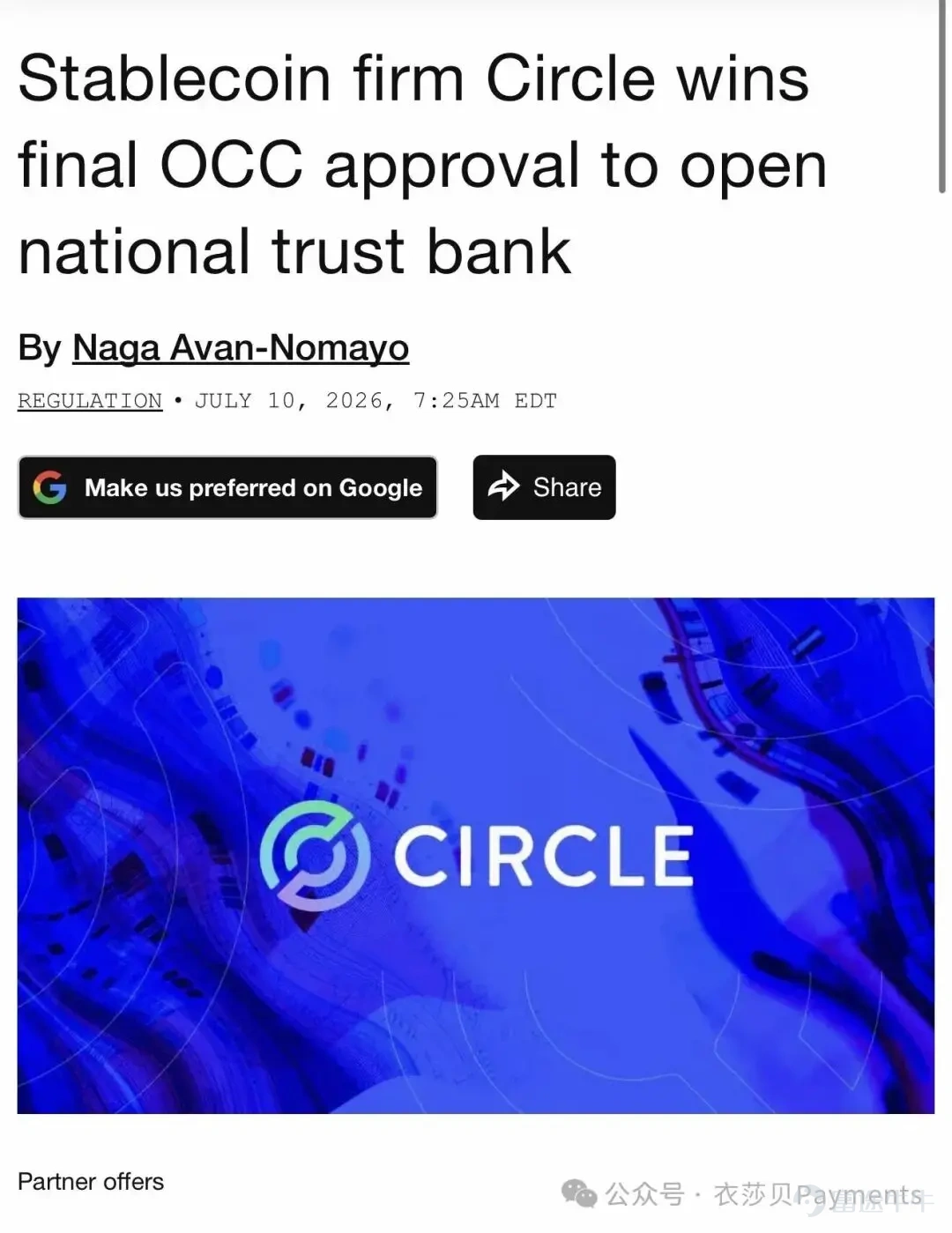

Circle Secures the 'Federal Infrastructure Charter' for Stablecoins: The Deeper Implications of OCC's Final Approval for Circle National Trust
Author: Yisha Bei
July 10, 2026,Circle announced it has received final approval from the U.S. Office of the Comptroller of the Currency (OCC) to establish Circle National Trust(First National Digital Currency Bank, N.A.). The news quickly drew market attention, sending Circle's pre-market share price up by more than 10% at one point.

This isFor the first time, a stablecoin issuer has formally entered the core U.S. financial regulatory framework as a federally chartered trust bank.A landmark event.
This marks an upgrade in the stablecoin competition—from 'who issues more tokens and who is more compliant' to 'who can control federally regulated infrastructure for issuance, reserves, custody, and settlement.'
Circle National Trust is anational trust bank(national trust bank), not a commercial bank.
It cannot accept public deposits, issue loans, or offer FDIC deposit insurance like traditional banks. Essentially, it is a OCC directly federally regulatedtrust institution, with a core function of providing fiduciary services, including digital asset custody.
According to Circle's official statement:
Initial phase: Primarily provides digital asset custody services for Circle itself and its affiliates; may be selectively opened to institutional clients (e.g., banks, regulated derivatives firms) later based on demand.
Reserve management: Explicitly listed as a 'future capability' (planned as a future capability) and is not yet live.
This represents an adjustment from Circle’s original proposal. When the application was filed in 2025, the market initially expected reserve management to be included within the federally regulated entity from the outset. However, upon final approval, the Office of the Comptroller of the Currency (OCC) adopted a more cautious, phased approach—first launching custody operations, with reserve management deferred to a later stage.
This 'simple-first, complex-later' segmentation strategy demonstrates Circle’s precise grasp of regulatory timing and reduces the complexity and uncertainty associated with a single, comprehensive approval.
1. Obtaining federal regulatory endorsement
Previously, USDC primarily relied on state-level money transmitter licenses and the New York BitLicense. With the establishment of Circle National Trust, its core custody business now falls directly under federal oversight by the Office of the Comptroller of the Currency (OCC).
This is highly significant for institutional adoption of USDC. When banks, broker-dealers, payment companies, and asset management firms evaluate whether to use USDC, what matters most is often not the technology, butregulatory certainty and clarity of the responsible entity. The trust endorsement provided by a federally regulated entity carries far greater weight than state-level licenses.
USDC is evolving from a 'stablecoin issued by a crypto company' into 'federally regulated dollar settlement infrastructure.'
2. Reserving a federal pathway for future reserve management
Although reserve management has not yet been migrated to Circle National Trust, the licensing framework is already in place to support this transition. Once conditions are ripe—such as further regulatory clarity and mature internal systems and risk controls—Circle can smoothly move USDC reserve management into the federally regulated entity.
This means that in the future, USDC’sIssuance – Custody – Reserve ManagementThe entire value chain has the opportunity to operate under higher regulatory standards, further enhancing its credibility as infrastructure for thedigital dollar" infrastructure.
3. Building vertically integrated stablecoin capabilities
Circle's long-term roadmap is becoming increasingly clear:
Issue USDC → Manage reserves → Custody assets → On-chain settlement → Cross-border payment network → Provide stablecoin infrastructure services to traditional financial institutions.
Rather than choosing to become a traditional commercial bank that accepts deposits and creates credit, it has opted fora lighter, more focused trust bank model centered on the core nature of stablecoin operations.This model aligns with the fundamental characteristics of stablecoins—full reserve backing and payment functionality—while maximizing the institutional advantages conferred by federal regulation.
For payment networks such as Visa, Mastercard, and Stripe, Circle National Trust will not directly compete for merchant acquiring business in the short term。
The change occurs at theunderlying settlement layer:
Merchants will still receive payments through PSPs;
PSPs can obtain USDC through Circle or partner banks;
USDC will be used for cross-border settlements, fund pooling, merchant payouts, and other use cases;
Circle National Trust provides custody under federal regulation (which may include reserve management in the future);
Traditional banks and payment institutions will continue to manage fiat accounts, compliance onboarding, local payment methods, and customer relationships.
This is effectivelystrengthening the stablecoin settlement rail, rather than replacing the existing payment system. It enhances regulatory compliance and institutional acceptance of stablecoins in scenarios such as cross-border payments, cash concentration, and real-time settlement.
From a broader perspective, this also marks a critical step in the evolution of stablecoins from 'peripheral innovation tools' to 'core financial infrastructure.' In the future, a new competitive landscape and value distribution framework will emerge around stablecoin issuance, custody, reserve management, and settlement networks.
After Circle obtained this license, other players are also accelerating their strategic moves:
CoinbaseStablecoin issuers like Paxos are also applying for similar trust bank charters;
Stripe,Bridgeand Ripple, among other payment and cross-border infrastructure providers, are likewise advancing their pursuit of relevant regulatory approvals.
What everyone is competing for isWho will control the issuance, custody, reserves, and settlement of the next-generation digital dollar?。
Tether remains primarily regulated at the state level and is clearly lagging in its federal licensing strategy.
With this move, Circle has significantly widened its regulatory moat compared to its main competitors.
The approval of Circle National Trust represents a significant institutional response from the U.S. regulatory system to the 'payment function' and 'infrastructure nature' of stablecoins.
It demonstrates that for stablecoins to truly become infrastructure for the global digital economy, they must operate within the highest tier of regulatory frameworks and exist in a form aligned with their business essence—as a trust bank rather than a commercial bank.
For Circle, this marks a milestone victory after a decade of regulatory efforts—and the starting point for even greater ambitions.
For the entire industry, the dimensions of stablecoin competition have been fundamentally upgraded—From token issuance capability to control over financial infrastructure。
Whoever can embed stablecoins into the federally regulated banking system will be best positioned to occupy critical nodes in the next-generation U.S. dollar settlement network.
Risk Disclaimer: The above content only represents the author's view. It does not represent any position or investment advice of Futu. Futu makes no representation or warranty.Read more


Comment (1)
to post a comment
16