
English
Back
Open Account
资舍
wrote a post · Jul 10 20:18

Why is it 0175.HK?

At the midpoint of the year, who emerged as the top-selling automaker in China’s domestic market in the first half? This has become a focal point of competition within the industry. $GEELY AUTO (00175.HK)$
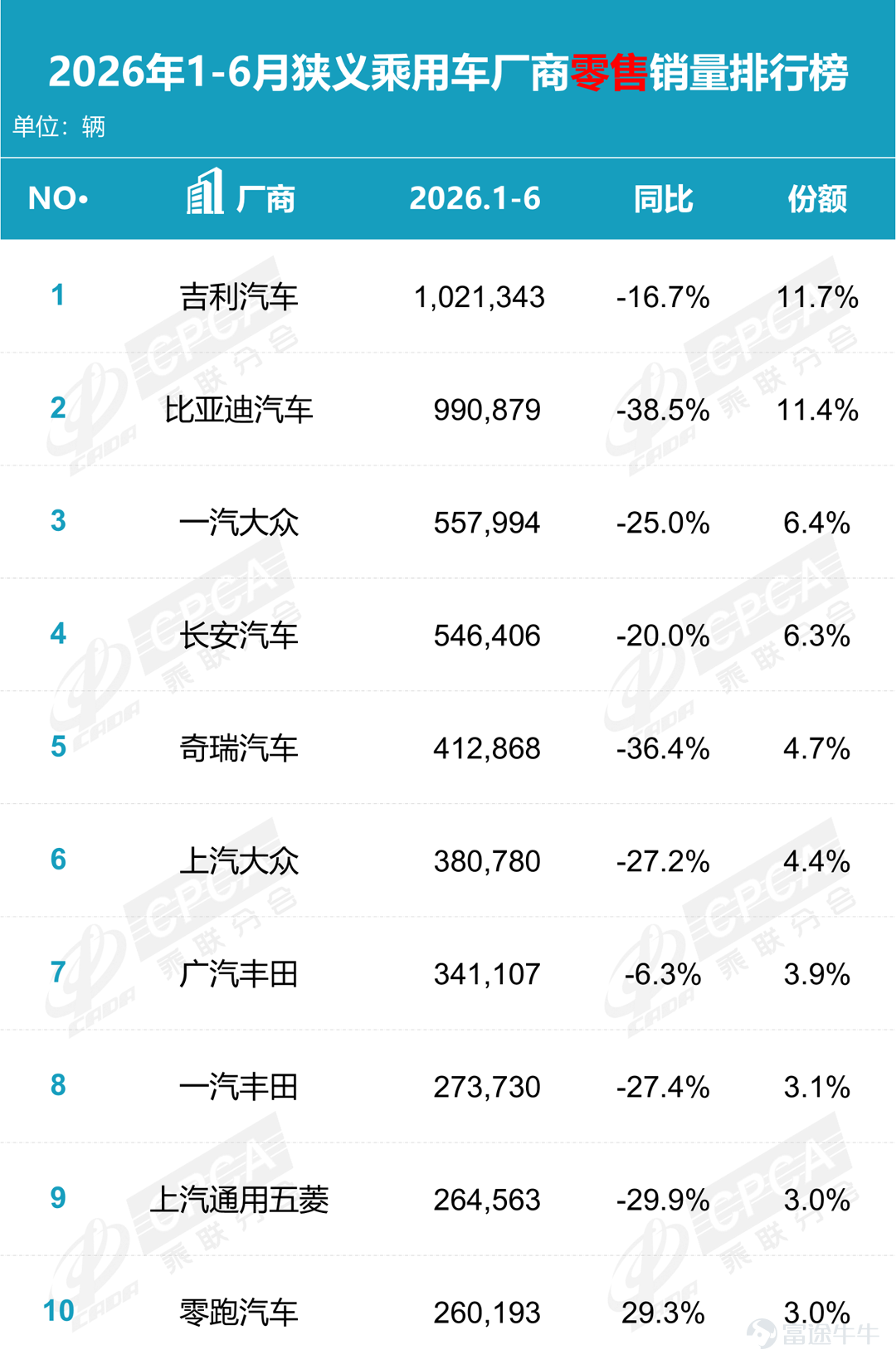
According to the latest first-half performance report released by the China Passenger Car Association (CPCA), Geely Auto topped the rankings with 1.0213 million vehicles sold, capturing an 11.7% market share and becoming the best-selling automaker by domestic retail volume in the first half of the year.
At the halfway point of the year, who emerged as the top domestic seller in the first half? This has become a focal point of competition within the industry. $GEELY AUTO (00175.HK)$ According to the latest first-half vehicle sales report released by the China Passenger Car Association, Geely Auto topped the rankings with 1.0213 million units sold, capturing an 11.7% market share and becoming the leading automaker by domestic retail sales in the first half of the year. Notably, most of the automakers in the top ten on this list reported year-on-year declines. In other words, Geely’s championship title was not achieved during favorable market conditions but rather through superior resilience amid a deep industry-wide adjustment phase. This undoubtedly adds greater depth and significance to the meaning and value of being the 'sales leader.' In the past, the sales champion was judged primarily by scale; today, it must also be evaluated based on product mix, resilience, and the company’s ability to maintain stability amid price wars, technological competition, and global rivalry. Geely Auto’s performance in the first half of the year offers a compelling case study for understanding the new competitive dynamics among Chinese automakers. Moreover, amid a broad and significant decline in auto stock prices this year, Geely Auto (0175.HK), listed in Hong Kong, stands out as the only A+H share auto stock to post positive returns since the beginning of the year, making it a standout investment opportunity in the sector. So, why Geely? Why stock code 0175.HK? On this question, Kung Fu Auto conducted an in-depth investigation. (1) Why is Geely ranked first? Amid a domestic auto market filled with declines in the first half of the year, Geely Auto managed to defy the trend and clinch the top spot in retail sales volume...
Notably, most of the other automakers in the top ten on this list reported year-over-year declines.
In other words, Geely’s championship title wasn’t achieved under favorable market conditions; rather, it was secured through superior resilience amid a profound industry-wide adjustment period.
This undoubtedly makes the meaning and value behind being 'number one in sales' even more worthy of reflection.
In the past, being the sales champion was mostly about scale; today, it also requires examining a company’s product mix, resilience, and ability to maintain stability amid price wars, technological competition, and global market pressures.
Geely’s performance in the first half of the year provides a compelling case study for observing the new competitive dynamics among Chinese automakers.
More notably, amid a broad and sharp decline in auto stocks this year, Geely Auto (0175.HK), listed in Hong Kong, has been the only A+H auto stock to post positive returns year-to-date, making it a standout investment opportunity in the sector.
So, why Geely, and why 0175.HK? In response, Kung Fu Auto conducted an in-depth investigation.
(1) Why is Geely number one?
In the first half of the year, as China’s auto market was filled with reports of declining sales, Geely managed to secure the top spot in retail volume by leveraging its well-balanced strategic advantage—avoiding overreliance on any single segment.
As is widely known, over the past two years, new energy vehicles (NEVs) have rapidly replaced internal combustion engine (ICE) vehicles. However, many automakers have struggled with legacy businesses declining too quickly while their new NEV offerings have not yet fully taken off, forcing them to rely heavily on price cuts to fill the sales gap.
For Geely, however, NEV sales reached 799,500 units in the first half, with NEV penetration rising to 56%—hitting a record high of 67% in June. Meanwhile, the China Star series still sold 580,600 units during the same period, retaining its position as the best-selling ICE passenger vehicle brand among Chinese automakers.
At the halfway point of the year, who emerged as the top domestic seller in the first half? This has become a focal point of competition within the industry. $GEELY AUTO (00175.HK)$ According to the latest first-half vehicle sales report released by the China Passenger Car Association, Geely Auto topped the rankings with 1.0213 million units sold, capturing an 11.7% market share and becoming the leading automaker by domestic retail sales in the first half of the year. Notably, most of the automakers in the top ten on this list reported year-on-year declines. In other words, Geely’s championship title was not achieved during favorable market conditions but rather through superior resilience amid a deep industry-wide adjustment phase. This undoubtedly adds greater depth and significance to the meaning and value of being the 'sales leader.' In the past, the sales champion was judged primarily by scale; today, it must also be evaluated based on product mix, resilience, and the company’s ability to maintain stability amid price wars, technological competition, and global rivalry. Geely Auto’s performance in the first half of the year offers a compelling case study for understanding the new competitive dynamics among Chinese automakers. Moreover, amid a broad and significant decline in auto stock prices this year, Geely Auto (0175.HK), listed in Hong Kong, stands out as the only A+H share auto stock to post positive returns since the beginning of the year, making it a standout investment opportunity in the sector. So, why Geely? Why stock code 0175.HK? On this question, Kung Fu Auto conducted an in-depth investigation. (1) Why is Geely ranked first? Amid a domestic auto market filled with declines in the first half of the year, Geely Auto managed to defy the trend and clinch the top spot in retail sales volume...
This means that while brands like Galaxy, Zeekr, and Lynk & Co are advancing aggressively in the NEV market, the China Star series continues to serve a large base of customers with strong demand for ICE and hybrid vehicles.
During a period of dramatic shifts in market demand, such a multi-energy strategy proves especially valuable. While it may not allow a company to lead in any single niche segment, it provides crucial flexibility to navigate volatility across different markets.
Secondly, Geely’s move toward premiumization is beginning to add meaningful profit margins to its sales volume.
Geely’s achievement as the first-half retail sales champion was driven not only by Galaxy and China Star delivering scale, but also by Zeekr and Lynk & Co continuously elevating the upper end of its product portfolio.
Among them, Zeekr delivered 35,200 vehicles in June, up 111% year-over-year; its cumulative deliveries for the first half reached 178,400 units, a 97% year-over-year increase, solidifying its position among the leaders in the premium new energy vehicle market.
At the halfway point of the year, who emerged as the top domestic seller in the first half? This has become a focal point of competition within the industry. $GEELY AUTO (00175.HK)$ According to the latest first-half vehicle sales report released by the China Passenger Car Association, Geely Auto topped the rankings with 1.0213 million units sold, capturing an 11.7% market share and becoming the leading automaker by domestic retail sales in the first half of the year. Notably, most of the automakers in the top ten on this list reported year-on-year declines. In other words, Geely’s championship title was not achieved during favorable market conditions but rather through superior resilience amid a deep industry-wide adjustment phase. This undoubtedly adds greater depth and significance to the meaning and value of being the 'sales leader.' In the past, the sales champion was judged primarily by scale; today, it must also be evaluated based on product mix, resilience, and the company’s ability to maintain stability amid price wars, technological competition, and global rivalry. Geely Auto’s performance in the first half of the year offers a compelling case study for understanding the new competitive dynamics among Chinese automakers. Moreover, amid a broad and significant decline in auto stock prices this year, Geely Auto (0175.HK), listed in Hong Kong, stands out as the only A+H share auto stock to post positive returns since the beginning of the year, making it a standout investment opportunity in the sector. So, why Geely? Why stock code 0175.HK? On this question, Kung Fu Auto conducted an in-depth investigation. (1) Why is Geely ranked first? Amid a domestic auto market filled with declines in the first half of the year, Geely Auto managed to defy the trend and clinch the top spot in retail sales volume...
Zeekr’s successful move upmarket has undoubtedly given Geely Auto a more stable product presence and profit source in the RMB 300,000-plus price segment.
In the first quarter of this year, Geely Auto’s core net profit per vehicle reached RMB 6,429, up 30% year-over-year—the highest for the same period in nearly five years. Its gross margin reached 17.5%, an improvement of 1.8 percentage points year-over-year. A virtuous cycle is now emerging among rising sales, product premiumization, and improved profitability.
Third—and the most noteworthy point of this update—is Galaxy’s resilience in the mainstream new energy vehicle market.
Galaxy’s cumulative sales in the first half totaled 519,800 units. Notably, during the first five months when the overall market faced pressure, Galaxy’s sales decline was significantly smaller than that of the broader market and mainstream brands in the same price range, with its market share rising by 0.43 percentage points year-over-year to 8.49%.
By June, Galaxy’s sales rebounded to 108,200 units, up 20% year-over-year and 32% month-over-month, once again outpacing the overall market’s growth rate.
At the halfway point of the year, who emerged as the top domestic seller in the first half? This has become a focal point of competition within the industry. $GEELY AUTO (00175.HK)$ According to the latest first-half vehicle sales report released by the China Passenger Car Association, Geely Auto topped the rankings with 1.0213 million units sold, capturing an 11.7% market share and becoming the leading automaker by domestic retail sales in the first half of the year. Notably, most of the automakers in the top ten on this list reported year-on-year declines. In other words, Geely’s championship title was not achieved during favorable market conditions but rather through superior resilience amid a deep industry-wide adjustment phase. This undoubtedly adds greater depth and significance to the meaning and value of being the 'sales leader.' In the past, the sales champion was judged primarily by scale; today, it must also be evaluated based on product mix, resilience, and the company’s ability to maintain stability amid price wars, technological competition, and global rivalry. Geely Auto’s performance in the first half of the year offers a compelling case study for understanding the new competitive dynamics among Chinese automakers. Moreover, amid a broad and significant decline in auto stock prices this year, Geely Auto (0175.HK), listed in Hong Kong, stands out as the only A+H share auto stock to post positive returns since the beginning of the year, making it a standout investment opportunity in the sector. So, why Geely? Why stock code 0175.HK? On this question, Kung Fu Auto conducted an in-depth investigation. (1) Why is Geely ranked first? Amid a domestic auto market filled with declines in the first half of the year, Geely Auto managed to defy the trend and clinch the top spot in retail sales volume...
This demonstrates that Galaxy is no longer relying solely on the Xingyuan model to carry the brand. Models like the Xingjian 7 and Galaxy E5 continue to maintain strong momentum in the SUV segment, while newer offerings such as the M7 and Xingyao 7 MAX are steadily ramping up. A more comprehensive product portfolio is now enabling Galaxy to serve diverse customer groups—from A0-segment battery electric city cars to mainstream new energy SUVs and higher-value family vehicles.
More importantly, Galaxy is currently in a product transition phase. For mainstream new energy brands, this ability to execute seamless generational transitions without disruption is the true source of market resilience.
(2) What key strengths does Geely Auto have for the second half of the year?
If the first half demonstrated how Geely Auto can hold steady during a market downturn, the more critical question for the second half is whether this resilient structure can continue expanding upward.
In Kung Fu Auto's view, Geely still has three trump cards to play in the second half of the year.
The first card is its overseas markets.
In June, Geely's export sales reached 102,900 units, surpassing 100,000 units for the first time, a 157% year-over-year increase. For the first half of the year, cumulative exports totaled 474,200 units, surging 158% year-over-year—already exceeding Geely’s full-year export volume for 2025.
At the halfway point of the year, who emerged as the top domestic seller in the first half? This has become a focal point of competition within the industry. $GEELY AUTO (00175.HK)$ According to the latest first-half vehicle sales report released by the China Passenger Car Association, Geely Auto topped the rankings with 1.0213 million units sold, capturing an 11.7% market share and becoming the leading automaker by domestic retail sales in the first half of the year. Notably, most of the automakers in the top ten on this list reported year-on-year declines. In other words, Geely’s championship title was not achieved during favorable market conditions but rather through superior resilience amid a deep industry-wide adjustment phase. This undoubtedly adds greater depth and significance to the meaning and value of being the 'sales leader.' In the past, the sales champion was judged primarily by scale; today, it must also be evaluated based on product mix, resilience, and the company’s ability to maintain stability amid price wars, technological competition, and global rivalry. Geely Auto’s performance in the first half of the year offers a compelling case study for understanding the new competitive dynamics among Chinese automakers. Moreover, amid a broad and significant decline in auto stock prices this year, Geely Auto (0175.HK), listed in Hong Kong, stands out as the only A+H share auto stock to post positive returns since the beginning of the year, making it a standout investment opportunity in the sector. So, why Geely? Why stock code 0175.HK? On this question, Kung Fu Auto conducted an in-depth investigation. (1) Why is Geely ranked first? Amid a domestic auto market filled with declines in the first half of the year, Geely Auto managed to defy the trend and clinch the top spot in retail sales volume...
Against the backdrop of domestic market pressures, overseas markets have become Geely’s new growth pillar. Going forward, as Zeekr accelerates its entry into overseas markets such as the Middle East and Hong Kong, and as the i-HEV Smart Hybrid technology empowers the China Star series’ global expansion, Geely is expected to continue scaling up overseas and build pricing power.
The second card is continuously pushing upward to unlock new incremental markets.
At the halfway point of the year, who emerged as the top domestic seller in the first half? This has become a focal point of competition within the industry. $GEELY AUTO (00175.HK)$ According to the latest first-half vehicle sales report released by the China Passenger Car Association, Geely Auto topped the rankings with 1.0213 million units sold, capturing an 11.7% market share and becoming the leading automaker by domestic retail sales in the first half of the year. Notably, most of the automakers in the top ten on this list reported year-on-year declines. In other words, Geely’s championship title was not achieved during favorable market conditions but rather through superior resilience amid a deep industry-wide adjustment phase. This undoubtedly adds greater depth and significance to the meaning and value of being the 'sales leader.' In the past, the sales champion was judged primarily by scale; today, it must also be evaluated based on product mix, resilience, and the company’s ability to maintain stability amid price wars, technological competition, and global rivalry. Geely Auto’s performance in the first half of the year offers a compelling case study for understanding the new competitive dynamics among Chinese automakers. Moreover, amid a broad and significant decline in auto stock prices this year, Geely Auto (0175.HK), listed in Hong Kong, stands out as the only A+H share auto stock to post positive returns since the beginning of the year, making it a standout investment opportunity in the sector. So, why Geely? Why stock code 0175.HK? On this question, Kung Fu Auto conducted an in-depth investigation. (1) Why is Geely ranked first? Amid a domestic auto market filled with declines in the first half of the year, Geely Auto managed to defy the trend and clinch the top spot in retail sales volume...
In the second half of the year, models such as Galaxy TT, Galaxy Battleship 700, and Zeekr 9X will enter the market or begin overseas rollouts. Specifically, the Galaxy TT will fill the gap in Geely’s C-segment pure-electric sports sedan lineup; the Galaxy Battleship 700 targets the high-value off-road SUV segment; and Zeekr 9X’s launch in the Middle East signifies that Geely’s premium new energy vehicles are entering more affluent global markets.
The significance of these new models lies not only in boosting sales volumes but also in further optimizing Geely’s product mix and capturing higher-margin niche segments.
The third card is that the 'One Geely' integration strategy is entering its realization phase.
From Zeekr’s privatization and reintegration into the group, to Radar Auto’s merger into Geely Auto, and on toLi Shufu’s proposal to shut down, merge, or restructure redundant entities and concentrate resources on strengthening Geely’s core listed platform (HKEX: 0175), Geely’s integration has progressed beyond the brand level to encompass operations, capital, and governance.
The ultimate goal of this integration is not simply to reduce the number of entities, but to enable more efficient flows of technology, procurement, manufacturing, distribution channels, and talent resources—continuously enhancing the efficiency of the 'One Geely' system and securing a proactive position in the next round of industry consolidation.
(3) Kung Fu Commentary
In the first half of the year, Geely Auto claimed the top spot in China’s passenger vehicle sales. On the surface, this appears to be a mere shift in rankings; more fundamentally, it reflects an evolution in the competitive logic among Chinese automakers.
As the price war moves into deeper waters, investment in intelligent technologies cannot be cut, and globalization must accelerate. Ultimately, what automakers are competing on is the resilience of their entire operational system.
This, undoubtedly, is the most noteworthy aspect of Geely Auto’s sales leadership in the first half of the year for the broader industry.It’s not about which competitor Geely pushed out of the top spot, but rather that it has demonstrated how, in the most fiercely competitive auto market, only a comprehensive system—one that can withstand downturns, sustain growth, and keep moving upward—can truly navigate through economic cycles.
Risk Disclaimer: The above content only represents the author's view. It does not represent any position or investment advice of Futu. Futu makes no representation or warranty.Read more
Thumbs Up
1
12K Views
Report
Comments
Write a Comment...
1